Billboards near South Milwaukee, WI
No Minimum Spend. No Long-Term Contracts. Just Results.
Trusted by Leading Brands


Billboard advertising
near South Milwaukee has never been easier



How much is a billboard near South Milwaukee?
Why Choose Blip for Billboard Advertising near South Milwaukee
Blip lets you launch fast in South Milwaukee and reach I-94's 150K+ daily drivers without contracts or long setup.
Use South Milwaukee timing controls to hit Lake Parkway commuters and airport traffic at the morning or evening rush.
Set a flexible budget in South Milwaukee, then scale up or down as shoppers flow toward Greenfield and Southridge Mall.
Track real-time results in South Milwaukee and optimize ads as lakefront, airport, and commuter traffic shifts.
South Milwaukee creatives are easy with Blip: test quick, bold messages for Grant Park, Summerfest, and winter commute crowds.
Frequently Asked Questions About Billboard Advertising near South Milwaukee
How much does a billboard cost in South Milwaukee with Blip?
Blip’s pay-per-play pricing in the South Milwaukee area starts at just $0.01 per display, with no minimums and no contracts. Each “blip” is a 7.5-to-10-second display, and pricing can change based on time of day, location, and advertiser demand. You set a daily budget, and Blip’s system uses it to bid for open ad slots on digital billboards serving the South Milwaukee area, so you only pay when your ad actually appears.
Where can I advertise near South Milwaukee with Blip?
We currently have 2 digital billboards serving the South Milwaukee area from nearby Greenfield, and those displays are only about 9 miles from South Milwaukee. The page also points to major nearby traffic corridors like I-94, WIS 794 (the Lake Parkway), and the Greenfield and Greendale retail area. That gives advertisers a practical way to reach local drivers, families, shoppers, and commuters without buying a much broader regional campaign than most advertisers actually need.
Why is South Milwaukee a strong market for digital billboard advertising with Blip?
Advertising near South Milwaukee works because the market sits inside one of the busiest south-county travel sheds, with I-94 segments near the airport carrying 150,000+ vehicles per day and the Lake Parkway carrying roughly 50,000 to 70,000 vehicles per day. Residents move constantly between the lakefront communities, the Milwaukee Mitchell International Airport corridor, major retail nodes in nearby Greenfield and Greendale, and job centers throughout the wider Milwaukee region. For billboard strategy, this is a market where local frequency matters more than geographic sprawl.
What kinds of people can Blip reach in the South Milwaukee area?
The South Milwaukee area is a car-first market, with roughly 80% of workers driving alone to work and another 7% to 8% carpooling. That makes weekday road audiences dependable for reaching commuters headed toward Milwaukee, Oak Creek, the airport district, and industrial or healthcare jobs across south Milwaukee County. The area also includes families, homeowners, shoppers, students, travelers, and regional event traffic.
What is the best time to advertise in South Milwaukee with Blip?
Weekday mornings are strong for commuter services and B2B-style recruiting, while afternoon and early evening are strong for restaurants, urgent care, auto service, and retail. Weekends can be better for entertainment, family offers, shopping, and events. The page also notes that summer is the strongest broad-reach season, with late August through October good for back-to-school and holiday timing.
Do I need a contract to advertise with Blip near South Milwaukee?
No, Blip has no long-term contracts or minimum commitments. You can start, pause, or stop your campaign at any time.
How fast can I launch a billboard campaign with Blip near South Milwaukee?
You can have your campaign live in minutes. Create a free account, select your locations, set your budget, upload your design, and start running once approved.
Where can I advertise with Blip near South Milwaukee?
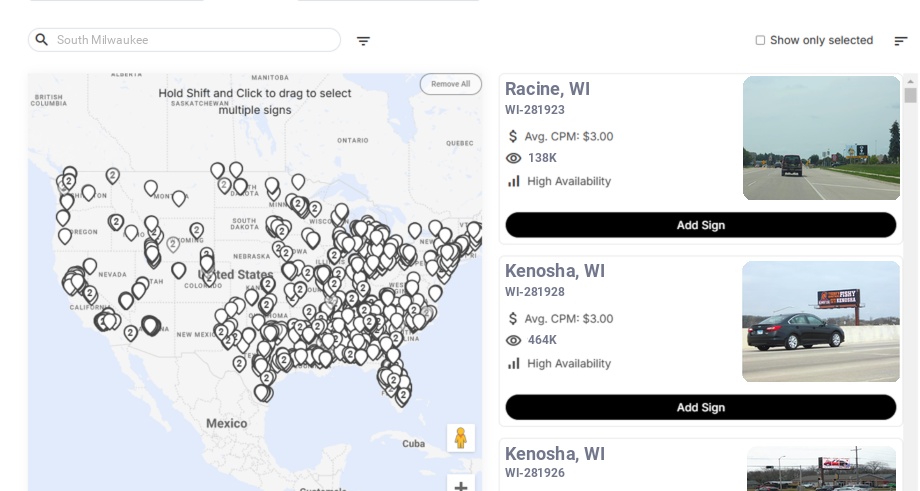
Blip has digital billboards near South Milwaukee. You can browse available locations on a map, choose the ones that fit your audience, and start advertising right away.
Still have questions? Launch a campaign in minutes — no contracts, no commitments.
Start Your CampaignSouth Milwaukee Billboard Advertising Guide
Advertising near South Milwaukee I-94 150,000+ vehicles per day and the Lake Parkway 50,000 to 70,000 vehicles per day. Residents in the South Milwaukee area move constantly between the lakefront communities, the Milwaukee Mitchell International Airport corridor, major retail nodes in nearby Greenfield Greendale, and job centers throughout the wider Milwaukee 80% of workers driving alone to work and another 7% to 8% carpooling. We currently have 2 digital billboards serving the South Milwaukee area from nearby Greenfield, and those displays are only about 9 miles from South Milwaukee. That gives us a practical way to reach local drivers, families, shoppers, and commuters without buying a much broader regional campaign than most advertisers actually need.
South Milwaukee area market overview
Population and trade area scale near South Milwaukee
We see the South Milwaukee area as a compact local market with access to a much larger regional audience. South Milwaukee 2020 population of 20,785, which is large enough to support local service, healthcare, retail, restaurant, and community-awareness campaigns on its own.
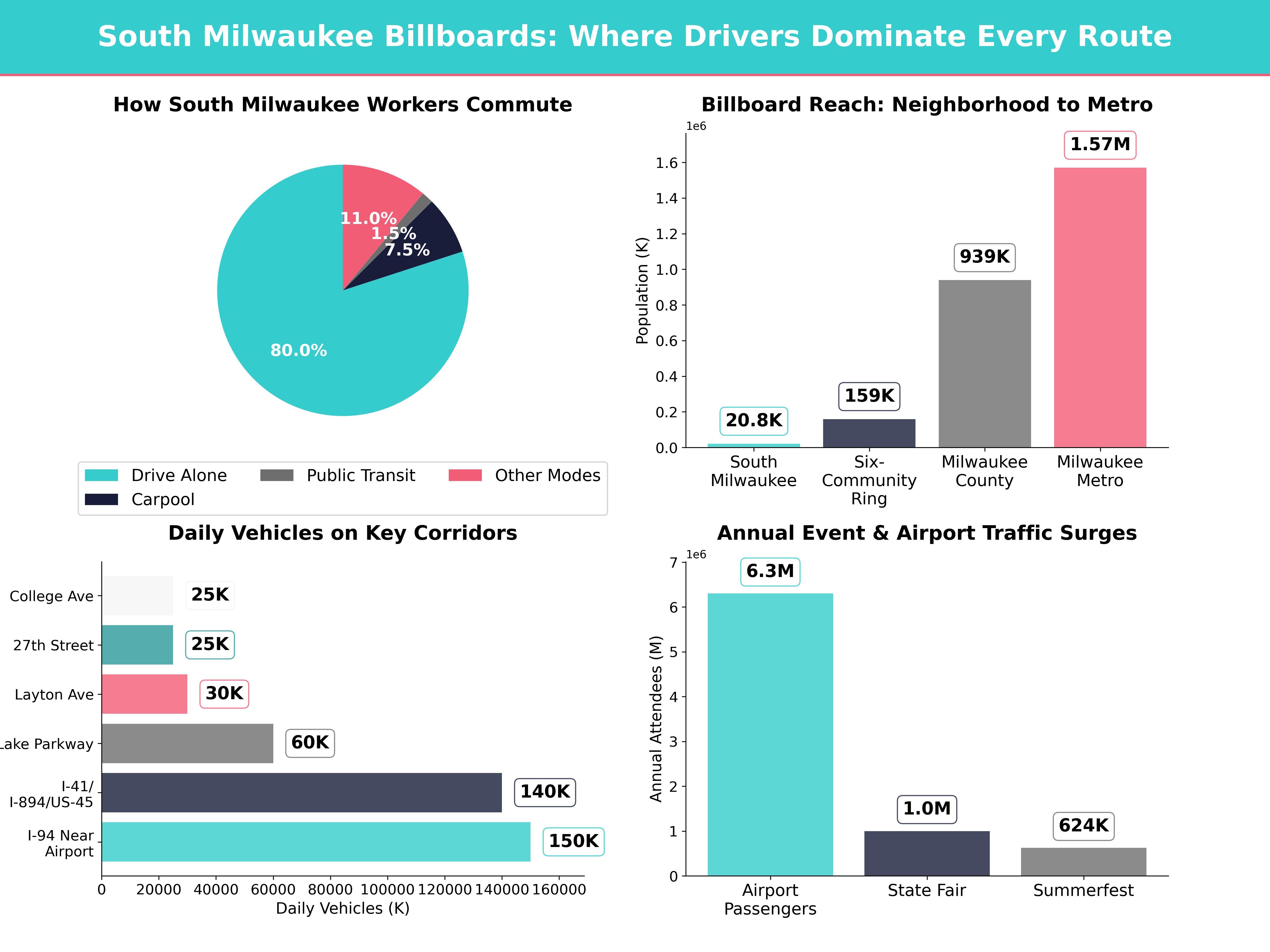
The immediate suburban ring around South Milwaukee adds meaningful scale. Nearby communities include Oak Creek 36,497 residents, Greenfield 37,732, Cudahy, with 18,429, St. Francis 9,365, and Franklin, with 36,504. Combined with South Milwaukee, those six communities total about 159,312 residents.
That local base sits inside an even larger county and metro economy. Milwaukee County 939,489 residents in 2020, the City of Milwaukee 577,222, and the broader Milwaukee metro had about 1.57 million residents. For advertisers, that means a campaign serving the South Milwaukee area can stay locally relevant while still benefiting from regional movement patterns.
Commuting, mobility, and economic indicators
The South Milwaukee area behaves like a car-first market. Recent American Community Survey estimates show roughly 80% of South Milwaukee workers driving alone to work, with another 7% to 8% carpooling. Public transit use is much smaller, at roughly 1% to 2% of commuting, and the average commute is around 24 minutes. Even with service from the Milwaukee County Transit System, road traffic is still the clearest path to broad local reach.
Economically, the South Milwaukee area benefits from several overlapping engines. The south shore communities bring stable residential demand, the airport corridor adds logistics and hospitality activity, nearby retail concentrations pull shoppers across city lines, and the wider county adds healthcare, education, manufacturing, and professional services. That mix matters because it creates multiple reasons for people to travel through the same corridors on weekdays, evenings, and weekends.
A few numbers help show why this market is so active:
- Milwaukee Mitchell International Airport handled about 6.3 million passengers in 2023.
- The Southridge Mall trade area in the Greenfield-Greendale corridor centers on roughly 1.2 million square feet of mall retail.
- The South Milwaukee area also benefits from proximity to major employers and institutions in Milwaukee County Oak Creek
For billboard strategy, we treat this as a market where local frequency matters more than geographic sprawl. A well-timed digital campaign near South Milwaukee can speak to repeat drivers who make the same trips every week.
South Milwaukee area traffic corridors
North-south corridors that serve the South Milwaukee area
When we plan campaigns serving the South Milwaukee area, we start with the roads that connect the lakefront communities to the airport, downtown Milwaukee, and the south suburban employment base. The most important north-south spine is I-94, especially around the airport corridor. WisDOT traffic counts 150,000 or more vehicles per day.
The second major route is WIS 794, commonly known as the Lake Parkway. That corridor directly serves travel between the South Milwaukee area, Cudahy, St. Francis 50,000 to 70,000 vehicles per day. For local advertisers, that makes it especially valuable for awareness campaigns aimed at commuters, healthcare visits, restaurants, and service businesses that draw from the south shore.
We also pay attention to east-west connectors feeding those routes. Busy stretches of College Avenue near the airport and Oak Creek corridor generally run in the 20,000 to 30,000 vehicles per day range, depending on location. Those volumes matter because College Avenue helps connect the South Milwaukee area to airport traffic, hotels, industrial parks, and retail.
West-side corridors that connect South Milwaukee to Greenfield
Our 2 digital billboards serving the South Milwaukee area are in nearby Greenfield I-41/I-894/US 45 near the Hale Interchange 140,000 vehicles per day.
That regional freeway system feeds major retail and commuter streets in Greenfield and Greendale. Around the Southridge area, Layton Avenue carries roughly 30,000 or more vehicles per day on busy commercial stretches, and 27th Street often exceeds 25,000 vehicles per day. Those are strong billboard environments for advertisers that want to reach the South Milwaukee area before people complete shopping, dining, healthcare, or service trips.
This matters more than distance alone. Even though the boards are not inside South Milwaukee itself, Greenfield is a natural intercept point for south-county residents traveling west for shopping, north for work, or around the county for daily errands. We often find that a strategically chosen board near a shared corridor performs better than a nominally closer location with weaker traffic flow.
South Milwaukee area audiences we can reach
Commuters and everyday workers in the South Milwaukee area
The first core audience is daily commuters. Because about 4 out of 5 South Milwaukee workers drive alone and another 7% to 8% carpool, the weekday road audience is dependable. We can use morning and late-afternoon scheduling to reach workers headed toward Milwaukee Oak Creek
This segment is especially strong for:
- Home services.
- Auto dealers and repair shops.
- Healthcare and urgent care.
- Insurance and financial services.
- Local restaurants with commuter-hour offers.
- Trade schools, staffing firms, and employers.
For these advertisers, digital billboards near South Milwaukee work best when the message is direct, timely, and location-aware. A commuter does not need a long story. They need one useful reason to remember a brand when they make the next purchase decision.
Families, homeowners, and south-county shoppers
The second big audience is the household decision-maker. The South Milwaukee area is full of stable residential neighborhoods, and the surrounding suburban ring adds more than 159,000 residents across South Milwaukee, Oak Creek, Greenfield, Cudahy, St. Francis, and Franklin. That audience responds well to practical categories such as dentists, clinics, HVAC, plumbing, family entertainment, grocery-adjacent services, and retail promotions.
We also like this market for family-oriented brands because local leisure activity is visible and recurring. Grant Park 380 acres and includes an 18-hole golf course, trails, picnic spaces, and lakefront access. That kind of amenity supports a steady rhythm of local movement in spring, summer, and early fall.
The Greenfield and Greendale retail cluster adds another layer. The Southridge trade area is one of the biggest shopping draws on the south side, so advertisers with a broad service radius can reach South Milwaukee area buyers while they are already in shopping mode. That is useful for retail, med spas, elective healthcare, furniture, entertainment, and quick-service food.
Students, travelers, and regional event audiences
The third audience is broader but still highly valuable. The South Milwaukee area sits close enough to tap into regional education, travel, and event traffic. Together, University of Wisconsin-Milwaukee, Marquette University, and Milwaukee Area Technical College serve more than 50,000 students. Not all of those students live near South Milwaukee, but many travel through south-county corridors, work locally, or visit throughout the year.
Travel volume is another major factor. Milwaukee Mitchell International Airport handled about 6.3 million passengers in 2023, and that movement spills into hotel, parking, dining, and rideshare activity near the South Milwaukee area. Brands serving travelers, shift workers, airport employees, or out-of-town visitors can benefit from that year-round flow.
Event traffic amplifies the market even more:
- Summerfest reported 624,407 attendees in 2023.
- The Wisconsin State Fair reported 1,003,399 attendees in 2023.
- American Family Field hosts 81 regular-season Milwaukee Brewers home games each year.
- Fiserv Forum hosts 41 regular-season Milwaukee Bucks
Those numbers remind us that the South Milwaukee area is not isolated. It sits inside a regional calendar that keeps roads active well beyond standard commuter hours.
Seasonal opportunities near South Milwaukee
Summer and festival season in the South Milwaukee area
Summer is the strongest broad-reach season for many campaigns serving the South Milwaukee area. Lakefront activity rises, Grant Park Summerfest runs across 3 weekends, and the Wisconsin State Fair lasts 11 days, which creates repeated travel into and around the county.
This is a strong window for restaurants, attractions, beverages, retail, urgent care, tourism, entertainment, and summer services. We also like summer for short, high-frequency bursts tied to holiday weekends, festival dates, sports weekends, and limited-time promotions.
Back-to-school and holiday timing near South Milwaukee
Late August through October is another smart period. K-12 schools return, college traffic normalizes, and families shift from leisure spending to routine purchases. That makes back-to-school, healthcare, tutoring, youth programs, apparel, auto maintenance, and home services especially relevant.
Holiday retail ramps up from early November through December. The Greenfield-Greendale shopping district becomes more competitive, and the South Milwaukee area’s family-heavy neighborhoods make gift, dining, and service messaging more effective. We also recommend more afternoon and early-evening weight during this stretch because December sunset in the Milwaukee area can arrive before 4:30 p.m., which changes visibility and shopping behavior.
Winter and spring response patterns
Winter in southeastern Wisconsin favors advertisers that solve immediate problems. Heating, plumbing, auto repair, urgent care, pharmacies, insurance, indoor entertainment, and quick-serve food all fit the season well. Gray skies and early darkness can actually help digital creative stand out, as long as the design is high contrast and uncluttered.
Spring is ideal for reset messaging. We usually recommend March through May for tax-related services, healthcare reminders, landscaping, exterior home work, graduation-related promotions, and spring retail refreshes. In the South Milwaukee area, that season also benefits from pent-up consumer movement after winter weather slows discretionary trips.
Billboard design tips for the South Milwaukee market
Creative choices that fit south-county geography
We recommend designing for motion, weather, and practicality. The South Milwaukee area is not a tourist-only market and not a downtown-only market. It is a real-life, errand-heavy, commuter-heavy, family-heavy place. Creative that feels useful usually outperforms creative that feels abstract.
A few design principles work especially well here:
- We keep copy to about 6 to 8 words when possible.
- We use 1 main idea, 1 offer, and 1 call to action.
- We lean on high-contrast color combinations because winter skies and overcast lakefront conditions can mute low-contrast artwork.
- We make the brand name large enough to be read instantly at suburban travel speeds.
Color and imagery should match the geography. Blues, whites, and lake-inspired palettes can work, but so can industrial steel tones, bold safety yellow, and strong retail red if the goal is urgency. We often advise avoiding generic “northwoods” imagery for this market because the South Milwaukee area feels more urban-suburban, more practical, and more everyday-driven than vacation-driven.
Message styles that resonate near South Milwaukee
We usually see the best performance from straightforward messages such as:
- “South Milwaukee Area Urgent Care.”
- “Fast Roof Repair Before Winter.”
- “Minutes from Southridge.”
- “Open Late Near the Airport.”
- “Family Dentistry Serving South Milwaukee.”
Location cues help. If a business serves multiple south-county communities, we can say so directly: South Milwaukee, Oak Creek Cudahy, and St. Francis
If a brand also targets the broader south side of Milwaukee, bilingual English-Spanish creative can work, but we still keep it extremely short. Digital billboards reward clarity, not density.
Regional strategies serving the South Milwaukee area
Using Greenfield to intercept South Milwaukee area shoppers
Because our available inventory serving the South Milwaukee area is in nearby Greenfield Southridge Mall, Layton Avenue, and 27th Street.
This is a strong fit for:
- Retail stores.
- Restaurants.
- Beauty and wellness services.
- Elective healthcare.
- Family entertainment.
- Financial services.
- Mobile or delivery-based local businesses.
In this setup, we are not trying to imply the board is inside South Milwaukee. We are using Greenfield to catch the same consumers who live in, commute through, or shop across the South Milwaukee area.
Building frequency across the south shore
For community brands, repetition matters more than novelty. A dental group, HVAC company, local bank, church, school, or citywide event often benefits from running longer and more steadily instead of buying one intense burst. The South Milwaukee area includes many repeat drivers whose routines do not change much from week to week.
That makes digital billboards useful for reinforcing memory. If we maintain a consistent look, a stable slogan, and reliable dayparts, people start recognizing the brand across multiple errands and commute cycles.
Targeting airport, Oak Creek, and countywide movement
Some advertisers need more than a neighborhood audience. They need the South Milwaukee area plus the airport corridor, the Oak Creek
This approach fits hotels, airport parking, healthcare systems, logistics recruiters, attractions, regional restaurants, and larger retailers. The advantage is that the South Milwaukee area becomes part of a connected road audience instead of a standalone pocket.
Blip tools for South Milwaukee area campaigns
Using timing and budget controls effectively
We like Blip’s tools in the South Milwaukee area because the market has clear daypart behavior. Weekday mornings are strong for commuter services and B2B-style recruiting. Afternoon and early evening are strong for restaurants, urgent care, auto service, and retail. Weekends can be better for entertainment, family offers, shopping, and events.
Because we can choose boards on a map, set day and time preferences, and control spend at the campaign level, we can shape a buy around the South Milwaukee area’s actual travel rhythms rather than committing to a fixed, one-size-fits-all schedule. We also only pay when an ad displays, with pricing that can start at $0.01 per display, which makes testing much easier for local advertisers.
Testing creative around the South Milwaukee audience
Our other advantage is flexibility. A Blip ad is only 7.5 to 10 seconds, so we can test different messages quickly. In the South Milwaukee area, that might mean running one version for commuters, one for weekend shoppers, and one for airport-oriented traffic.
We can also respond to seasonality without rebuilding a whole contract. If a snowstorm hits, if a school semester starts, if Summerfest opens, or if a holiday sale begins, we can adjust artwork, timing, or budget without the friction that usually comes with traditional billboard buying.
Getting started with billboard rental near South Milwaukee
How we evaluate the right billboard for the South Milwaukee area
When we start a campaign serving the South Milwaukee area, we usually begin with 3 questions.
- Who exactly are we trying to reach?
- What route are they already driving?
- What action do we want after they see the ad?
If the goal is local household awareness, we prioritize repeat commuter and shopper corridors. If the goal is immediate action, we focus on strong offer language, nearby location cues, and the hours when purchase intent is highest. If the goal is broader brand presence, we look for long enough campaign duration to build recognition.
Because our inventory serving the South Milwaukee area is in nearby Greenfield, we evaluate those boards based on their ability to intercept shared south-county traffic. We look at freeway access, retail adjacency, commuting direction, and whether the likely viewer is in decision mode or just passing through.
What to expect from the rental process
Traditional billboard companies often push advertisers into fixed terms, rep-managed inventory, and slower revision cycles. We take a much simpler route. We can select available digital billboards, launch with a modest test budget, swap creative, change schedules, and optimize based on performance without waiting through a lengthy sales process.
That matters for South Milwaukee area advertisers because many of them are local or regional businesses, not national brands. They need practical control. They need the ability to promote a hiring push this month, a seasonal sale next month, and a new service line after that.
A practical first-campaign plan for near South Milwaukee
For many advertisers, a smart first campaign looks like this:
- We start with the 2 Greenfield digital billboards that serve the South Milwaukee area.
- We run 2 to 3 creative versions instead of trying to force every message into one design.
- We emphasize weekday commute windows first, then add weekends if the category is retail or entertainment.
- We use one memorable promise, one clear brand mark, and one action step.
- We let the campaign run long enough to cover a real business cycle, then review results and refine.
The key is not to chase every possible audience at once. The South Milwaukee area rewards relevance. If we know whether we want commuters, families, shoppers, travelers, or event traffic, the nearby Greenfield inventory can become a very efficient way to build visibility near South Milwaukee without the cost and rigidity that usually comes with traditional billboard rental.