Billboards near Whitefish Bay, WI
No Minimum Spend. No Long-Term Contracts. Just Results.
Trusted by Leading Brands


Billboard advertising
near Whitefish Bay has never been easier

How much is a billboard near Whitefish Bay?
Why Choose Blip for Billboard Advertising near Whitefish Bay
-
Blip lets Whitefish Bay advertisers launch in minutes and target I-43 commuters plus North Shore shoppers near Glendale and Bayshore.
-
With no contracts or minimums, Whitefish Bay brands can test ads around school runs, downtown Milwaukee traffic, and weekend lakefront trips.
-
Blip-optimized campaigns can auto-place your Whitefish Bay ads across Glendale and Milwaukee boards based on your goals, timing, and budget.
-
Use dayparting in Whitefish Bay to hit 6-9 a.m. and 3-6 p.m. commuters on I-43, Silver Spring, and Port Washington Road.
-
Track Whitefish Bay performance in real time and shift spend fast for Summerfest, Bucks games, or back-to-school demand.
-
Blip's creative tools help Whitefish Bay ads stay clean and local, perfect for North Shore families and polished commuter messaging.
Frequently Asked Questions About Billboard Advertising near Whitefish Bay
How much does a billboard cost in Whitefish Bay with Blip?
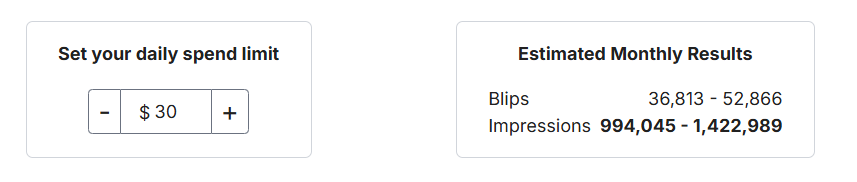
Blip makes billboard advertising in the Whitefish Bay area flexible and approachable by using pay-per-play pricing, so you only pay when your ad actually appears. Each “blip” is a 7.5-to-10-second display on a rotating digital billboard, and pricing starts at $0.01 per display. Since the total cost is simply the sum of your individual blips, you stay in control with no contracts and no minimums.
Where can I advertise near Whitefish Bay with Blip?
We have 14 digital billboards serving the Whitefish Bay area, all within 10.0 miles of the village, including locations in Glendale just 1.6 miles away and Milwaukee about 6.2 miles away. Nearby inventory in Glendale and Milwaukee naturally serves everyday travel patterns in the Whitefish Bay area. That gives us a strong mix of close-to-home frequency, commuter reach, and regional visibility for brands that want to influence North Shore households.
What kind of audience does Whitefish Bay, Wisconsin have for billboard advertising?
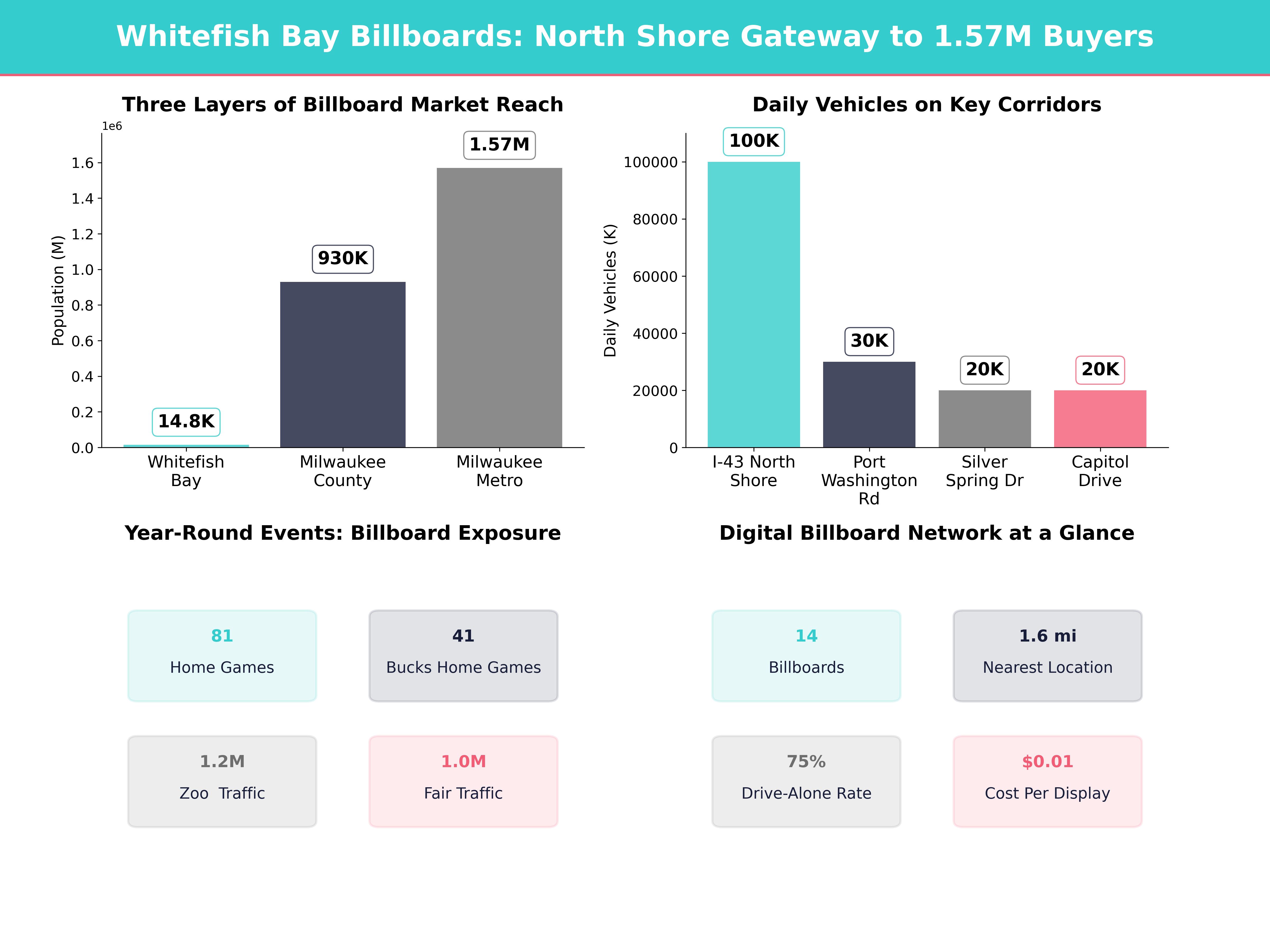
The Village of Whitefish Bay is a compact, high-attention North Shore community with roughly 14,800 residents in just over 2.1 square miles. The surrounding Milwaukee County market adds more than 930,000 residents, and the broader region totals about 1.57 million people. The Whitefish Bay area is one of the most family-driven parts of the North Shore, and the 4-school structure of the Whitefish Bay School District creates recurring demand around school starts, extracurriculars, youth healthcare, childcare, enrichment, sports, tutoring, and family dining.
What roads near Whitefish Bay get the most billboard traffic?
For broad commuter reach, I-43 is the dominant north-south spine serving the Whitefish Bay area, and recent counts on the North Side and North Shore approach are comfortably above 100,000 vehicles per day on major stretches. For local intent, Port Washington Road commonly carries 30,000+ daily vehicles on active commercial segments, while Silver Spring Drive is often in the 20,000 to 30,000 vehicles per day range. Capitol Drive also serves the Whitefish Bay area by funneling regional traffic across Milwaukee’s east side and toward nearby neighborhoods.
When is the best time to advertise in Whitefish Bay with Blip?
If we want reach during peak work travel, we usually emphasize 6 a.m. to 9 a.m. and 3 p.m. to 6 p.m. windows. Summer is the most obvious surge season near Whitefish Bay, and back-to-school season is one of the most reliable planning moments because family schedules snap back into place. Winter also remains active with holiday shopping, dining, gatherings, healthcare appointments, and indoor entertainment.
Do I need a contract to advertise with Blip near Whitefish Bay?
No, Blip has no long-term contracts or minimum commitments. You can start, pause, or stop your campaign at any time.
How fast can I launch a billboard campaign with Blip near Whitefish Bay?
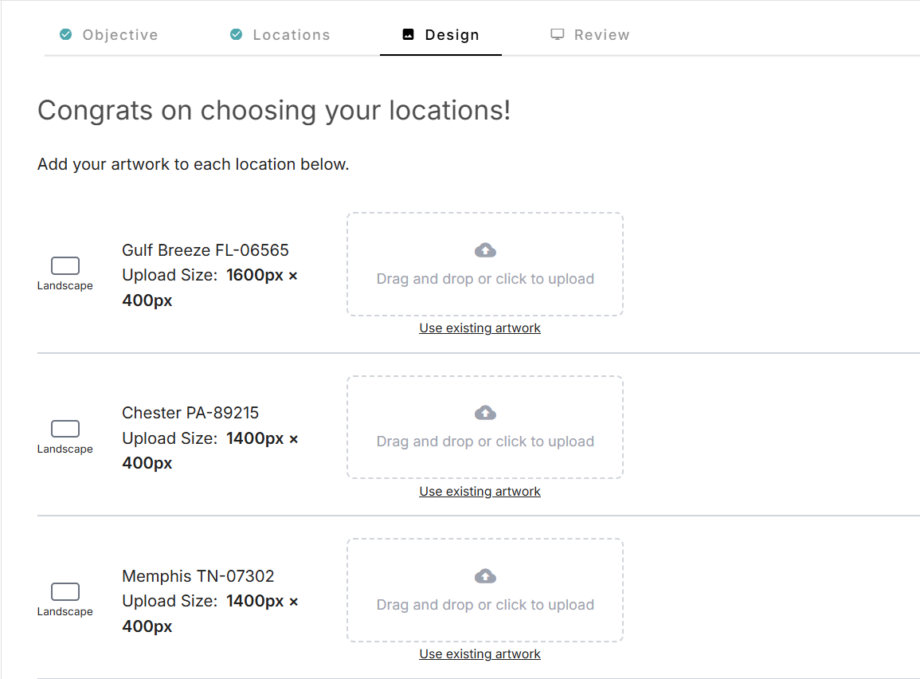
You can have your campaign live in minutes. Create a free account, select your locations, set your budget, upload your design, and start running once approved.
Where can I advertise with Blip near Whitefish Bay?
Blip has digital billboards near Whitefish Bay. You can browse available locations on a map, choose the ones that fit your audience, and start advertising right away.
Still have questions? Launch a campaign in minutes — no contracts, no commitments.
Start Your CampaignWhitefish Bay Billboard Advertising Guide
Advertisers looking to reach the Whitefish Bay Glendale Milwaukee 14 digital billboards serving the Whitefish Bay area, all within 10.0 miles of the village, including locations in Glendale just 1.6 miles away and Milwaukee about 6.2 miles away. That gives us a strong mix of close-to-home frequency, commuter reach, and regional visibility for brands that want to influence North Shore households.
Whitefish Bay area market overview
Demographics and economic context near Whitefish Bay
The Village of Whitefish Bay 14,800 residents in just over 2.1 square miles. That density matters because local trips spill quickly into adjacent corridors near Whitefish Bay, especially through Glendale retail routes and Milwaukee commuter routes. The surrounding Milwaukee County 930,000 residents, and the broader region promoted by Choose Milwaukee 1.57 million people. When we advertise near Whitefish Bay, we are not just reaching one village; we are tapping a tightly connected suburban audience inside a much larger metro economy.
The Whitefish Bay area also benefits from a strong mix of local business activity and regional economic anchors. The neighborhood business district supported by Discover Whitefish Bay Bayshore, downtown Milwaukee’s office core, and convention and entertainment venues that keep traffic moving year-round. The expanded Baird Center now spans about 1.3 million square feet, and Fiserv Forum seats roughly 17,500 for basketball, which helps sustain event traffic, dining demand, and hospitality spending across the region. Milwaukee Mitchell International Airport handled more than 6.2 million passengers in 2023, which reinforces how much regional movement feeds the Whitefish Bay area.
For family-oriented advertisers, the school base is especially important. The Whitefish Bay School District operates 4 schools, which helps create stable weekday routines, dependable parent traffic, and recurring back-to-school demand. That is why categories such as healthcare, tutoring, orthodontics, real estate, home services, enrichment, and family dining often perform well when we target the Whitefish Bay area.
Commuting behavior and mobility in the Whitefish Bay area
The Whitefish Bay area is walkable by suburban standards, and Milwaukee County Transit System service adds another layer of mobility, but this is still a vehicle-led market. In practical campaign planning, we should think of the North Shore as a place where drive-alone commuting commonly falls in the 70% to 80% range in local planning profiles, which keeps roadside advertising highly efficient. Residents regularly move between Whitefish Bay, Glendale, downtown Milwaukee, Shorewood Fox Point Bayside
That pattern is one of the biggest advantages of advertising near Whitefish Bay instead of insisting on inventory inside the village itself. Because municipal borders are close together, the right billboard near a shopping route or commuter route can influence the same audience multiple times per week. We usually find that movement-based targeting works better here than strict city-limit targeting.
Key traffic corridors serving Whitefish Bay
I-43 and the north-south commute near Whitefish Bay
For broad commuter reach, WisDOT traffic count data I-43 is the dominant north-south spine serving the Whitefish Bay area. Exact totals vary by segment and year, but recent counts on the North Side and North Shore approach are comfortably above 100,000 vehicles per day on major stretches. That kind of volume is ideal for campaigns aimed at professionals commuting to downtown Milwaukee, regional healthcare systems, event venues, universities, and service businesses that want repeated weekday exposure.
If we want reach during peak work travel, we usually emphasize 6 a.m. to 9 a.m. and 3 p.m. to 6 p.m. windows. Those dayparts align well with Whitefish Bay area households traveling to work, school, and after-school activities. They also help us catch the same drivers at moments when they are making immediate decisions about coffee, groceries, appointments, restaurants, and errands.
Port Washington Road, Silver Spring Drive, and Capitol Drive near Whitefish Bay
For local intent, nearby arterial roads matter just as much as freeway scale. In Glendale, Port Washington Road commonly carries 30,000+ daily vehicles on active commercial segments, making it one of the best roads for campaigns focused on shopping, dining, healthcare, and local services serving the Whitefish Bay area. It is especially valuable because it connects North Shore households to large-format retail and freeway access in a single movement corridor.
Silver Spring Drive is another important route because it links the Whitefish Bay area to Glendale retail, east-west cross-town traffic, and neighborhood commercial activity. On busy segments, WisDOT counts often place Silver Spring in the 20,000 to 30,000 vehicles per day range. That makes it a strong fit for restaurants, clinics, family services, retail promotions, and local awareness campaigns.
Capitol Drive also serves the Whitefish Bay area by funneling regional traffic across Milwaukee’s east side and toward nearby neighborhoods. Key commercial stretches generally exceed 20,000 daily vehicles, which gives us a useful middle ground between hyperlocal targeting and pure freeway reach. When advertisers want visibility among both local residents and broader Milwaukee drivers, Capitol Drive can be an efficient part of the mix.
Lake Drive, Oakland Avenue, and local connectors serving Whitefish Bay
Not every valuable corridor needs the highest count. Lake Drive, Oakland Avenue, and nearby connectors generally carry lower traffic than I-43, but they offer highly qualified local exposure among North Shore residents, shoppers, and school-related trips. These routes are especially helpful for premium brands, medical practices, home services, and local retailers that care more about relevance than raw regional scale.
We like to think of these roads as quality-over-quantity pathways. Freeway boards can build broad familiarity, while local approach roads reinforce that message among residents already moving through the Whitefish Bay area. That one-two combination is often stronger than using either strategy alone.
Audience segments in the Whitefish Bay area
Commuters and professionals near Whitefish Bay
A large share of Whitefish Bay area adults work in professional, managerial, healthcare, education, and business-service roles across the metro. Many commute south toward downtown Milwaukee, west toward medical and corporate destinations, or north and west through the broader North Shore. That makes roadside messaging highly effective for banks, legal services, recruiting campaigns, healthcare networks, insurance, B2B brands, and premium consumer services.
Downtown Milwaukee adds a steady flow of work and event traffic through venues such as the Baird Center, Fiserv Forum, and major office buildings. For advertisers serving professionals, Milwaukee-based boards help us build scale, while Glendale boards help us reinforce the message closer to home. The combination is especially useful when we want awareness to feel both regional and neighborhood-relevant.
Families, homeowners, and school households in the Whitefish Bay area
The Whitefish Bay area is one of the most family-driven parts of the North Shore, and that shows up in spending patterns. The 4-school structure of the Whitefish Bay School District creates recurring demand around school starts, extracurriculars, youth healthcare, childcare, enrichment, sports, tutoring, and family dining. Homeowners in the area also create consistent demand for remodeling, HVAC, roofing, landscaping, cleaning, and financial planning.
Family recreation nearby adds another reason this audience is valuable. The Milwaukee County Zoo 1.2 million visitors each year and is home to nearly 2,000 animals across 330 species, while Schlitz Audubon Nature Center 185 acres and 6 miles of trails near the North Shore. Those destinations reinforce the area’s strong family and outdoor orientation. For many brands, the Whitefish Bay area is less about one-time impulse buyers and more about repeat household decision-makers.
Students and young adults who intersect with the Whitefish Bay area
The Whitefish Bay area is not a college town, but it sits close to several major higher-education audiences that overlap with local traffic patterns. The University of Wisconsin-Milwaukee 22,000 students, Marquette University 11,000, and Milwaukee School of Engineering serves about 2,700 students. Those audiences move through Milwaukee corridors that also influence the Whitefish Bay area, especially for food, entertainment, apartments, banking, wireless, and recruiting campaigns.
This segment matters because many students and recent graduates also work part-time, attend events, and spend weekends across the North Shore and Milwaukee’s east side. If we want to reach younger consumers without abandoning affluent household audiences, a mixed Glendale-and-Milwaukee strategy is often the best balance.
Shoppers, visitors, and eventgoers serving the Whitefish Bay market
Regional destinations near Whitefish Bay create strong visitor and discretionary-spending audiences. Summerfest runs for 9 days across 3 weekends, typically featuring 600+ artists on 12 stages, while Wisconsin State Fair Park hosts an 11-day fair that draws more than 1 million fairgoers in a typical year. Those events bring extra movement through Milwaukee corridors that also serve North Shore residents.
Year-round venues add even more depth. Milwaukee Art Museum holds a collection of roughly 30,000 works of art, convention activity flows through the 1.3 million-square-foot Baird Center, and major downtown entertainment draws repeat trips from the Whitefish Bay area. For hospitality, restaurants, attractions, live events, and retail brands, this means we can reach both residents and visitors with the same nearby billboard network.
Seasonal timing opportunities near Whitefish Bay
Summer in the Whitefish Bay area
Summer is the most obvious surge season near Whitefish Bay, and it is usually worth treating as a distinct campaign window. Between Summerfest, lakefront recreation, neighborhood shopping, weddings, tourism, and family outings, traffic patterns become broader and more discretionary. The North Shore also sees more dining, ice cream, entertainment, outdoor service, and retail demand during warm weather.
This is also when sports and event traffic help. Milwaukee Brewers regular seasons include 81 home games, which creates repeated city-bound and city-return traffic from spring through early fall. If we are promoting restaurants, beverage brands, events, retail, attractions, or rideshare-adjacent services, summer near Whitefish Bay usually deserves heavier weight from Thursday through Sunday.
Back-to-school and fall routines in the Whitefish Bay area
Back-to-school season is one of the most reliable planning moments for the Whitefish Bay area because family schedules snap back into place. We usually recommend launching school-related campaigns 2 to 3 weeks before classes resume and sustaining them through September. That timing works well for healthcare providers, dentists, orthodontists, after-school programs, tutoring centers, youth sports, apparel, and grocery-related promotions.
Fall is also strong for home services, financial services, and local retail because households shift from travel spending to routine spending. College campuses restart as well, which reactivates the 22,000+ students at UWM, the 11,000+ at Marquette, and the 2,700 at MSOE. For many advertisers, fall is the best blend of predictable commuting and motivated purchasing.
Holiday, winter, and event-season campaigns near Whitefish Bay
Winter changes the creative, but it does not reduce the value of the market. The Whitefish Bay area remains active with holiday shopping, dining, gatherings, healthcare appointments, and indoor entertainment. Milwaukee Bucks 41 home games, so downtown traffic stays meaningful from fall into spring, especially for restaurants, parking, nightlife, and event-related brands.
Winter is also a high-opportunity season for urgent services and practical household categories. HVAC, plumbing, snow removal, auto repair, urgent care, insurance, and tax-related services can all benefit from timely billboard messaging near Whitefish Bay. We usually recommend concise, need-based creative and flexible budget shifts during major cold snaps, snow events, and holiday shopping peaks.
Billboard design tips for the Whitefish Bay market
Creative that fits the North Shore mindset near Whitefish Bay
The Whitefish Bay area responds well to creative that feels polished, credible, and locally aware. We usually recommend a cleaner aesthetic than we might use for a purely urban nightlife audience. Colors such as navy, lake blue, white, charcoal, forest green, and warm neutrals often fit the North Shore’s lakefront-and-family identity better than overly loud palettes, unless the brand is intentionally youthful or event-driven.
Local relevance matters here. Phrases like “Serving Milwaukee’s North Shore,” “Near Bayshore,” “Minutes from downtown Milwaukee,” or “Trusted by North Shore families” usually feel more grounded than generic metro messaging. We also like imagery that reflects real regional behavior, such as family households, professional commuters, lakefront leisure, shopping, dining, and well-kept homes.
Messaging approaches that work near Whitefish Bay
Because our digital billboards near Whitefish Bay rotate short ad slots of 7.5 to 10 seconds, simple messaging works best. We recommend one clear promise, one brand cue, and one action. In a car-heavy market, drivers should understand the ad almost instantly.
A few practical rules usually help:
- We keep the headline short and easy to absorb at a glance.
- We use one location cue, such as “Near Glendale,” “North Shore,” or “Downtown Milwaukee.”
- We emphasize trust, convenience, or premium value for family and professional audiences.
- We swap to seasonal creative when school, weather, sports, or retail calendars shift.
- We avoid QR codes for driver-focused creative, because safe scan behavior is unrealistic on busy roads.
For Whitefish Bay area campaigns, we also find that polished offers usually outperform cluttered discount boards. Value still matters, but the presentation should feel credible and organized rather than chaotic.
Regional strategies around Whitefish Bay
Suburban corridor strategy near Whitefish Bay
If our goal is to reach Whitefish Bay households during routine errands, the closest and most efficient approach is often suburban corridor inventory in Glendale. Those boards sit just 1.6 miles from Whitefish Bay and align well with shopping, dining, school, and service trips. We especially like this strategy for home services, healthcare, grocery-adjacent brands, local retail, youth programs, and neighborhood restaurants.
This approach works because suburban repetition matters. A resident may not drive downtown every day, but many will pass through Glendale repeatedly for shopping and errands. That creates dependable exposure among the same households we want to influence.
Highway interchange strategy serving the Whitefish Bay area
When we need scale, frequency, and commuter reach, we usually add freeway-oriented inventory near I-43 and related interchange zones. These locations are ideal for regional healthcare, recruiting, higher education, events, auto, legal services, and brands that want to stay top-of-mind with working adults. They also help us influence people before they choose where to stop, eat, book, or buy.
This strategy becomes even more valuable when an advertiser serves both the Whitefish Bay area and the wider Milwaukee market. Freeway impressions build broad recognition, while suburban boards reinforce local familiarity. That layered approach is often stronger than concentrating every dollar on one road type.
Commercial district strategy near Glendale and Milwaukee for Whitefish Bay reach
Commercial-district boards are especially useful when we want proximity to spending moments. Glendale retail zones near Bayshore are strong for shopping, dining, beauty, healthcare, and weekend traffic. Milwaukee commercial boards, about 6.2 miles from Whitefish Bay, extend reach into downtown, the east side, and event-heavy corridors where residents of the Whitefish Bay area regularly travel.
For many advertisers, the best plan is to split the market this way:
- We use Glendale boards for household frequency and North Shore relevance.
- We use Milwaukee boards for commuter scale, student reach, and event-related visibility.
- We combine both when we want the Whitefish Bay area to see the brand in multiple contexts during the same week.
Blip tools for Whitefish Bay area campaigns
When we use manual billboard selection near Whitefish Bay
Manual selection is useful when we already know the exact movement pattern we want. If the goal is to reach Whitefish Bay area families on suburban shopping routes, we can hand-pick the closest Glendale boards and focus on weekday afternoons or weekends. If the goal is to influence downtown-bound professionals, we can choose Milwaukee commuter boards and weight the morning and evening rush.
That kind of control is valuable in a market where municipal boundaries are tight and travel behavior is predictable. It lets us build a campaign around actual Whitefish Bay area routines instead of buying broad coverage that wastes impressions.
When Blip optimization works best for Whitefish Bay campaigns
Blip-optimized campaigns are often the better choice when we want the platform to balance reach, timing, and budget across the full set of 14 digital billboards serving the Whitefish Bay area. This is especially helpful for advertisers who care more about results than hand-selecting every board. We can set goals, budget, and targets, then let the system distribute spend where it can perform best across Glendale and Milwaukee.
The economics are helpful too. Blip’s pay-per-play model starts at $0.01 per display, so we can test the Whitefish Bay area without the heavy upfront commitment that traditional billboard buying often requires. Because pricing changes with demand, time of day, and location, we can also shift weight quickly around school starts, festival weeks, holiday periods, or weather-driven service demand. Real-time analytics make it easier to learn which corridors and dayparts actually move the needle.
Getting started with billboard rental near Whitefish Bay
How we evaluate billboard fit for the Whitefish Bay area
When we start a campaign near Whitefish Bay, we usually evaluate locations by audience intent first, not by simple distance alone. A billboard 1.6 miles away in Glendale may be more valuable to a family-service brand than a higher-volume board farther away, because it aligns better with regular household trips. A Milwaukee board 6.2 miles away may be better for recruiting, events, or professional services because it reaches commuters and downtown visitors at scale.
We recommend asking a few practical questions before launch:
- Are we trying to reach Whitefish Bay area residents during errands, during commutes, or during entertainment trips?
- Do we need repeated exposure to a narrow North Shore audience, or broader awareness across Milwaukee County?
- Are our best hours weekday commute windows, school-related afternoons, evening event traffic, or weekends?
- Does our creative look polished enough for an affluent, family-oriented North Shore audience?
Those questions usually point us toward the right mix of Glendale boards, Milwaukee boards, or both.
What to expect when renting a billboard near Whitefish Bay
Traditional billboard companies often require fixed terms, rep-managed inventory discussions, and larger commitments than a local advertiser really needs. Blip simplifies that process. We can launch online, choose manual or optimized buying, upload creative, set a daily budget, and change the campaign whenever the strategy changes. There are no contracts, no minimums, and no need to wait for a long sales cycle just to test a market.
For a smart Whitefish Bay area launch, we usually recommend this sequence:
- We define one primary goal, such as awareness, store traffic, recruiting, or event attendance.
- We choose the corridor type that best matches that goal, such as Glendale retail routes, I-43 commuter routes, or Milwaukee destination routes.
- We build one clean creative version first, then add variants only after performance data starts to come in.
- We start with a manageable budget, monitor results, and increase spend around the best-performing times and locations.
That process keeps the campaign practical and measurable. For advertisers who want to reach affluent North Shore households without overcommitting, nearby digital billboard rental can be one of the most efficient ways to build visibility in the Whitefish Bay area.