Billboards near Wauwatosa, WI
No Minimum Spend. No Long-Term Contracts. Just Results.
Trusted by Leading Brands


Billboard advertising
near Wauwatosa has never been easier




How much is a billboard near Wauwatosa?
Why Choose Blip for Billboard Advertising near Wauwatosa
Blip lets Wauwatosa brands launch fast and self-serve, reaching I-94's 150K+ traffic without sales calls or delays.
Use Blip-optimized campaigns in Wauwatosa to auto-shift budget toward Bluemound, Mayfair, and commute times that fit your goal.
No contracts in Wauwatosa means you can test near Froedtert, MCW, and Children’s Wisconsin, then pause or scale anytime.
Wauwatosa campaigns stay flexible with dayparting for 6-9 a.m. and 3-6 p.m. commuter rushes on I-41/US 45 and I-94.
Blip's real-time analytics help Wauwatosa advertisers track plays and refine creative for Summerfest, State Fair, and game-day traffic.
Frequently Asked Questions About Billboard Advertising near Wauwatosa
How much does billboard advertising cost in Wauwatosa with Blip?
Each “blip” is a 7.5-to-10-second display on a rotating digital billboard, with pricing that starts at $0.01 per play and can vary based on time of day, location, and demand. That means your daily budget goes toward open ad slots serving the Wauwatosa area, helping Blip maximize your reach without contracts or minimums. You can set, adjust, or pause your budget anytime, so it’s easy to start small and see how far your dollars can go.
Where can I advertise near Wauwatosa with Blip?
Our 20 digital billboards in nearby Milwaukee, Glendale, Greenfield, and Menomonee Falls help us stay visible across the Wauwatosa area without locking into a traditional long-term buy. Boards in nearby Milwaukee are useful when we want visibility on east-west commuter and event traffic tied to I-94, the stadium district, downtown, and convention demand. Boards in nearby Menomonee Falls, Glendale, and Greenfield help cover north-side, northwest-suburban, and south-county movement into Wauwatosa.
What kind of traffic drives billboard advertising in Wauwatosa?
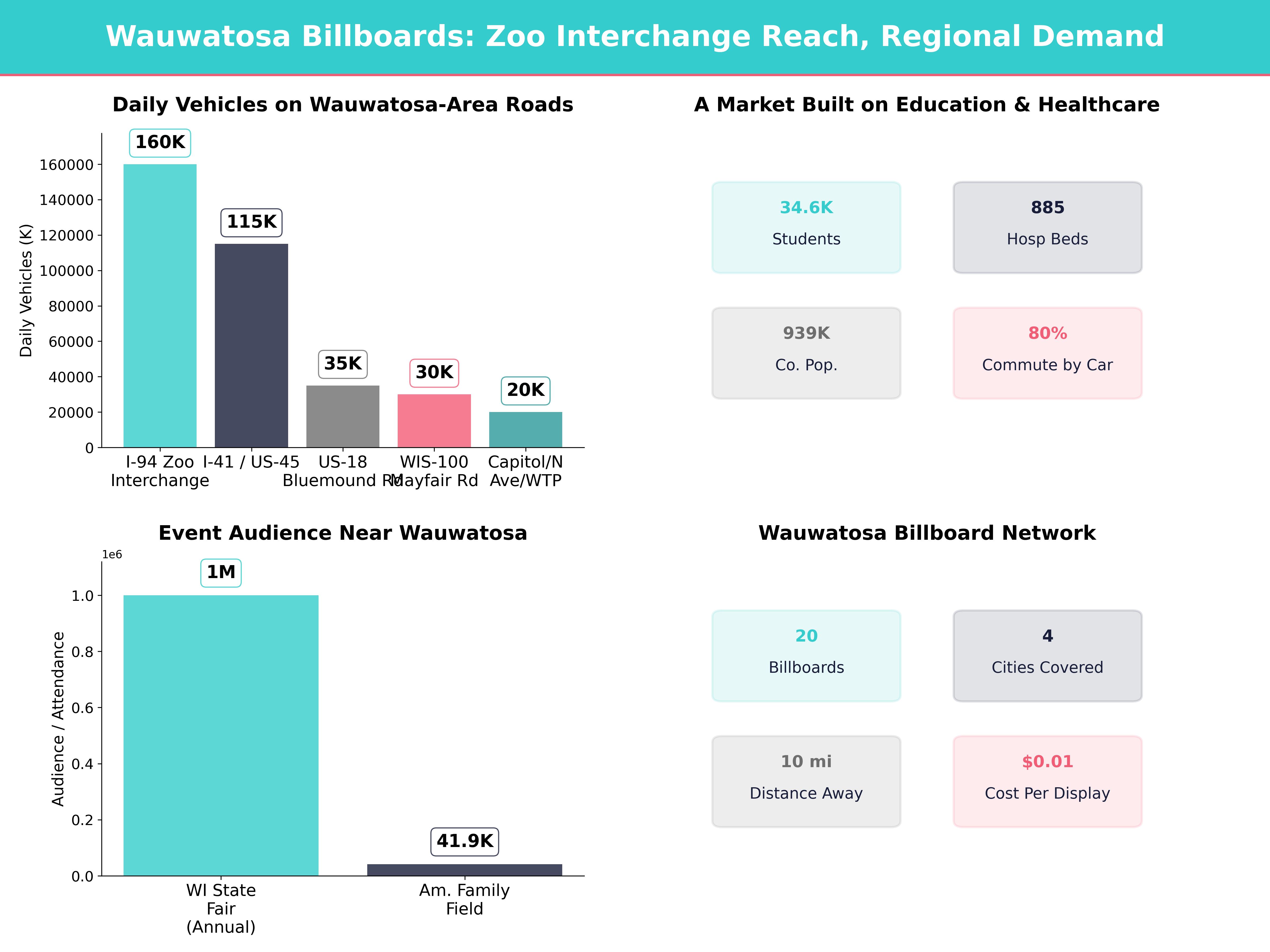
Nearby segments of I-94 around the Zoo Interchange commonly carry about 150,000 to 170,000 vehicles per day. Nearby segments of I-41/US 45 often run in the 100,000 to 130,000 vehicles-per-day range, depending on the exact segment and count year. Busy segments of US 18/Bluemound Road near the Mayfair and State Fair corridors often run around 30,000 to 40,000 vehicles per day.
Why is Wauwatosa a strong market for Blip billboard ads?
Wauwatosa sits at one of southeastern Wisconsin’s most connected crossroads, and the market blends established neighborhoods, major healthcare and education anchors, destination retail, and steady freeway traffic. The city has 48,387 residents, but the nearby City of Milwaukee adds another 577,222 residents, which means brands often draw from a much larger trade area than city limits alone suggest. Event demand from Summerfest, Wisconsin State Fair, and American Family Field gives brands a strong reason to advertise near Wauwatosa.
Do I need a contract to advertise with Blip near Wauwatosa?
No, Blip has no long-term contracts or minimum commitments. You can start, pause, or stop your campaign at any time.
How fast can I launch a billboard campaign with Blip near Wauwatosa?
You can have your campaign live in minutes. Create a free account, select your locations, set your budget, upload your design, and start running once approved.
Where can I advertise with Blip near Wauwatosa?
Blip has digital billboards near Wauwatosa. You can browse available locations on a map, choose the ones that fit your audience, and start advertising right away.
Still have questions? Launch a campaign in minutes — no contracts, no commitments.
Start Your CampaignWauwatosa Billboard Advertising Guide
Wauwatosa Milwaukee County Milwaukee 150,000 to 170,000 vehicles per day and I-41/US 45 often running in the 100,000 to 130,000 range. Our 20 digital billboards in nearby Milwaukee Glendale Greenfield Menomonee Falls 9-day Summerfest, the 11-day Wisconsin State Fair, and 41,900-seat American Family Field—gives brands a strong reason to advertise near Wauwatosa.
Wauwatosa area market overview
Population and regional scale near Wauwatosa
When we advertise near Wauwatosa 48,387 residents inside a county of 939,489 people. The nearby City of Milwaukee 577,222 residents, which means Wauwatosa brands often draw from a much larger trade area than city limits alone suggest. That is why billboard coverage serving the Wauwatosa area works so well from nearby cities rather than from a single neighborhood-only approach.
Our inventory is positioned to mirror how this market actually moves. We have boards in 4 nearby cities, all within 10.0 miles of Wauwatosa, including Milwaukee 4.8 miles, Glendale 6.3 miles, Greenfield 6.9 miles, and Menomonee Falls 9.3 miles. That spread matters because Wauwatosa customers routinely travel outward for work, school, sports, shopping, and entertainment.
Economic anchors and commuting patterns serving the Wauwatosa area
Wauwatosa’s economic pull is much larger than its population because it sits beside one of Wisconsin’s biggest healthcare clusters. Froedtert Hospital is an 885-bed academic hospital, and the Medical College of Wisconsin enrolls more than 1,600 students. Nearby Children’s Wisconsin adds another major healthcare audience, which gives the Wauwatosa area a dependable stream of physicians, nurses, students, staff, patients, and visiting families.
Retail also matters here. Mayfair Mall, The Mayfair Collection, and surrounding commercial corridors make the Wauwatosa area one of the region’s strongest places for shopping, dining, personal services, and family spending. Event venues close by, including Wisconsin State Fair Park, American Family Field, and downtown Milwaukee destinations promoted by Visit Milwaukee, expand that audience even further.
The commuting pattern is still overwhelmingly road-based. Regional planning from SEWRPC, local travel behavior, and statewide commute data all point the same direction: roughly 4 in 5 Wisconsin workers commute by car, truck, or van. The Milwaukee County Transit System is important for local mobility, but broad commercial reach in the Wauwatosa area still comes from roadway visibility on the freeways and arterials people already use every day.
Key traffic corridors serving the Wauwatosa area
Freeways that carry Wauwatosa-area commuters
The freeway network around Wauwatosa is the core reason outdoor advertising works so well here. WisDOT traffic counts show that nearby segments of I-94 around the Zoo Interchange commonly carry about 150,000 to 170,000 vehicles per day. Nearby segments of I-41/US 45 often run in the 100,000 to 130,000 vehicles-per-day range, depending on the exact segment and count year. Those are some of the heaviest travel volumes in Wisconsin, and they are directly tied to Wauwatosa-area commuting, shopping, and hospital traffic.
These freeways do different jobs for advertisers serving Wauwatosa. I-94 carries east-west drivers between downtown Milwaukee, the stadium district, the State Fair area, Wauwatosa, and western suburbs such as Brookfield I-41/US 45 moves north-south traffic from Menomonee Falls and the northwest suburbs toward the Wauwatosa medical district, Mayfair, and downtown connections. When we want broad brand awareness, these are the first routes we consider.
Arterial roads and commercial corridors near Wauwatosa
Surface roads matter because they connect freeway exposure to local action. Busy segments of US 18/Bluemound Road near the Mayfair and State Fair corridors often run around 30,000 to 40,000 vehicles per day. WIS 100/Mayfair Road commonly lands in the 25,000 to 35,000 range on major commercial segments. Other important connectors, including Capitol Drive, North Avenue, and Watertown Plank Road, frequently exceed 20,000 vehicles per day where retail, healthcare, and neighborhood traffic overlap.
For campaign planning, we think about these roads by intent. Bluemound and Mayfair Road are strong for retail, restaurants, healthcare, and family services. Watertown Plank Road is especially relevant when we want to stay top of mind with medical professionals, patients, and campus visitors. Capitol Drive and North Avenue help us reach households moving between Wauwatosa, Milwaukee, and nearby suburbs during normal daily routines.
How our nearby billboard cities map to Wauwatosa traffic
Our nearby digital billboards line up well with the main approach patterns into the Wauwatosa area.
- Boards in nearby Milwaukee I-94, the stadium district, downtown, and convention demand.
- Boards in nearby Menomonee Falls I-41/US 45 traffic flowing south toward Wauwatosa jobs, healthcare, and retail.
- Boards in nearby Glendale
- Boards in nearby Greenfield
Audience segments advertisers can reach near Wauwatosa
Commuters, healthcare workers, and professionals in the Wauwatosa area
One of the most valuable audiences near Wauwatosa is the professional commuter. The medical district alone creates steady demand from early morning through late evening, and shift changes make outdoor frequency especially useful. Froedtert Hospital, with 885 beds, and the Medical College of Wisconsin, with 1,600+ students, keep the area active well beyond a standard 9-to-5 schedule.
That makes the Wauwatosa area especially attractive for healthcare recruiting, legal services, financial services, home services, continuing education, and business-to-business messaging. We can also reach professionals traveling between Wauwatosa and downtown Milwaukee, as well as office workers visiting clients near the Wauwatosa Chamber of Commerce
Families, shoppers, and weekend visitors serving the Wauwatosa area
Wauwatosa is also a family market with strong regional draw. Mayfair Mall and The Mayfair Collection bring in shoppers from multiple parts of Milwaukee County and beyond. The Milwaukee County Zoo 190 acres and houses more than 2,000 animals, which makes it one of the area’s most reliable family destinations. Wisconsin State Fair Park covers 200 acres, and the Wisconsin State Fair itself runs for 11 days and regularly attracts more than 1 million attendees.
Those destinations create a broad weekend audience for restaurants, healthcare clinics, retail, attractions, insurance, entertainment, and family services. When we want to reach households making real spending decisions, the Wauwatosa area gives us one of the best mixes of suburban family traffic and regional destination traffic in southeastern Wisconsin.
Students, sports fans, and eventgoers near Wauwatosa
The education and events audience is larger than many advertisers first assume. The University of Wisconsin-Milwaukee serves more than 22,000 students, Marquette University has more than 11,000 students, and the Medical College of Wisconsin adds 1,600+ more. That puts the broader market at well over 34,600 students across just those three institutions, not counting local K-12 families or other colleges.
Sports and convention traffic further expand the reachable audience. American Family Field has about 41,900 seats, the Baird Center now offers more than 1.3 million square feet of total space, and Summerfest runs for 9 days over 3 weekends. When those visitors drive through Milwaukee County, many of them pass through the same highway system that serves the Wauwatosa area.
Seasonal and timing opportunities near Wauwatosa
Winter and early spring campaigns serving the Wauwatosa area
Winter in southeastern Wisconsin changes how people move, but it does not reduce the importance of roadway visibility. In colder months, we usually lean into categories that solve practical problems, including healthcare, urgent care, tax services, home services, gyms, schools, and indoor retail. Because daylight is shorter and weather can be gray or snowy, we often prioritize simple creative and strong commuter dayparts like 6 a.m. to 9 a.m. and 3 p.m. to 6 p.m.
Early spring is a smart time for healthcare enrollment pushes, landscaping pre-booking, moving services, and home improvement campaigns. It is also when baseball season returns, which matters because American Family Field adds game-day traffic near the same corridors that serve Wauwatosa.
Summer peaks near Wauwatosa
Summer is the biggest seasonal surge for many Wauwatosa-area advertisers. Summerfest brings 9 days of festival demand over 3 weekends, the Wisconsin State Fair delivers 11 days and more than 1 million visits, and the Milwaukee County Zoo
This is also a good time to run heavier Friday-through-Sunday schedules. Families and visitors are out longer, and destination-based messages such as “next exit,” “near Mayfair,” or “minutes from State Fair Park” tend to work well.
Fall and holiday timing for the Wauwatosa area
Late August through November brings another excellent window. College students return, healthcare systems recruit, sports schedules intensify, and parents shift into school-year routines. With 22,000+ students at UWM, 11,000+ at Marquette, and 1,600+ at MCW, the fall audience near Wauwatosa becomes more concentrated and predictable.
The holiday season adds even more opportunity because the Mayfair corridor becomes a regional shopping hub. We usually recommend earlier daily coverage, higher weekend emphasis, and creative that highlights convenience, giftability, same-day service, or proximity to familiar landmarks. For healthcare, retail, and personal services, October through December is often one of the most efficient periods of the year.
Billboard design tips for the Wauwatosa market
Creative choices that fit southeastern Wisconsin
The Wauwatosa area responds well to clean, direct, practical creative. This is not a market where vague brand poetry usually outperforms clarity. We generally do better with strong contrast, one clear value proposition, and one memorable action.
A few design approaches tend to fit the local geography especially well:
- We use bold contrast because winter skies, early sunsets, and snow glare can make low-contrast creative harder to read.
- We keep freeway creative to about 6 to 8 words when possible, especially on I-94 and I-41/US 45 where drivers make fast decisions.
- We favor one dominant image, one offer, and one location cue rather than trying to explain everything at once.
- We use practical language such as price points, limited-time offers, opening dates, or short service benefits when the category supports it.
Messaging that feels local near Wauwatosa
Local relevance matters here because the market mixes destination retail with neighborhood loyalty. Messages that reference familiar corridors or districts often feel more believable than generic metro-wide claims. Phrases such as “Near Mayfair,” “Off Bluemound,” “Close to Froedtert,” or “Next stop after State Fair Park” can help connect the message to a real trip people are already taking.
We also recommend tailoring creative by audience segment:
- For healthcare and recruiting, we use trust-building language, credentials, and simple next steps.
- For family brands, we use bright imagery, clear offers, and messages that feel easy, safe, and convenient.
- For restaurants and retail, we emphasize immediacy, including same-day deals, new menu items, and weekend shopping cues.
- For event-driven brands, we connect the message to the season, the game, the fair, or the festival calendar.
Regional strategies for reaching the Wauwatosa area
Suburban corridor strategy near Wauwatosa
If we want households and repeat local spenders, suburban corridor coverage is usually our first move. Boards near Glendale Menomonee Falls
Highway interchange strategy serving the Wauwatosa area
If our goal is maximum awareness, highway-focused boards near Milwaukee
Commercial district strategy for Wauwatosa-area shoppers
If we want action-oriented traffic, we focus on the retail and service corridors that influence purchase decisions. Boards serving the Mayfair, Bluemound, State Fair, and south-county approach routes from Greenfield
Blip tools for Wauwatosa-area campaigns
When we use Blip-optimized campaigns near Wauwatosa
For broad awareness across the Wauwatosa area, we often start with a Blip-optimized campaign. That approach is especially useful when we want the platform to distribute budget across our 20 nearby boards based on where and when inventory is available. It is a good fit for campaigns that want regional coverage without manually managing every corridor.
When we use manual campaigns for Wauwatosa-area strategy
If we know the route, the audience, and the timing, manual control can be very effective. We can select specific boards near Milwaukee Glendale Greenfield Menomonee Falls
Blip’s flexibility supports the rhythms of this market without making the process heavy. We can upload multiple creatives, test messages by season, and adjust pacing as conditions change. Each ad display runs for 7.5 to 10 seconds, and pricing starts at $0.01 per display, which makes it practical to test the Wauwatosa area without overcommitting budget. Real-time analytics also help us shift spend toward the boards and times that are working best.
Getting started with billboard rental near Wauwatosa
What to expect when renting digital billboards serving the Wauwatosa area
The smartest way to start is with one clear objective. We usually define whether the campaign is meant to drive awareness, foot traffic, appointments, recruiting, or event attendance. Once we know that, choosing boards near Wauwatosa becomes much easier because the route strategy follows the business goal.
A practical starting workflow looks like this:
- We define the primary audience, such as commuters, families, shoppers, students, or eventgoers.
- We match that audience to likely travel routes, including I-94, I-41/US 45, Bluemound Road, Mayfair Road, or south-county connectors.
- We build 2 or 3 creative versions so we can test different offers, visuals, or calls to action.
- We set a budget and either let Blip optimize across the nearby network or manually choose the boards that best fit the goal.
- We monitor performance and adjust the creative, schedule, or board mix as the campaign runs.
How we evaluate which billboard locations fit Wauwatosa-area goals
Not every location serves the same purpose, so we evaluate boards by intent rather than by map distance alone.
- If we need broad market awareness, we prioritize high-volume freeway boards serving the Wauwatosa area.
- If we need shoppers and families, we prioritize boards tied to Mayfair, the zoo, State Fair traffic, and weekend retail movement.
- If we need healthcare or professional reach, we prioritize routes connected to the medical campus, commuter peaks, and weekday business flow.
- If we need event visibility, we prioritize Milwaukee-facing routes tied to conventions, festivals, and game traffic.
This is also where Blip feels very different from many traditional billboard companies. Traditional buying often means sales calls, fixed packages, longer commitments, and limited flexibility once the campaign is live. With Blip, we can launch digitally, skip printing, start with almost any budget, and make changes whenever the Wauwatosa-area strategy needs to evolve. That gives us a much easier way to test, learn, and scale the locations that truly fit our goals near Wauwatosa.