Billboards in Kenosha, WI
No Minimum Spend. No Long-Term Contracts. Just Results.
Trusted by Leading Brands


Billboard advertising
in Kenosha has never been easier
How much is a billboard in Kenosha?
Why Choose Blip for Billboard Advertising in Kenosha
-
Blip lets you launch fast on Kenosha's I-94 and WIS 50 corridors, reaching Milwaukee-Chicago commuters without sales calls or contracts.
-
Set flexible budgets in Kenosha and pay only when ads play, ideal for testing downtown, Pleasant Prairie, or lakefront traffic.
-
Use Blip dayparting to hit Kenosha's weekday shift workers and weekend lakefront visitors at the right time, not all day.
-
Track Kenosha campaign results in real time and shift spend as Bristol Renaissance Faire, the County Fair, or school traffic changes.
-
Blip's creative tools make it easy to tailor Kenosha billboards with local cues like Green Bay Road, Sheridan Road, or 75th Street.
Frequently Asked Questions About Billboard Advertising in Kenosha
How much does a billboard cost in Kenosha with Blip?
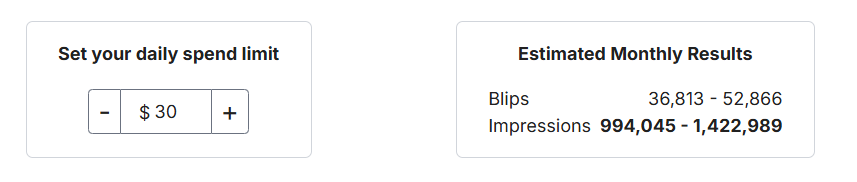
With Blip, billboard advertising in Kenosha is priced to fit real budgets because you only pay when your ad actually appears. Each “blip” is a 7.5-to-10-second display on a rotating digital billboard, with pricing starting at just $0.01 per display. Since cost per blip changes based on time of day, location, and advertiser demand, you stay in control of what you spend.
Where can I advertise with Blip in Kenosha?
Kenosha’s strongest billboard inventory follows the roads people actually use every day, especially I-94, WIS 50, WIS 31, and Sheridan Road. I-94 through eastern Kenosha County carries 100,000 or more vehicles per day in several segments, while WIS 50 and Green Bay Road are important commercial corridors for local reach. Downtown Kenosha and lakefront approaches can also work well for destination messaging and local events.
Why is Kenosha a strong billboard market for Blip?
Kenosha gives us a rare billboard market: a nearly 100,000-resident city anchored inside a 169,151-person county, positioned directly on the high-traffic corridor between Milwaukee and Chicago. More than 90% of workers in the county commute by car, truck, or van, which makes the area especially strong for out-of-home advertising. The market also pulls commuters, shoppers, summer visitors, and event traffic.
What kind of audience can Blip reach in Kenosha?
The biggest audience in Kenosha is still the daily driver, but the market also includes students, families, shoppers, and tourists. Kenosha is home to the University of Wisconsin-Parkside, Carthage College, Gateway Technical College, and Kenosha Unified School District, which creates strong education and family audiences. Summer visitors, downtown visitors, and eventgoers also add seasonal reach.
When is the best time to run billboard ads in Kenosha?
Summer is the easiest season for many advertisers to win in Kenosha because local residents, Illinois visitors, and Wisconsin travelers all overlap. Back-to-school season is also important because Kenosha has K-12, college, and technical education audiences all at once. Holiday shopping and winter service campaigns can perform well too, especially for healthcare, urgent care, auto repair, and retail.
Do I need a contract to advertise with Blip in Kenosha?
No, Blip has no long-term contracts or minimum commitments. You can start, pause, or stop your campaign at any time.
How fast can I launch a billboard campaign with Blip in Kenosha?
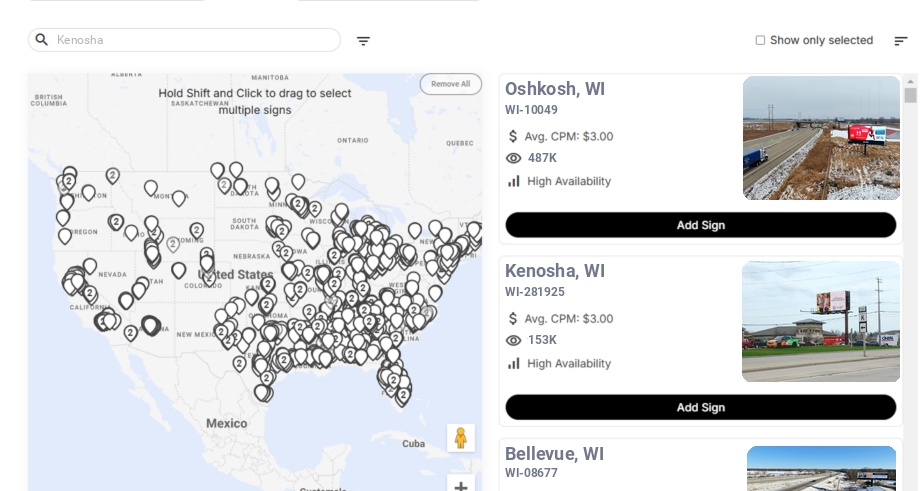
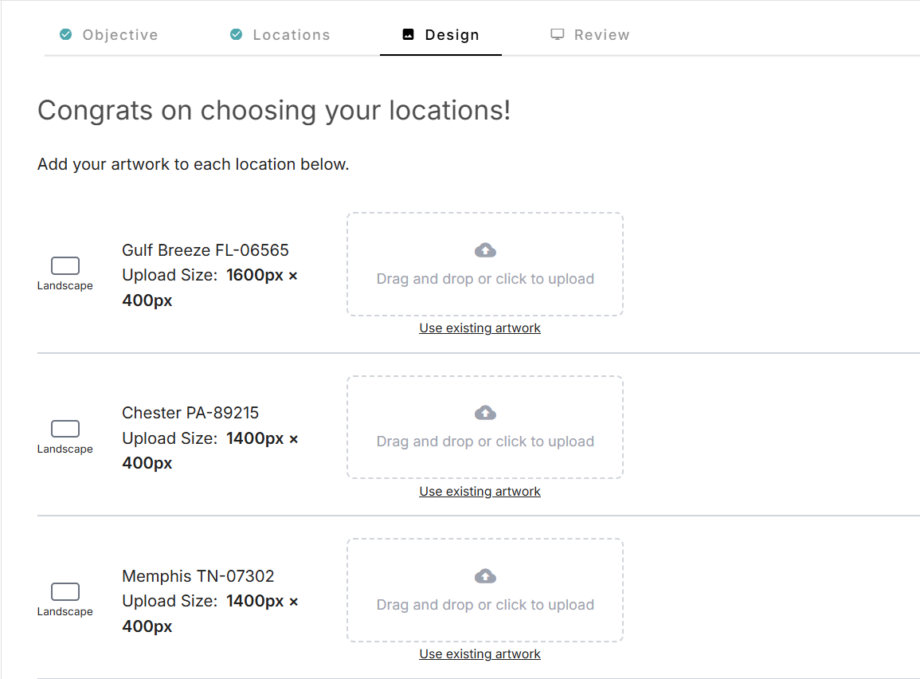
You can have your campaign live in minutes. Create a free account, select your locations, set your budget, upload your design, and start running once approved.
Where can I advertise with Blip in Kenosha?
Blip has digital billboards in Kenosha. You can browse available locations on a map, choose the ones that fit your audience, and start advertising right away.
Still have questions? Launch a campaign in minutes — no contracts, no commitments.
Start Your CampaignKenosha Billboard Advertising Guide
Kenosha 100,000-resident city anchored inside a 169,151-person county, positioned directly on the high-traffic corridor between Milwaukee Chicago. According to the Wisconsin Department of Administration, the City of Kenosha 99,986 residents in the 2020 Census, which made it Wisconsin’s fourth-largest city, while Kenosha County reached 169,151. The market is especially strong for out-of-home advertising because more than 90% of workers in the county commute by car, truck, or van when we combine solo drivers and carpools, and because the area pulls both everyday commuters and summer visitors to its nearly 8 miles of Lake Michigan shoreline. When we add in Pleasant Prairie Somers, three higher-education institutions, outlet shopping, and event traffic, we get a local market that rewards smart, location-specific billboard strategy.
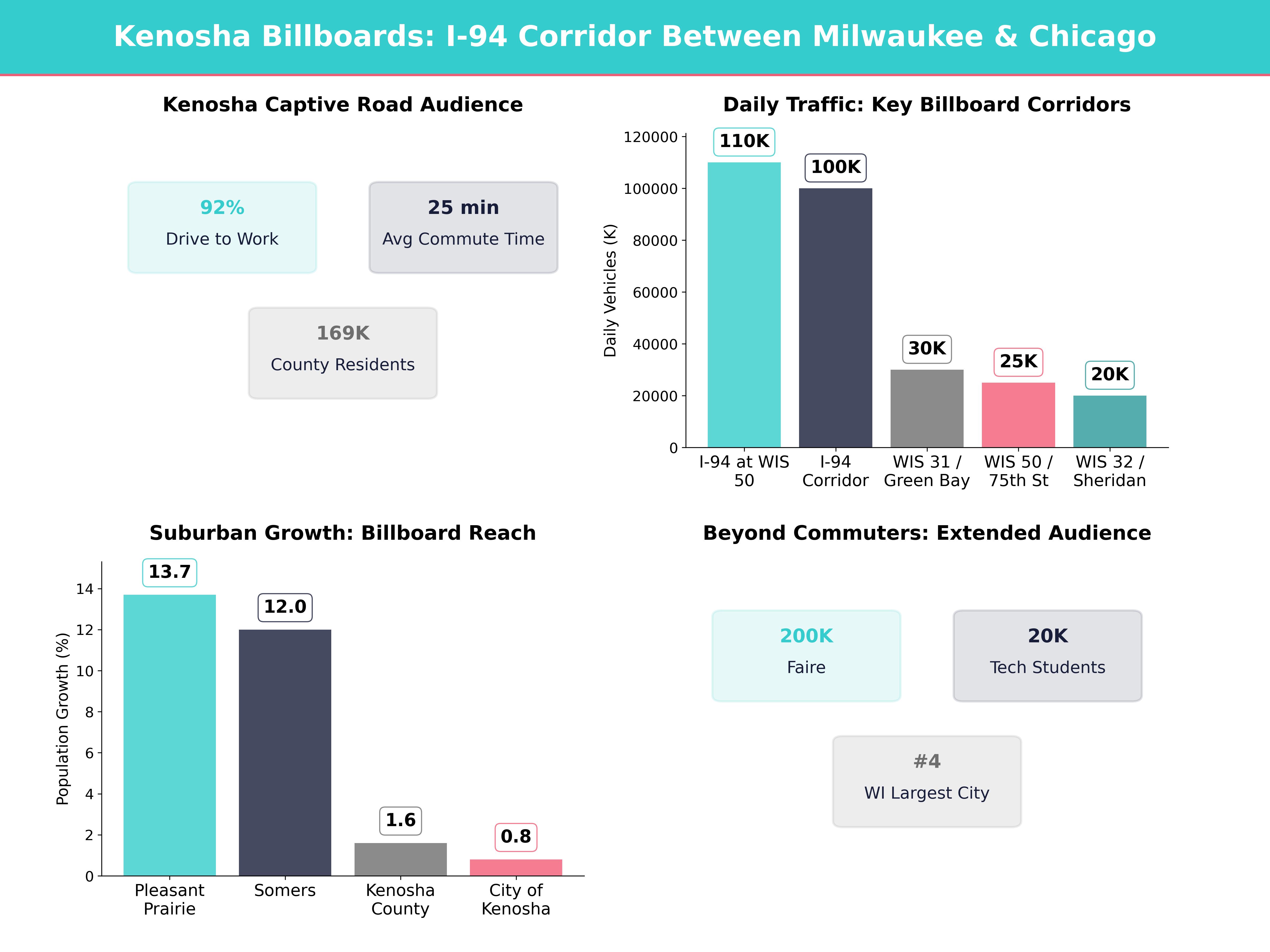
Kenosha Market Overview for Billboard Advertisers
Kenosha’s population, growth, and local footprint
Kenosha is large enough to support sustained local frequency, and it is regional enough to deliver pass-through reach. The City of Kenosha 99,218 residents in 2010 to 99,986 in 2020, which was a gain of 768 residents, or about 0.8%. Kenosha County grew from 166,426 residents in 2010 to 169,151 in 2020, which was an increase of 2,725 residents, or about 1.6%.
The county’s growth story becomes more compelling when we look at key suburban and industrial communities. Pleasant Prairie 19,719 residents in 2010 to 22,413 in 2020, which was a jump of 2,694 residents, or about 13.7%. Somers also expanded, rising from 8,359 residents in 2010 to about 9,400 in 2020, which was an increase of roughly 12%. For billboard advertisers, that matters because growth in Pleasant Prairie and Somers has been closely tied to retail development, logistics investment, and commuter housing.
Kenosha also benefits from geography. The market sits about 40 miles south of Milwaukee and about 65 miles north of Chicago, which makes it part local city, part interstate corridor, and part borderland trade area. That mix lets us reach residents, workers, shoppers, and travelers with the same campaign if we choose our boards carefully.
Kenosha’s economy and travel behavior
The local economy is diversified enough to support many billboard categories at once. Kenosha Area Business Alliance, Pleasant Prairie Kenosha County regularly promote growth in logistics, advanced manufacturing, healthcare, higher education, and distribution. That creates opportunity for advertisers in hiring, healthcare, quick-service dining, auto services, financial services, home improvement, higher education, and regional retail.
Travel behavior strongly favors outdoor advertising. In the most recent multi-year commuting estimates, roughly 92% of Kenosha County workers traveled to work by car, truck, or van, and the average commute sat in the mid-20-minute range, or about 25 minutes. That combination is ideal for billboard frequency because commuters repeat the same routes, at the same times, on the same workdays.
Kenosha still has valuable non-driving audiences too. Metra Union Pacific North Line Kenosha Area Transit Kenosha Electric Streetcar 2-mile downtown loop. That means downtown boards can influence both motorists and people already in destination mode.
Key Traffic Corridors for Kenosha Billboards
Kenosha’s strongest billboard inventory follows the roads people actually use every day. The best locations are not just “busy.” They are busy with the right audience for the right message.
I-94, I-41, and US 45 in Kenosha County
The Wisconsin Department of Transportation traffic count system consistently shows that the I-94 corridor through eastern Kenosha County is the region’s dominant billboard route. In several Kenosha County segments, I-94 carries 100,000 or more vehicles per day, and the busiest interchanges around WIS 50 110,000 AADT.
This corridor is ideal for campaigns that need broad reach and repeat exposure. We especially like it for these advertiser types:
- Retailers that want to intercept shoppers headed to Pleasant Prairie Premium Outlets
- Healthcare providers such as Froedtert South Aurora Health Care, and urgent care brands that benefit from brand recall and directional messaging.
- Employers such as Uline, Haribo of America, Amazon, and regional manufacturers that need to reach shift workers and job seekers.
- Colleges and training providers that want visibility across the whole corridor rather than inside one neighborhood.
Because this route carries both local and interstate traffic, creative needs to be simple and immediate. A clear brand name, one benefit, and one location cue usually outperform dense copy here.
WIS 50, 75th Street, and the Kenosha east-west retail spine
WIS 50, which becomes 75th Street through much of the city, is Kenosha’s most important east-west commercial artery. WisDOT counts along this corridor commonly land in the 25,000 to 35,000 vehicles per day range, depending on the segment. The route links downtown Kenosha, residential neighborhoods, hospital and service nodes, west-side retail, and the I-94 interchange area.
For advertisers, WIS 50 is where “regional” reach becomes “actionable” reach. We use it for:
- Restaurants, quick-serve brands, and coffee concepts that need a same-day visit.
- Medical, dental, vision, and urgent care providers that need to stay top of mind close to decision points.
- Entertainment, family attractions, and local events that depend on weekend traffic.
- Home services and legal brands that want broad household penetration inside the city.
Messages can be slightly more detailed here than on I-94 because portions of the route operate at lower speeds and with more stop-and-go conditions. That makes WIS 50 a strong corridor for directional cues such as “off 75th Street,” “next right,” or “minutes away.”
WIS 31, Green Bay Road, and north-south neighborhood commerce
WIS 31, or Green Bay Road, is another dependable billboard corridor. In many city and suburban segments, traffic volumes commonly fall in the 20,000 to 30,000 AADT range. The road ties together commercial centers, residential districts, service businesses, and access points toward University of Wisconsin-Parkside Somers, and northern Kenosha County.
We like Green Bay Road for advertisers that want a true local audience rather than a mostly through-travel audience. Auto repair, grocery, telecom, fitness, childcare, banking, and elective healthcare all perform well on this type of route because the audience is closer to home and closer to routine errands.
This corridor also works well for public awareness campaigns. Local institutions such as Kenosha Unified School District, Gateway Technical College, and community events can use Green Bay Road boards to build recognition among residents who circulate through multiple city neighborhoods each week.
Sheridan Road, WIS 32, and Kenosha’s lakefront approaches
WIS 32, including Sheridan Road in the southeastern part of the market, is lighter than I-94 but still valuable. Traffic volumes on many urban and near-lakefront segments often sit around 15,000 to 20,000 vehicles per day, with slower speeds and more destination-oriented drivers. That changes the advertising opportunity.
We use this corridor for:
- Restaurants, bars, and local entertainment venues near downtown and the harbor.
- Tourism and hospitality campaigns tied to Visit Kenosha, lakefront museums, and seasonal events.
- Real estate, senior living, and neighborhood services that benefit from a more local, more attentive audience.
- Southbound and northbound campaigns that need to catch travelers moving toward the Illinois border.
If our goal is immediate visitation to downtown, the harbor, or the lakefront museum district, these boards can outperform higher-volume interstate boards because the audience is already close to the destination.
Audience Segments We Can Reach in Kenosha
Commuters, regional travelers, and cross-border workers
The biggest audience in Kenosha is still the daily driver. With more than 90% of workers commuting by vehicle, billboard advertising can achieve the kind of repeat frequency that search and social often struggle to match on a route-based basis. Kenosha also has a large population of workers moving between southeastern Wisconsin and northeastern Illinois, which makes interstate boards especially efficient for employers, healthcare systems, and regional retailers.
The north-south nature of the market matters here. A driver going from the Illinois line to Pleasant Prairie Somers, or central Kenosha may see our ad multiple times per week, even if we only buy a small cluster of digital locations.
Students and education audiences in Kenosha
Kenosha is not just a commuter market. It is also a college and training market. University of Wisconsin-Parkside 4,000 students, Carthage College enrolls about 2,700, and Gateway Technical College serves more than 20,000 students and learners annually across its district. Kenosha Unified School District serves about 19,000 students, which gives family-oriented advertisers a substantial K-12 audience too.
That mix supports several campaign categories:
- Apartments, student housing, and roommate-friendly services can target late summer and early semester move-in windows.
- Banks, insurers, telecoms, and healthcare providers can target young adults building new routines.
- Colleges, certification programs, and employers can target transfer, continuing education, and workforce training audiences.
Education audiences also create calendar-driven traffic spikes. August, September, January, and May are especially useful months for targeted creative swaps.
Families, shoppers, and everyday service buyers
Kenosha’s family audience is strongest in the city’s residential neighborhoods, in west-side retail areas, and in fast-growing suburban communities like Pleasant Prairie Somers. These consumers respond well to convenience, value, and location-specific messaging. They are the audience most likely to act on healthcare, grocery, family dining, auto service, home repair, childcare, tutoring, and seasonal retail messages.
The shopping audience is also broader than the city alone. Pleasant Prairie Premium Outlets
Tourists, weekend visitors, and eventgoers in Kenosha
Tourism is a meaningful bonus audience in Kenosha, especially from late spring through early fall. Visit Kenosha promotes nearly 8 miles of Lake Michigan shoreline, museums, public beaches, and lakefront events. Downtown destinations such as the Kenosha Public Museum Civil War Museum Dinosaur Discovery Museum give the city a family-friendly visitor base beyond beach traffic alone.
Summer also brings distinctive event audiences. The Bristol Renaissance Faire 8 weekends and roughly 200,000 visitors each season, and the Kenosha County Fair creates a concentrated 5-day surge in August. These visitors are excellent prospects for restaurants, lodging, attractions, convenience retail, fuel, and impulse purchases.
Seasonal and Timing Opportunities in Kenosha
Summer in Kenosha brings the broadest audience mix
Summer is the easiest season for many advertisers to win in Kenosha because local residents, Illinois visitors, and Wisconsin travelers all overlap. That is when we can combine commuter inventory with tourism-oriented creative. Campaigns tied to lakefront dining, festivals, museums, beaches, HarborMarket, and weekend recreation usually perform best from late May through early September.
We also like summer for regional retailers and entertainment brands because event traffic raises the total audience without changing the core commute base. When the Bristol Renaissance Faire Kenosha County Fair is approaching, boards along I-94 and WIS 50 can speak to both planned visitors and spontaneous stop-ins.
Back-to-school timing matters across Kenosha
Back-to-school season is unusually important here because Kenosha has K-12, college, and technical education audiences all at once. We typically see strong timing opportunities in these windows:
- Late July through early September for Kenosha Unified School District families, college move-ins, sports physicals, and retail resets.
- January for new semester campaigns, winter enrollment pushes, and gym or wellness offers.
- April and May for graduation, summer employment, moving, and apartment leasing.
If we are advertising to students or parents, we should match our dayparting to actual travel patterns. Morning commute windows can reach parents and school staff, while late afternoon and early evening can capture pickup traffic, retail trips, and student workers.
Holiday retail and winter service campaigns in Kenosha
Kenosha’s winter conditions change how people read outdoor ads. Daylight gets short, roads can be wet or snowy, and drivers become more task-focused. That is good for essential categories such as healthcare, urgent care, legal services, tire and auto repair, home heating, insurance, and tax preparation.
Holiday shopping is another important seasonal opportunity. Pleasant Prairie Premium Outlets
Billboard Design Tips for the Kenosha Market
Creative that fits Kenosha’s corridor identity
Kenosha is a “where am I stopping?” market as much as it is a “who am I learning about?” market. That means our creative should usually include one of three things: a precise location cue, a practical reason to stop, or a timely offer. Phrases like “Off Hwy 50,” “Next Exit in Pleasant Prairie,” “Minutes from Downtown Kenosha,” and “Near the Metra Station” are especially useful because they fit how drivers navigate the area.
We should design differently for different road speeds. On I-94, we want very few words, oversized type, and a single dominant message. On WIS 50, Green Bay Road, or downtown approaches, we can add one extra piece of information, such as an address cue, an opening date, or a hiring wage.
Colors, imagery, and local references that resonate in Kenosha
Local context matters. Kenosha sits on Lake Michigan, so blue, white, and clean high-contrast palettes often feel natural for tourism, healthcare, and family brands. At the same time, winter skies, gray pavement, and industrial corridors make bright red, orange, and yellow accents highly visible for retail, QSR, auto service, and hiring campaigns.
Imagery should match the submarket. We recommend:
- Lakefront and downtown imagery for hospitality, museums, dining, and events near the harbor.
- Family and convenience imagery for WIS 50 retail and neighborhood services.
- Straightforward workplace imagery for hiring campaigns in Pleasant Prairie Somers, and industrial corridors.
Specific local references also help. Kenosha audiences respond better to “75th Street,” “Green Bay Road,” “Sheridan Road,” “Pleasant Prairie,” and “Downtown Kenosha” than to generic “near you” language. Those references signal relevance immediately.
What to emphasize by category in Kenosha
Hiring campaigns should lead with the practical facts first. If we are recruiting along I-94 or in industrial zones, we should show the pay range, shift, benefit, or location before anything else. Healthcare campaigns should emphasize same-day access, specialty, insurance acceptance, or proximity to a known corridor.
Restaurant and retail campaigns should use distance, exit, or limited-time offer language because the audience is often close enough to act right away.
Regional Strategies Across Kenosha
Downtown and lakefront Kenosha
Downtown Kenosha is our best submarket for destination messaging. The area combines the harbor, museums, restaurants, Downtown Kenosha Inc., the Kenosha Electric Streetcar Carthage College into one compact zone. Here we should emphasize events, dining, entertainment, apartment living, and locally distinctive brands.
Because speeds are lower and drivers may already be deciding where to park, this is also the best part of the market for boards that use neighborhood identity and lifestyle appeal instead of pure highway brevity.
West Kenosha and the WIS 50 commercial corridor
West Kenosha is where service-driven advertising shines. This area is strong for hospitals, clinics, urgent care, dental groups, furniture, grocery, auto service, telecom, and family dining. The combination of residential density and daily errands means advertisers benefit from high repetition and practical creative.
If our budget is modest, west-side boards can be more efficient than interstate boards because they deliver a more local audience with stronger immediate purchase intent.
Pleasant Prairie and the I-94 logistics belt
The Pleasant Prairie
This is the right part of the market for advertisers that want scale beyond city limits. A board here can reach residents from Kenosha County, Racine County, and nearby Illinois communities in a single buy window.
Southern and western Kenosha County communities
The rest of the county matters too. Communities such as Bristol Salem Lakes, Twin Lakes Paddock Lake, and Silver Lake
If our target customer lives outside the city core, we should not over-focus on downtown boards. A countywide strategy often performs better when it pairs one or two high-reach interstate boards with one or two local service-area boards.
Using Blip Tools in Kenosha
How we can apply Blip’s flexibility to Kenosha travel patterns
Kenosha is a strong fit for Blip because traffic patterns are predictable but audiences vary by corridor. We can daypart morning and late afternoon on I-94 for commuter and workforce messaging, then shift more of the budget to midday or weekend hours for lakefront dining, outlet shopping, and event traffic. That is especially helpful in a market where summer Saturdays look very different from winter Tuesdays.
Flexible budgeting also helps us test geography without overcommitting. We can compare downtown Kenosha boards against Pleasant Prairie boards, or WIS 50 boards against I-94 boards, and see which mix produces the best reach for our goal.
How we can use analytics and creative testing in Kenosha
Real-time campaign data is valuable in a market with several distinct subareas. We can run one version of creative for interstate boards, another for downtown boards, and another for retail corridors, then adjust based on delivery and business response. Kenosha is small enough for fast learning, but large enough that one-size-fits-all creative usually leaves results on the table.
Blip’s artwork tools are also useful here because local relevance matters. We can quickly generate variants that say “Downtown Kenosha,” “Off Hwy 50,” or “Pleasant Prairie Exit” without rebuilding a campaign from scratch.
Getting Started with Billboard Rental in Kenosha
What to expect when renting a billboard in Kenosha
The first step is to match the billboard to the business objective. If we want broad awareness, we should start with I-94 or another high-volume corridor. If we want immediate store visits, we should look harder at WIS 50, Green Bay Road, Sheridan Road, or downtown approaches. If we want hiring results, we should focus on routes workers actually use to reach industrial and warehouse districts.
With digital inventory, our ad will usually appear as a short rotating spot rather than a full-time static face. On Blip, each ad display is a 7.5- to 10-second blip, and campaigns can start with pay-per-play pricing beginning at $0.01 per display. That structure is especially useful in Kenosha because we can align spend with peak local demand instead of committing to a long, fixed contract.
How Blip simplifies the Kenosha buying process
Traditional billboard buying often requires long sales cycles, fixed terms, and limited flexibility after launch. Blip makes Kenosha buying easier because we can choose boards on a map, set our own budget, control timing, upload creative, and adjust the campaign as local conditions change. That is helpful in a market where weather, school calendars, summer events, and commuter flow all shape performance.
For example, a restaurant near the harbor may want to push Friday afternoon and Saturday traffic in July, while a healthcare clinic near WIS 50 may want weekday frequency year-round. Blip lets us build each strategy around the actual market rather than around a preset package.
How we should evaluate Kenosha billboard locations
As we choose locations, we should ask five practical questions. Does the board sit on the route our customer already drives? Is the traffic fast and regional, or slower and destination-oriented? Is our business close enough for the viewer to act soon after seeing the ad? Do we need weekday commuter impressions, weekend leisure impressions, or both? Can we tailor the creative to the specific road, district, or exit?
In Kenosha, the best billboard is rarely just the one with the biggest traffic count. The best billboard is the one that puts the right message in front of the right driver at the right point in the trip. If we use that lens, Kenosha becomes one of the most practical and scalable digital billboard markets in southeastern Wisconsin.