Billboards near Brown Deer, WI
No Minimum Spend. No Long-Term Contracts. Just Results.
Trusted by Leading Brands


Billboard advertising
near Brown Deer has never been easier

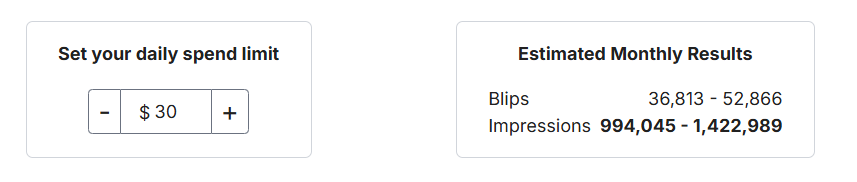
How much is a billboard near Brown Deer?
Why Choose Blip for Billboard Advertising near Brown Deer
-
Blip lets you launch fast near Brown Deer and target I-43 or Brown Deer Road commuters without sales delays.
-
Set a flexible budget for Brown Deer and reach North Shore, Mequon, and Menomonee Falls drivers when traffic peaks.
-
Daypart your Brown Deer ads for 6-9 a.m. or 3:30-6:30 p.m. to catch repeat commuters on I-41/US 45.
-
No contracts mean Brown Deer campaigns can flex for summer fairs, Brewers games, or back-to-school traffic.
-
Track Brown Deer results in real time and shift spend toward the Menomonee Falls boards serving the north metro corridor.
-
Use Blip creative tools to test clear, high-contrast messages for Brown Deer drivers moving through suburban routes.
Frequently Asked Questions About Billboard Advertising near Brown Deer
How much does a billboard cost in Brown Deer with Blip?
Blip makes billboard advertising in the Brown Deer area flexible and accessible by letting you set a daily budget and only pay when your ad actually appears. Pricing is dynamic, so the cost per blip can change based on time of day, location, and demand, and pricing starts at $0.01 per display. Your total cost is simply the sum of the individual blips your ad receives over time.
Where can I advertise with Blip near Brown Deer?
Our 2 digital billboards in Menomonee Falls, just 6.7 miles from Brown Deer, give us a strong way to reach drivers moving through this wider suburban corridor. The market sits at the crossroads of Milwaukee’s North Shore, the western suburbs, and major commuter traffic flowing through northern Milwaukee County. For brands that want flexible, targeted visibility serving the Brown Deer area, this is a market where local relevance and regional traffic overlap.
Is Brown Deer good for Blip billboard ads during commute times?
Yes, this is still a strongly car-oriented market, with more than 4 out of 5 workers commuting by car, truck, or van in both the Brown Deer area and Milwaukee County overall. Average one-way commute times generally fall in about the 22- to 24-minute range, or about 23 minutes, which is ideal for billboard visibility on suburban approaches and freeway connectors. Recent ACS patterns support reaching working adults during dependable weekday drive times.
What traffic routes near Brown Deer work best for billboard ads with Blip?
I-43 near Brown Deer Road carries roughly 120,000 to 140,000 vehicles per day on key segments, making it one of the most important routes for reaching drivers. Nearby I-41/US 45 commonly lands around 100,000 to 120,000 vehicles per day, and Brown Deer Road often carries about 20,000 to 30,000 vehicles per day. These routes connect commuters, shoppers, and suburban travelers across the Brown Deer area.
When is the best time to run billboard ads in Brown Deer?
Late spring through summer is one of the strongest advertising windows near Brown Deer because warmer weather increases retail trips, home-improvement projects, restaurant visits, golf outings, and family recreation. Fall is another strong season as back-to-school activity accelerates, while winter creative can perform well for practical services like heating, tire, and insurance offers. For many brands, the most efficient timing windows are 6:00 a.m. to 9:00 a.m., 11:00 a.m. to 2:00 p.m., and 3:30 p.m. to 6:30 p.m.
Do I need a contract to advertise with Blip near Brown Deer?
No, Blip has no long-term contracts or minimum commitments. You can start, pause, or stop your campaign at any time.
How fast can I launch a billboard campaign with Blip near Brown Deer?
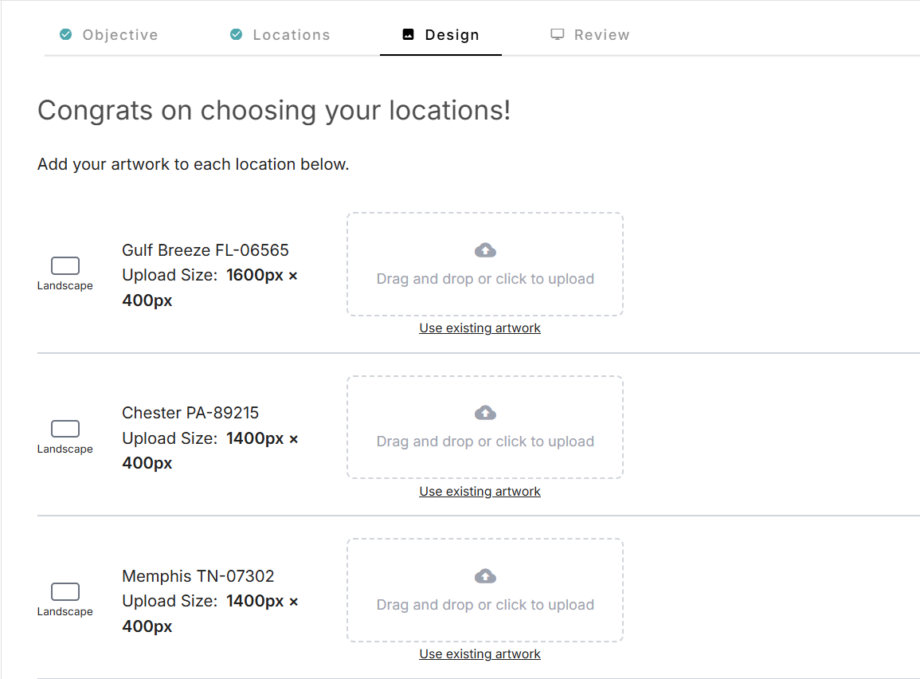
You can have your campaign live in minutes. Create a free account, select your locations, set your budget, upload your design, and start running once approved.
Where can I advertise with Blip near Brown Deer?
Blip has digital billboards near Brown Deer. You can browse available locations on a map, choose the ones that fit your audience, and start advertising right away.
Still have questions? Launch a campaign in minutes — no contracts, no commitments.
Start Your CampaignBrown Deer Billboard Advertising Guide
Advertising near Brown Deer Milwaukee Milwaukee County 939,489 residents), with nearby freeway segments carrying roughly 100,000 to 140,000 vehicles per day. The Village of Brown Deer 12,507 residents, but the practical trade area serving the Brown Deer area is much larger once we include nearby Menomonee Falls Glendale Mequon Germantown 110,000 residents across those nearby communities combined. Our 2 digital billboards in Menomonee Falls, just 6.7 miles from Brown Deer, give us a strong way to reach drivers moving through this wider suburban corridor. For brands that want flexible, targeted visibility serving the Brown Deer area, this is a market where local relevance and regional traffic overlap.
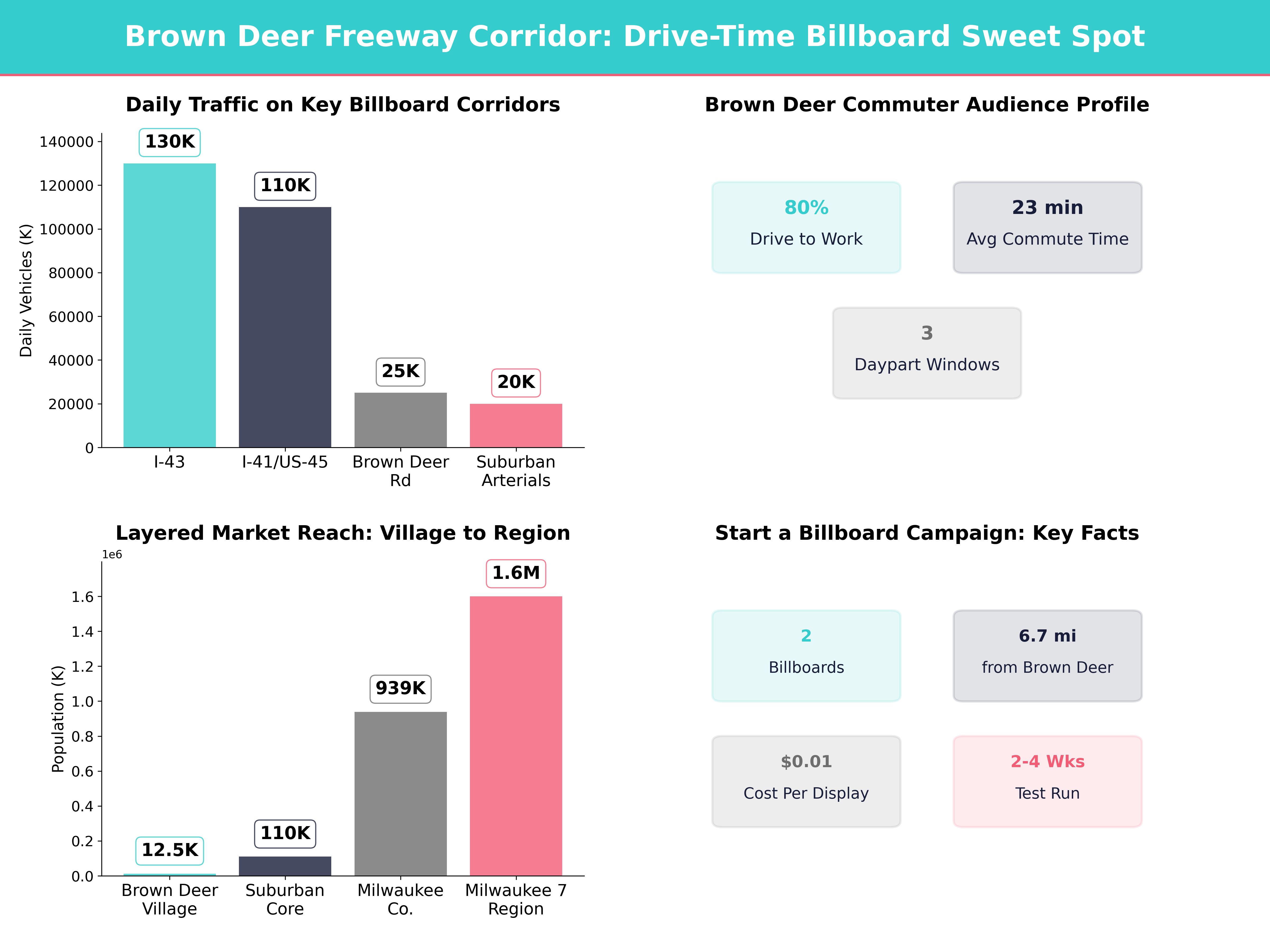
Brown Deer area market overview
Brown Deer’s position in the north metro economy
The Brown Deer area benefits from being close to several different kinds of demand at once. It is connected to suburban households, office and industrial employment, healthcare trips, school traffic, and retail movement between the North Shore and the western suburbs. That combination matters because billboard campaigns near Brown Deer do not depend on a single neighborhood shopping district. They can speak to a broader north-metro audience that moves across municipal lines every day.
The scale of that reachable market is meaningful. Milwaukee County 939,489 residents, and the wider Milwaukee 7 Regional Partnership 1.6 million people across southeastern Wisconsin, including roughly 110,000 residents in the immediate nearby suburban core. Around Brown Deer, nearby communities add substantial household density of their own, including Menomonee Falls at about 38,500 residents, Mequon at about 25,100, Glendale at about 13,300, and Germantown at about 20,900. When we advertise near Brown Deer, we are often reaching decision-makers who live in one suburb, work in another, and shop across the whole northern side of metro Milwaukee.
This regional positioning also creates flexibility by category. Healthcare groups, colleges, restaurants, auto dealers, banks, home-service companies, and employers all benefit from cross-suburban traffic. A campaign serving the Brown Deer area can target local awareness, but it can also support customer acquisition across a much wider service radius.
Demographics, commuting, and economic context near Brown Deer
The Brown Deer area is part of a diversified regional economy shaped by manufacturing, healthcare, logistics, education, retail, and professional services. Regional planning from SEWRPC and economic development work from Milwaukee 7 7-county regional footprint. That is useful for billboard strategy because many trips near Brown Deer are purposeful and recurring, not purely discretionary.
From a commuting perspective, this is still a strongly car-oriented market. Recent ACS patterns typically place commuting by car, truck, or van at more than 4 out of 5 workers in both the Brown Deer area and Milwaukee County overall. Average one-way commute times generally fall in about the 22- to 24-minute range, or about 23 minutes, which is ideal for billboard visibility on suburban approaches and freeway connectors.
That commuting behavior supports several common advertising goals near Brown Deer:
- We can reach working adults during dependable weekday drive times.
- We can reach families during after-school, errand, and weekend shopping trips.
- We can reach students and young professionals moving between campuses, apartments, and part-time jobs.
- We can reach north-suburban residents who may live near Brown Deer, but spend money across Glendale, Mequon, Menomonee Falls, and greater Milwaukee.
Key traffic corridors serving the Brown Deer area
North-south freeway routes near Brown Deer
When we plan roadside advertising serving the Brown Deer area, the first corridors we look at are the major north-south freeways. Traffic count maps from the Wisconsin Department of Transportation regularly show that I-43 near Brown Deer Road carries roughly 120,000 to 140,000 vehicles per day on key segments. That makes I-43 one of the most important routes for reaching drivers traveling between downtown Milwaukee, Glendale, the North Shore, and northern suburban communities.
The second major corridor is I-41/US 45, which is especially important for the western side of the Brown Deer market. WisDOT counts on nearby segments commonly land around 100,000 to 120,000 vehicles per day. Because our two digital billboards serving the Brown Deer area are located in Menomonee Falls, this corridor is especially relevant. It helps us connect with drivers moving between Menomonee Falls, Germantown, Waukesha County, and the broader north Milwaukee suburban trade area.
These north-south routes matter for more than pure volume. They carry repeat traffic. That repetition supports brand recall, short promotional messages, recruiting campaigns, and appointment-based services that benefit from multiple exposures across the same workweek.
East-west connectors and suburban arterials near Brown Deer
Freeways create scale, but east-west connectors create local intent. Brown Deer Road is the signature east-west route serving the Brown Deer area, and busier segments often carry about 20,000 to 30,000 vehicles per day. Brown Deer Road links residential neighborhoods, retail pockets, freeway access points, and cross-suburban trips. It also functions as a practical bridge between I-43 traffic on the east side and western suburban traffic heading toward Menomonee Falls and beyond.
Other useful supporting routes include Port Washington Road, WIS 100, Appleton Avenue, and county-line connectors that tie Brown Deer-area travel to Menomonee Falls and Germantown. Depending on the segment, these arterials frequently run in the 15,000 to 25,000 vehicles per day range, while portions of Appleton Avenue near Menomonee Falls often exceed 20,000 daily vehicles.
For advertisers, that means the Brown Deer market is not limited to one inbound path. We can reach it through several overlapping travel behaviors:
- Commuters heading north and south on I-43.
- West-side suburban drivers using I-41/US 45.
- Shoppers and service users moving east-west on Brown Deer Road.
- Household errand traffic connecting retail, schools, healthcare, and dining destinations.
Because our nearby inventory sits in Menomonee Falls, it is particularly effective for campaigns that want to capture the western approach to the Brown Deer area and the broader northern suburban commute shed.
Brown Deer area audience segments
Commuters and household decision-makers near Brown Deer
The most dependable audience serving the Brown Deer area is the daily commuter. This includes residents of Brown Deer, Glendale, Mequon, Menomonee Falls, Germantown, and adjacent communities who drive to jobs, schools, appointments, and retail destinations throughout the week. Since more than 80% of workers in the market commute by car, truck, or van, roadside messaging remains a strong fit.
For many local and regional businesses, these commuters are also household decision-makers. They choose healthcare providers, banks, restaurants, grocery options, home-improvement vendors, and family entertainment. They also respond well to messages built around convenience, trust, timing, and proximity.
This segment is especially valuable for categories such as:
- Healthcare and urgent care.
- Home services, including HVAC, roofing, plumbing, and remodeling.
- Banks, insurance firms, and legal services.
- Auto dealers, repair shops, and tire stores.
- Restaurants and retail with strong commuter-hour appeal.
- Employers recruiting for hourly, skilled-trade, or professional roles.
Students, families, and regional visitors serving the Brown Deer market
The Brown Deer area also benefits from access to major education and recreation audiences. The University of Wisconsin-Milwaukee enrolls about 23,000 students, Milwaukee Area Technical College serves more than 30,000 students annually, and Concordia University Wisconsin in Mequon enrolls roughly 5,000 students. Those students create recurring traffic for housing, food, retail, healthcare, banking, and entertainment brands.
Families are another important audience. The Brown Deer School District and surrounding North Shore and suburban districts create predictable back-to-school and after-school movement. Household-oriented campaigns near Brown Deer often perform best when they emphasize convenience, family value, and trusted local service.
Regional leisure traffic adds another layer. Milwaukee County Parks 150 parks and parkways, and Brown Deer Park Golf Course 18-hole destination. Nearby shopping and dining destinations, including The Bayshore, also pull regular traffic from the same suburban audience we want to reach.
Visitors matter too, even when they are not staying near Brown Deer itself. Visit Milwaukee promotes a regional tourism economy built around festivals, sports, conventions, lakefront attractions, and neighborhood dining. Many of those visitors move through the same freeway network that serves the Brown Deer area.
Seasonal and timing opportunities near Brown Deer
Spring and summer timing near Brown Deer
Late spring through summer is one of the strongest advertising windows near Brown Deer. Warmer weather increases retail trips, home-improvement projects, restaurant visits, golf outings, and family recreation. It also brings more discretionary driving, which is useful for brands that want to build awareness rather than capture only strict commute traffic.
The Milwaukee event calendar strengthens summer reach. Summerfest runs for 9 days, Wisconsin State Fair runs for 11 days, and the Milwaukee Brewers host 81 regular-season home games at American Family Field. Even when those events are not next door to Brown Deer, they increase regional driving and expand the number of people circulating through the metro.
For campaigns serving the Brown Deer area, spring and summer are especially strong for:
- Home services, because roofing, landscaping, remodeling, and exterior work ramp up.
- Healthcare and dental promotions, because families often schedule appointments during school breaks.
- Restaurants, events, and retail, because weekend movement increases.
- Colleges and employers, because recruiting for fall starts often begins in summer.
We also like summer for geographically themed creative. Messaging that references North Shore convenience, local recreation, golf, patio season, or easy suburban access tends to feel more relevant than generic citywide branding.
Fall and winter timing near Brown Deer
Fall is the reset season for the Brown Deer market. Back-to-school activity starts in late July, accelerates through August, and continues into September as K-12 districts and colleges settle back into routine. That makes late summer and early fall strong for healthcare, tutoring, restaurants, banking, fitness, wireless plans, and student-focused housing or retail.
Sports also keep the market active after summer ends. The Milwaukee Bucks 41 regular-season home games at Fiserv Forum, and college activity remains strong throughout the academic year. Those event-driven trips keep the metro moving even as outdoor tourism slows.
Winter shifts the message mix, not the value of the medium. In Wisconsin, winter conditions make urgency and practicality more powerful. We often see stronger creative resonance for snow removal, heating service, tire and battery offers, healthcare access, insurance, tax preparation, and holiday retail. Shorter daylight hours also help bright digital displays stand out during late afternoon and early evening commutes.
For many brands serving the Brown Deer area, the most efficient timing windows by season look like this:
- 6:00 a.m. to 9:00 a.m. for commuter-heavy weekday awareness.
- 11:00 a.m. to 2:00 p.m. for lunch, errands, and service calls.
- 3:30 p.m. to 6:30 p.m. for after-work and family decision-making.
- Thursday through Sunday for retail, dining, and entertainment pushes.
Billboard design tips for advertisers near Brown Deer
Creative choices that fit the Brown Deer-area geography
The Brown Deer market responds best to clarity. This is a suburban driving environment where people are moving with purpose, so our creative should be easy to absorb in a glance. We usually recommend headlines of about 6 to 8 words, one strong visual, and one clear call to action.
Local geography should influence color and contrast. Wisconsin skies can be gray for long stretches in fall and winter, and leafy suburban corridors can visually soften low-contrast creative in spring and summer. High-contrast combinations, such as dark blue with white, black with yellow, or red with white, tend to read well year-round.
Imagery should feel like the north Milwaukee suburbs rather than generic national stock. Campaigns near Brown Deer often work better when they show:
- Real homes, local storefronts, clinics, or vehicles.
- Family-oriented and commuter-oriented visuals.
- Seasonal cues that match Wisconsin weather.
- Straightforward offers rather than abstract brand concepts.
If we want to localize without clutter, we can reference recognizable place cues such as the North Shore, Menomonee Falls, Mequon, Brown Deer Road, or I-43 access. That kind of specificity signals relevance without requiring too much copy.
Messaging that resonates with audiences serving Brown Deer
The Brown Deer area blends practical suburban purchasing with regional mobility, so the strongest messages usually emphasize one of four things: convenience, trust, savings, or immediacy. A strong billboard near Brown Deer might promote “Same-Day Appointments,” “Now Hiring,” “Minutes Away,” or “Free Estimate This Week.”
We also recommend matching the message to the trip type:
- For commuter audiences, we should use fast, decisive wording.
- For families, we should emphasize reliability, safety, or value.
- For students, we should spotlight affordability, speed, or flexibility.
- For higher-consideration services, we should lead with credibility and a simple next step.
Digital billboards also give us room to rotate seasonal creative. We can run one message in January for heating service, another in April for spring cleanup, and another in August for back-to-school or fall recruitment, all without redesigning an entire static buy.
Regional strategies near Brown Deer
Using Menomonee Falls inventory to reach the Brown Deer area
Because our inventory serving the Brown Deer area is concentrated in nearby Menomonee Falls 6.7 miles from Brown Deer, so the screens are close enough to capture relevant suburban movement while still offering strong traffic volume.
This west-side positioning is particularly useful for:
- Brands drawing customers from Menomonee Falls, Germantown, and northwest Milwaukee County.
- Employers recruiting from a wider labor pool.
- Healthcare systems serving patients across multiple suburbs.
- Retailers and service businesses that want area-wide visibility rather than hyperlocal walk-in traffic.
If our goal is broad awareness serving the Brown Deer area, using both nearby screens can help us build frequency with repeat drivers.
North Shore, retail, and service-area strategy near Brown Deer
The Brown Deer market is also influenced by the North Shore and east-side retail flows. People serving Brown Deer often shop, dine, or seek services across Glendale, Mequon, and nearby commercial corridors. That makes the market well suited to campaigns that define a service area instead of one tiny map pin.
For example, we can use billboard copy to signal that we serve:
- The Brown Deer area and North Shore households.
- North suburban commuters heading to or from Milwaukee.
- Families shopping near The Bayshore or other retail hubs.
- Patients, diners, or customers willing to travel 10 to 20 minutes for the right option.
That last point is important. In suburban Milwaukee, a 10- to 20-minute drive often feels normal for healthcare, specialty retail, dining, or family services. That gives advertisers more flexibility than they sometimes expect.
Category-by-category tactics near Brown Deer
Different business types should use the market differently.
Healthcare brands should prioritize weekday commute windows, trust-driven creative, and practical calls to action such as appointments, urgent care, imaging, primary care, or specialty access.
Home-service companies should lean on seasonality and urgency. Spring storms, summer exterior work, fall maintenance, and winter heating issues all create timely reasons to advertise near Brown Deer.
Retail and restaurant brands should push evenings and weekends, especially from Thursday through Sunday, with simple offers, new openings, limited-time promotions, or recognizable location cues.
Employers should run longer recruiting flights. Repetition matters for hiring, especially when we want to reach skilled trades, warehouse workers, healthcare staff, or office candidates who are already driving the corridor every day.
Using Blip tools for the Brown Deer area
Timing, budget, and creative testing near Brown Deer
Blip works well for the Brown Deer market because we do not need to buy the whole month, the whole day, or the whole board to make an impact. We can focus our budget on the hours and days that line up with actual local behavior. That is especially useful when our nearby inventory is limited to 2 digital billboards and we want each dollar to work harder.
A few Blip capabilities matter most here:
- We can choose billboard locations on a map and concentrate on the Menomonee Falls screens serving the Brown Deer area.
- We can daypart around commute windows, lunch traffic, or weekend retail movement.
- We can test more than one creative theme and shift budget toward the best performer.
- We can use flexible budgeting instead of locking ourselves into a rigid long-term package.
Because each blip is a 7.5- to 10-second display, clarity is essential. Because pricing starts at $0.01 per display, we can also test the market without overcommitting.
Flexibility for seasonal and local campaigns near Brown Deer
The Brown Deer area rewards nimble advertising. Weather changes, school calendars shift, sports seasons overlap, and consumer behavior looks different in January than it does in July. Blip helps us adapt quickly.
That flexibility is useful when we want to:
- Add spend around festival weekends, sports dates, or holiday shopping.
- Swap creative to match snow, storms, heat, or seasonal promotions.
- Pause a campaign after an event ends.
- Increase visibility for a hiring push, product launch, or grand opening.
- Compare commute-heavy scheduling against all-day awareness.
We also get real-time reporting, which helps us judge whether a campaign is delivering enough exposure during the specific windows we care about.
Getting started with billboard rental near Brown Deer
What to expect when we rent billboards serving the Brown Deer area
Renting a billboard near Brown Deer is much simpler on Blip than through a traditional billboard process. Traditional outdoor buying often involves back-and-forth sales conversations, fixed multi-week commitments, and less flexibility once the campaign starts. With Blip, we can choose the available digital locations serving the Brown Deer area, set a daily budget, upload artwork, pick our timing, and adjust as performance data comes in.
For this market, we should start with a simple reality check. There are 2 nearby digital billboards serving Brown Deer, and both are in Menomonee Falls. That means location selection is straightforward. The bigger strategic question is not which of dozens of boards to choose. The bigger question is which audience movement we want to prioritize, such as west-side commuters, area-wide awareness, retail traffic, or recruiting visibility.
How we evaluate the right billboard fit near Brown Deer
When we launch a campaign serving the Brown Deer area, we recommend this sequence:
- We define the main goal first. That goal might be awareness, store traffic, appointment booking, event attendance, or hiring.
- We match the goal to the dominant route. A commuter campaign should emphasize rush hours, while a restaurant or retail campaign may need evenings and weekends.
- We start with clean, short creative. A headline, a logo, and one action step usually outperform crowded layouts.
- We run long enough to judge repetition. A test period of 2 to 4 weeks is often long enough to see whether timing, messaging, and budget are aligned.
- We review analytics and optimize. If one time block is outperforming another, we shift spend instead of waiting for a contract term to end.
We should also judge each location by practical fit, not just by raw traffic. A board with strong volume is useful, but a board positioned along the actual travel path of our audience is usually more valuable. For the Brown Deer market, that often means prioritizing routes tied to Menomonee Falls, I-41/US 45, Brown Deer Road connections, and broader north-suburban commuting patterns.
The best starting campaigns near Brown Deer are usually the simplest ones. We take a strong local offer, a readable design, a focused schedule, and the nearby Menomonee Falls digital inventory, then let data guide the next move. That approach gives us a realistic, efficient way to build visibility serving the Brown Deer area without the friction that usually comes with traditional billboard rental.