Billboards in Windsor, WI
No Minimum Spend. No Long-Term Contracts. Just Results.
Trusted by Leading Brands


Billboard advertising
in Windsor has never been easier
How much is a billboard in Windsor?
Why Choose Blip for Billboard Advertising in Windsor
-
Blip makes Windsor, Wisconsin billboards easy to launch on I-39/90/94 or U.S. 51, reaching commuters and interstate travelers in minutes.
-
Set flexible daily budgets in Windsor, Wisconsin and pay only when ads play—ideal for testing local routes without long commitments.
-
Use dayparting in Windsor, Wisconsin to hit Madison commuters, airport traffic, and Friday northbound travelers at the right time.
-
Blip's real-time analytics help Windsor, Wisconsin advertisers see what works on WIS 19, then shift spend fast.
-
Upload and tweak creative fast with Blip in Windsor, Wisconsin, so winter service offers or UW game-day promos stay fresh.
Frequently Asked Questions About Billboard Advertising in Windsor
How much does a billboard cost in Windsor, Wisconsin with Blip?
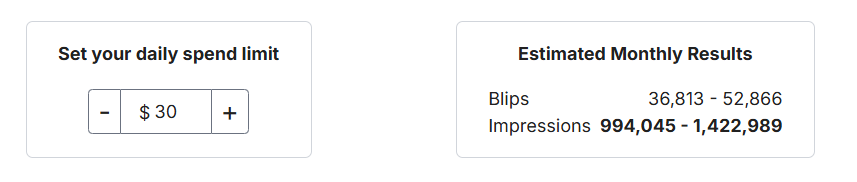
With Blip, billboard advertising in Windsor can be surprisingly affordable because you only pay when your ad actually appears. Each “blip” is a 7.5-to-10-second display on a rotating digital billboard, and pricing starts at just $0.01 per display. Cost per blip changes based on time of day, location, and advertiser demand, so you stay in control while still reaching local viewers.
Where can I advertise with Blip in Windsor, Wisconsin?
Windsor, Wisconsin is a strong billboard market because we can reach north Dane County residents, Madison-area commuters, and interstate travelers from one strategically placed geography. Windsor sits where local household traffic meets the larger pull of Madison, Sun Prairie, and the I-39/90/94 corridor. Most purchase-oriented trips in this area still happen by car, especially along the interstate, U.S. 51, and WIS 19, so outdoor ads can build frequency instead of relying on one-time exposure.
Why is Windsor, Wisconsin a good market for billboard advertising with Blip?
Windsor works best when we think of it as a gateway market rather than an isolated village. The immediate local audience is smaller than Madison’s, but the commercial reach is larger because Windsor sits inside one of Wisconsin’s fastest-growing counties and along one of its most important freight and commuter routes. For billboard advertisers, that combination creates a useful mix of repetition, household income, and regional mobility.
What roads in Windsor, Wisconsin get the most traffic for billboard ads?
According to count maps from the Wisconsin Department of Transportation, key segments of I-39/90/94 in the Windsor-Madison-DeForest area generally fall in the 70,000 to 90,000 AADT range. Heavier segments of U.S. 51 commonly run around 20,000 to 30,000 AADT, while busier stretches of WIS 19 are often in the 10,000 to 15,000 AADT range. Many Windsor advertisers should also think beyond the village itself, because U.S. 151 on the Madison east side commonly carries about 50,000 to 70,000 vehicles per day.
When is the best time to run Blip billboard ads in Windsor, Wisconsin?
Spring is a prime activation window for home services, healthcare, landscaping, real estate, and family retail. For commuter-heavy campaigns, we often start with 6:00 to 9:00 a.m., 11:00 a.m. to 1:00 p.m., and 3:00 to 7:00 p.m. windows. Summer is also the best time to lean into northbound traveler behavior, and late August through October is one of Windsor’s strongest advertising windows.
Do I need a contract to advertise with Blip in Windsor?
No, Blip has no long-term contracts or minimum commitments. You can start, pause, or stop your campaign at any time.
How fast can I launch a billboard campaign with Blip in Windsor?
You can have your campaign live in minutes. Create a free account, select your locations, set your budget, upload your design, and start running once approved.
Where can I advertise with Blip in Windsor?
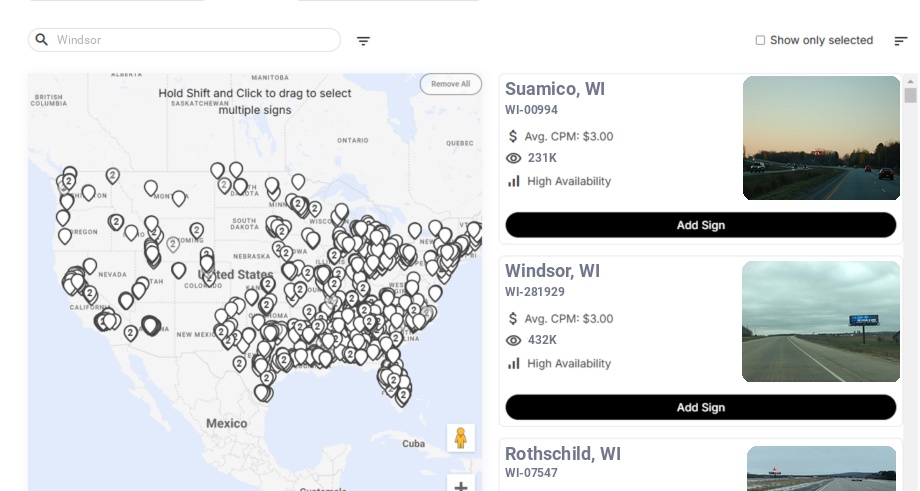
Blip has digital billboards in Windsor. You can browse available locations on a map, choose the ones that fit your audience, and start advertising right away.
Still have questions? Launch a campaign in minutes — no contracts, no commitments.
Start Your CampaignWindsor Billboard Advertising Guide
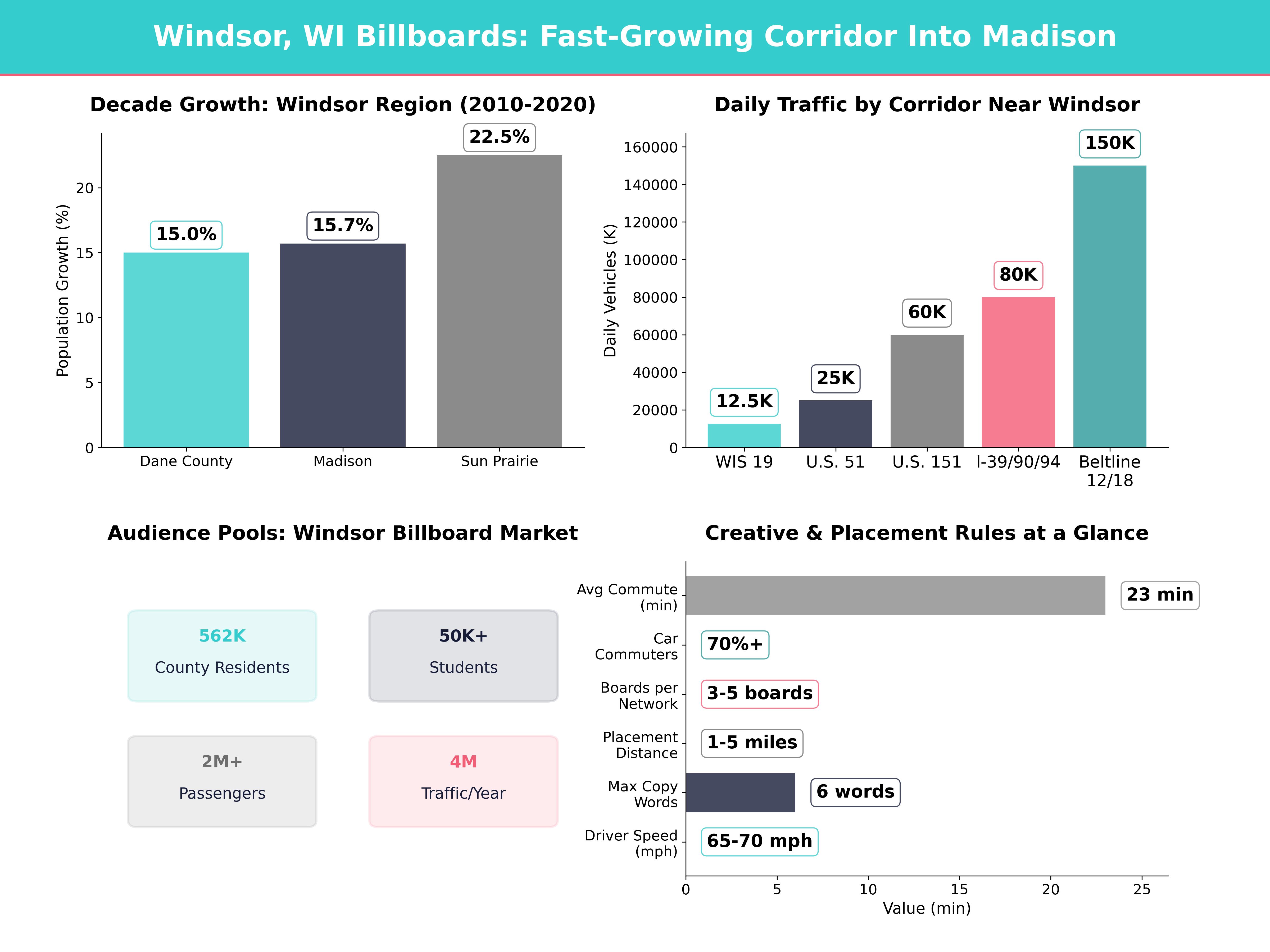
Windsor, Wisconsin is a strong billboard market because we can reach north Dane County residents, Madison-area commuters, and interstate travelers from one strategically placed geography. Dane County counted 561,504 residents in 2020, and Windsor sits where local household traffic meets the larger pull of Madison, Sun Prairie Destination Madison, the University of Wisconsin–Madison (more than 50,000 students), and Dane County Regional Airport (more than 2 million passengers in 2023).
Windsor Market Overview for Billboard Advertisers
Windsor works best when we think of it as a gateway market rather than an isolated village. The immediate local audience is smaller than Madison’s, but the commercial reach is larger because Windsor sits inside one of Wisconsin’s fastest-growing counties and along one of its most important freight and commuter routes. For billboard advertisers, that combination creates a useful mix of repetition, household income, and regional mobility.
Population growth and economic strength around Windsor
Dane County grew from 488,073 residents in 2010 to 561,504 in 2020. That was a gain of 73,431 people, or 15.0%, in a single decade. The City of Madison grew from 233,209 to 269,840 over the same period, which was an increase of 36,631 residents, or 15.7%. Nearby Sun Prairie 29,364 residents to 35,967, which was a gain of 6,603 people, or 22.5%.
Those numbers matter because Windsor sits between growing rooftops and growing job centers. The regional economy is anchored by durable employers and institutions such as UW–Madison, UW Health, Epic, Exact Sciences, American Family Insurance, and Wisconsin state government. Organizations such as the Madison Region Economic Partnership and the Greater Madison Chamber of Commerce
What mobility patterns mean for Windsor campaigns
Even in a county known for bikes, buses, and a walkable university core, daily life around Windsor remains road-centered. Recent community survey estimates show that more than 70% of Dane County workers commute in a car, truck, or van, and the average trip to work is about 23 minutes. That is long enough for repeated roadside exposure to matter, but short enough that route selection still reveals intent. A driver on U.S. 51 is often making a neighborhood decision, while a driver on I-39/90/94 may be making a regional one.
For advertisers, that means Windsor is unusually flexible. We can use it for pure awareness, especially when we want north-south interstate reach, or for high-intent local capture when we want nearby families, homeowners, and service buyers. We can also extend from Windsor into the broader Madison metro without losing the suburban and commuter audience that often converts best for healthcare, auto, home services, education, retail, and restaurants.
Key Traffic Corridors for Windsor Billboard Campaigns
Windsor’s travel patterns are defined by a few high-value corridors. When we understand which roads carry through-traffic and which roads carry local decision-makers, we can match billboard placement to advertiser goals instead of buying visibility for visibility’s sake.
Interstate 39/90/94 through Windsor
According to count maps from the Wisconsin Department of Transportation, key segments of I-39/90/94 in the Windsor-Madison- DeForest 70,000 to 90,000 AADT range. This is the market’s broad-reach backbone. It carries daily commuters into Madison, truck traffic moving through south-central Wisconsin, airport-bound drivers, and weekend leisure travelers heading north toward the Wisconsin Dells.
This corridor is especially strong for several advertiser categories. Regional retail and auto dealers benefit because the interstate delivers reach across multiple north and east Dane County communities. Hospitals, urgent care systems, and specialty clinics benefit because drivers on this route are often traveling to major destinations rather than browsing locally. Attractions, hotels, restaurants, and travel brands benefit because Friday afternoon northbound traffic and Sunday southbound traffic often carry leisure intent.
U.S. 51 and the DeForest-Windsor spine
U.S. 51 is a different kind of billboard environment. Heavier segments in the DeForest-Windsor trade area commonly run around 20,000 to 30,000 AADT, which is far lower than the interstate but usually much higher in local intent. This is where we can reach people who live nearby, work nearby, or are completing everyday errands rather than passing through the region.
That makes U.S. 51 a strong fit for home services, because homeowners on repeat routes respond well to familiarity and urgency. It also fits local restaurants, banks, childcare providers, and fitness brands, because these categories rely on proximity and frequency. Additionally, it fits real estate, senior living, and medical practices, because these buyers often need several reminders before acting.
WIS 19 and local east-west movement in Windsor
WIS 19 is one of Windsor’s most useful local connectors. On busier stretches near village activity and interstate access, traffic is often in the 10,000 to 15,000 AADT range. That is not mass-market volume, but it is exactly the kind of road that matters for service businesses, neighborhood retail, schools, and new-housing-oriented campaigns.
We usually like WIS 19 when we want to influence people close to the decision point. A board on or near this corridor can help a daycare fill openings, a grocery store announce a new location, or a contractor stay top of mind in fast-growing subdivisions. It also works well for campaigns that need message specificity, such as “Next Right,” “Open Late,” or “Near Windsor Crossing,” because the audience is geographically concentrated.
U.S. 151 and the Madison east-side extension
Many Windsor advertisers should also think beyond the village itself. On the Madison east side and through the Sun Prairie approach, U.S. 151 commonly carries about 50,000 to 70,000 vehicles per day on major segments. If we want scale beyond north Dane County, that corridor connects Windsor-oriented advertising with one of the region’s fastest-growing suburban audiences.
From there, we can extend to the Madison Beltline, where some U.S. 12/18 segments exceed 120,000 vehicles per day and the busiest sections top 150,000. Those boards are less “Windsor local,” but they are highly useful when our actual customer base spans the whole metro. We often use this extension for hospitals, universities, legal services, events, insurance, and brands that need broad Madison awareness while still maintaining a north-side presence.
Audience Segments We Can Reach in Windsor
Windsor succeeds as an outdoor market because several valuable audiences overlap here. We are not limited to one type of driver.
Windsor commuters, homeowners, and household decision-makers
The first audience is the everyday commuter household. These drivers live in Windsor, DeForest, Sun Prairie, Waunakee 73,431 residents between 2010 and 2020, and nearby Sun Prairie added 6,603, the pool of local households using these roads is materially larger than it was a decade ago.
This audience matters most for advertisers selling recurring or high-consideration services. Home improvement, HVAC, plumbing, roofing, healthcare, banking, grocery, legal services, and child-focused brands all benefit from the kind of repeated exposure Windsor roads provide. If the offer is relevant to families managing a busy week, Windsor is a useful place to show up.
Students, faculty, and early-career professionals near Windsor
The Madison region also gives us access to a large education-driven audience. UW–Madison enrolls more than 50,000 students, and it brings in faculty, staff, visiting families, and alumni throughout the year. Even though campus is not in Windsor, the north and east approaches to Madison capture a meaningful share of student and university-related travel, especially at the start of semesters, on game weekends, and during apartment-turn season.
This audience is especially relevant for apartments, furniture, telecom, food delivery, healthcare, entertainment, financial services, and regional employers recruiting young professionals. Windsor is not where we would run only for campus nightlife, but it is very effective when we want to intercept the broader student-and-family travel pattern before it disperses.
Airport travelers, eventgoers, and leisure visitors in the Windsor area
Travel-oriented audiences are another major advantage. Dane County Regional Airport handled more than 2 million passengers in 2023, and it sits on the northeast side of Madison, which makes Windsor-area routes highly relevant for airport hotels, parking, rental cars, healthcare systems, visitor attractions, and business services.
Event traffic also matters. World Dairy Expo at the Alliant Energy Center draws nearly 50,000 attendees over 5 days each fall, and that influx includes both in-state and out-of-state travelers. For broader leisure marketing, northbound drivers toward the Wisconsin Dells are valuable too, especially because the Dells market draws roughly 4 million visitors a year. Windsor sits on a corridor where business travel, event travel, and vacation travel can all be reached with the right timing.
Seasonal and Timing Opportunities for Windsor Billboards
Windsor is not a flat, same-every-month market. Traffic purpose changes with school calendars, Badger sports, tourism, and weather. When we time campaigns to those patterns, we usually get better efficiency.
Spring and summer timing in Windsor
Spring is a prime activation window for home services, healthcare, landscaping, real estate, and family retail. School districts such as the DeForest Area School District, the Sun Prairie Area School District, the Waunakee Community School District, and the Madison Metropolitan School District move into spring break and end-of-year routines that shift family travel patterns toward shopping, activities, and appointments.
By July, average highs in Madison are about 82°F, and sunset in late June stays after 8:30 p.m. Longer evenings support restaurant, entertainment, travel, and retail campaigns because drivers are still out well after work. We usually like commuter-heavy dayparts for local services from 6:00 to 9:00 a.m. and 3:00 to 7:00 p.m., then broader leisure exposure from Friday noon through Sunday evening.
Summer is also the best time to lean into northbound traveler behavior. If we are promoting attractions, convenience retail, restaurants, hotels, or travel services, Windsor’s interstate access becomes especially valuable from Memorial Day through Labor Day.
Fall and winter timing in Windsor
Late August through October is one of Windsor’s strongest advertising windows. Back-to-school traffic returns, apartment and household moves continue, and Wisconsin football brings 6 or 7 home Saturdays in many seasons. That lift combines well with state-government activity, convention traffic, and seasonal events in Madison.
Early October adds a particularly strong B2B and agricultural opportunity through World Dairy Expo, which packs 5 days of concentrated event traffic into the market. For advertisers in equipment, ag finance, insurance, hotels, dining, or trade services, that short run can justify a tightly targeted burst.
Winter changes both the audience and the creative requirements. In January, Madison’s average high is about 28°F, and sunset arrives before 4:30 p.m. near the solstice. That means we usually want higher contrast, more urgency, and earlier dayparting. Holiday retail campaigns should rise in November, service businesses should stay visible during weather-related needs, and healthcare, auto repair, tire, battery, tax, and legal advertisers can all benefit from winter reminder frequency. School calendars also typically include about 2 weeks of winter break and about 1 week of spring break, which changes weekday commuter volume and family movement.
Billboard Design Tips for the Windsor Market
Creative that works in Windsor usually feels practical, local, and immediately useful. We are speaking to a mix of suburban families, professionals, airport users, university households, and Wisconsin road-trippers, so the strongest creative is clear enough for speed but grounded enough to feel relevant.
Creative themes that fit Windsor and north Dane County
We usually see Windsor ads perform better when they reflect the region’s mix of growth and familiarity. This is a market where modern apartments, biotech jobs, logistics traffic, farmland edges, and youth sports families all coexist. Creative that references convenience, reliability, value, and regional identity often feels more natural than abstract brand poetry.
Strong local cues can include neighborhood accessibility, outdoor recreation, airport convenience, game-day energy, fresh food, or winter reliability. For example, a restaurant can lean into “North of Madison,” “Easy Off I-39/90/94,” or “Family Dinner Tonight,” while a medical advertiser can lean into “Same-Day Care” or “Near MSN Airport.” Because the Madison area is highly educated and comparison-oriented, proof-point copy often works well. Clear claims such as hours, proximity, availability, or a specific offer usually outperform vague slogans.
Creative built for Windsor’s fast roads and long winters
Many Windsor impressions happen on roads where drivers are moving 65 to 70 mph, especially on the interstate network. Because of that, we should usually keep copy to 6 words or fewer, present 1 offer, and ask for 1 action. A board that tries to tell a full story will lose to one that states a single memorable benefit.
Color choices should also reflect the local environment. In winter, dark afternoons, snow glare, and gray skies reward strong contrast, such as white or warm yellow on navy, black, or deep green. In summer, brighter blues and greens can work well because they match travel, lake, and outdoor-season cues. We also generally prefer bold directional language in Windsor, because many drivers are making route-based decisions. “Next Exit,” “Minutes Away,” and “Near the Airport” feel useful here in a way they might not in a denser downtown setting.
Regional Strategies Around Windsor
The best Windsor campaigns usually combine local precision with regional awareness. We do not need to treat every nearby area the same.
Windsor, DeForest, and Waunakee for high-intent local demand
When our goal is direct response from nearby households, we usually prioritize Windsor, DeForest, and Waunakee 5 to 10 miles of the storefront often matters more than a high-profile placement deeper in Madison.
This submarket is where frequency pays off. The same driver may see the same route several times a week, which is exactly what local brands need when they are trying to own a category or become the default option.
Sun Prairie, the airport district, and Madison’s east side for scale
If we want more volume, the eastward strategy matters. Sun Prairie 22.5% population growth in the last full census decade, and the airport district gives us access to both residents and visitors. Boards serving this zone are strong for retail, healthcare systems, employers, colleges, hotels, entertainment, and brands that need wider north-and-east-side awareness.
This is also a good place to speak to people before they choose between destinations. A family may still be deciding where to eat, shop, or book services while driving through the east-side network. That makes the area useful for competitive messaging and limited-time offers.
Downtown Madison, Alliant, and event routes for broader regional awareness
For some advertisers, Windsor should be the northern anchor, not the whole plan. If the service area covers the full county, we often extend into downtown Madison, the Monona Terrace convention area, the Alliant Energy Center, and major university approaches. That strategy works particularly well for hospitals, colleges, legal services, financial brands, major retailers, and high-profile events.
A 3-to-5-board regional network can often outperform one premium board because it creates reach across multiple trip types. We can use Windsor for northbound and commuter repetition, then add east-side or central-city boards for event, campus, and government traffic.
Using Blip Tools Effectively in Windsor
Blip is especially useful in Windsor because this market has overlapping audiences that peak at different times of day and in different seasons. We can apply Blip’s tools to those local patterns instead of buying a static schedule.
Using Blip budgets and dayparts in Windsor
In Windsor, dayparting is not just a nice extra. It is usually one of the easiest ways to improve relevance. For commuter-heavy campaigns, we often start with 6:00 to 9:00 a.m., 11:00 a.m. to 1:00 p.m., and 3:00 to 7:00 p.m. windows. For travel, dining, and entertainment, we usually add Friday noon through Sunday evening. For airport-related campaigns, we often emphasize early mornings, late afternoons, and event weekends.
Flexible budgeting also helps in a market where demand shifts quickly. We can push harder during Badger home games, World Dairy Expo week, summer tourist weekends, or back-to-school season, then scale back when traffic quality is lower. That keeps Windsor campaigns aligned with actual local movement rather than a fixed monthly buy.
Using analytics and creative testing to refine Windsor campaigns
Windsor is a good market for creative testing because the audiences are distinct enough to compare. We can run 2 or 3 versions of a message, such as one aimed at local families, one aimed at interstate travelers, and one aimed at airport users, then watch which placements and time blocks deliver the best response.
We can also update creative by season. A roofing company can pivot from storm repair to insulation. A clinic can pivot from sports physicals to flu shots. A restaurant can switch from game-day traffic to holiday catering. Real-time reporting helps us decide whether to concentrate spend on interstate reach, local-route repetition, or a blended Windsor-plus-Madison strategy.
Getting Started with Billboard Rental in Windsor
Renting a billboard in Windsor is easiest when we start with the customer’s route, not the map alone. This area can function as a local village market, a suburban Madison market, or a statewide travel corridor depending on where the board sits.
How to evaluate Windsor billboard locations
When we choose locations around Windsor, we should ask a few practical questions first. Those questions help us sort whether a Windsor board should behave like a neighborhood reminder, a commuter billboard, or a regional awareness asset.
- If our goal is local store traffic, we should prioritize boards that sit within about 1 to 5 miles of the destination.
- If our goal is broad awareness, we should prioritize I-39/90/94 or U.S. 151 faces with the heaviest circulation.
- If our service area covers multiple communities, we should consider a 3-to-5-board mix instead of relying on a single placement.
- If our business depends on staffed phones or appointments, we should weight budget toward the hours when customers can act immediately.
- If our audience is seasonal, we should match locations to the traffic pattern, such as commuter mornings, airport peaks, or weekend northbound travel.
What to expect when launching a Windsor billboard campaign
Traditional billboard buying around Madison can feel rigid because inventory is often packaged in long terms and broad market bundles. Windsor advertisers usually need more precision than that. A local dentist may only need DeForest and Windsor frequency. A regional hospital may need interstate reach plus east-side reinforcement. A restaurant may only care about Friday and Saturday dinner traffic.
That is where Blip simplifies the process. We can choose boards that match the routes our audience already drives, set budgets that fit the season, test different messages, and adjust quickly if one corridor outperforms another. We do not have to guess our way into a long commitment before we know whether Windsor should be treated as a village campaign, a north Dane County campaign, or part of a larger Madison network.
The best first step is simple. We identify the audience we value most, map the roads they already use, and choose Windsor-area boards that intersect those trips at the right time of day. When we do that well, billboard rental in Windsor becomes less about buying space and more about owning a route.