Billboards in Aberdeen, MD
No Minimum Spend. No Long-Term Contracts. Just Results.
Trusted by Leading Brands


Billboard advertising
in Aberdeen has never been easier



How much is a billboard in Aberdeen?
Why Choose Blip for Billboard Advertising in Aberdeen
-
Blip lets Aberdeen advertisers launch fast on I-95, U.S. 40, or MD 22 — no contracts, no minimums, just self-serve control.
-
Set a flexible budget in Aberdeen and reach APG workers, commuters, and sports fans when it matters most.
-
Use dayparting on Blip to hit Aberdeen's 6-9 a.m. commute, lunch traffic, or IronBirds game nights.
-
Track Aberdeen campaign results in real time and shift spend between I-95 travelers and local Route 40 shoppers.
-
Blip's creative tools help Aberdeen ads stay bold and clear for fast-moving drivers near Exit 85 and APG routes.
Frequently Asked Questions About Billboard Advertising in Aberdeen
How much does a billboard cost in Aberdeen with Blip?
With Blip, the cost of billboard advertising in Aberdeen is built to fit your budget. You set a daily spend, and Blip’s algorithm uses it to bid on open ad slots for your rotating digital billboard ads. You only pay when your ad actually displays, with each 7.5-to-10-second “blip” starting at just $0.01 per display.
Where can I advertise with Blip in Aberdeen, Maryland?
Aberdeen’s main interchange sits at Exit 85, and core I-95 segments in the area typically carry roughly 90,000 to 110,000 vehicles per day. U.S. 40, or Pulaski Highway, is the workhorse local-commercial route, and Maryland Route 22 is one of the most strategically important commuter routes in the market. These roads let advertisers reach local residents, commuters, and travelers moving through the Mid-Atlantic corridor.
Why is Aberdeen a strong billboard market for Blip?
Aberdeen gives advertisers a strong billboard market because it combines a growing local population, heavy highway movement on nearby I-95 segments, and year-round demand tied to defense, logistics, retail, and sports tourism. The city counted 16,254 residents in the 2020 Census, and Harford County reached 260,924 residents in 2020. Aberdeen sits inside a broader trade area that supports both city and county audiences.
What kind of audience can Blip reach in Aberdeen?
Aberdeen supports both direct-response campaigns and long-term brand campaigns because it has recurring local demand, not just occasional visitor traffic. About 4 in 5 workers, or roughly 80%, drive alone to work, and typical commute times are around 30 minutes. That makes it ideal for repeated roadway exposure to commuters, residents, and regional travelers.
When is the best time to run billboard ads in Aberdeen?
From April through August, Aberdeen becomes especially attractive for family-oriented advertising because youth baseball travel, weekend tournaments, warm-weather dining, and regional leisure trips increase. The IronBirds season also adds a regular entertainment rhythm from roughly June through September. For most campaigns, the page recommends using dayparts like 6 a.m. to 9 a.m., 11 a.m. to 2 p.m., and 3 p.m. to 7 p.m. depending on the audience.
Do I need a contract to advertise with Blip in Aberdeen?
No, Blip has no long-term contracts or minimum commitments. You can start, pause, or stop your campaign at any time.
How fast can I launch a billboard campaign with Blip in Aberdeen?
You can have your campaign live in minutes. Create a free account, select your locations, set your budget, upload your design, and start running once approved.
Where can I advertise with Blip in Aberdeen?
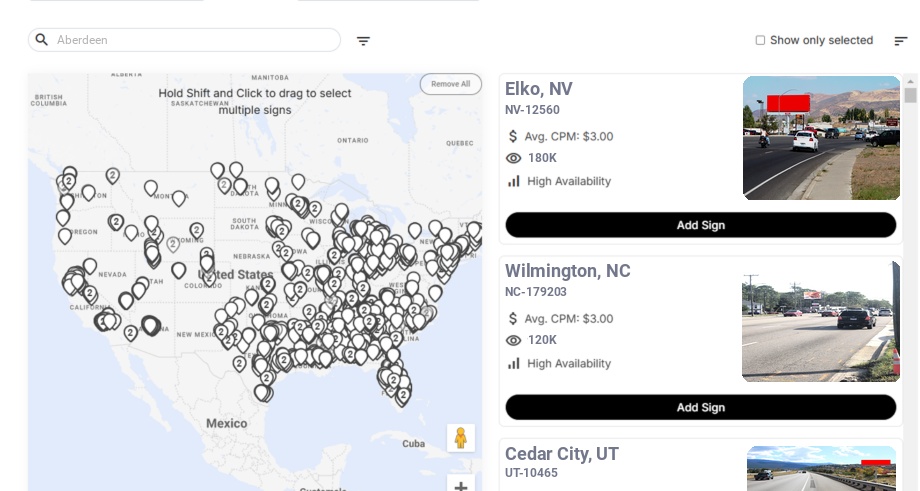
Blip has digital billboards in Aberdeen. You can browse available locations on a map, choose the ones that fit your audience, and start advertising right away.
Still have questions? Launch a campaign in minutes — no contracts, no commitments.
Start Your CampaignAberdeen Billboard Advertising Guide
Aberdeen 90,000 to 110,000 vehicles per day, and year-round demand tied to defense, logistics, retail, and sports tourism, including Aberdeen Proving Ground’s roughly 72,500-acre footprint and a baseball season with about 66 home dates. The city counted 16,254 residents in the 2020 Census, and it sits inside Harford County 260,924 residents in 2020, giving advertisers both a city audience and a broader county trade area.
We also benefit from Aberdeen’s position along Interstate 95, U.S. 40, and the routes feeding Aberdeen Proving Ground, because this is still a market where daily life happens largely by car. On top of that, Aberdeen sits roughly 35 miles northeast of Baltimore, and about 40 miles southwest of Wilmington
Aberdeen Market Overview
Aberdeen’s growth and local scale
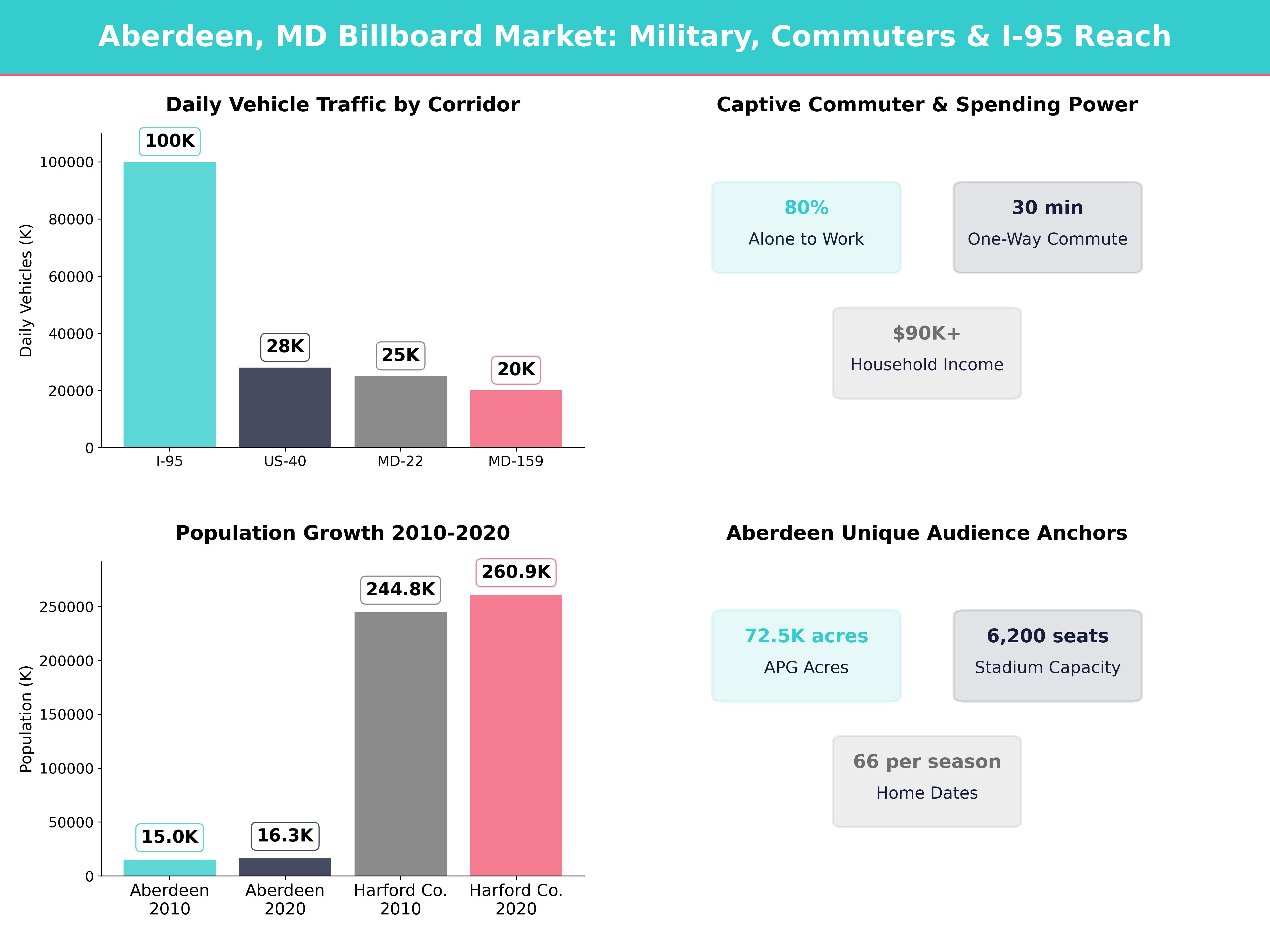
When we advertise in Aberdeen 14,959 residents in 2010 to 16,254 residents in 2020, which is an increase of about 8.7% over the decade. Over the same period, Harford County grew from 244,826 to 260,924, which is an increase of about 6.6%. Those figures matter because billboards work best where there is enough local density to support repeated exposure, but not so much media fragmentation that outdoor gets lost.
Aberdeen’s position in the county also makes it more valuable than its city population alone might suggest. The city functions as a gateway for residents from Havre de Grace, northern Harford County, eastern Harford County, and parts of nearby Cecil County. That means one well-placed digital board can reach people who live elsewhere, but shop, work, dine, or pass through Aberdeen regularly.
The economic base that supports recurring demand
Our outdoor strategy in Aberdeen is anchored by one dominant employment force: Aberdeen Proving Ground. The installation was established in 1917, spans about 72,500 acres, and includes roughly 21 miles of shoreline along the Chesapeake Bay region. We do not need every advertiser to be defense-related, but we do need to understand what that presence creates. It creates stable weekday traffic, contractor activity, technical hiring, lunchtime movement, and a large ecosystem of adjacent services that includes housing, healthcare, financial services, auto care, restaurants, and business support.
That economic mix is reinforced by local and regional institutions such as the Harford County Office of Economic Development Greater Aberdeen Committee Harford County Chamber of Commerce, and the Maryland Department of Commerce. For advertisers, the practical takeaway is simple. Aberdeen supports both direct-response campaigns and long-term brand campaigns because it has recurring local demand, not just occasional visitor traffic.
What mobility looks like in the Aberdeen area
Aberdeen remains highly car-oriented. County commute patterns consistently show that about 4 in 5 workers, or roughly 80%, drive alone to work, and typical commute times are around 30 minutes. Harford Transit LINK MARC Penn Line provide useful mobility options, but road travel is still the dominant behavior. That is exactly what billboard advertisers want, because repeated roadway exposure creates memory, familiarity, and action.
Harford County also has household income strength that supports discretionary spending. Median household income in the county is above $90,000, which is important for advertisers in home services, healthcare, finance, automotive, education, and family entertainment. In practical terms, Aberdeen gives us a working, driving, and relatively stable audience that is reachable many times per week.
Key Traffic Corridors for Aberdeen Billboards
Interstate 95 in Aberdeen
According to Maryland State Highway Administration traffic maps, I-95 is the dominant high-reach corridor for the Aberdeen market. Aberdeen’s main interchange sits at Exit 85, and core I-95 segments in the area typically carry roughly 90,000 to 110,000 vehicles per day. That level of volume makes I-95 the best fit for advertisers that need scale rather than hyperlocal precision.
We usually recommend Aberdeen-area I-95 boards for these categories:
- Quick-service restaurants, convenience retail, and fuel brands perform well because travelers make decisions quickly near exits and service clusters.
- Hotels, sports venues, and family attractions perform well because weekend visitors often need a near-term stop, stay, or activity.
- Regional healthcare, colleges, and major retailers perform well because the corridor reaches both local residents and travelers from outside Harford County.
- Auto dealers and financial institutions perform well because repeated regional exposure supports longer consideration cycles.
If our goal is awareness across Harford County and the broader northeast Maryland corridor, I-95 usually deserves first consideration.
U.S. 40 through Aberdeen
U.S. 40, or Pulaski Highway, is the workhorse local-commercial route. SHA count maps generally show Aberdeen-area U.S. 40 segments in the range of about 20,000 to 35,000 vehicles per day, depending on the exact segment. While that is lower than I-95, it often delivers better local relevance because drivers on U.S. 40 are closer to retail centers, restaurants, service businesses, and neighborhood decision points.
We like U.S. 40 placements when we want to reach:
- Local diners and shoppers, because they are already in a transaction-oriented mindset.
- Auto repair, tire, and parts businesses, because roadway context makes the message immediately relevant.
- Healthcare clinics, urgent care, and dental practices, because proximity matters for appointment-based services.
- Apartment communities and home services, because these categories benefit from frequent exposure to residents who travel the same route repeatedly.
In Aberdeen, U.S. 40 is often the best corridor for advertisers who need action from local households rather than broad pass-through reach.
Maryland Route 22 and the APG approach
Maryland Route 22, including the Aberdeen Thruway and Churchville Road approaches, is one of the most strategically important commuter routes in the market. On many segments near Aberdeen and the APG access pattern, traffic volumes are commonly around 20,000 to 30,000 vehicles per day. Those numbers matter less for pure scale and more for audience quality. This corridor is packed with weekday intent.
We typically use MD 22 for messages aimed at:
- Hiring campaigns, because the route reaches defense-related employees, contractors, skilled trades, and office workers.
- Business services, because decision-makers and working professionals travel this route repeatedly.
- Lunch, coffee, and after-work dining, because timing and proximity are critical on this corridor.
- Banks, insurance, and healthcare, because these categories benefit from steady weekday frequency and trust-building repetition.
If we want to speak to a working professional audience, MD 22 is usually more efficient than a purely traveler-focused board.
Maryland Route 159, Beards Hill Road, and local connectors
MD 159, or Bel Air Avenue, along with nearby commercial connectors such as Beards Hill Road, gives us access to Aberdeen’s everyday local audience. MD 159 traffic is commonly in the range of 15,000 to 25,000 vehicles per day on busier local segments. This is where we find the strongest household orientation.
These roads are especially effective for:
- Grocery, pharmacy, childcare, and family services, because drivers are close to everyday errands.
- Schools, tutoring, and enrichment programs, because parents notice these messages during routine trips.
- Local medical and wellness providers, because short-drive convenience is a strong motivator.
- Community events and civic campaigns, because these routes connect directly to neighborhood life.
When we want Aberdeen residents to remember a local brand name and act within a few days, these connectors can outperform larger highways on efficiency.
Audience Segments in Aberdeen
Aberdeen’s defense, technology, and industrial workforce
No Aberdeen campaign is complete without accounting for the workforce shaped by Aberdeen Proving Ground and the businesses around it. Even when we do not market directly to military or defense audiences, the local economy is influenced by engineers, analysts, contractors, logistics teams, support staff, and related service workers. Because APG has been a regional anchor since 1917, weekday traffic patterns are unusually consistent for a city of Aberdeen’s size.
For this audience, billboards work best when we emphasize immediate practical value. Hiring ads with a real wage, shift timing, location cue, or benefit callout tend to be stronger than vague branding. B2B campaigns also benefit from specificity, especially when we reference nearby service areas like Aberdeen, Belcamp, Bel Air Havre de Grace.
Aberdeen’s commuters and routine service consumers
Because about 80% of workers in the area drive alone and typical commute times are around 30 minutes, Aberdeen is ideal for frequency-based outdoor advertising. These are the people we reach on repeated weekday patterns, including morning departures, lunchtime trips, and the evening drive home.
This segment is ideal for:
- Healthcare systems, because frequent exposure builds trust before the appointment need appears.
- Banks, credit unions, and insurance brands, because financial decisions reward repetition.
- Home services, because plumbing, HVAC, roofing, and remodeling brands need to be memorable before the need becomes urgent.
- Retail and dining, because route-based reminders can convert the same day.
The value here is not just impressions. The value is habit. Aberdeen drivers often follow the same roads several times each week.
Aberdeen’s families, youth sports visitors, and weekend travelers
Aberdeen also has a meaningful family and visitor segment thanks to baseball and sports tourism. Leidos Field at Ripken Stadium Aberdeen IronBirds, seats about 6,200 fans, and a typical Minor League Baseball season brings about 66 home dates to the city. Nearby, The Ripken Experience Aberdeen
That combination gives us a strong audience for:
- Hotels, restaurants, and attractions, because visiting families need places to stay, eat, and spend free time.
- Sporting goods, healthcare, and family retail, because these categories align naturally with tournament traffic.
- Regional destinations, because visitors often extend trips into Visit Harford attractions, Havre de Grace, and nearby waterfront stops.
For many advertisers, the smartest move is to run one commuter-oriented message on weekdays and a family-travel message on weekends.
Aberdeen’s students, parents, and education-minded households
Education is another meaningful audience layer. Harford County Public Schools serves more than 37,000 students, which creates a large parent-driven market for tutoring, orthodontics, pediatric care, enrichment programs, youth sports, and family entertainment. Aberdeen also benefits from nearby higher education assets such as Harford Community College, Cecil College, and workforce training connections tied to the HEAT Center
This audience responds best to practical, timely offers. When our billboard creative speaks clearly to registration dates, open houses, program starts, or limited-time family promotions, it usually performs better than abstract branding.
Seasonal and Timing Opportunities in Aberdeen
Spring and summer in Aberdeen
From April through August, Aberdeen becomes especially attractive for family-oriented advertising. Youth baseball travel, weekend tournaments, warm-weather dining, and regional leisure trips all increase the value of boards near I-95, U.S. 40, and the Ripken sports complex. The IronBirds season also adds a regular entertainment rhythm from roughly June through September.
During these months, we usually prioritize:
- Hotels, restaurants, and attractions, because visiting families need immediate options.
- Retail and convenience brands, because road-tripping families make quick-stop decisions.
- Healthcare and urgent care, because sports-related travel creates short-notice needs.
- Community events, because summer calendars are packed and outdoor media helps us stand out.
We also like to use dayparting aggressively in summer. Midday and early evening often matter more than winter morning commute windows.
Back-to-school and fall timing in Aberdeen
From late August through the fall, we shift attention toward routine local demand. School calendars reset household patterns, commuter traffic normalizes after summer travel, and families return to recurring purchases. Because Harford County Public Schools serves more than 37,000 students, the back-to-school period is a major marketing moment for family services.
This is when we recommend stronger emphasis on:
- Tutoring, childcare, and after-school programs.
- Medical, dental, and vision appointments.
- Home services, because fall maintenance and winter prep become relevant.
- Recruiting and training programs, because employers often increase hiring after summer seasonality.
For local businesses, fall is often the best time to lean into frequency and neighborhood relevance rather than broad traveler reach.
Holiday and winter patterns in Aberdeen
Holiday retail and winter service needs create another distinct advertising window in November and December, followed by reset-style campaigns in January and February. Aberdeen does not lose its commuter base in winter, so advertisers still benefit from the same weekday road system even when tourism softens.
In winter, we often see strong value in campaigns for:
- Retail, gifts, and restaurants, especially near shopping routes.
- Auto service and tires, because winter conditions make the category feel urgent.
- Tax services, fitness, and financial planning, because early-year behavior shifts create fresh intent.
- Healthcare and pharmacies, because seasonal illness and routine care both drive demand.
Weather can also make major routes even more important. When trips become more concentrated on primary corridors, digital billboards on those roads gain added visibility.
Best dayparts for Aberdeen campaigns
Aberdeen is a market where time targeting can improve efficiency significantly. We usually start with these windows:
- 6 a.m. to 9 a.m. works well for commuter, coffee, breakfast, healthcare, and hiring messages.
- 11 a.m. to 2 p.m. works well for lunch, urgent care, banking, and same-day retail prompts.
- 3 p.m. to 7 p.m. works well for dinner, family activities, home services, and repeat commuter exposure.
- Friday afternoons and weekend daylight hours work well for travel, lodging, entertainment, and sports-related campaigns.
The exact mix depends on whether we are targeting APG-adjacent commuters, local residents, or I-95 travelers.
Billboard Design Tips for the Aberdeen Market
Creative themes that fit Aberdeen
Aberdeen audiences usually respond best when our creative feels grounded, credible, and locally aware. This is not a market where overly abstract luxury branding tends to do the heavy lifting. Because the area blends defense employment, working families, sports tourism, and Mid-Atlantic highway travel, we generally get stronger performance from clear offers and familiar cues.
In Aberdeen, we often recommend:
- Bold, high-contrast colors, because I-95 and U.S. 40 viewing conditions favor fast readability.
- Confident but practical language, because working commuters tend to respond to usefulness over hype.
- Patriotic, athletic, or Chesapeake-adjacent visual cues, when they fit the brand honestly, because those themes align with local identity.
- Location-based copy, such as “Exit 85,” “Near APG,” or “On Route 40,” because route familiarity improves recall.
A restaurant ad that says “Hot wings at Exit 85” is often stronger here than a generic brand line with no directional value.
Message structure that works locally
For Aberdeen, we like messages that answer one of three questions quickly. Where is it. Why should we care. Why now. That usually means one headline, one offer, and one action cue.
Creative tends to be stronger when we include details like:
- A real price or savings point, if the business competes on value.
- A weekday lunch or evening timing cue, if the business depends on commuter behavior.
- A family or group angle, if the campaign aligns with baseball or tourism traffic.
- A hiring callout with pay, shift, or benefit language, if the goal is recruiting.
Because digital boards rotate quickly, we also like to test 2 or 3 creative versions rather than relying on a single design for the entire campaign.
Regional Strategies Around Aberdeen
Aberdeen core and the immediate trade area
Within Aberdeen itself, we usually focus on the corridors closest to daily transactions. That means U.S. 40, MD 159, Beards Hill Road, and routes feeding major retail and service clusters. These placements are ideal for restaurants, urgent care, auto repair, apartments, banks, and local events.
If our advertiser needs residents to act fast, the Aberdeen core is usually the right starting point. We are trading maximum scale for stronger local relevance.
The APG and Route 22 approach
The MD 22 approach gives us a more employment-centered strategy. This is the best regional submarket for B2B visibility, recruiting, healthcare, financial services, and higher-consideration local services. It is especially effective when we align creative with weekday traffic and keep the message direct.
We often recommend this zone for advertisers who want reliable weekday reach without paying for pure interstate volume.
The I-95 traveler corridor from Belcamp to Perryville
When we need regional movement, we look beyond Aberdeen’s city lines and think in corridor terms. The stretch that connects the wider Aberdeen area with Belcamp, Havre de Grace, and Perryville
Hotels, tourism, casinos, destination dining, healthcare systems, and major retailers often benefit most from this wider corridor view. In many cases, a combination of one interstate board and one local board gives us the best balance of scale and conversion potential.
Northern and western Harford County connections
Aberdeen does not operate in isolation. It is connected economically to places like Bel Air
That strategy is especially useful for brands with multiple locations or a service radius that extends well beyond Aberdeen.
Using Blip Tools for Aberdeen Campaigns
Matching Blip features to Aberdeen traffic patterns
Aberdeen is a good market for flexible digital strategy because its audiences change by corridor and by time of day. We can use Blip’s scheduling tools to put commuter creative on MD 22 in the morning, then emphasize restaurant, retail, or family offers on I-95 and U.S. 40 later in the day. That matters in a place where weekday workers, lunch traffic, sports families, and pass-through travelers all overlap.
We also like to use Blip’s map-based buying to compare nearby boards before we spend too heavily. In Aberdeen, a small change in placement can shift us from a local-resident audience to a traveler audience very quickly.
Budgeting and testing in Aberdeen
Because Aberdeen has distinct micro-markets, we usually advise starting with a focused test rather than a broad, unfocused launch. We might begin with 1 to 3 boards, run for 2 to 4 weeks, and compare performance by corridor. That approach helps us learn whether our best audience is commuters on MD 22, local households on U.S. 40, or travelers on I-95.
Blip’s flexible budgeting also helps when seasonality matters. We can increase spend during baseball-heavy weekends, back-to-school weeks, or holiday retail periods without locking ourselves into a rigid long-term pattern.
Creative rotation and real-time refinement
Aberdeen is especially well suited to creative rotation. We can run a hiring message during weekday mornings, a lunch or retail offer during midday, and a family-entertainment message during evenings or weekends. We can also tailor copy by corridor, so an I-95 board can use distance and exit language while a local board can use neighborhood cues and store proximity.
Real-time analytics then help us decide what to keep, pause, or expand. In a market this route-dependent, those adjustments can make a meaningful difference.
Getting Started with Billboard Rental in Aberdeen
How we should evaluate billboard options in Aberdeen
When we start renting a billboard in Aberdeen, we should begin with one simple question: who exactly do we want to reach. If we want APG-adjacent professionals, we should look first at MD 22 and related commuter flows. If we want local households, we should prioritize U.S. 40, MD 159, and other in-town commercial routes. If we want broad awareness or visitor traffic, we should emphasize I-95.
We also evaluate each location by a few practical criteria:
- Speed of traffic matters because faster roads require simpler creative.
- Distance to the point of action matters because restaurants and retail need close-in visibility.
- Direction of travel matters because inbound and outbound traffic can behave differently.
- Time of day matters because Aberdeen’s audience changes sharply between morning commute, midday errands, and weekend travel.
A billboard that looks excellent on a map is only truly valuable when it matches the audience behavior we need.
Why Aberdeen advertisers often prefer a self-serve approach
Traditional billboard buying can feel slow and inflexible, especially in a market like Aberdeen where timing matters. Sports weekends, hiring pushes, school-year promotions, and local events all create short windows of opportunity. A self-serve platform lets us move faster, adjust budgets more easily, and test more than one corridor before we scale.
That flexibility is especially useful in Aberdeen because we are rarely dealing with just one audience. We are usually balancing commuters, residents, and travelers at the same time.
A practical launch plan for Aberdeen
For most advertisers, we recommend a straightforward launch sequence:
- We define whether the campaign goal is awareness, store visits, recruiting, or event traffic.
- We choose the corridor that best matches that goal, starting with I-95, U.S. 40, or MD 22.
- We build simple creative with one message, one visual idea, and one action cue.
- We run the campaign long enough to gather useful data, usually at least 2 weeks.
- We review results and shift spend toward the best-performing boards, times, and messages.
Aberdeen rewards advertisers who stay local in their thinking but strategic in their execution. When we combine the city’s commuter patterns, sports activity, and corridor geography with smart digital billboard planning, we can build campaigns that feel timely, visible, and highly relevant to the people most likely to respond.