Billboards in California, MD
No Minimum Spend. No Long-Term Contracts. Just Results.
Trusted by Leading Brands


Billboard advertising
in California has never been easier
How much is a billboard in California?
Why Choose Blip for Billboard Advertising in California
-
Blip lets you launch fast in California, MD, reaching MD 235 commuters and 30-minute drive-time traffic without traditional buying hurdles.
-
In California, MD, no contracts or minimums let you test MD 4 and MD 237 routes, then shift budget as results come in.
-
Use Blip dayparting in California, MD to catch 6-9am and 3-6pm defense commuters on MD 235 and Great Mills Rd.
-
Blip real-time analytics help you track California, MD campaigns and tune spend for summer waterfront visitors and back-to-school rushes.
-
Blip's creative tools make it easy to refresh ads for California, MD's family shoppers, waterfront tourism, and base-adjacent audience.
Frequently Asked Questions About Billboard Advertising in California
How much does a billboard cost in California, Maryland with Blip?
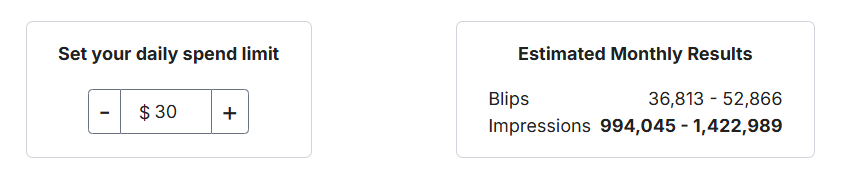
With Blip, the cost of billboard advertising in California can be surprisingly accessible because you only pay when your ad actually runs. Each “blip” is a 7.5-to-10-second display on a rotating digital billboard, starting at just $0.01 per display. You set a daily budget, and Blip’s algorithm uses it to bid on open ad slots, helping maximize your reach based on real-time demand, time of day, and location.
Where can I advertise with Blip in California, Maryland to reach the most drivers?
If we want the highest raw exposure in the California market, MD 235 is usually where we start. Busy California and Lexington Park segments of MD 235 often fall in the 30,000 to 50,000+ AADT range, making it the county’s most important commercial spine. MD 4 is often the reach corridor, while MD 237 and MD 246 are useful for household precision and base-adjacent relevance.
Why is California, Maryland a good place for billboard advertising with Blip?
California, Maryland gives us one of Southern Maryland’s clearest billboard opportunities because it combines dependable commuter traffic, regional shopping demand, and seasonal visitor flow. More than 80% of workers drive alone and average commute times are around 30 minutes. Because most trips here happen by car along MD 235 and MD 4, billboard advertising matches how people actually move through the market.
What kind of audience can Blip reach in California, Maryland?
The single most important audience in this market is the defense ecosystem, with more than 20,000 jobs tied to NAS Patuxent River, Webster Field, and supporting contractors. California is also a family market, with St. Mary’s County Public Schools serving 17,000+ students. The region also includes students and continuing education audiences from St. Mary’s College of Maryland, the College of Southern Maryland, and the University System of Maryland at Southern Maryland.
When is the best time to run billboard ads in California, Maryland with Blip?
Because this market is so commuter-driven, we usually think about three core windows first: 6 a.m. to 9 a.m., 11 a.m. to 2 p.m., and 3 p.m. to 6 p.m. From Memorial Day to Labor Day, California also benefits from stronger leisure behavior across Southern Maryland’s waterfront destinations. The back-to-school window and holiday shopping season are also strong timing opportunities.
Do I need a contract to advertise with Blip in California?
No, Blip has no long-term contracts or minimum commitments. You can start, pause, or stop your campaign at any time.
How fast can I launch a billboard campaign with Blip in California?
You can have your campaign live in minutes. Create a free account, select your locations, set your budget, upload your design, and start running once approved.
Where can I advertise with Blip in California?
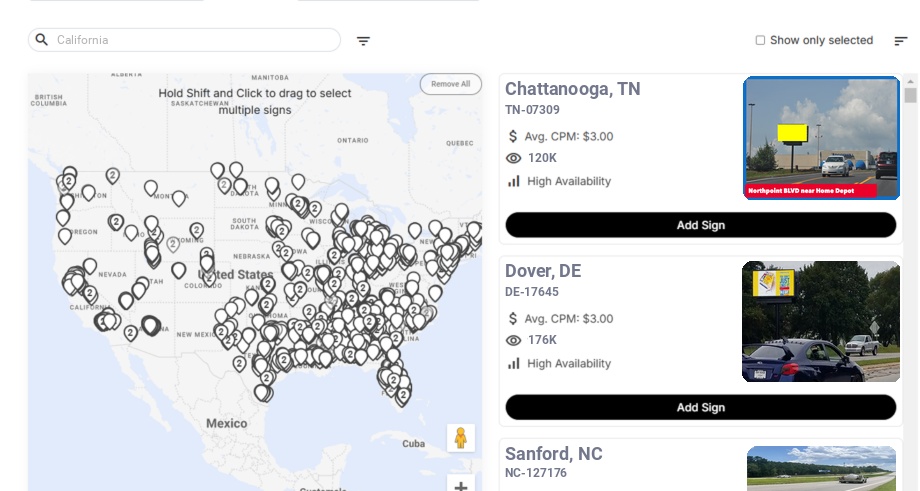
Blip has digital billboards in California. You can browse available locations on a map, choose the ones that fit your audience, and start advertising right away.
Still have questions? Launch a campaign in minutes — no contracts, no commitments.
Start Your CampaignCalifornia Billboard Advertising Guide
California, Maryland gives us one of Southern Maryland’s clearest billboard opportunities because it combines dependable commuter traffic, regional shopping demand, and seasonal visitor flow, with more than 80% of workers driving alone and average commute times around 30 minutes. The community sits in St. Mary’s County, which had 113,777 residents in 2020, and it serves a broader 3-county Southern Maryland market of roughly 373,000 people across St. Mary’s County, Calvert County
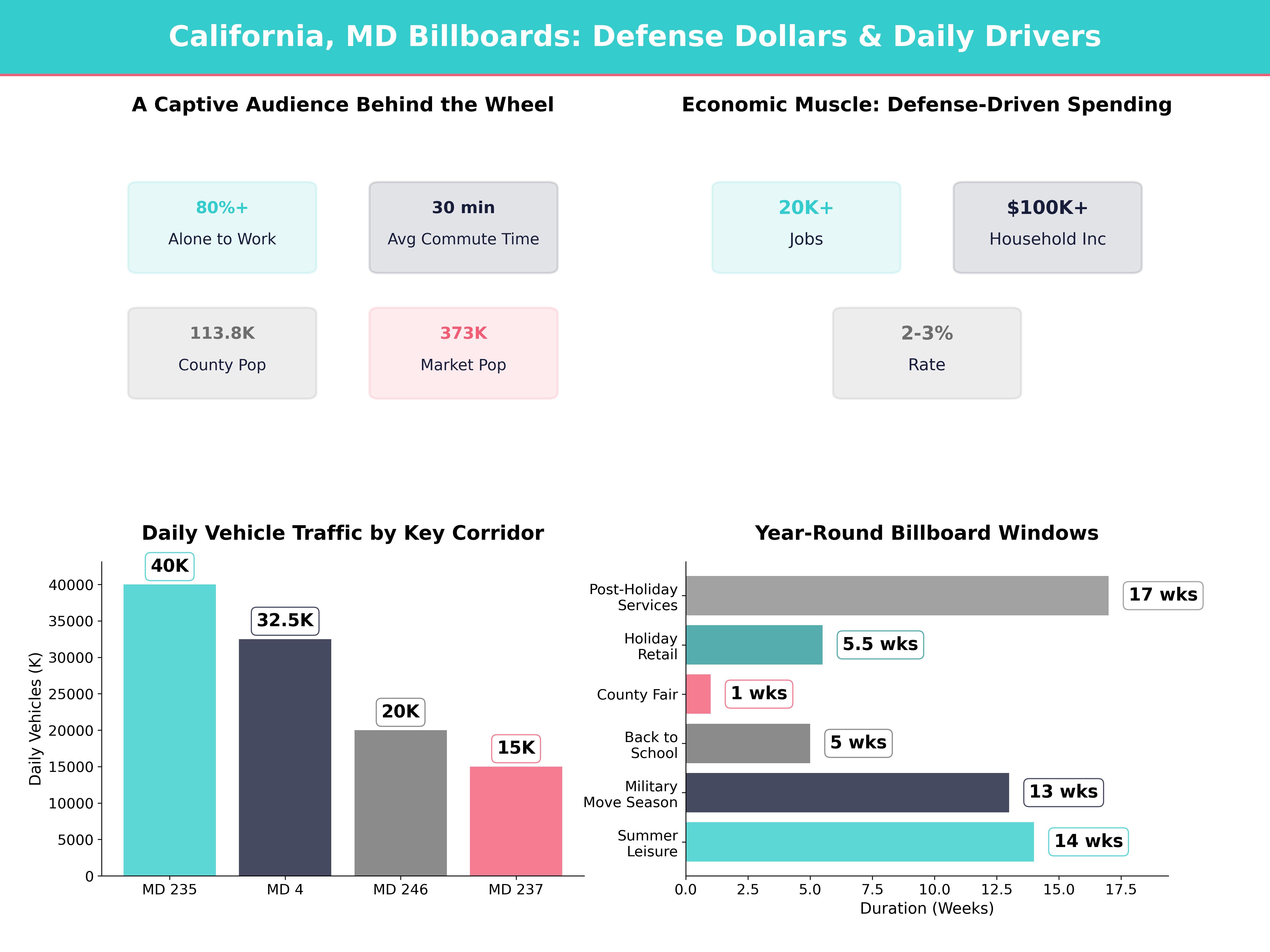
California, Maryland Market Overview
Growth, income, and economic stability in California, Maryland
When we advertise in California, Maryland, we are really advertising into the commercial center of southern St. Mary’s County. According to the Maryland Department of Planning, St. Mary’s County grew from 86,211 residents in 2000 to 113,777 in 2020, which is roughly 32% growth in 20 years. That long-run expansion matters because California has absorbed much of the county’s newer retail, medical, and residential activity.
We also like this market because the economy is unusually stable for a community of its size. St. Mary’s County Economic Development and the Southern Maryland Navy Alliance more than 20,000 jobs across military, civilian, and contractor roles. That kind of employment base creates steady weekday traffic, dependable household spending, and strong recruiting demand.
From a spending-power perspective, the county is attractive as well. Recent county profiles from the Maryland Department of Planning show median household income above $100,000, and county unemployment has generally stayed in the 2% to 3% range in recent labor reports from the Maryland Department of Labor. For billboard advertisers, that combination usually means we are speaking to working households with regular pay cycles, repeat routines, and meaningful local buying power.
Why California, Maryland is a car-first advertising market
California is not a walkable downtown market. It is a corridor market, and that is exactly why billboards work here. Southern St. Mary’s County is organized around a small number of unavoidable north-south and east-west routes, so we can reach the same drivers again and again as they move between home, work, shopping, school, and recreation.
Local commute behavior reinforces that pattern. County profile data indicate that more than 80% of workers drive alone, carpooling accounts for roughly 1 in 10 commuters, and average travel time is about 30 minutes. Public transit exists, but it is modest compared with the sheer scale of driving in the California, Lexington Park, Leonardtown, and Solomons corridor. For us, that means roadside visibility is not supplemental. It is central.
The geography helps too. St. Mary’s County sits at the end of a peninsula, so there are fewer alternate routes than we see in larger metro areas. That limited route choice increases repeat exposure and makes a strong billboard location feel even stronger over time.
Key Traffic Corridors for California, Maryland
California, Maryland’s travel patterns are dominated by a handful of corridors that carry the market. When we understand those routes, we can choose boards for reach, frequency, or audience precision instead of buying visibility blindly.
MD 235, Three Notch Road
Maryland State Highway Administration traffic maps show that busy California and Lexington Park segments of MD 235 often fall in the 30,000 to 50,000+ AADT range. This is the county’s most important commercial spine, and it connects retail centers, restaurants, medical offices, neighborhoods, and the broader approach to NAS Patuxent River.
This corridor is especially valuable for advertisers that need repetition. Retail, grocery, and restaurants can use MD 235 to stay visible during everyday shopping trips. Healthcare, dental, urgent care, and pharmacy brands can use the corridor to build familiarity before a need becomes urgent. Auto dealers, repair shops, telecom providers, and financial services benefit because the same drivers see the message repeatedly during the workweek.
If we want the highest raw exposure in the California market, MD 235 is usually where we start.
MD 4, St. Andrew’s Church Road, and the Solomons approach
Around California and the approach toward Solomons, MD 4 commonly carries about 25,000 to 40,000+ AADT, depending on the segment, according to Maryland State Highway Administration traffic resources. This route is critical because it brings in regional traffic from northern St. Mary’s County, Calvert County
We like MD 4 for broader-market campaigns because it reaches more than just daily California shoppers. Tourism, hospitality, and events can reach visitors heading to Solomons Business Association destinations, Calvert Marine Museum Home services can use MD 4 to reach countywide homeowners traveling between residential areas and retail hubs. Healthcare systems, colleges, and major employers can use the route when they need awareness across a larger trade area.
If MD 235 is the frequency corridor, MD 4 is often the reach corridor.
MD 237, Chancellors Run Road
MD 237, or Chancellors Run Road, typically sits in the 10,000 to 20,000 AADT range on key segments near California and Lexington Park, based on Maryland State Highway Administration traffic mapping. This road connects substantial residential communities to MD 235, which makes it a strong “decision on the way” corridor.
We use MD 237 when we want to reach families and neighborhood-based consumers before they enter the heavier retail flow. Childcare, tutoring, youth sports, and family entertainment can connect with parents during school and after-school travel. Local medical practices, dentists, and veterinarians can stay top of mind with nearby households. Community events and local service businesses can gain relevance by appearing close to where residents actually live.
This is a smart corridor for advertisers who care more about household fit than countywide scale.
MD 246, Great Mills Road, and the base-adjacent approach
MD 246, or Great Mills Road, often lands in the 15,000 to 25,000 AADT band on active segments, and it feeds directly into the broader Lexington Park and base-adjacent travel pattern. Even where count data vary by segment, the road clearly functions as a high-value connector for workers, families, and students.
We like this area for campaigns that need to feel close to everyday life near Lexington Park. Quick-service restaurants and convenience brands can capture lunch, dinner, and errand traffic. Recruiting, staffing, and training advertisers can reach workers tied to defense, retail, and healthcare. Housing, storage, insurance, and moving-related businesses can stay visible to military and contractor households.
When we want local relevance near the base orbit, MD 246 and its surrounding approaches deserve attention.
Audience Segments We Can Reach in California, Maryland
Defense, contractor, and technology workers in California, Maryland
The single most important audience in this market is the defense ecosystem. St. Mary’s County Economic Development and the Southern Maryland Navy Alliance 20,000+ jobs tied to NAS Patuxent River, Webster Field, and supporting contractors. That audience includes engineers, analysts, technicians, administrators, service members, and highly skilled support staff.
For billboard strategy, this matters in three ways. First, these workers generate reliable weekday traffic. Second, many of them commute on fixed schedules, which makes dayparting especially useful. Third, they are attractive customers for housing, finance, healthcare, recruiting, telecom, automotive, and professional services.
Families and household decision-makers in California, Maryland
California is also a family market. St. Mary’s County Public Schools serves 17,000+ students, and each student represents parents, grandparents, or caregivers making recurring decisions about food, healthcare, after-school activities, tutoring, apparel, and home services. Much of the housing growth around California and neighboring communities has reinforced that family profile.
We should keep that in mind when we write creative. Family audiences in this market tend to respond to convenience, trust, and practicality more than abstract brand language. Messages about location, speed, value, availability, and community fit usually travel well here.
Students, continuing education, and young adults around California, Maryland
We can also reach a meaningful education audience. St. Mary’s College of Maryland enrolls about 1,500 students, and the region also benefits from the presence of College of Southern Maryland and the University System of Maryland at Southern Maryland
That audience is useful for advertisers in several categories. Apartments, restaurants, wireless carriers, banks, healthcare providers, and continuing education programs can all benefit from visibility near commuter and campus-oriented routes.
Visitors, boaters, and weekend travelers in California, Maryland
California is not just a resident market. It is also a gateway market. Many visitors pass through California on their way to Solomons Business Association attractions, Annmarie Sculpture Garden & Arts Center, Calvert Marine Museum Patuxent River Naval Air Museum, and Point Lookout State Park. We also see strong local leisure movement around waterfront dining, boating, festivals, and family outings.
This segment matters most for restaurants, hotels, attractions, event promoters, real estate, marinas, and premium retail. Weekend traffic may not look exactly like weekday commuter traffic, but it can be highly valuable because it carries more discretionary intent.
Seasonal and Timing Opportunities in California, Maryland
Weekday commute windows in California, Maryland
Because this market is so commuter-driven, timing matters. We usually think about three core windows first: 6 a.m. to 9 a.m., 11 a.m. to 2 p.m., and 3 p.m. to 6 p.m. The morning block works well for coffee, breakfast, healthcare reminders, recruiting, and professional services. Midday is useful for quick-service restaurants, same-day medical care, and retail errands. The afternoon and early evening block is ideal for dinner, grocery, family activities, and urgent household purchases.
If our audience is tied to the defense workday, weekdays often outperform weekends for practical-service categories. If our audience is tied to dining, entertainment, or tourism, Fridays after 3 p.m. and Saturdays can become much more important.
Summer waterfront season and moving season in California, Maryland
From Memorial Day to Labor Day, we get roughly 14 weeks of stronger leisure behavior across Southern Maryland’s waterfront destinations. California benefits because many of those trips run through MD 4 and MD 235. That is the time to lean into dining, attractions, real estate, marine businesses, hotels, summer camps, and seasonal retail.
Late spring through August is also a major moving window for military and contractor households. In practical terms, that gives us about 12 to 14 weeks when storage, apartments, home services, furniture, insurance, and telecom offers can feel especially timely. In a base-oriented market, that seasonal pattern is more important than it would be in many small towns.
Back-to-school and fall events in California, Maryland
The back-to-school window usually builds during the 4 to 6 weeks before classes resume for St. Mary’s County Public Schools and area colleges. This is a strong period for dental, vision, urgent care, tutoring, youth activities, family restaurants, and retail. It is also a good time for service businesses that want to reach parents once summer travel winds down.
Fall brings community event opportunities too. The St. Mary’s County Fair 4-day burst of attention in late summer or early fall, and area destinations continue to benefit from comfortable weather into October. For event-oriented advertisers, short campaign bursts around major weekends can work very well.
Holiday retail and winter services in California, Maryland
Holiday shopping in this market is usually compressed into about 5 to 6 weeks from mid-November through December. That timing favors gift retail, restaurants, entertainment, healthcare enrollment reminders, and charitable campaigns. Because California is a shopping hub, holiday messages can perform well even when tourism softens.
Winter is also a good time for practical-service messaging. Tax preparation, gyms, medical appointments, legal services, HVAC, and home improvement brands can all benefit from January-through-April visibility, which gives us roughly 4 months of steady intent-based messaging after the holidays.
Billboard Design Tips for California, Maryland
Use local shorthand that feels native to California, Maryland
Creative in California works best when it sounds like it belongs here. Locals recognize references to California, Lexington Park, Leonardtown
That does not mean we should overstuff the copy. It means we should use 1 strong local cue, 1 clear offer, and 1 call to action. A billboard that feels geographically grounded usually outperforms one that feels generic.
Design for highway speed in California, Maryland
Most of the strongest boards in this market serve drivers moving at roughly 45 to 55 mph, and each digital ad only appears for about 7.5 to 10 seconds. That means our creative has to be legible instantly. We usually do best with 6 to 8 words of primary copy, a bold brand mark, and a simple visual hierarchy.
This is especially important on MD 235 and MD 4. Those roads reward clarity, not cleverness. If a message needs explanation, it is probably too long for this market.
Match visuals to Southern Maryland’s culture
California, Maryland sits at the intersection of defense work, suburban family life, and Chesapeake recreation. Our best creative often reflects that blend. Clean navy, white, and steel tones can feel credible for healthcare, finance, and technical employers. Blues, sunset oranges, seafood reds, and waterfront imagery can feel right for restaurants, tourism, and lifestyle brands.
Family-centered imagery, local landmarks, and practical service visuals tend to resonate more than polished big-city aesthetics. We should also respect the market’s trust orientation. Military, contractor, and family audiences often respond well to messages about reliability, convenience, availability, insurance acceptance, service hours, or community reputation. In many cases, 2 or 3 proof points are enough, and more than that becomes clutter.
Rotate creative with the California, Maryland calendar
This is a market where seasonal swaps are worth the effort. Summer leisure creative, back-to-school utility creative, holiday retail creative, and winter service creative should not all look the same. We should refresh artwork every 4 to 6 weeks during active seasons so the message stays timely and repeat viewers do not tune it out.
Regional Strategies Around California, Maryland
The California retail core
The California retail core is where we go for broad local visibility. This area works best for retailers, restaurants, healthcare groups, banks, telecom providers, and service businesses that want everyday frequency. If our goal is store traffic or top-of-mind awareness, this is usually the first zone we prioritize.
We should think of this area as the county’s decision corridor. People are already shopping here, comparing options here, and running errands here, so a billboard can influence action quickly.
Lexington Park and the Pax River approach
Lexington Park and the broader base approach are ideal when we want to reach military, civilian, and contractor traffic with a practical mindset. This zone is strong for recruiting, storage, apartments, insurance, auto services, cell phone plans, healthcare, and quick-service food.
If our product solves a daily problem, the base-adjacent approach is often more valuable than a purely tourism-oriented board. This is where routine and repetition matter most.
Solomons and the MD 4 bridge corridor
The Solomons-facing side of the market is where we lean in for leisure, hospitality, and weekend intent. This zone is valuable for restaurants, attractions, events, marinas, specialty retail, and premium real estate. It is also a smart place to capture cross-county travelers coming from Calvert County St. Mary’s County.
When we need a countywide or visitor-facing message, pairing an MD 4 board with an MD 235 board often gives us a stronger reach-plus-frequency mix than either corridor alone.
Leonardtown and north-county service routes
Northbound routes toward Leonardtown are useful for higher-consideration services. The county seat, MedStar St. Mary’s Hospital, and numerous professional offices make this area well suited for healthcare specialists, legal services, home improvement, education, and financial planning.
If our customer makes a slower, more deliberate decision, this part of the market can be very effective. We may not need the heaviest traffic count if the audience alignment is stronger.
Using Blip Tools in California, Maryland
Daypart around real California, Maryland travel behavior
Blip’s scheduling tools are especially useful in a commuter-led market like this one. We can concentrate delivery during the 6 a.m. to 9 a.m. and 3 p.m. to 6 p.m. windows for commuting audiences, or shift toward lunch and weekend periods for restaurants, attractions, and retail. That lets us align spend with actual intent instead of buying the entire day evenly.
Test reach against frequency in California, Maryland
California is a good market for controlled testing. We can run one board on MD 235 for dense repetition, one on MD 4 for broader reach, and one on a connector like MD 237 or MD 246 for neighborhood relevance. Starting with 2 or 3 locations makes it easier to learn which audience segment responds best.
Because pricing is flexible and starts at $0.01 per display, we can test without locking ourselves into a traditional long-term structure. That is especially helpful for local businesses that need to learn the market before scaling.
Adjust creative and bids as seasons change in California, Maryland
This market changes meaningfully by season, so we should let our campaign change too. Summer leisure traffic, school-year family routines, fall events, and winter services all call for different creative. With Blip, we can refresh artwork quickly, raise or lower budgets as demand shifts, and keep campaigns aligned with the calendar instead of freezing the same message for months.
Use analytics to learn California, Maryland quickly
We do not need to guess our way through Southern Maryland. We can review performance after 7 to 14 days, compare time blocks, compare corridors, and keep the boards that fit our goal best. If one route delivers stronger frequency and another delivers broader coverage, we can rebalance the mix rather than restarting from scratch.
Getting Started with Billboard Rental in California, Maryland
Start with the outcome, not the board
Before we choose inventory, we should decide what success looks like. Are we trying to build countywide awareness, drive same-week foot traffic, support a grand opening, recruit workers, promote an event, or stay visible during a seasonal rush. The answer changes which corridor matters most.
In California, Maryland, the best board is rarely just the cheapest or the busiest. It is the one that lines up with the audience’s real travel pattern.
Pick California, Maryland billboard locations by route, not just by ZIP code
We should evaluate locations based on where people drive every day. If we want high frequency, we should usually start on MD 235. If we want regional reach, we should usually add MD 4. If we want household precision, we should look at connectors such as MD 237 or MD 246. If we want professional-service relevance, we should consider routes serving Leonardtown and the hospital corridor.
That route-first mindset is especially important in an unincorporated place like California, where travel behavior matters more than municipal boundaries.
Plan a short testing cycle, then optimize
A smart starting plan is to launch 2 or 3 boards, run 2 creative versions if possible, and review results after 7 to 14 days. That is long enough to learn which corridor and message combination is earning attention, but short enough to pivot before we waste spend.
Traditional billboard buying often forces advertisers into longer commitments and slower changes. In a market with clear commuter patterns and strong seasonality, we usually benefit from being able to adjust quickly.
Use self-serve flexibility to match Southern Maryland’s rhythm
California, Maryland is not a market where one static annual plan fits everything. Summer is different from January. Weekday defense traffic is different from Saturday tourism traffic. A back-to-school push is different from a holiday retail push. That is why flexible digital buying works so well here.
When we keep our campaign simple, local, and route-aware, billboard rental in California can be remarkably efficient. We can start with a small test, learn which corridors matter most, update creative as the season changes, and scale the placements that truly fit our goals.