Billboards in Olney, MD
No Minimum Spend. No Long-Term Contracts. Just Results.
Trusted by Leading Brands


Billboard advertising
in Olney has never been easier



How much is a billboard in Olney?
Why Choose Blip for Billboard Advertising in Olney
Blip lets you launch in Olney fast, reaching MD 97 and MD 108 commuters without contracts or setup hassle.
In Olney, set flexible budgets for school-year rushes and weekend arts traffic near Olney Theatre Center.
Use Blip's dayparting in Olney to hit 6-9 a.m. and 3-7 p.m. drive-alone commuters on busy arterials.
Track real-time results in Olney and shift spend toward MD 97, the ICC, or US 29 as traffic patterns change.
Blip's creative tools make it easy to tailor Olney billboards for family households, MedStar visits, and local events.
Frequently Asked Questions About Billboard Advertising in Olney
How much does a billboard cost in Olney with Blip?
With Blip, billboard advertising in Olney is designed to be affordable and flexible. You set a daily budget, and Blip’s algorithm uses it to bid on open ad slots, so you only pay when your ad actually appears. Each “blip” is a 7.5-to-10-second display on a rotating digital billboard, with pricing that can start at just $0.01 per display.
Where can I advertise with Blip in Olney, Maryland?
Olney’s billboard value comes from a small number of roads that carry a disproportionate share of local attention. MD 97, Georgia Avenue, is the spine of the market, and MD 108 is the second critical route. The Intercounty Connector near the MD 97 interchange and US 29 for eastern regional reach are also strong options.
Why is billboard advertising in Olney, Maryland a good fit for local businesses?
Olney, Maryland gives us a compelling billboard market because it combines a sizable suburban population with road-driven daily life and steady cross-county travel. Olney has no WMATA Metrorail station and most trips depend on arterials like MD 97 and MD 108, so roadside visibility matters more here than in rail-centered parts of the Washington region. Those key corridors often carry 40,000 to 60,000 AADT on the busiest segments.
When is the best time to run an Olney billboard campaign with Blip?
Olney rewards advertisers that align their message with local rhythms. For school-year advertising, we usually prioritize 6:00 to 9:00 a.m. for morning drop-off and commute traffic, and 3:00 to 7:00 p.m. for pickup, after-school activity, dinner, and errands. Spring and summer also open up additional opportunities, and fall is especially strong because of school routines, cooler weather, arts programming, and holiday spending.
What kind of audience can billboard ads in Olney reach?
Olney’s audience is not one-dimensional, and the best campaigns usually match message, corridor, and time of day to the right audience segment. We can reach commuters and cross-county professionals, families and homeowners, students and healthcare audiences, and arts, recreation, and weekend visitors. That mix makes Olney a market where utility and trust usually outperform novelty.
Do I need a contract to advertise with Blip in Olney?
No, Blip has no long-term contracts or minimum commitments. You can start, pause, or stop your campaign at any time.
How fast can I launch a billboard campaign with Blip in Olney?
You can have your campaign live in minutes. Create a free account, select your locations, set your budget, upload your design, and start running once approved.
Where can I advertise with Blip in Olney?
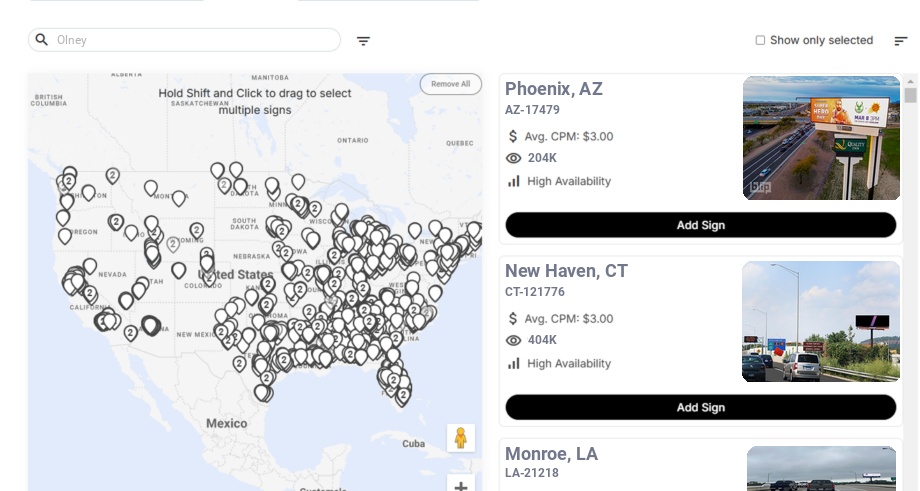
Blip has digital billboards in Olney. You can browse available locations on a map, choose the ones that fit your audience, and start advertising right away.
Still have questions? Launch a campaign in minutes — no contracts, no commitments.
Start Your CampaignOlney Billboard Advertising Guide
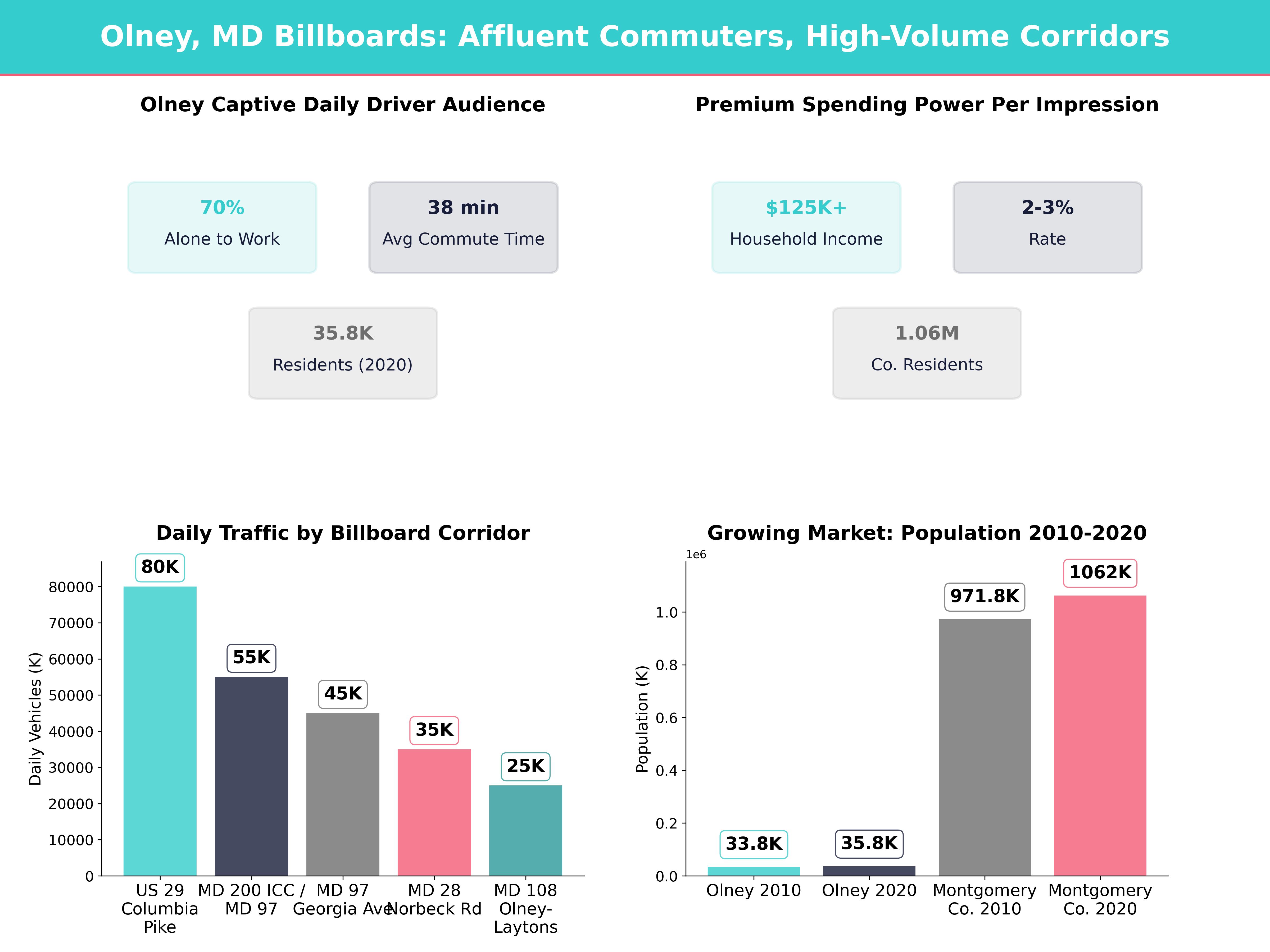
Olney, Maryland gives us a compelling billboard market because it combines a sizable suburban population with road-driven daily life and steady cross-county travel. The Olney area counted 35,820 residents in 2020, and it sits inside Montgomery County, which had 1,062,061 residents in the same census. Because Olney has no WMATA Metrorail station and most trips depend on arterials like MD 97 and MD 108, roadside visibility matters more here than in rail-centered parts of the Washington region, with those key corridors often carrying 40,000 to 60,000 AADT on the busiest segments. We also benefit from Olney’s mix of family households, healthcare activity, arts destinations, parks, and weekend recreation, with Montgomery Parks 421 parks on roughly 37,000 acres, Olney Theatre Center operating on a 14-acre campus, and MedStar Montgomery Medical Center serving the area as a 138-bed hospital.
Olney Market Overview
Olney functions as a high-value suburban node within northern Montgomery County. We are not buying into a tiny rural crossroads. We are reaching a mature community with regional connections to Silver Spring, Rockville, Brookeville
Population, growth, and household profile in Olney
Olney grew from 33,844 residents in 2010 to 35,820 residents in 2020, which is an increase of about 5.8%. Montgomery County grew from 971,777 residents in 2010 to 1,062,061 in 2020, which is about 9.3% growth and adds about 90,284 residents countywide. That combination matters because it tells us Olney sits inside a county that keeps adding residents, jobs, and consumer demand even when local growth is moderate.
The county is also affluent by any national standard. Recent ACS estimates place Montgomery County’s median household income above $125,000, which supports strong demand for healthcare, home services, financial services, education, dining, and recreation. Organizations such as the Montgomery County Economic Development Corporation, Montgomery Planning, and the Olney Chamber of Commerce reinforce that this is a business-friendly, high-spending market rather than a purely pass-through corridor.
Commuting behavior and what it means for advertisers in Olney
Olney is more auto-dependent than transit-rich parts of lower Montgomery County. Recent ACS estimates indicate that roughly 70% of Olney workers drive alone to work, and average commute time is around 38 minutes. That is exactly the pattern we want for billboard advertising, because long, repeated drives create repeated impressions.
Local transit absolutely exists. Ride On serves the area, and regional transit remains important in the county overall. Even so, Olney’s lack of a Metrorail station pushes a large share of daily visibility back onto the road network.
Recent data from the Maryland Department of Labor has also kept Montgomery County unemployment below 3% through much of the post-pandemic recovery period, often in the 2% to 3% range. For advertisers, that usually means we are speaking to employed households with regular routines, predictable shopping cycles, and strong local service demand.
For billboard strategy, those conditions usually translate into four advantages:
- We can build frequency efficiently because many residents use the same roads every weekday.
- We can target practical, conversion-oriented categories such as healthcare, home improvement, insurance, legal services, dining, retail, and education.
- We can justify localized messaging because Olney residents often make decisions close to home.
- We can also scale outward because nearby regional corridors pull in drivers from across Montgomery County, Howard County, and the I-95 side of the region.
Key Traffic Corridors for Olney Billboard Campaigns
Olney’s billboard value comes from a small number of roads that carry a disproportionate share of local attention. AADT varies by segment and year, but recent Maryland Department of Transportation State Highway Administration Traffic Volume Maps
MD 97, Georgia Avenue, in Olney
MD 97, Georgia Avenue, is the spine of the market. Recent state traffic counts generally place central Olney segments in the 40,000 to 50,000 AADT range, with some nearby segments south of town rising even higher. This route links Olney southward toward Glenmont and Silver Spring, and northward toward Brookeville
This is our best corridor for broad local reach because it captures:
- Daily commuters, who create reliable weekday repetition.
- Retail and restaurant traffic, because Georgia Avenue carries shoppers into Olney’s commercial core.
- Healthcare and service advertisers, because residents use this route for routine appointments and errands.
- Community institutions, including schools, churches, and nonprofit organizations that depend on local recognition.
If we want one road that best represents “Olney visibility,” MD 97 is usually it.
MD 108, Olney-Laytonsville Road and Ashton Road
MD 108 is the second critical route. Recent state counts typically place busy Olney-area segments in the mid-20,000s to low-30,000s AADT. The road ties Olney to Laytonsville Ashton
This corridor works especially well for:
- Family services, such as tutoring, orthodontics, childcare, camps, and youth activities.
- Home services, because MD 108 draws from established residential neighborhoods.
- Grocery, pharmacy, and quick-service retail, because many drivers are making practical local trips rather than long-distance commutes.
- Political and civic campaigns, because the road reaches community-minded residents in a highly local context.
MD 108 is often less about broad countywide branding and more about relevance, convenience, and local conversion.
MD 200, the Intercounty Connector, near Olney
The Intercounty Connector is an 18-mile toll road that changes Olney from a local market into a regional one. Near the MD 97 interchange, recent counts generally fall around 50,000 to 60,000 AADT. That volume is meaningful because it reflects fast-moving cross-county trips rather than purely neighborhood circulation.
The ICC is ideal when we want to reach drivers moving between:
- Rockville, Gaithersburg
- Eastern Montgomery County and the I-95 corridor.
- Laurel Howard County, and other regional job centers.
Advertisers that usually benefit most from ICC exposure include hospitals, colleges, legal services, dealerships, entertainment venues, and multi-location retail brands. We should treat ICC boards less like neighborhood signs and more like regional brand amplifiers.
US 29, Columbia Pike, for eastern regional reach from Olney
US 29 is not in Olney proper, but it is strategically important for brands serving Olney plus the east side of the county. Around Burtonsville 70,000 to 90,000 AADT range. That makes US 29 a strong companion corridor for campaigns that need more scale than Olney alone can provide.
US 29 is a smart choice for advertisers targeting:
- Regional healthcare systems and specialty practices.
- Higher education and workforce training.
- Retail chains serving multiple suburban trade areas.
- Events and attractions that depend on weekend visitation from a wider geography.
When we pair an Olney-centered buy with US 29, we often get both local familiarity and broader regional awareness.
MD 28, Norbeck Road, and southern feeder routes
MD 28, Norbeck Road, and connected feeders such as Layhill Road help funnel traffic between Olney, Aspen Hill, and the ICC. Busy segments in the southern approach often run in the 30,000 to 40,000 AADT band. These routes are useful when we want to influence motorists before they disperse into residential neighborhoods.
This cluster is particularly effective for:
- Home improvement and repair advertisers.
- Urgent care, dental, and elective healthcare providers.
- Grocery, fuel, and routine retail brands.
- Services with immediate call-to-action, such as tax help, auto repair, and insurance.
For many local businesses, these feeder roads can outperform flashier regional placements because they intercept drivers close to decision time.
Audience Segments We Can Reach in Olney
Olney’s audience is not one-dimensional. We can reach several distinct groups, and the best campaigns usually match message, corridor, and time of day to the right audience segment.
Commuters and cross-county professionals in Olney
The first audience is the weekday commuter. Between MD 97, MD 108, MD 28, the ICC, and nearby US 29, we can capture people traveling toward Silver Spring, Rockville, and regional employment centers. The local drive-alone share of roughly 70% and average commute near 38 minutes tell us these residents spend enough time on the road for frequency to work.
This audience is especially valuable for:
- Financial services.
- Healthcare and specialist referrals.
- Legal services.
- Auto-related businesses.
- Food and beverage offers tied to morning and evening routines.
Families, homeowners, and school-centered households in Olney
Olney is one of those suburban markets where school schedules and household logistics shape daily behavior. Montgomery County Public Schools serves more than 160,000 students across 211 schools, and the Olney area feeds into one of the county’s established school clusters. We also benefit from the county’s recreation culture. Montgomery Parks 421 parks on roughly 37,000 acres, which supports year-round family movement for sports, playgrounds, trails, and community events.
That is why Olney billboards often work well for:
- Pediatric and family healthcare.
- Orthodontics and dentistry.
- Tutoring, test prep, and enrichment programs.
- Home services, remodeling, and landscaping.
- Grocery, dining, and everyday retail.
In practical terms, this is a market where utility and trust usually outperform novelty.
Students, educators, and healthcare audiences around Olney
We can also reach a broader education and healthcare ecosystem. Montgomery College serves about 45,000 students annually across credit and noncredit programs. Nearby schools, including Sandy Spring Friends School, expand the education audience further. On the healthcare side, MedStar Montgomery Medical Center in Olney is a 138-bed hospital that draws patients, staff, vendors, and caregivers.
Those facts open the door for campaigns focused on:
- Hiring and recruitment.
- Continuing education and adult learning.
- Senior care and rehabilitation.
- Specialist care, imaging, and outpatient services.
- Community health awareness.
Healthcare advertising is especially well suited to Olney because patients and families often choose providers close to home when trust and convenience are high.
Arts, recreation, and weekend visitors in Olney
Olney has a stronger cultural and leisure profile than many suburban communities its size. Olney Theatre Center operates on a 14-acre campus and gives the area a year-round performing arts draw. The nearby Adventure Park at Sandy Spring, Sandy Spring Museum, and the county’s 93,000-acre Agricultural Reserve
This audience matters for:
- Restaurants and hospitality.
- Events and ticketed attractions.
- Nonprofits and fundraising campaigns.
- Outdoor recreation brands.
- Local retail that benefits from weekend browsing.
Weekend traffic in and around Olney is not just local shopping traffic. It also includes people arriving for arts, recreation, and community experiences.
Seasonal and Timing Opportunities in Olney
Olney rewards advertisers that align their message with local rhythms. Because the area is family-heavy and commute-heavy, timing matters almost as much as location.
School-year rhythms in Olney
Back-to-school is one of the cleanest windows in this market. Montgomery County Public Schools typically begins in late August and runs through June, so campaigns for tutoring, orthodontics, youth activities, after-school care, family dining, and routine healthcare tend to perform best from late summer into fall.
For school-year advertising, we usually prioritize:
- 6:00 to 9:00 a.m. for morning drop-off and commute traffic.
- 3:00 to 7:00 p.m. for pickup, after-school activity, dinner, and errands.
- Midweek consistency, because routines are strongest from Tuesday through Thursday.
Spring and summer opportunities in Olney
Spring and summer open up a different set of use cases. The Olney Farmers and Artists Market typically runs from May through November, and Olney Days brings additional local visibility in late spring. Outdoor recreation also expands as visitors head toward Adventure Park at Sandy Spring, park facilities managed by Montgomery Parks
Summer campaigns often work well for:
- Camps and youth programs.
- Outdoor dining and entertainment.
- Swimming, fitness, and recreation.
- Home improvement, lawn care, and pest control.
- Real estate and moving services.
The nearby Montgomery County Agricultural Fair in Gaithersburg 9 days each August, which creates another useful late-summer awareness window for countywide brands.
Fall and holiday timing in Olney
Fall is especially strong in Olney because we get the overlap of school routines, cooler weather, arts programming, and holiday spending. Olney Theatre Center helps keep evening and weekend activity elevated, while healthcare providers can promote annual checkups, flu shots, and year-end insurance use before December deadlines.
For many local categories, November and December are ideal for:
- Holiday retail.
- Dining and catering.
- Medical and dental appointments.
- Gift-oriented entertainment.
- Charity and community messaging.
Weather-driven and service-response timing in Olney
Because Blip campaigns can be adjusted quickly, Olney is a good market for weather-sensitive advertisers. Winter storms, summer heat, and severe weather all change consumer priorities. That flexibility matters for HVAC companies, roofing contractors, restoration firms, urgent care providers, pharmacies, and auto services.
In practice, we can increase exposure just before a forecast event, push service messages when demand spikes, and then reallocate budget once conditions normalize.
Billboard Design Tips for the Olney Market
Olney does not respond best to generic highway creative. The audience is practical, community-oriented, and accustomed to local institutions. Our creative should look like it understands that.
Use family-centered, suburban cues in Olney creative
The strongest Olney creative usually emphasizes trust, convenience, and everyday usefulness. Messages such as “Open Saturdays in Olney,” “Family care near MD 97,” or “After-school spots available” often fit the market better than abstract branding alone.
This is a place where we should favor:
- Clear benefits over clever wordplay.
- Real services over vague lifestyle claims.
- Community credibility over big-city swagger.
Match the visual tone to Olney’s environment
Olney sits close to wooded neighborhoods, equestrian landscapes, and the 93,000-acre Agricultural Reserve. That means earthy greens, deep blues, clean whites, and warm neutrals often feel more native than hyper-neon palettes. When we advertise arts, recreation, or local services, imagery that nods to parks, tree canopy, or community gathering places can feel especially on-brand.
For healthcare and professional services, calm and polished visuals usually fit better than loud, urgent designs. For entertainment and dining, we can go bolder, but we should still keep the look refined.
Build copy around decision points in Olney
On local arterials like MD 97 and MD 108, directional language matters. Drivers are often deciding where to stop, where to turn, or which provider to remember for later. That means short, specific copy tends to work best.
In Olney, we should often use lines such as:
- “2 miles ahead.”
- “Next right on 108.”
- “Minutes from MedStar.”
- “Book before school starts.”
Those messages are more useful than generic awareness headlines because local motorists are frequently in decision mode.
Tailor the message to the corridor and audience
Creative should change depending on where we place it. On MD 97, commuter-friendly messages and broad category claims usually work well. On MD 108, neighborhood relevance and family utility tend to win. On the ICC or US 29, we usually need bigger-brand creative with simple takeaways, because vehicles are moving faster and trip intent is more regional.
We should also respect Olney’s cultural identity. Referencing Olney Theatre Center, weekend recreation, community schools, or local convenience can make an ad feel native rather than imported.
Regional Strategies Around Olney
A strong Olney campaign usually works better when we think in zones instead of treating the whole area the same way.
The Olney core around MD 97 and MD 108
The commercial heart of Olney is where we go for high-frequency local conversion. This zone is best for restaurants, banks, dentists, physical therapy, grocery-adjacent retail, urgent care, and service businesses that depend on repeated local exposure.
In the core, we should prioritize:
- Convenience-driven offers.
- Strong location cues.
- Frequent weekday impressions.
- Reinforcement of established local names.
The southern approach from Glenmont and Silver Spring
The southbound and northbound approaches toward Silver Spring catch workers heading home or starting the day. This area is valuable for commuter-facing messages, especially those tied to appointments, takeout, home services, and next-step actions.
This zone is especially good when we want to reach:
- Office commuters returning to Olney.
- Households making after-work decisions.
- Consumers planning evening and weekend purchases.
North and east of Olney, including Brookeville and Sandy Spring
The northern and eastern edges feel more semi-rural and destination-oriented. Here, we can speak effectively to homeowners, outdoor recreation users, nonprofit supporters, and families moving between Olney, Brookeville Sandy Spring Museum destinations.
This zone is a natural fit for:
- Landscaping and home exterior services.
- Equestrian, farm, and outdoor-adjacent businesses.
- Nonprofit and community event promotion.
- Weekend dining and attraction traffic.
Regional gateways via the ICC and US 29
When our target is bigger than Olney, we should add the ICC or US 29. These routes extend reach toward Rockville, Laurel Howard County. We can use them to recruit employees, build regional awareness, or support multi-location businesses without losing Olney-specific relevance.
The best strategy is often layered. We can use local boards for repetition and regional boards for scale.
Using Blip Tools in Olney
Olney is a market where Blip’s flexibility is unusually useful because traffic patterns are consistent, but audience intent changes sharply by corridor and time of day.
Daypart around Olney’s real traffic behavior
We should not buy every hour equally. In Olney, weekday commuting and family errand windows are distinct, so we can prioritize 6:00 to 9:00 a.m., 3:00 to 7:00 p.m., and weekend midday blocks such as 10:00 a.m. to 6:00 p.m. when leisure traffic rises.
That lets us align spend with the moments when residents are most likely to notice and act.
Split local and regional budgets in Olney
Olney campaigns often benefit from a two-tier setup. We can put one portion of budget into MD 97 and MD 108 for dense local frequency, and another portion into the ICC or US 29 for broader regional exposure. That structure usually gives us a better balance of efficiency and reach than putting every dollar into one road type.
Rotate creative by audience, season, and objective
Because Olney has distinct audience segments, we can upload multiple versions of artwork and rotate them intelligently. A family healthcare brand might run one message during school-year weekdays, another on weekends near recreation periods, and a third during open-enrollment or year-end scheduling season.
That kind of sequencing is especially useful for:
- Schools and enrichment programs.
- Healthcare systems.
- Seasonal retailers.
- Event and entertainment advertisers.
Use performance data to refine Olney placements
Olney is not so large that we need guesswork for very long. Once a campaign is running, we can compare how commuter-heavy boards, neighborhood boards, and regional gateway boards perform. Then we can shift budget toward the corridors and dayparts that best match our goal, whether that goal is awareness, search lift, web traffic, or foot traffic.
Getting Started with Billboard Rental in Olney
Renting a billboard in Olney works best when we begin with a clear objective and then map that objective to the right roads, times, and audience segments.
Define the goal before we choose an Olney billboard
We should first decide whether the campaign is trying to do one of three things:
- Build broad local awareness.
- Capture nearby shoppers and service buyers.
- Extend reach beyond Olney into the wider county and regional commuter network.
A restaurant, dentist, tutoring center, or home service company will usually want local repetition first. A hospital, college, or multi-location retailer may need both local boards and regional gateway boards.
Evaluate Olney boards by trip intent, not just geography
The right board is not simply the one closest to our address. It is the one placed in front of the right driver at the right moment. As we evaluate options, we should ask:
- Is the board on a road people use every weekday, or mostly on occasional trips?
- Are drivers heading toward our business, or away from it?
- Is this a local decision corridor like MD 108, or a regional awareness corridor like the ICC?
- Can our message be understood quickly in that traffic environment?
In Olney, those questions matter because the difference between a neighborhood conversion board and a regional branding board can be substantial.
Start focused, learn quickly, and expand in Olney
A practical way to start is with a 2- to 4-week test on a small cluster of boards that represent different functions, such as one local arterial, one commuter approach, and one regional connector. From there, we can watch performance, refine creative, and add locations that match what the data tells us.
That approach is often more efficient than locking into a broad traditional buy before we know which part of the Olney market responds best.
Why billboard rental is simpler with Blip in Olney
Traditional billboard buying can be slow, inflexible, and hard to localize. In a market like Olney, where timing, corridor choice, and message fit matter so much, self-serve control is a real advantage. We can choose boards on a map, align schedules to school and commute patterns, adjust spend for seasonal pushes, and refresh creative when priorities change.
For advertisers in Olney, that means we can move from idea to live campaign quickly, stay close to the rhythms of the community, and build a billboard strategy that actually reflects how people here travel and make decisions.