Billboards in Eden, MD
No Minimum Spend. No Long-Term Contracts. Just Results.
Trusted by Leading Brands


Billboard advertising
in Eden has never been easier



How much is a billboard in Eden?
Why Choose Blip for Billboard Advertising in Eden
-
Blip lets you launch in Eden, Maryland fast and self-serve, reaching US 13 commuters without contracts or minimums.
-
Use Blip-optimized campaigns in Eden, Maryland to auto-pick digital boards and timing for US 50 beach traffic and US 113 travelers.
-
Set a flexible daily budget in Eden, Maryland and pay only when your ad plays—great for testing lower-shore reach around Salisbury and Princess Anne.
-
Daypart in Eden, Maryland to hit morning drive-alone commuters, Friday Ocean City-bound traffic, or Sunday return trips with Blip.
-
Track real-time results in Eden, Maryland and shift spend as seasonal demand moves from hospital and campus traffic to summer visitors.
-
Blip's creative tools help you tailor boards for Eden, Maryland with clear, local messaging for US 13, Salisbury, and coastal routes.
Frequently Asked Questions About Billboard Advertising in Eden
How much does a billboard cost in Eden, Maryland with Blip?
With Blip, pricing starts at just $0.01 per display. The cost per blip can change based on time of day, location, and advertiser demand, but Blip works to maximize your reach for whatever budget you choose. Since your total cost is simply the sum of each individual blip, billboard advertising in Eden can be a practical way to test the waters and grow your visibility without overspending.
Where can I advertise with Blip in Eden, Maryland?
If we can choose only one corridor to understand near Eden, it is US 13. Eden sits directly on the north-south spine that connects Fruitland, Salisbury, Princess Anne, and points farther south on the peninsula. US 50 and US 113 also matter because they link the Salisbury area to Cambridge, Berlin, Ocean City, and other lower-shore destinations.
Why is billboard advertising in Eden, Maryland valuable with Blip?
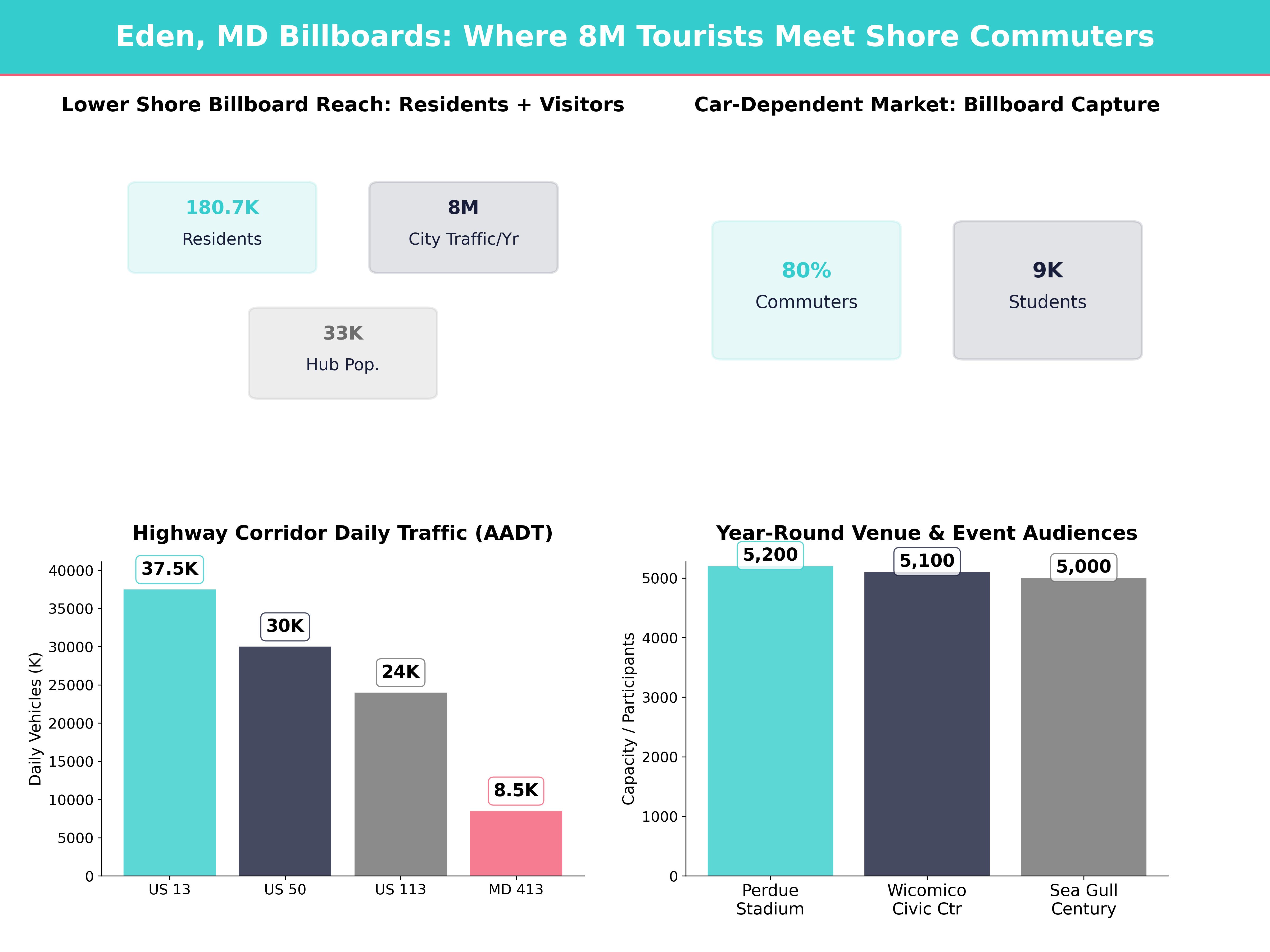
Eden, Maryland is a small place with outsized billboard value because it sits inside the lower Eastern Shore travel network, not far from Salisbury, Princess Anne, and the roads that funnel traffic toward the coast. The surrounding lower-shore counties hold a combined 180,668 residents, and nearby Salisbury alone has 33,050 residents. When we add Ocean City’s roughly 8 million annual visitors, we get a market where local frequency and seasonal reach can work together.
What kind of traffic and audience does Eden, Maryland have for billboards?
The lower Eastern Shore is fundamentally a driving market, and recent commuting tables consistently show that roughly 80% of workers in Somerset, Wicomico, and Worcester counties drive alone to work. That means repeated visibility along US routes can build familiarity fast. This market also includes rural households, university students, hospital workers, military and public-sector employees, service workers, retirees, and beach-bound visitors.
When is the best time to run billboard ads in Eden, Maryland with Blip?
Summer is the lower shore’s biggest visibility season, while fall is often underrated on the Eastern Shore. Winter traffic is lighter on the tourism side, but that does not make the market weak because it is a strong period for local retail, tax services, healthcare, insurance, legal services, and recruitment campaigns. Spring is the start of the market’s annual acceleration as college admissions activity picks up, families visit campus, and weekend tourism starts to build.
Do I need a contract to advertise with Blip in Eden?
No, Blip has no long-term contracts or minimum commitments. You can start, pause, or stop your campaign at any time.
How fast can I launch a billboard campaign with Blip in Eden?
You can have your campaign live in minutes. Create a free account, select your locations, set your budget, upload your design, and start running once approved.
Where can I advertise with Blip in Eden?
Blip has digital billboards in Eden. You can browse available locations on a map, choose the ones that fit your audience, and start advertising right away.
Still have questions? Launch a campaign in minutes — no contracts, no commitments.
Start Your CampaignEden Billboard Advertising Guide
Eden, Maryland is a small place with outsized billboard value because it sits inside the lower Eastern Shore Salisbury, Princess Anne Somerset County, Wicomico County Worcester County hold a combined 180,668 residents, and nearby Salisbury alone has 33,050 residents. Recent commuting patterns for the region show that roughly 8 in 10 workers drive alone, which keeps daily impressions concentrated on a relatively small set of roads. When we add Ocean City's roughly 8 million annual visitors, we get a market where local frequency and seasonal reach can work together.
Eden, Maryland Market Overview
Eden is small, but the trade area is not
When we advertise in Eden, we are really buying into a lower-shore trade area rather than a stand-alone town. Population counts compiled by the Maryland Department of Planning put Somerset County at 24,620 residents in 2020, Wicomico County 103,588, and Worcester County at 52,460. Together, those three counties total 180,668 residents, which gives us a meaningful regional audience even though Eden itself is small.
Nearby Salisbury is the lower shore’s biggest commercial and medical hub, with 33,050 residents in the city and a much larger daytime draw. That matters because many Eden-area trips are destination-based. Residents often travel north for shopping, healthcare, education, and services, which makes corridor advertising more useful than neighborhood-only targeting.
Population trends shape the audience mix
The lower shore is not growing evenly, and that unevenness helps us think about campaign goals. From 2010 to 2020, Somerset County’s population declined by about 7% (from 26,470 to 24,620), while Wicomico County grew by about 5% (from 98,733 to 103,588), and Worcester County grew by about 2% (from 51,454 to 52,460). In practical terms, that means we should expect the strongest everyday commercial density around Salisbury and the most pronounced seasonal swings closer to the coast.
This is also a market with multiple audience layers at once. We can reach rural households, university students, hospital workers, military and public-sector employees, service workers, retirees, and beach-bound visitors within the same broader network of roads. That mix rewards billboard campaigns that stay simple, location-aware, and repeated often.
Car dependence keeps out-of-home especially relevant
The lower Eastern Shore is fundamentally a driving market. Recent commuting tables consistently show that roughly 80% of workers in Somerset, Wicomico, and Worcester counties drive alone to work. Public transit exists through systems such as Shore Transit, but the dominant habit is still point-to-point travel by car.
For billboard advertisers, that has two implications. First, repeated visibility along US routes can build familiarity fast. Second, message timing matters because morning northbound commuting, afternoon southbound returning traffic, and summer beach travel create different windows for different offers.
The economy is diverse enough for many advertiser categories
Eden sits near several of the lower shore’s most dependable economic anchors. TidalHealth Peninsula Regional 288-bed hospital. Salisbury University enrolls more than 7,000 students, and the University of Maryland Eastern Shore near Princess Anne enrolls more than 2,000 students. The area also benefits from year-round activity tied to Perdue Farms, local agriculture, education, county government, and coastal tourism.
That combination makes Eden useful for more than one advertising objective. We can use billboard campaigns here for broad brand awareness, event promotion, healthcare line growth, retail foot traffic, hiring, political messaging, and seasonal tourism marketing.
Key Traffic Corridors Around Eden, Maryland
US 13 is the backbone of the Eden market
If we can choose only one corridor to understand near Eden, it is US 13. Eden sits directly on the north-south spine that connects Fruitland, Salisbury, Princess Anne Maryland State Highway Administration show that US 13 rises from roughly 25,000 AADT on lighter southern segments to more than 50,000 AADT around Salisbury’s busiest commercial sections.
That volume makes US 13 the most versatile billboard corridor in the area. We should prioritize it when we want reach across everyday local traffic.
- Healthcare advertisers benefit because the route feeds trips toward TidalHealth
- Retailers and restaurants benefit because US 13 captures habitual shopping traffic moving into Salisbury and Fruitland.
- Colleges, trade schools, and employers benefit because the corridor connects student, staff, and commuter populations throughout the lower shore.
US 50 captures east-west movement and beach intent
US 50 matters because it links the Salisbury area to Cambridge Berlin, and Ocean City. Rounded SHA traffic maps place many US 50 segments in the lower shore in roughly the 20,000 to 40,000 AADT range, with the strongest volumes near Salisbury and sustained demand on the approach to the coast.
This corridor is especially valuable when we want to reach travelers who are in motion with a clear destination already in mind. That often means stronger response for high-intent categories.
- Hotels, attractions, restaurants, and beach services perform well because US 50 captures visitors en route to coastal destinations.
- Big-box retail, convenience, and fuel brands benefit because travelers make planned stops along this corridor.
- Event venues and tourism campaigns benefit because the route carries people heading toward weekend, festival, and convention activity.
US 113 helps us intercept seasonal and regional traffic
US 113 is another important lower-shore corridor, especially for travel through Worcester County and for movement between inland communities and the beach market. Rounded SHA counts often place this route in about the 18,000 to 30,000 AADT band on relevant regional segments, with seasonal surges during summer travel periods.
US 113 is useful when we want to complement US 50 instead of relying on it alone. It can help us stay visible to travelers who bypass downtown Salisbury or who approach the coast from a different angle.
- Vacation rentals, real estate, and home services benefit because many travelers on US 113 are repeat visitors or property owners.
- Auto dealers and healthcare groups benefit because the corridor carries longer-distance local trips that involve considered purchases.
- Regional retailers benefit because the route connects inland households to larger commercial nodes.
MD 413 is smaller, but it is highly relevant for local intent
MD 413 is the key route from the US 13 spine into Princess Anne Crisfield 5,000 to 12,000 AADT range, which is much lower than US 13 but still meaningful because the traffic is locally concentrated and often purpose-driven.
This corridor is where we trade some raw scale for more local relevance. It is particularly useful for advertisers that want Somerset County visibility instead of pure regional reach.
- Local healthcare, legal, banking, and government-related services benefit because MD 413 carries practical errand traffic.
- University messaging works well because the route feeds the University of Maryland Eastern Shore.
- Marine, seafood, and outdoor tourism brands benefit because the corridor leads toward Janes Island State Park, Crisfield, and other water-oriented destinations.
Audience Segments We Can Reach from Eden, Maryland
Commuters, shoppers, and errand traffic
The most dependable audience near Eden is the everyday driver. Because roughly 80% of workers in the lower-shore counties commute by car, we can build strong repetition among people traveling between Somerset County, Salisbury, and the retail clusters around US 13. This is ideal for advertisers who need familiarity more than a single immediate conversion.
Commuter-oriented billboard campaigns in this market often work best for:
- Healthcare providers.
- Quick-service restaurants.
- Auto repair and dealerships.
- Grocery, home improvement, and discount retail.
- Hiring campaigns for employers with recurring labor needs.
Students, faculty, and campus visitors
The lower shore has two meaningful higher-education audiences. Salisbury University brings more than 7,000 students into the market, and the University of Maryland Eastern Shore adds more than 2,000 students near Princess Anne. Those populations also bring faculty, staff, parents, visiting families, and alumni traffic during orientation, athletics, and commencement periods.
That makes the Eden area useful for education, banking, apartments, telecom, healthcare, and food brands that want to stay visible during the school year. It also creates timing opportunities around late-summer move-in, fall homecoming activity, spring admissions, and May graduation.
Healthcare workers and patients
Healthcare is one of the most reliable ad categories on the lower shore. TidalHealth Peninsula Regional 288-bed hospital, and the broader Salisbury medical cluster pulls in patients from multiple counties. Many of those trips happen by car, often on repeat routes, which is exactly the kind of behavior billboard advertising can reinforce.
We should think beyond emergency care here. Orthopedics, oncology, imaging, urgent care, dental groups, pharmacies, and specialty referrals all benefit from repeated route-based exposure in markets where people travel for care.
Tourists, sports fans, and eventgoers
Tourism expands the audience dramatically once we move beyond purely local traffic. The Town of Ocean City regularly cites roughly 8 million annual visitors. The Roland E. Powell Convention Center 214,000 square feet of meeting and exhibit space, which brings in trade shows, consumer events, and seasonal conventions. In Salisbury, the Wicomico Youth & Civic Center seats about 5,100, and Arthur W. Perdue Stadium seats about 5,200.
Those venues create dependable waves of travelers and locals who are already predisposed to spend. The Delmarva Shorebirds also play 66 home games in a typical season, which gives us a long run of sports-related impressions from spring through early fall.
Outdoor recreation audiences
The lower shore’s outdoor culture is another strong fit for billboard advertising. Janes Island State Park features 30 miles of marked water trails, and nearby destinations such as Pocomoke River State Park reinforce the area’s appeal for paddling, camping, fishing, and boating. These travelers often respond well to practical offers such as gear, food, lodging, marina services, and family attractions.
Seasonal and Timing Opportunities in Eden, Maryland
Spring in Eden, Maryland
Spring is the start of the market’s annual acceleration. College admissions activity picks up, families visit campus, baseball season begins, and weekend tourism starts to build. Because the Delmarva Shorebirds host 66 home games across the season, spring boards in the Salisbury area can serve restaurants, entertainment brands, auto dealers, and family attractions especially well.
We also see value in spring campaigns for healthcare screenings, landscaping, home services, and wedding-related businesses. The weather improves, driving increases, and local consumers start planning summer spending.
Summer in Eden, Maryland
Summer is the lower shore’s biggest visibility season. Ocean City's roughly 8 million annual visitors drive major demand across US 50 and US 113, while local residents continue using US 13 for work and shopping. If we want both tourists and locals, summer is when a multi-corridor plan makes the most sense.
This is the best season for:
- Beach and hospitality campaigns.
- Convenience, fuel, and travel-stop messaging.
- Restaurants, seafood, and entertainment.
- Urgent care and pharmacy awareness for visitors.
- Real estate and vacation-rental marketing.
Fall in Eden, Maryland
Fall is often underrated on the Eastern Shore. Colleges are back in session, local routines resume, and event traffic becomes more concentrated. Sea Gull Century, organized by Salisbury University, draws about 5,000 cyclists each year. Crisfield National Hard Crab Derby over Labor Day weekend.
For many advertisers, fall is a smart time to shift from broad tourist language to school-year, healthcare, financial, and hiring messages. The audience is still mobile, but the intent is more practical and easier to target by corridor.
Winter in Eden, Maryland
Winter traffic is lighter on the tourism side, but that does not make the market weak. It simply changes the mix. Winter is a strong period for local retail, tax services, healthcare, insurance, legal services, and recruitment campaigns because the audience becomes more resident-heavy and less distracted by seasonal travel.
We should also remember that fewer tourism advertisers are competing for attention in winter. That can make a clear, frequent message feel even more dominant.
Billboard Design Tips for Eden, Maryland
Use Eastern Shore cues that feel local
Creative in this market should look like it belongs on the lower shore. Colors such as coastal blue, marsh green, sunrise orange, and crab red feel natural here because they echo the region’s water, seafood, beach, and agricultural identity. Imagery tied to boats, waterfront dining, farm fields, baseball, or campus life can work well when it matches the offer.
We do not need to overdo the theme, but we should avoid generic urban creative that could run anywhere. Eden-area drivers respond better when a message feels connected to Salisbury, Princess Anne, Crisfield, or Ocean City specifically.
Write for route intent, not just brand awareness
A driver on US 13 near Eden is often headed somewhere practical. A driver on US 50 may be headed somewhere recreational. That difference should shape the copy.
For example, local-service boards near Eden and Princess Anne should emphasize convenience, trust, and next-step clarity. Beach-bound boards should emphasize fun, urgency, and location. Phrases like “On the way to Ocean City,” “Next stop in Salisbury,” or “South toward Princess Anne” can feel much more relevant than a generic slogan when the placement supports them.
Keep language plainspoken and easy to read
The lower shore has plenty of loyal local audiences, and billboard creative should respect that with direct, useful language. We should favor short headlines, a single promise, and one memorable brand cue. Messages that try to sound too clever can lose clarity at highway speed.
This is also a market where place names matter. Salisbury, Fruitland, Princess Anne UMES, and Ocean City are meaningful shorthand. When we use them carefully, we make the board feel immediately relevant.
Rotate by season instead of forcing one all-year message
Because this market changes so much by season, our creative should change too. Summer boards can lean into beaches, seafood, and travel. Fall boards can pivot to campuses, events, and local services. Winter boards can move toward healthcare, finance, and hiring. Spring boards can support home improvement, admissions, and sports.
A rotating creative strategy usually performs better here than a one-size-fits-all message.
Regional Strategies Across the Eden, Maryland Trade Area
Salisbury and Fruitland for scale and commercial density
When we want maximum everyday reach, we should lean north toward Salisbury and Fruitland. This is where the lower shore’s biggest concentration of retail, medical, education, and event traffic comes together. Boards in this zone are usually the best starting point for brands that need awareness across multiple counties.
This is the right sub-area for healthcare systems, auto dealers, retailers, QSR brands, entertainment venues, and employers with ongoing hiring needs.
Eden to Princess Anne for Somerset County relevance
When we want Somerset County visibility specifically, we should build around the US 13 and MD 413 approach to Princess Anne University of Maryland Eastern Shore.
The scale is smaller than Salisbury, but the audience is often more focused. That can improve relevance for advertisers who do not need regional sprawl.
South toward Crisfield for marine and leisure brands
As we move farther south, the audience becomes more tied to waterfront recreation, seafood culture, and local destination travel. That makes the route toward Crisfield Janes Island State Park a good fit for marinas, boat services, seafood restaurants, lodging, fishing charters, and regional events.
We should think of this as a precision play rather than a mass-reach play. The traffic is lighter, but the intent can be excellent.
Eastbound strategies for Ocean City and Worcester County
If our goal includes tourists, weekenders, or second-home audiences, we should extend the plan toward US 50 and US 113 in Worcester County. This is where beach demand can justify seasonal expansion beyond the core Eden-Salisbury corridor.
That approach works especially well for hospitality brands, healthcare services that treat visitors, real estate, attractions, and retailers that want to intercept travelers before they arrive in Ocean City.
Using Blip Tools in the Eden, Maryland Market
We can choose precision or automation based on the goal
In a market like Eden, manual selection works well when we know exactly which corridor matters most. If we want daily commuter reach, we can focus on US 13-heavy inventory. If we want summer travel intent, we can lean into US 50 and US 113 placements. If we want Somerset County relevance, we can emphasize boards that reinforce Princess Anne and MD 413 traffic.
A Blip-optimized campaign is often the better fit when we want broader lower-shore coverage and want the system to spread budget across the highest-opportunity placements automatically.
Dayparting is especially useful here
The Eden market responds well to time-based strategy because travel patterns are predictable. Morning weekday windows can emphasize commuter services and coffee or breakfast offers. Midday can support healthcare, errands, and quick-service dining. Friday afternoon and evening can support beach traffic, restaurants, and entertainment. Sunday return traffic can support grocery, home services, and back-to-work messaging.
We should use these rhythms instead of running the same schedule every hour of the week.
Creative rotation helps us match different audiences
Because the market serves commuters, students, and tourists at once, we should rotate creative by audience segment. One version can speak to local residents on US 13. Another can speak to beach-bound travelers on US 50. A third can emphasize student or parent relevance near Salisbury University or UMES.
Blip’s artwork tools make that easier than traditional billboard workflows, and the ability to adjust quickly is especially valuable in a market with strong seasonal shifts.
Real-time performance data helps us learn the market faster
Lower-shore advertisers often start with assumptions about which route matters most. Real-time reporting lets us validate those assumptions quickly. If summer boards on coastal approaches outperform our commuter boards, we can reallocate. If Somerset County frequency matters more than beach exposure, we can tighten the footprint.
That flexibility is useful in Eden because the best plan often changes by month.
Getting Started with Billboard Rental in Eden, Maryland
Start with the real question, not the map pin
The first step is to define what we actually want from the campaign. If we want broad awareness, we should start with Salisbury-area and US 13 inventory. If we want Somerset County penetration, we should focus on Eden, Princess Anne, and MD 413-linked routes. If we want visitor traffic, we should extend toward US 50 and US 113.
In other words, we should rent for the behavior we want to capture, not just for the smallest geographic label.
Expect to evaluate corridors more than individual towns
Because Eden is small, the best digital billboard options may be nearby rather than inside the immediate community itself. That is normal. In this market, effectiveness usually comes from owning a corridor and repeating the message across the path people actually drive.
When we compare locations, we should look at:
- The direction of travel the board faces.
- The speed and dwell time of traffic near the board.
- The nearby anchors, such as hospitals, campuses, shopping clusters, or beach routes.
- Whether the audience is steady year-round or highly seasonal.
Launch with a focused test and expand from what works
A practical way to begin is with a 2- to 4-week test across 2 or 3 strategic corridors. We can then compare results by objective. A local service brand may find that frequency on US 13 is enough. A tourism brand may find that adding US 50 produces a better lift during summer weekends. A university or healthcare campaign may want both Salisbury reach and Somerset reinforcement.
Traditional billboard buying often forces us into longer commitments before we know what is working. Blip simplifies that process by letting us start smaller, learn faster, and adjust placements, creative, and timing as soon as the market tells us more.
The best Eden, Maryland plan is usually regional, simple, and repeated
The strongest billboard campaigns around Eden rarely depend on one flashy message or one isolated board. They win by matching the right routes with the right season, then repeating a clear offer often enough to become familiar. In a market anchored by 180,668 lower-shore residents, 8 million Ocean City visitors, heavy auto dependence, and a few dominant highways, that kind of disciplined planning can go a long way.