Billboards in Brandywine, MD
No Minimum Spend. No Long-Term Contracts. Just Results.
Trusted by Leading Brands


Billboard advertising
in Brandywine has never been easier
How much is a billboard in Brandywine?
Why Choose Blip for Billboard Advertising in Brandywine
-
Blip lets you launch fast in Brandywine and target US 301/MD 5 commuters without contracts or hassle.
-
Set flexible daily budgets in Brandywine, then scale as traffic builds on the 301 and Beltway corridors.
-
Use Blip-optimized campaigns in Brandywine to auto-fit your ads to shoppers near Brandywine Crossing and National Harbor flow.
-
Daypart in Brandywine for 6-10 a.m. and 3-7 p.m. commute peaks on MD 5 and US 301.
-
Track Brandywine results in real time and shift spend toward the routes driving more reach across Prince George's and Charles County.
-
Blip's creative tools make it easy to swap Brandywine messages for commuters, families, or weekend leisure traffic fast.
Frequently Asked Questions About Billboard Advertising in Brandywine
How much does a billboard cost in Brandywine with Blip?
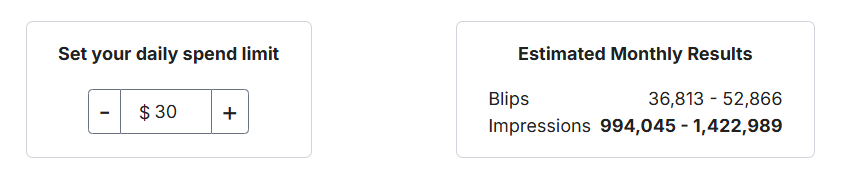
With Blip, the cost of billboard advertising in Brandywine is flexible and easy to manage. You set a daily budget, and Blip only charges you when your ad actually appears as a 7.5-to-10-second “blip” on a rotating digital billboard, starting at just $0.01 per display. Pricing changes based on time of day, location, and advertiser demand, while Blip’s algorithm works to get the most reach from your budget.
Where can I advertise with Blip in Brandywine, Maryland?
Brandywine’s strongest billboard opportunities are along major travel corridors like US 301 and MD 5, where daily traffic is concentrated. The area also connects to the Beltway and MD 210 for broader metro and leisure reach. That makes it practical to target commuters, shoppers, and visitors headed toward places like National Harbor and Waldorf.
What makes Brandywine, Maryland a good market for Blip billboards?
Brandywine gives us a strong billboard market because it sits at the crossroads of southern Prince George’s County, nearby Charles County, and the broader Washington-Arlington-Alexandria metro area of about 6.3 million residents. The area is highly car-oriented, with about 70% of workers driving alone to work countywide and daily trips concentrated on a small number of major roads, especially US 301 and MD 5. That combination of regional pass-through traffic, suburban household spending, and nearby leisure destinations makes Brandywine a practical place to build awareness and drive action with digital billboards.
Who are the main audiences for billboard advertising in Brandywine, Maryland?
The biggest everyday audience is still the commuter, and about 7 in 10 county workers drive alone to work with average commute times above 35 minutes. Brandywine is also a strong family and homeowner market, with owner occupancy around 63% and Prince George’s County Public Schools serving more than 130,000 students. Nearby destination traffic from National Harbor, MGM National Harbor, and Show Place Arena also adds event visitors and leisure travelers to the mix.
When is the best time to run a billboard campaign in Brandywine, Maryland with Blip?
Fall is one of the best billboard seasons in Brandywine because commuting normalizes, schools are back, and family routines become more predictable. Friday afternoons and Saturdays are especially valuable in summer because they catch people before leisure plans are finalized. In the morning, 6 a.m. to 10 a.m. can work well for northbound commuting, while 3 p.m. to 7 p.m. is useful for evening return traffic.
Do I need a contract to advertise with Blip in Brandywine?
No, Blip has no long-term contracts or minimum commitments. You can start, pause, or stop your campaign at any time.
How fast can I launch a billboard campaign with Blip in Brandywine?
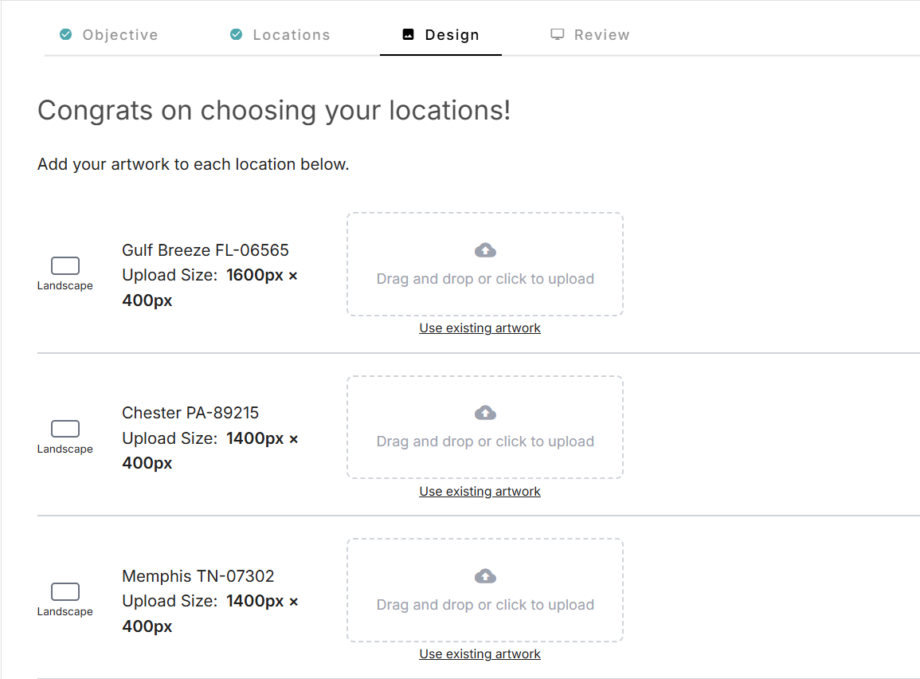
You can have your campaign live in minutes. Create a free account, select your locations, set your budget, upload your design, and start running once approved.
Where can I advertise with Blip in Brandywine?
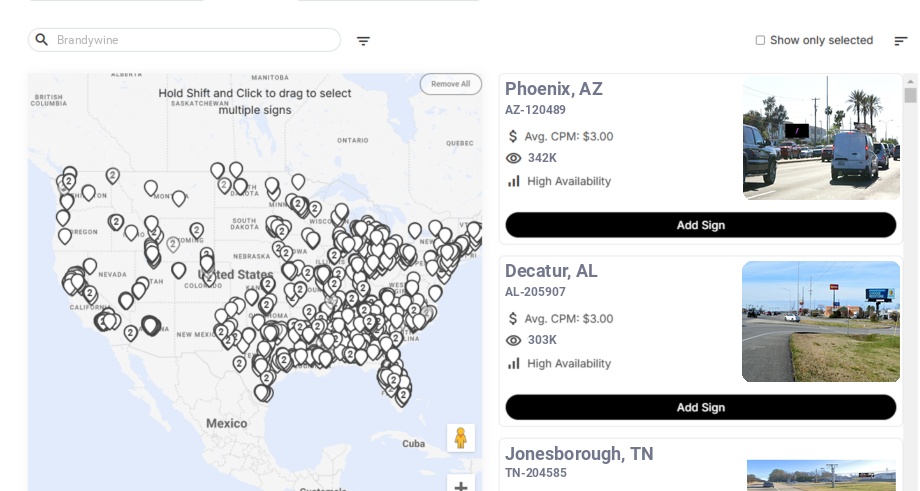
Blip has digital billboards in Brandywine. You can browse available locations on a map, choose the ones that fit your audience, and start advertising right away.
Still have questions? Launch a campaign in minutes — no contracts, no commitments.
Start Your CampaignBrandywine Billboard Advertising Guide
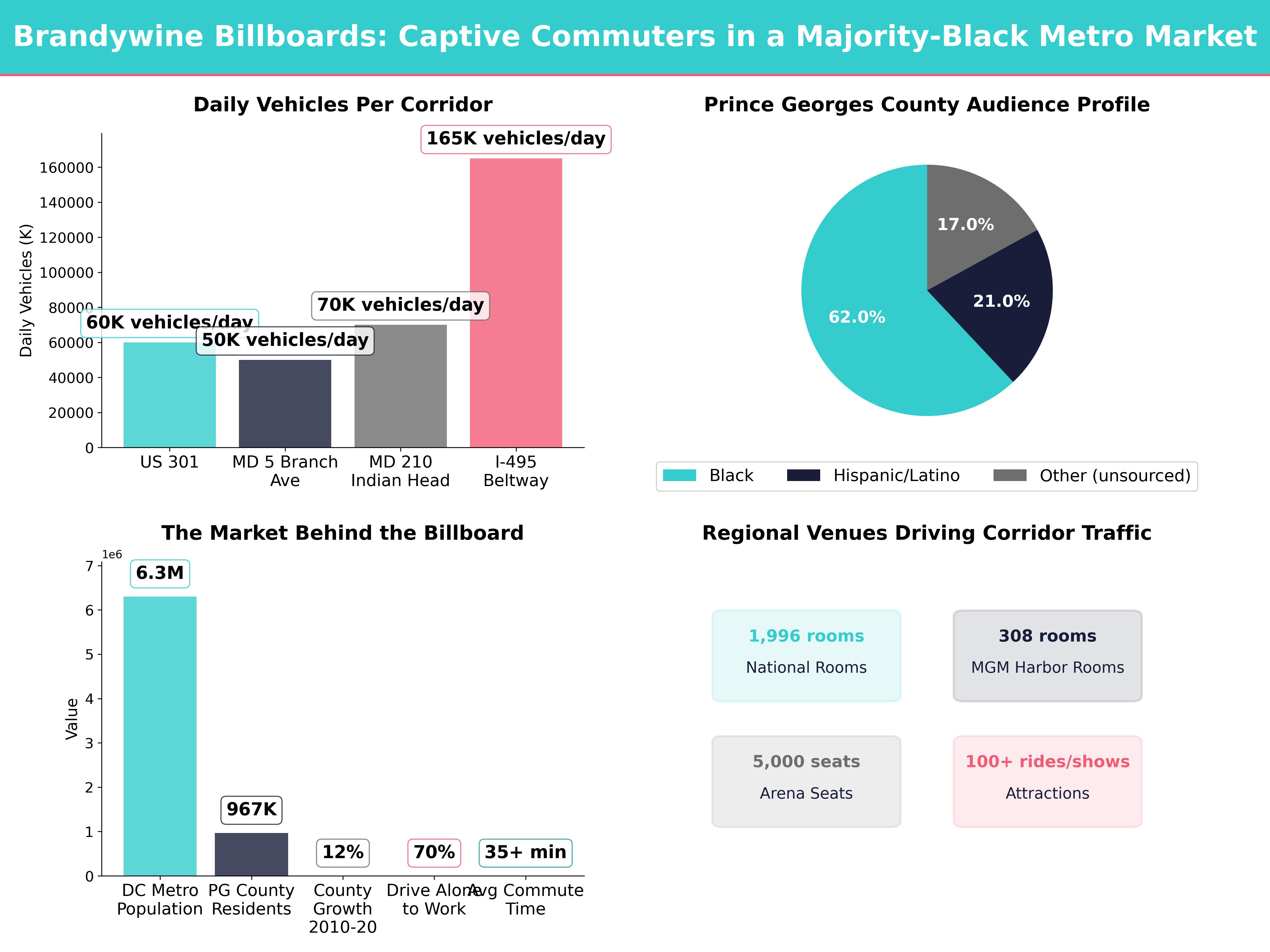
Brandywine gives us a strong billboard market because it sits at the crossroads of southern Prince George’s County Charles County 6.3 million residents. Even though Brandywine is not a dense urban core, it benefits from a much larger surrounding population, including 967,201 residents in Prince George’s County and 166,617 more in Charles County. The area is highly car-oriented, with about 70% of workers driving alone to work countywide and daily trips concentrated on a small number of major roads, especially US 301 and MD 5. That combination of regional pass-through traffic, suburban household spending, and nearby leisure destinations makes Brandywine a practical place to build awareness and drive action with digital billboards.
Brandywine Market Overview
Brandywine works best when we think beyond the census-designated place and focus on the larger south-county trade area. Prince George’s County grew from 863,420 residents in 2010 to 967,201 in 2020, which was an increase of about 12%. The county also includes 27 municipalities, and Brandywine sits in the path of shoppers, commuters, and families moving between places like Upper Marlboro, Bowie, Waldorf, and La Plata
The demographics are useful for message planning. Prince George’s County is one of the country’s most prominent majority-Black counties, with Black residents making up roughly 6 in 10 county residents, and Hispanic or Latino residents accounting for about 1 in 5. Recent household profiles also put owner occupancy at around 63%, with renter occupancy at roughly 37%, which tells us this is a market with a large base of settled households making recurring decisions about healthcare, automotive services, education, insurance, home improvement, and family spending.
Commuting behavior matters even more for billboards. Recent ACS profiles show that about 7 in 10 workers in Prince George’s County drive alone to work, and average travel time to work is more than 35 minutes. That gives us long, repeated exposure windows on the road, which is exactly where digital billboards perform well.
The local economy supports that daily movement. The Prince George’s County Economic Development Corporation emphasizes sectors such as healthcare, education, logistics, hospitality, retail, and professional services. Brandywine also benefits from nearby destinations like Brandywine Crossing National Harbor, MedStar Southern Maryland Hospital Center, and the event infrastructure around Show Place Arena
For advertisers, that mix means we can use Brandywine billboards for more than simple local branding.
- Retailers and restaurants can reach households making regular shopping trips along US 301 and MD 5.
- Home service companies can stay top of mind with homeowners who commute by car and often make purchase decisions on the way home.
- Healthcare, legal, and financial brands can build familiarity in a market where trust and repeated exposure matter.
- Entertainment and tourism brands can intercept residents and visitors headed toward National Harbor, Upper Marlboro, Waldorf, and other regional draws.
Key Traffic Corridors Around Brandywine
Brandywine’s strength is not random traffic dispersion. The area funnels movement into a handful of major corridors, which makes location strategy especially important. Traffic count data from the Maryland Department of Transportation and the Maryland State Highway Administration consistently show that these roads carry the bulk of the region’s driving audience, with daily counts ranging from roughly 40,000 to 180,000+ vehicles depending on the corridor.
US 301, Crain Highway, in Brandywine
US 301 is the backbone corridor for Brandywine. MDOT SHA traffic maps show Brandywine-area segments commonly carrying roughly 50,000 to 70,000 vehicles per day, depending on the exact segment and interchange. The route connects Bowie, Upper Marlboro, Brandywine, Waldorf, and La Plata
This corridor is especially strong for:
- Retail and big-box shopping, because drivers are often already in a destination mindset near Brandywine Crossing
- Automotive, tire, and repair brands, because the audience is heavily vehicle-dependent.
- Furniture, home improvement, and self-storage, because south-county households often use US 301 for longer errand runs.
- Quick-service restaurants and convenience brands, because the route supports both commuter and weekend traffic.
If our goal is immediate store visits, US 301 is usually the first corridor we should evaluate.
MD 5, Branch Avenue, and the northbound commuter flow
MD 5 is Brandywine’s other core arterial. Traffic counts on nearby segments often fall in the 40,000 to 60,000 AADT range, with heavier volumes as the route moves north toward Clinton, Camp Springs, and the Beltway. This road is one of the most important commuter paths between southern Prince George’s County and the job centers closer to Washington.
That makes MD 5 a smart fit for advertisers that need repeated weekday frequency, especially during morning and evening drive times.
- Healthcare systems can use MD 5 to build awareness before appointment decisions are made.
- Schools, colleges, and training programs can reach working adults during routine commutes.
- Professional services, including legal, tax, insurance, and real estate brands, can stay visible in a high-frequency corridor.
- Recruiting campaigns can target job seekers traveling north toward major employment centers.
MD 5 is also useful when we want to reach residents who may live in Brandywine but regularly travel toward Beltway-adjacent destinations.
I-495, the Capital Beltway, for metro-scale reach from Brandywine
Brandywine itself is south of the Beltway, but the I-495 connection is crucial for advertisers that want scale. Near the Branch Avenue area, Beltway segments regularly carry more than 150,000 vehicles per day, and some nearby segments are in the 180,000+ range. That makes the corridor highly valuable when we want to extend a Brandywine campaign into the broader Washington market without losing Prince George’s County relevance.
This strategy works especially well for:
- Hospitals and medical specialists serving a wide trade area.
- Universities and degree programs recruiting across multiple parts of the county.
- Regional events and entertainment venues that need awareness beyond one zip code.
- Consumer brands launching a promotion across southern Prince George’s County and the eastern Beltway side.
If we are promoting destinations such as National Harbor, MGM National Harbor Gaylord National Resort & Convention Center
MD 210, Indian Head Highway, and the westbound leisure connection
For some Brandywine advertisers, the most overlooked opportunity is the westbound connection toward Accokeek and Oxon Hill via MD 210. Northbound sections of MD 210 closer to the Beltway often exceed 70,000 vehicles per day, and that traffic includes leisure, entertainment, and destination-oriented travel headed to National Harbor and the southwest side of the Washington metro.
That corridor is useful for:
- Entertainment and nightlife campaigns.
- Restaurants and hospitality offers.
- Premium retail and event promotions.
- Weekend-focused campaigns aimed at couples, groups, and staycation travelers.
The nearby Tanger Outlets National Harbor, MGM National Harbor National Harbor ecosystem makes this a different audience from the Brandywine weekday commuter. We should treat it that way in both message and timing.
Brandywine Audience Segments
Brandywine is valuable because several distinct audiences overlap in the same road network. When we plan by audience instead of by city limits alone, billboard placement decisions become much clearer.
Commuters and regional workers in Brandywine
The biggest everyday audience is still the commuter. With about 7 in 10 county workers driving alone and average commute times above 35 minutes, many residents spend long stretches in the car each week. That favors advertisers who benefit from repetition, including healthcare, legal services, home services, auto services, and financial brands.
The commuter audience is especially strong on:
- US 301 for north-south movement.
- MD 5 for Washington-bound travel.
- The Beltway connection for wider regional reach.
We should remember that Brandywine commuters are often balancing work, family, errands, and school pickups in the same trip chain. Messages about convenience, trust, and time savings usually outperform abstract branding alone.
Families and homeowners in southern Prince George’s County
Prince George’s County’s roughly 63% owner-occupancy rate makes Brandywine a strong family and household market. Nearby schools, youth activities, shopping trips, and medical appointments all contribute to repeat road exposure. Prince George’s County Public Schools serves more than 130,000 students, which means there is a large population of parents making decisions about tutoring, camps, pediatric care, orthodontics, dining, and weekend recreation.
For family-focused brands, Brandywine billboards can support:
- Back-to-school promotions.
- Family dining and grocery messaging.
- Home remodeling and maintenance services.
- Health, dental, vision, and urgent care reminders.
- Community event awareness.
This is a good market for practical value propositions, especially when the ad clearly signals location and ease.
Students, adult learners, and education audiences near Brandywine
Education is not the first audience many advertisers associate with Brandywine, but it is meaningful in the broader county. The University of Maryland enrolls more than 40,000 students, and the county also includes Prince George’s Community College, Bowie State University, and access southward to the College of Southern Maryland.
That gives us several education-oriented opportunities:
- Colleges and trade schools can recruit working adults on commute corridors.
- Apartment communities can target students and staff in wider regional campaigns.
- Tutoring, test prep, and after-school programs can reach parents in family-heavy areas.
- Employers can recruit healthcare, logistics, and service workers from a broad commuter pool.
Because Brandywine sits between county educational assets and southern residential growth, it can play a valuable supporting role in education campaigns.
Event visitors and leisure travelers around Brandywine
Brandywine also benefits from nearby destination traffic. National Harbor is a 350-acre waterfront destination, Gaylord National Resort & Convention Center 1,996 rooms and 546,000 square feet of meeting space, and MGM National Harbor 308-room hotel. The Capital Wheel 180 feet over the waterfront, and Show Place Arena 5,000 people.
We can add other regional draws as well. Rosecroft Raceway 1/2-mile harness racing venue, and Six Flags America markets more than 100 rides, shows, and attractions.
This audience is ideal for:
- Hotels and short-term rentals.
- Restaurants and bars.
- Festivals, concerts, and special events.
- Attractions, casinos, shopping, and family entertainment.
- Premium service brands that benefit from higher-spending leisure traffic.
Seasonal and Timing Opportunities in Brandywine
Brandywine is not a one-season market. The road network stays relevant year-round, but the audience mix changes enough that we should adjust campaigns by season and by daypart.
Spring in Brandywine
Spring is strong for home services, healthcare, tax-related services, real estate, lawn care, and graduation-oriented campaigns. Families begin planning for summer, and shopping trips increase as weather improves. We can also use spring campaigns to capture event traffic tied to Show Place Arena Gaylord National Resort & Convention Center
This is a good season for messages such as:
- Home improvement before summer.
- Tax prep and refund-season offers from January through April.
- Prom, graduation, and celebration services.
- Spring break and weekend entertainment.
Summer travel and family activity near Brandywine
Summer is when Brandywine’s location really helps. Family travel, shopping, and weekend leisure all rise, and regional attractions become more active. Six Flags America, National Harbor, Tanger Outlets National Harbor, and MGM National Harbor
Summer campaigns often work best for:
- Restaurants and fast casual dining.
- Attractions and entertainment.
- Hotels, casinos, and nightlife.
- Auto service, roadside assistance, and travel-related retail.
- Moving, storage, and apartment campaigns.
Friday afternoon and Saturday placements are especially valuable in summer because they catch people before leisure plans are finalized.
Fall timing in Brandywine
Fall is one of the best billboard seasons in Brandywine because commuting normalizes, schools are back, and family routines become more predictable. Prince George’s County Public Schools typically return in late August, which restarts daily school and work trip chains. Colleges also return to session, and county event schedules become more active.
This is a strong period for:
- Back-to-school retail and tutoring.
- Healthcare open enrollment messaging.
- College recruitment and adult education.
- Family dining and after-school activities.
- Political, nonprofit, and community awareness campaigns.
If our audience is commuters, fall is often the best season to lean into weekday frequency.
Holiday and winter opportunities around Brandywine
Holiday shopping gives Brandywine a clear retail role, especially around Brandywine Crossing National Harbor and Gaylord National Resort & Convention Center
Winter campaigns work well for:
- Retail promotions and gift messaging.
- Restaurants, events, and holiday outings.
- Healthcare reminders, including urgent care and year-end benefits usage.
- Tax services starting in January.
- Gym, wellness, and self-improvement offers in the new year.
Shorter daylight hours also mean illuminated digital billboards begin standing out earlier in the afternoon commute.
Billboard Design Tips for the Brandywine Market
Brandywine is a route-driven market, so our creative should feel useful to drivers, not decorative. The best ads usually combine a local cue, a clear offer, and a fast visual read.
Use Brandywine-specific directional language
Drivers in this market think in roads, exits, and nearby places. Creative tends to perform better when it acknowledges that behavior directly.
We should use phrasing like:
- “Next exit in Brandywine.”
- “Before Waldorf on 301.”
- “North on 5.”
- “Minutes from Brandywine Crossing
- “On the way to National Harbor.”
That style works because Brandywine drivers are often making decisions in motion. A billboard that helps them orient is more actionable than one that only states a brand name.
Reflect the actual households we reach in Brandywine
The county’s population is roughly 62% Black and about 21% Hispanic or Latino, so inclusive casting and culturally aware creative matter. We should show families, professionals, students, and homeowners who look like the people actually traveling these roads.
Messages that usually fit the market include:
- Trust and reliability.
- Value and convenience.
- Family use cases.
- Local pride and neighborhood relevance.
- Time-saving solutions for busy households.
Political-junkie creative that feels hyper-insider to downtown Washington often misses the mark south of the Beltway. Brandywine audiences usually respond better to practical, everyday benefits.
Match the creative style to the corridor
Not every Brandywine-area board should say the same thing.
- On US 301, price points, store openings, and “shop now” language often fit the destination-shopping mindset.
- On MD 5, service businesses, healthcare, education, and recruiting messages often benefit from weekday repetition.
- Near I-495 and MD 210, event, hospitality, and entertainment ads can feel more natural because the audience includes more regional and leisure traffic.
We should also keep visual hierarchy simple. One idea, one location cue, and one call to action usually work best in a fast-moving corridor.
Regional Strategies Within Greater Brandywine
Brandywine works best when we divide the market into sub-areas instead of treating every billboard the same.
The Brandywine retail core
The immediate Brandywine area, especially around Brandywine Crossing
If we operate a nearby business, this is where messages like “today,” “this weekend,” and “next exit” can do real work.
Northbound from Brandywine toward Clinton, Camp Springs, and the Beltway
This strategy is ideal when our audience lives in south county but works farther north. We should emphasize commute windows, professional services, healthcare, recruiting, and education. If we want working adults to remember us during repetitive weekday travel, this is usually the most efficient direction.
This corridor also supports campaigns tied to WMATA park-and-ride behavior and larger Washington-bound commuting patterns.
Southbound from Brandywine toward Waldorf and Charles County
A southbound strategy lets us extend beyond Prince George’s County and tap into Charles County 166,617 residents in 2020. That audience includes shoppers, homeowners, and families who regularly travel between Waldorf, Brandywine, and the Washington side of the region.
This approach works well for:
- Furniture and home improvement.
- Auto dealers and service centers.
- Medical offices and specialists.
- Regional retail and dining.
- Storage, moving, and real estate services.
Southbound boards are especially useful when our business serves both Prince George’s and Charles counties.
Westbound from Brandywine toward Accokeek and National Harbor
This is the leisure and premium-spending strategy. National Harbor, MGM National Harbor Gaylord National Resort & Convention Center Rosecroft Raceway
We should lean into:
- Entertainment.
- Dining.
- Events.
- Hospitality.
- Premium services.
- Weekend promotions.
This is often where stronger photography, aspirational imagery, and event-driven timing make the most sense.
Eastbound from Brandywine toward Upper Marlboro and Bowie
The eastbound strategy is useful for countywide awareness, family attractions, and event support. Show Place Arena Six Flags America, Prince George’s Community College, Bowie State University, Upper Marlboro, and Bowie give this side of the county a different audience mix than the Brandywine retail core.
For advertisers with broader service areas, this is where we can shift from hyperlocal messaging to countywide visibility.
Using Blip Tools in Brandywine
Blip is especially useful in Brandywine because the market has clear corridor logic. We do not need to lock into a rigid plan if traffic patterns, weather, or seasonal behavior shift.
Use Blip-optimized campaigns when we want broad Brandywine coverage
If our goal is general awareness across southern Prince George’s County, parts of Charles County, and the corridors feeding the Beltway or National Harbor, an optimized campaign can spread budget across the most useful participating boards. That approach is a good fit for healthcare systems, colleges, regional retailers, and multi-location service brands.
Use manual selection when Brandywine intent matters most
If we care about a very specific behavior, manual selection usually makes more sense. For example, we might focus tightly on boards near the US 301, MD 5 interchange if we want store visits in Brandywine, or we might choose National Harbor-oriented routes if we are promoting entertainment or hospitality.
Dayparting is also important here. In Brandywine, we should often test:
- 6 a.m. to 10 a.m. for northbound commuting.
- 3 p.m. to 7 p.m. for evening return traffic.
- Friday afternoons for weekend planning.
- Saturdays for shopping and leisure-heavy campaigns.
Use creative variants and analytics to refine Brandywine campaigns
Brandywine is a good market for localized creative testing. We can run one version for southbound shoppers, another for northbound commuters, and a third for leisure traffic heading toward National Harbor or Upper Marlboro. Blip’s artwork tools also make it easier to build versions that swap a route cue, a date, a price point, or a neighborhood reference without rebuilding the entire campaign.
As results come in, we can shift spend toward the corridors and times that are actually producing response.
Getting Started With Billboard Rental in Brandywine
Renting a billboard in Brandywine is easiest when we start with the goal, not the screen.
Define what success looks like in Brandywine
We should first decide whether we want store traffic, countywide awareness, event attendance, website visits, or lead generation. A local Brandywine retailer will usually prioritize boards near shopping approaches, while a regional service brand may need a wider mix across Brandywine, Waldorf, Clinton, and Beltway connectors.
Evaluate Brandywine billboard locations by travel behavior
The best board is not always the one closest to us. We should evaluate each option by asking:
- Is the audience moving toward our location or away from it?
- Is the board near a decision point, such as an exit, a retail cluster, or a corridor split?
- Does the board match weekday commuting, weekend shopping, or leisure travel?
- Will the same drivers see the ad repeatedly enough to build recall?
In Brandywine, travel direction matters a lot because the market is shaped by just a few major corridors.
Start small, learn quickly, and scale what works
Traditional billboard buying can involve slower availability checks, packaged schedules, and less flexibility. With Blip, we can usually launch faster, test creative with modest budgets, and change direction as we learn. A practical starting point is to run a focused campaign for 2 to 4 weeks, watch which corridors and dayparts perform best, and then expand into adjacent routes once we see traction.
For many advertisers, a simple rollout works best:
- We choose a goal and a trade area.
- We select commuter, retail, or leisure corridors that fit that goal.
- We build artwork that names the place, the offer, and the next step.
- We launch, measure, and refine.
In Brandywine, that process tends to work because the market is so readable. The roads are predictable, the audiences are repeat travelers, and the surrounding region keeps supplying new shoppers, commuters, and event visitors. When we match our boards, timing, and creative to those local habits, Brandywine can deliver much more than pass-through awareness.