Billboards near Woodlawn, MD
No Minimum Spend. No Long-Term Contracts. Just Results.
Trusted by Leading Brands


Billboard advertising
near Woodlawn has never been easier
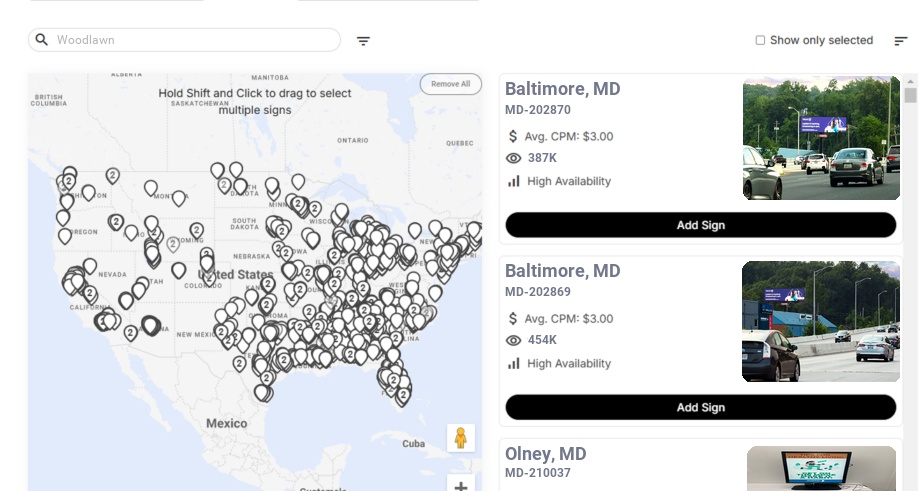



How much is a billboard near Woodlawn?
Why Choose Blip for Billboard Advertising near Woodlawn
-
Blip's self-serve platform lets you launch Woodlawn billboards fast and target I-695 and I-70 commuters without traditional media-buying delays.
-
Set a flexible daily budget for Woodlawn and Blip keeps you on track, so you can reach SSA, CMS, and Security Boulevard traffic without long contracts.
-
Use Blip-optimized campaigns in Woodlawn to auto-pick the best boards and times for Beltway rush hours, midday errands, or weekend shopping.
-
Daypart Woodlawn ads to hit 6-9 a.m. and 3-7 p.m. commuters near I-695, or shift spend to evenings when local shopping traffic climbs.
-
Track Woodlawn performance in real time with Blip, then adjust creative and timing as traffic changes on U.S. 40 and Security Boulevard.
-
Blip's creative tools make it easy to build bold Woodlawn ads for diverse commuters, federal workers, and healthcare pros in seconds.
Frequently Asked Questions About Billboard Advertising near Woodlawn
How much does a billboard cost near Woodlawn, Maryland with Blip?
With Blip, you set your own daily budget for Woodlawn billboards, and the system automatically keeps your campaign within that limit. You only pay for the individual “blips” you receive, and each ad plays for 7.5 to 10 seconds. The price of each blip changes based on the time of day, location, and advertiser demand, so you can start on any budget and adjust your spending at any time.
Where can I advertise near Woodlawn, Maryland with Blip?
Blip’s digital billboards in nearby Baltimore can help advertisers reach the Woodlawn area along key commuter routes. Woodlawn sits near I-695, I-70’s eastern terminus, Security Boulevard, and U.S. 40, which are major traffic corridors feeding the area. This setup offers high visibility for residents, commuters, and visitors moving through western Baltimore County.
What kind of traffic is around Woodlawn, Maryland for billboard ads?
Woodlawn sits at the nexus of major roads that carry heavy daily traffic. Recent AADT volumes include I-695 near the I-70 interchange at often 160,000–180,000 vehicles per day, I-70 approaching the Beltway at 80,000–95,000, Security Boulevard at 45,000–60,000, and U.S. 40 at 35,000–50,000. These counts translate into millions of monthly vehicle impressions along corridors feeding the Woodlawn area.
Who is the audience for Woodlawn, Maryland billboards with Blip?
Woodlawn is a dense, commuter-heavy community with a 2020 population of roughly 40,000 people and a median age around 36–37 years. The area is majority Black, with sizable White, Asian, and Hispanic/Latino communities, and it includes a large middle-income base plus commuters with higher incomes working for federal agencies and healthcare systems. This makes it a strong market for employment, education, retail, dining, and healthcare messaging.
When is the best time to run billboard ads in Woodlawn, Maryland?
Weekday rush hours from 6–9 a.m. and 3–7 p.m. are strong for reaching commuters linked to SSA, CMS, and downtown Baltimore employers. Midday is useful for local errands, while evenings and weekends can be effective for shopping and entertainment. By allocating more budget to the most relevant time blocks, you can keep visibility high when your core audience is actually on the road.
Do I need a contract to advertise with Blip near Woodlawn?
No, Blip has no long-term contracts or minimum commitments. You can start, pause, or stop your campaign at any time.
How fast can I launch a billboard campaign with Blip near Woodlawn?
You can have your campaign live in minutes. Create a free account, select your locations, set your budget, upload your design, and start running once approved.
Where can I advertise with Blip near Woodlawn?
Blip has digital billboards near Woodlawn. You can browse available locations on a map, choose the ones that fit your audience, and start advertising right away.
Still have questions? Launch a campaign in minutes — no contracts, no commitments.
Start Your CampaignWoodlawn Billboard Advertising Guide
Located just west of Baltimore along the I-695 Beltway, Woodlawn is a dense, commuter-heavy community anchored by major federal offices and diverse neighborhoods. With Blip’s digital billboards in nearby Baltimore serving the Woodlawn area, we can help advertisers put timely, targeted messages in front of residents, commuters, and visitors as they move through this busy western Baltimore County corridor. For brands specifically seeking billboards near Woodlawn without paying downtown Baltimore rates, this setup offers high visibility along key commuter routes at flexible budgets.
Understanding the Woodlawn Area Market
Woodlawn is a census-designated place in western Baltimore County with a 2020 population of roughly 40,000 people (about 40,100 residents) packed into about 9 square miles. That’s a population density in the range of 4,100–4,300 residents per square mile—significantly higher than the overall Baltimore County density of about 1,450 residents per square mile reported in recent county planning documents from Baltimore County Government
A few defining market traits:
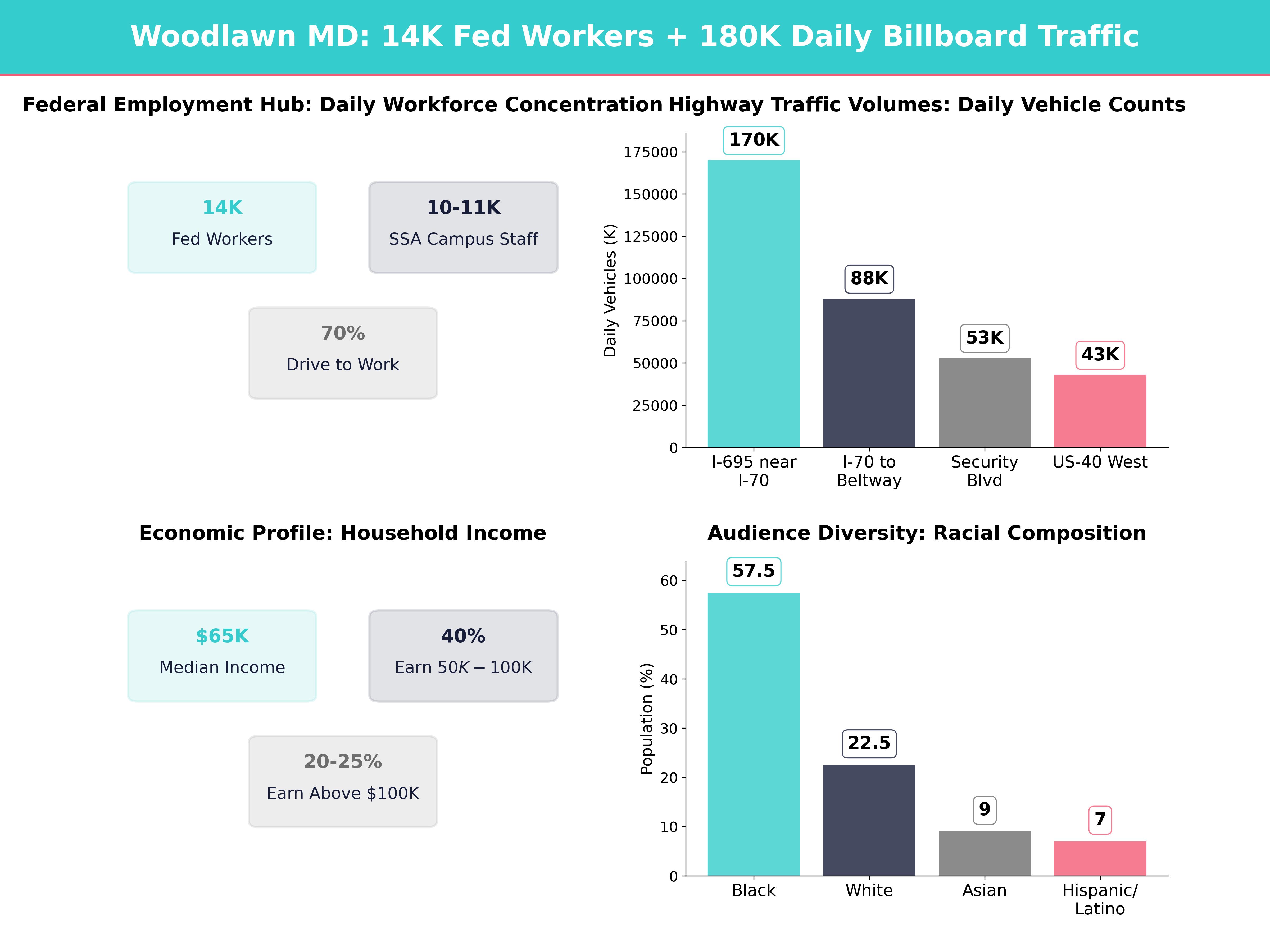
- Government and healthcare hub: Woodlawn hosts the national headquarters of the Social Security Administration Centers for Medicare & Medicaid Services (CMS). Publicly available workforce figures indicate that the SSA’s Woodlawn campus supports on the order of 10,000–11,000 employees, while CMS operations in the same complex add several thousand more, creating a combined federal employment center easily exceeding 14,000 daily workers on and around the campus. Daily inbound and outbound traffic tied to these complexes, plus contractors and vendors, generates tens of thousands of weekday trips and a powerful commuter audience for billboard advertising near Woodlawn.
- Strong regional ties to Baltimore: Baltimore City’s population is about 569,000, while Baltimore County adds another 856,000+ residents, according to recent estimates cited by Baltimore City and Baltimore County
-
Proximity to key arteries: Woodlawn sits at the nexus of I‑695 (Baltimore Beltway), I‑70’s eastern terminus, Security Boulevard, and U.S. 40 (Baltimore National Pike). According to the Maryland Department of Transportation and State Highway Administration, recent average annual daily traffic (AADT) volumes for this area include:
- I‑695 near the I‑70 interchange: often 160,000–180,000 vehicles per day.
- I‑70 approaching the Beltway: frequently 80,000–95,000 vehicles per day.
- U.S. 40 west of Baltimore City: regularly 35,000–50,000 vehicles per day.
- Security Boulevard segments near the federal complex: commonly 45,000–60,000 vehicles per day. These counts translate into millions of monthly vehicle impressions along corridors feeding the Woodlawn area and make billboard rental near Woodlawn a strong option for advertisers that want consistent reach among commuters.
When we combine this geography with flexible digital billboard scheduling, advertisers can zero in on high-value traffic patterns near Woodlawn while still benefiting from metro-wide exposure in the Baltimore area.
Audience & Demographics Around Woodlawn
To craft effective billboard creative serving the Woodlawn area, we should start with who lives and works there. Understanding these audience traits helps ensure that billboard advertising near Woodlawn feels relevant and tailored rather than generic.
Key demographic characteristics (latest available Census-based estimates for Woodlawn CDP and Baltimore County, as summarized in regional planning profiles from Baltimore Metropolitan Council
-
Population size & age
- Woodlawn: ~40,000 residents, with a median age around 36–37 years.
- Baltimore County overall: about 855,000+ residents, median age about 39 years.
- Roughly 62–65% of Woodlawn residents are in the 18–64 working-age bracket, and around 22–25% are under age 18.
- Implication: A relatively young, working-age core audience—prime for employment, education, retail, dining, and entertainment messaging.
-
Household income
- Woodlawn median household income is in the mid–$60,000s (about $63,000–$67,000).
- Baltimore County median household income is in the upper–$70,000s (roughly $75,000–$80,000).
- In Woodlawn, a sizable share of households (often 40%+) earn between $50,000 and $100,000 annually, with an additional 20–25% earning above $100,000.
- Implication: The area includes a large middle-income base plus commuters with higher incomes who work for federal agencies, healthcare systems, and regional corporations, making it attractive for both value and premium offerings.
-
Diversity
- Woodlawn’s population is majority Black, often reported at around 55–60% of residents, with sizeable White (roughly 20–25%), Asian (about 8–10%), and Hispanic/Latino communities (about 6–8%).
- Baltimore County as a whole is now “majority-minority,” with people of color collectively making up slightly more than 50% of the population, reflecting a broader trend toward diversity across the region.
- Implication: Inclusive, culturally aware creative—imagery that reflects different ages, races, and family types—tends to resonate better near Woodlawn.
-
Education & employment
- In Woodlawn, roughly 85–90% of adults 25+ have at least a high school diploma, and around 30–35% have an associate degree or higher. In Baltimore County overall, bachelor’s degree attainment is closer to 37–40%.
- Major employment sectors in western Baltimore County, as documented by Baltimore County Department of Economic & Workforce Development
- Nearby anchors such as the University of Maryland, Baltimore County (UMBC), major hospital systems like LifeBridge Health University of Maryland Medical System, and large school systems such as Baltimore County Public Schools
- Implication: B2B and recruitment campaigns (e.g., tech, healthcare, call centers, logistics) can do well by targeting the professional commuter base. Educational institutions and training programs can also reach upskilling adults.
Using this data, we can tailor language, tone, and offers. For example, an urgent-care clinic might highlight convenient evening hours for working professionals, while a college could emphasize part-time or online programs near Woodlawn for adults balancing full-time employment and seeing messages on billboards near Woodlawn during their commute.
Traffic Patterns: Where and When to Focus Campaigns
Our Blip digital billboards in Baltimore are strategically positioned to capture traffic serving the Woodlawn area, particularly along routes that residents and commuters naturally travel. Thoughtful placement and scheduling turn basic billboard rental near Woodlawn into a more precise, data-informed media buy.
Key Corridors Affecting Woodlawn
When planning dayparting and budgets, it helps to understand the primary flows:
-
I‑695 (Baltimore Beltway) west and northwest
- Connects Woodlawn to Towson, Pikesville, Catonsville, and the rest of the metro.
- I‑695 segments between I‑70 and I‑83 consistently rank among the region’s busiest, with AADT levels often well above 150,000 vehicles per day, per Maryland DOT traffic monitoring
- Carries commuter traffic looping around the city and heavy truck traffic bypassing downtown; trucks can represent 8–12% of total volume on certain Beltway segments.
- Ideal for: Commuter-focused campaigns, regional brand awareness, retail with multiple locations in the Baltimore area.
-
I‑70 terminus near Security Boulevard
- Feeds traffic from western Maryland directly into the Beltway at Woodlawn; AADT near the terminus often falls between 80,000 and 95,000 vehicles per day.
- Many inbound commuters use this route to reach the SSA and CMS campuses; federal employment commute surveys for the area suggest that more than 70% of employees drive alone or carpool.
- Ideal for: Employer recruitment, federal contractor services, B2B tech, professional services, and hospitality that targets out-of-area visitors heading into the Baltimore region.
-
Security Boulevard & U.S. 40
- Heavily trafficked surface roads for local shopping, dining, and services.
- Depending on the specific segment, Security Boulevard can see 45,000–60,000 vehicles per day, while U.S. 40 around the Baltimore County line typically handles 35,000–50,000 vehicles daily.
- Connect Woodlawn to Catonsville, Gwynn Oak, and other nearby neighborhoods, as well as shopping areas like Security Square Mall and retail clusters highlighted by Enjoy Baltimore County
- Ideal for: Stores, restaurants, gyms, auto services, and medical practices aiming at everyday local errands.
Use MDOT’s traffic counts and planning resources from Maryland DOT and the MDOT SHA traffic volume maps Baltimore County Government Baltimore County Department of Public Works & Transportation
Timing Strategies with Blip
Blip lets us buy “blips” (individual ad plays) at specific times of day and days of week. For the Woodlawn area, consider:
-
Weekday rush hours (6–9 a.m., 3–7 p.m.)
- In many commuter corridors around Woodlawn, more than 55–60% of weekday traffic occurs between 6–10 a.m. and 3–7 p.m., based on hourly profiles from MDOT count stations.
- Capture thousands of daily commuters linked to SSA, CMS, and downtown Baltimore employers, as well as students and staff traveling to UMBC and other campuses.
- Best for: Recruitment, transit alternatives, financial services, coffee and quick-service restaurants, and brand-awareness plays.
-
Midday (10 a.m.–3 p.m.)
- Often accounts for roughly 25–30% of daily traffic volume on major arterials but with a higher share of local trips and errands.
- Strong for local errands: grocery, healthcare appointments, school runs, and shopping along corridors like Security Boulevard and U.S. 40.
- Best for: Retail promotions, medical and dental offices, daycare, senior services, and government/public information.
-
Evenings and weekends
- Weekend traffic on shopping and entertainment corridors can rival or exceed weekday volumes; local retail centers in western Baltimore County report that 35–45% of weekly visits occur Friday–Sunday.
- Tap into leisure and family activities across the metro, including events and attractions promoted by Visit Baltimore Visit Maryland
- Best for: Dining, entertainment, events promoted by Visit Baltimore
By allocating more budget to the most relevant time blocks, we can stretch spend while keeping visibility high when our core audience is actually on the road and most likely to notice Woodlawn billboards along their route.
Crafting Creative That Works Near Woodlawn
For digital billboards serving the Woodlawn area, we should design specifically for fast-moving Beltway and arterial traffic.
Visuals and Copy
- Large, high-contrast text: Industry legibility studies suggest that drivers have about 6–8 seconds to view a billboard, but on high-speed roads they may process the main message in under 2 seconds. Aim for 6–8 words maximum on the main line. Use clean fonts and strong color contrast so drivers traveling 55–65 mph can understand the message quickly.
- Locally grounded language: Phrases like “Minutes from Security Boulevard,” “Just off the Beltway,” or “Near the SSA complex” help people immediately place your location. Referencing well-known landmarks—SSA campus, CMS, Security Square Mall area, or “just 10 minutes from the Beltway”—anchors your message and signals that your business is genuinely local to those seeking billboard advertising near Woodlawn.
- Reflect the area’s diversity: With more than half of Woodlawn residents identifying as Black and a combined 40%+ identifying as White, Asian, Hispanic/Latino, or multiracial, use imagery that represents the racial and age diversity of Woodlawn and Baltimore County. Campaigns that show multi-generational families or varied workplaces typically generate broader identification.
-
Clear calls to action: For commuters, CTAs should be simple:
- “Apply today at …”
- “Exit now for …”
- “Open evenings & weekends”
- “Scan to save 20%” (QR codes can work at certain slower-traffic locations, but we should test and avoid over-relying on them where speeds are high.)
Creative Variations Leveraging Digital
Because Blip is fully digital, we can schedule multiple creatives and rotate them dynamically:
- Directional creatives: One design for eastbound commuters (“Next right on Security Blvd”) and another for westbound (“Exit 1 mile for …”). This is especially effective on Beltway segments where daily directional flows can top 70,000 vehicles in each direction.
- Time-sensitive offers: Happy hour specials from 3–7 p.m., weekend-only sales, or time-limited registration deadlines for schools and programs. For example, during back-to-school season when local retailers report double-digit percentage increases in weekend foot traffic, countdown-style creatives can heighten urgency.
- Weather-aware themes: Baltimore’s climate data show roughly 30+ days per year with high temperatures above 90°F and 15–20 days with measurable snowfall. On hot, humid summer days, emphasize cold drinks, indoor attractions, and HVAC services. In winter, promote heating tune-ups and indoor family activities.
- Language variations: If your audience data supports it, test bilingual English/Spanish creatives for services with strong Hispanic outreach near the Woodlawn area, where Spanish-speaking households account for a growing share—often 5–8% of local residents.
Local Industries & Use Cases That Perform Well
Because Woodlawn is part of a large, diversified metro, many verticals can succeed. Some of the highest-potential categories for boards serving the Woodlawn area include:
1. Government Contractors & Professional Services
With SSA and CMS headquartered near Woodlawn, plus federal offices in downtown Baltimore and at sites like the Social Security Administration’s Woodlawn campus
- The federal government and related contractors represent thousands of professional and technical jobs in the immediate area; public data indicate that federal civilian employment in the Baltimore region exceeds 40,000 positions.
- Highlight contract vehicles, cloud and cybersecurity services, health IT, and staffing solutions.
- Time ads to morning and evening commutes for federal and contractor employees; surveys of Baltimore-area commuters by regional planners such as the Baltimore Metropolitan Council
- Emphasize clearance-friendly roles or remote/hybrid options in recruitment campaigns.
2. Healthcare & Insurance
Between CMS, area hospitals, urgent care, and specialty practices:
- Healthcare and social assistance represent one of the largest employment sectors in Baltimore County, accounting for roughly 15–20% of all jobs, according to Baltimore County economic reports
- Promote open enrollment periods, Medicare Advantage and supplemental plans, and local clinics—particularly important given that more than 15% of Baltimore County residents are age 65+.
- Use simple, outcome-driven lines: “Same-day appointments,” “Walk-ins welcome,” “Medicare questions? We can help.”
- Focus heavier budgets during fall open enrollment (typically October–December) and January–March when healthcare decision-making peaks and claims data show high utilization.
3. Education & Training
With a young, working population and nearby institutions:
- Institutions like UMBC, Community College of Baltimore County (CCBC), and local trade schools collectively serve tens of thousands of students each semester in the Baltimore region.
- Universities, community colleges, and trade schools can promote degrees, certificates, and bootcamps.
- Launch heavier campaigns in May–September for fall enrollments and November–January for spring starts; these windows align with financial aid and registration deadlines.
- Use concise program hooks: “IT training in 6 months,” “Evening nursing classes,” “Debt-free trade careers.”
4. Retail, Dining, and Entertainment
Woodlawn-area residents and commuters regularly travel into Baltimore and nearby suburbs for shopping and fun:
- Retail sales in Baltimore County exceed $15 billion annually across categories like food, clothing, and general merchandise, based on county economic summaries.
- Feature promotions for malls, strip centers, restaurants, and entertainment venues highlighted by Visit Baltimore Enjoy Baltimore County
- Run weekend-heavy and evening-heavy schedules for movies, live music, and sports events at venues promoted by local media such as Baltimore Sun, WBAL-TV, and WJZ-TV.
- Use countdown creatives (“This weekend only,” “3 days left,” “Tonight at 7 p.m.”) to drive urgency; event marketers often see 20–30% of total ticket sales come in the final week before an event.
5. Local News, Events, and Public Information
Local media like the Baltimore Sun, WBAL-TV, WJZ-TV, and WMAR-2 News demonstrate how news and events drive interest:
- Event organizers can promote festivals, cultural events, and community meetings across the metro area; regional attractions listed by Visit Baltimore Visit Maryland
- Municipal agencies and nonprofits can share public health updates, voting reminders, or emergency messaging targeted to the west side of the metro, where quick reach along I‑695 and U.S. 40 is essential.
- Public information campaigns often measure success through increased website visits or hotline calls; even a 5–10% lift during a 4–6 week flight can justify future buys.
Seasonality and Timing in the Woodlawn Area
Seasonality in the Baltimore region is pronounced, and we can use it to our advantage.
Local climate normals from state environmental and weather summaries show:
- Average January highs around 41°F and lows around 25°F.
- Average July highs around 87°F and lows around 69°F.
- Roughly 40 inches of rain and 15–20 inches of snow per year.
That translates into four distinct seasons for campaign planning:
-
Winter (Dec–Feb):
- Weather: Cold with potential snow/ice events; darker commutes—sunset can be as early as 4:45 p.m. in December.
- Emphasis: Heating/HVAC, auto repair, healthcare, New Year promotions, tax preparation.
- Strategy: Focus on rush hours when darkness increases the visibility and impact of bright digital boards, especially along I‑695 and major arterials.
-
Spring (Mar–May):
- Weather: Milder temperatures, more travel and outdoor activities.
- Emphasis: Home improvement, landscaping, spring sports, enrollment for summer programs and schools.
- Strategy: Ramp spending as daylight extends and people begin planning projects and trips; align messaging with school calendars from Baltimore County Public Schools Baltimore City Public Schools.
-
Summer (Jun–Aug):
- Weather: Hot and humid; strong tourism and regional events.
- Emphasis: Amusement parks, waterfront activities, family attractions, summer sales, back-to-school in late July/Aug.
- Travel data from state tourism offices indicate that summer can account for 30–40% of annual leisure trips in Maryland.
- Strategy: Increase weekend and midday flights to reach families and travelers; coordinate with local events promoted by Visit Baltimore Visit Maryland
-
Fall (Sep–Nov):
- Weather: Pleasant, strong back-to-school and pre-holiday shopping season.
- Emphasis: Education, recruiting, healthcare open enrollment, retail promotions, and holiday events.
- Strategy: Carefully time promotions around school calendars and major regional events (such as fall festivals and sports seasons) to capture attention. Health plans and brokers can increase frequency during Medicare and Affordable Care Act open enrollment periods, when inquiry volumes can spike 30–50%.
Blip’s ability to quickly update artwork lets us pivot creative as seasons or events change—ideal for staying relevant in a market that experiences four distinct seasons and a full calendar of events.
Budgeting, Targeting, and Optimization with Blip
Digital billboards serving the Woodlawn area via our Baltimore placements allow for granular control over spend, timing, and testing. For businesses exploring billboard rental near Woodlawn for the first time, this flexibility reduces risk and allows for measured experimentation.
Setting a Smart Starting Budget
- Start with a daily budget that gives you consistent presence during your key dayparts—often in the range of $10–$50/day for local businesses, adjusting up for broader metro coverage or competitive seasons like November–December, when CPMs can rise 20–30% across many media channels.
- Use a test period of 2–4 weeks (14–28 days) to evaluate which time blocks and creatives produce the best lift in traffic, calls, or web visits. This duration is usually long enough to smooth out weekday/weekend variation and one-off events.
Narrowing by Time and Location
- Select boards located along routes most used by Woodlawn-area residents: Beltway segments that feed Security Boulevard and U.S. 40, and corridors between west Baltimore City and western Baltimore County, including links to neighborhoods covered by local community associations listed on Baltimore County’s community organizations pages
- Use dayparting to avoid paying for low-relevance hours (for example, overnight slots if your service operates only 9–5). In many markets, shifting spend away from 11 p.m.–5 a.m. can reallocate 10–20% of your budget into higher-impact times.
Measuring Performance
Because billboards are a top-of-funnel medium, we look for directional indicators:
- Compare website traffic, Google search volume, or branded queries in the Baltimore area before and after campaigns. A 10–25% lift in branded searches during a billboard flight is common for well-executed campaigns.
- Track offer codes or custom URLs shown only on the boards; even a handful of redemptions can be significant for high-value services.
- Watch store visits or call volume from ZIP codes near Woodlawn and western Baltimore County. Many advertisers use simple before/after comparisons in POS or CRM data for ZIP codes like 21207, 21228, and nearby areas.
- Pair results with local analytics tools or customer surveys promoted in-store or via email.
Over time, shift budget toward the creative, time blocks, and boards that correlate with best performance, using Blip’s flexibility to turn locations or schedules on and off as you learn.
Local Rules, Community Fit, and Best Practices
Baltimore City and Baltimore County have their own sign and outdoor advertising regulations. While Blip handles permitting and compliance for the boards we operate, it’s still useful for advertisers to be aware of the local context.
- Refer to Baltimore County Government’s Department of Permits, Approvals and Inspections
- In adjacent areas, consult Baltimore City Department of Transportation and Baltimore City planning resources if your messaging references city-based locations or initiatives.
- Consider community expectations: safety-oriented messaging, minimal visual clutter, and avoiding content that could be confusing at high speeds.
- Public sector and nonprofit messages—such as those around health, education, and civic participation—often resonate highly in a government-worker-heavy market like the Woodlawn area. For example, turnout initiatives around elections, flu shot campaigns, or emergency preparedness efforts promoted by local agencies have historically leveraged outdoor media to reach broad audiences quickly.
Aligning creative with local values and concerns—such as economic opportunity, healthcare access, and community pride—can help campaigns feel like part of the community rather than noise on the commute.
Bringing It All Together for the Woodlawn Area
To effectively use Blip billboards serving the Woodlawn area, we combine:
- Market knowledge
Dense, diverse neighborhoods (over 4,000 residents per square mile), substantial middle-income households (median incomes in the $60,000–$80,000 range), and major federal employers (tens of thousands of nearby government and contractor jobs) drive strong commuter and local-errand traffic. - Traffic and timing strategy
Focus on Beltway and arterial commuters during rush hours, families and shoppers midday and weekends, and seasonal peaks tied to healthcare, education, and retail—especially along corridors where daily traffic volumes routinely exceed 50,000–150,000 vehicles. - Sharp, localized creative
Short, bold copy; inclusive imagery that reflects Woodlawn’s majority-minority makeup; and references to familiar routes and landmarks like Security Boulevard, U.S. 40, and the SSA/CMS campuses. - Flexible, data-informed optimization
Use Blip’s digital flexibility to test, measure, and refine creative and scheduling without committing to long-term static buys. Track outcomes in web analytics, call logs, and in-store traffic across key ZIP codes to identify lifts of 10–20% or more during active flights.
By tying these elements together, advertisers can leverage our digital billboards in Baltimore to build powerful, efficient campaigns that truly connect with the audiences living, working, and commuting near Woodlawn, Maryland—and capture the full value of billboard advertising near Woodlawn through targeted, flexible placements that match real-world traffic and community patterns.