Billboards near Dundalk, MD
No Minimum Spend. No Long-Term Contracts. Just Results.
Trusted by Leading Brands


Billboard advertising
near Dundalk has never been easier



How much is a billboard near Dundalk?
Why Choose Blip for Billboard Advertising near Dundalk
-
Choose Blip in Dundalk to launch in minutes and reach commuters on I-95, I-895, and I-695 without traditional buying hassles.
-
Blip’s flexible budgets fit Dundalk’s value-minded households, so you can start small and scale around port and retail traffic.
-
Daypart your Dundalk campaign for 5:30-9:30 a.m. or 3:00-7:30 p.m. to catch shift workers, commuters, and families.
-
Use Blip-optimized timing in Dundalk to let the platform auto-pick billboards and plays near Broening Highway and Eastern Avenue goals.
-
Track Dundalk results in real time, then shift spend fast for Ravens, Orioles, or Heritage Fair surges near Baltimore routes.
-
No contracts with Blip means Dundalk advertisers can test ads for port jobs, healthcare, or shopping and tweak creative anytime.
Frequently Asked Questions About Billboard Advertising near Dundalk
How much does a billboard cost near Dundalk, Maryland with Blip?
With Blip, you set your own daily budget and only pay for the digital ad time you receive, making it easy to test Dundalk billboards without a big upfront commitment. Each 7.5–10 second “blip” is individually priced based on the time of day, location, and advertiser demand, so you stay in control. Because Blip is pay-per-blip, your total spend is simply the sum of those brief ad displays on billboards near Dundalk, Maryland, and you can adjust your budget or schedule anytime.
Where can I advertise with Blip near Dundalk, Maryland?
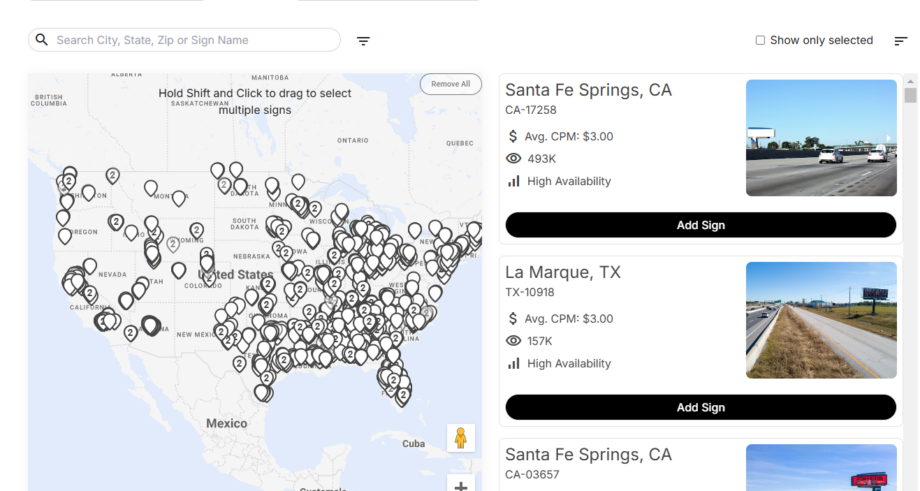
We operate three digital billboards near Dundalk, located in Baltimore within approximately 10 miles. These boards are positioned to follow natural travel patterns between Dundalk and downtown and Inner Harbor employment centers, Port of Baltimore terminals, east-side industrial areas and logistics hubs, and shopping and entertainment hubs in Baltimore and nearby suburbs. For many advertisers, this setup functions much like a cluster of billboards near Dundalk, layered along the exact routes local drivers use every day.
Who does billboard advertising near Dundalk, Maryland reach with Blip?
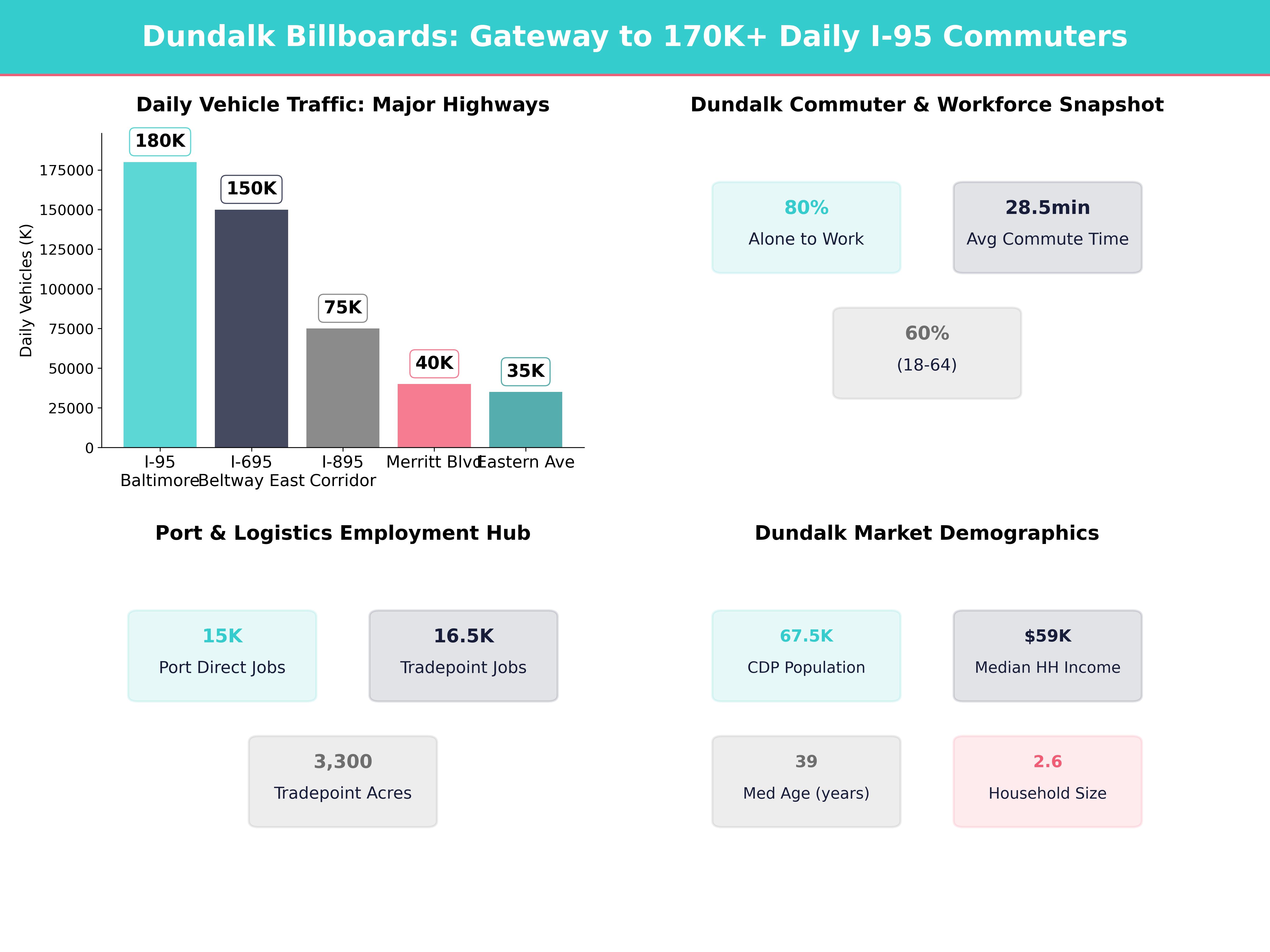
Dundalk is a blue-collar, commuter-heavy community with deep ties to manufacturing and logistics, but it’s also seeing growth in e-commerce, health care, and service jobs nearby. With more than 60% of residents in the working-age 18–64 bracket and over 80% of Dundalk workers driving alone to work, campaigns can reach workers, commuters, families, and port traffic moving through one of the most heavily traveled logistics and commuter hubs on the East Coast. The area also supports strong family-oriented messaging, value-conscious buying habits, and a mix of owner-occupied and renter-occupied households.
When is the best time to run Blip ads near Dundalk, Maryland?
Dundalk-area traffic patterns are driven by commuting, shift work, port activity, and family schedules, so Blip can align campaigns with those patterns. Morning peak runs from 5:30–9:30 a.m., evening peak runs from 3:00–7:30 p.m., and weekends can be strong for retail, family activities, and sports promotions. With Blip’s ability to buy specific hours and days, you can concentrate your budget on these high-value windows instead of paying for time blocks that don’t match your audience.
What roads and traffic patterns matter most for billboards near Dundalk, Maryland with Blip?
I-95 in the Baltimore region often carries 170,000–190,000 vehicles per day, while I-895 segments see 60,000–90,000+ vehicles per day, mixing long-distance traffic, regional commuters, and significant freight volume. The eastern and southeastern legs of I-695 routinely handle 140,000–160,000 vehicles per day, and Eastern Avenue and Merritt Boulevard also draw heavy daily traffic. Holabird Avenue and Broening Highway connect residential Dundalk to marine terminals and industrial zones, with strong concentrations of heavy trucks and shift workers during port operating hours.
Do I need a contract to advertise with Blip near Dundalk?
No, Blip has no long-term contracts or minimum commitments. You can start, pause, or stop your campaign at any time.
How fast can I launch a billboard campaign with Blip near Dundalk?
You can have your campaign live in minutes. Create a free account, select your locations, set your budget, upload your design, and start running once approved.
Where can I advertise with Blip near Dundalk?
Blip has digital billboards near Dundalk. You can browse available locations on a map, choose the ones that fit your audience, and start advertising right away.
Still have questions? Launch a campaign in minutes — no contracts, no commitments.
Start Your CampaignDundalk Billboard Advertising Guide
Dundalk, Maryland sits at the heart of Baltimore County’s Port of Baltimore, downtown Baltimore, and major commuting corridors. With three digital billboards serving the Dundalk area from nearby Baltimore, we can reach workers, commuters, families, and port traffic moving through one of the most heavily traveled logistics and commuter hubs on the East Coast. This guide outlines how to use those boards—near Dundalk—to build cost‑effective, data‑driven campaigns with Blip and get more value from billboard advertising near Dundalk without committing to long‑term contracts.
Understanding the Dundalk Area Market
Dundalk is a blue‑collar, commuter-heavy community with deep ties to manufacturing and logistics, but it’s also seeing growth in e‑commerce, health care, and service jobs nearby. That mix makes flexible digital Dundalk billboards a strong fit for reaching multiple audience types throughout the day.
Key market facts:
- Population: The Dundalk CDP has roughly 67,000–68,000 residents, placing it among the largest unincorporated communities in Maryland and a sizable standalone market within Baltimore County.
- Age & households: The median age is about 39 years, with more than 60% of residents in the working‑age 18–64 bracket. Average household size is roughly 2.6 people, reflecting a mix of single‑adult, couple, and family households. About 30%+ of households include children under 18, which supports strong family‑oriented messaging.
- Income: Median household income in the Dundalk area is in the mid‑ to upper‑$50,000s (approx. $57,000–$60,000), below the Baltimore County median (around $83,000–$89,000), reinforcing value‑conscious buying habits and strong interest in deals, promotions, and practical products. Roughly 13–15% of residents live below the poverty line, higher than the county average, which makes price and savings messages especially effective.
- Housing & tenure: Around 60–65% of occupied housing units are owner‑occupied and 35–40% are renter‑occupied, a balance that supports both home‑improvement and move‑related services (storage, furniture, leasing, real estate).
- Commuters: Over 80% of Dundalk workers drive alone to work, with an average commute time of about 27–30 minutes, and a large share commute to nearby job centers such as downtown Baltimore, the Port of Baltimore, Tradepoint Atlantic in Sparrows Point, and industrial zones along Broening Highway and Eastern Avenue. Many cross or circle the city on I‑95, I‑895, and I‑695, where our digital billboards in Baltimore can repeatedly reach them.
Helpful local context and data sources:
- Baltimore County Government Baltimore County Economic & Workforce Development
- Maryland Department of Transportation (MDOT) – traffic counts and corridor planning, including detailed AADT maps from MDOT State Highway Administration.
- Maryland Port Administration / Port of Baltimore – trade, cargo, and port employment trends.
- Visit Baltimore
- City and regional data from Baltimore City Government and Baltimore City Department of Transportation.
- Local news for on‑the‑ground trends: The Baltimore Sun, WBAL-TV 11, WJZ-TV, WMAR-2 News, and the local Dundalk Eagle.
For advertisers, this means campaigns near Dundalk should lean into:
- High frequency along commuter corridors.
- Strong, value-forward messaging that highlights savings or convenience.
- Relevance to working families, industrial and port workers, and service/healthcare employees.
Where Our Billboards Serve the Dundalk Area
We operate three digital billboards near Dundalk, located in Baltimore within approximately 10 miles. These boards are positioned to follow natural travel patterns between Dundalk and:
- Downtown and Inner Harbor employment centers.
- Port of Baltimore terminals.
- East‑side industrial areas and logistics hubs.
- Shopping and entertainment hubs in Baltimore and nearby suburbs.
Because these are flexible digital units rather than static placements, businesses can treat them as on‑demand Dundalk billboards that support both short-term promotions and always‑on brand awareness.
Key roadway dynamics to consider:
- I‑95 and I‑895: MDOT data indicate that I‑95 in the Baltimore region often carries 170,000–190,000 vehicles per day, while I‑895 segments see 60,000–90,000+ vehicles per day, mixing long‑distance traffic, regional commuters, and significant freight volume.
- I‑695 (Baltimore Beltway): The eastern and southeastern legs of the Beltway routinely handle 140,000–160,000 vehicles per day, with heavy use by Dundalk‑area residents and truck traffic circulating between the Port of Baltimore, Tradepoint Atlantic, and distribution centers.
-
Arterials feeding Dundalk:
- Eastern Avenue: Commonly records 30,000–40,000 vehicles per day on key segments linking Dundalk with Baltimore City.
- Merritt Boulevard: Serves as a major commercial spine with 35,000–45,000 vehicles per day, drawing shoppers to big‑box retail and service clusters.
- Holabird Avenue and Broening Highway: Connect residential Dundalk to marine terminals and industrial zones, with strong concentrations of heavy trucks and shift workers during port operating hours.
By using Blip’s flexible scheduling, we can align ad rotations on Baltimore boards with the times Dundalk‑area residents are heading to and from work, school, and shopping, maximizing exposure on high‑volume stretches documented by MDOT. This makes billboard advertising near Dundalk more targeted and efficient than traditional fixed‑schedule campaigns.
Key Audience Segments Near Dundalk
When planning creative and scheduling, it helps to think in terms of specific audience segments using these roads:
-
Port & Industrial Workers
- The Port of Baltimore, managed by the Maryland Port Administration, has handled more than 50 million tons of cargo annually in recent years (over 52 million tons in a recent year) and consistently ranks among the top U.S. ports for autos, farm and construction machinery, and imported sugar.
- Port activity supports an estimated 15,000+ direct jobs and more than 130,000 total jobs statewide (direct, indirect, and induced), with many workers commuting from eastern Baltimore County communities like Dundalk, Edgemere, and Middle River.
- Key employers and nearby hubs include marine terminals, warehouses, refineries, metals operations, food processing plants, and logistics companies along Broening Highway, Holabird Avenue, and Sparrows Point.
- What works: Safety gear, tools, workwear, industrial services, union and trade school messaging, shift‑friendly restaurants, auto repair, and financial services tailored to hourly and shift‑based workers.
-
Tradepoint Atlantic & Logistics Workforce
- The Tradepoint Atlantic logistics and industrial hub in nearby Sparrows Point spans more than 3,300 acres and has attracted major tenants such as Amazon, FedEx, Under Armour, and other national logistics and manufacturing brands.
- Public economic‑development updates indicate the site supports 15,000–18,000+ jobs (direct and indirect) and continues to expand, generating heavy daily flows of employee vehicles and tractor‑trailers through the east side of Baltimore County and across the Beltway.
- What works: Recruitment advertising, B2B logistics services, temporary staffing, equipment leasing, and transportation/commuter offers (ridesharing, park‑and‑ride, fleet maintenance).
-
Commuters to Downtown & Medical Corridors
- The broader Baltimore metro area has about 2.8–2.9 million residents, and downtown Baltimore and surrounding medical corridors remain among the largest job clusters in Maryland.
- Flagship institutions such as Johns Hopkins Hospital ( Johns Hopkins Medicine University of Maryland Medical Center (UMMC) together employ tens of thousands of people and treat millions of patient visits annually, drawing staff, patients, and visitors from Dundalk and neighboring communities.
- Many Dundalk commuters use I‑95, I‑895, and local arterials to reach offices, hospitals, universities, and government buildings in and around downtown.
- What works: Consumer services (insurance, banking, legal), healthcare marketing (urgent care, specialists, dental), education campaigns (community colleges, certification programs), and lifestyle brands targeting working professionals and hospital staff.
-
Families & Local Shoppers
- With a median age around 39 and stable K‑12 enrollment via Baltimore County Public Schools ( BCPS 110,000 students across the county, including multiple schools in and around Dundalk.
- Dundalk‑area households frequent nearby shopping hubs like Eastpoint Mall, Merritt Boulevard retail corridors, and regional power centers across eastern Baltimore County and into Baltimore City.
- What works: Grocery and discount retailers, family dining, after‑school programs and tutoring, youth sports and activities, local attractions, and big‑ticket purchase reminders (car dealerships, furniture, home improvement, telecom).
-
Visitors & Event-Goers
- According to Visit Baltimore tens of millions of visitors annually (more than 20–25 million in recent years), generating billions of dollars in spending on hotels, dining, and entertainment. Many of these visitors travel along I‑95, I‑895, and I‑695 near the Dundalk area to reach the Inner Harbor, casinos, and sports venues.
- Major events such as Baltimore Ravens games at M&T Bank Stadium and Baltimore Orioles games at Oriole Park at Camden Yards regularly draw 20,000–70,000+ attendees per event, depending on sport and season, with extensive regional traffic before and after games, as covered by outlets like WBAL-TV 11 and WJZ-TV.
- What works: Tourism, attractions (Inner Harbor, museums, harbor cruises), casinos, concerts, festivals, and special events, including Fourth of July at the harbor and regional fairs.
Timing: When to Run Your Blips Near Dundalk
Dundalk-area traffic patterns are driven by commuting, shift work, port activity, and family schedules. With Blip’s ability to buy specific hours and days, we can align campaigns with these patterns and make every dollar spent on billboards near Dundalk work harder.
Weekday Scheduling
-
Morning peak (5:30–9:30 a.m.)
- Traffic volumes on key commuter interstates and arterials can reach 2–3 times off‑peak levels, especially on I‑95, I‑895, and I‑695.
- Targets: Port and industrial shift workers, downtown commuters, healthcare staff going to early shifts, school‑related traffic.
- Use: Recruitment, time‑sensitive offers (breakfast, coffee, toll‑adjacent services), reminders about appointments and deadlines, mobile app sign‑ups that can be completed on arrival at work.
-
Midday (10:00 a.m.–3:00 p.m.)
- Typically steadier flows with a mix of freight, service workers, and errand traffic; MDOT counts often show midday volumes at 60–75% of peak levels on regional corridors.
- Targets: Service workers on staggered shifts, seniors, stay‑at‑home parents, small‑business owners running errands, delivery drivers.
- Use: Healthcare messages, government services, retail and grocery promotions, B2B campaigns, and calls to schedule weekday appointments.
-
Evening peak (3:00–7:30 p.m.)
- Another strong peak as port, logistics, office, and hospital workers head home; family and shopping trips increase, and game/event nights can spike volumes even further on I‑95 and I‑395 into downtown.
- Targets: Workers heading home, parents picking up kids, shoppers heading to big box stores or restaurants.
- Use: Restaurants, entertainment, urgent care, retail promotions, political ads near election cycles, and reminders about same‑day or next‑day service.
-
Late evening/overnight (8:00 p.m.–2:00 a.m.)
- Vehicle counts decline but heavy‑truck percentages rise on routes serving the Port of Baltimore and Tradepoint Atlantic, with some segments seeing 20–30% truck traffic overnight.
- Targets: Second‑ and third‑shift workers, truckers, nightlife and service employees.
- Use: Staffing and logistics recruitment, convenience stores, 24‑hour services, towing and roadside assistance, safety campaigns (DUI prevention, road safety).
Weekend Scheduling
-
Saturdays
- Retail‑focused travel increases, with many shopping centers in eastern Baltimore County experiencing some of their highest weekly foot‑traffic levels between late morning and early evening.
- Valuable for home improvement, auto, furniture, recreation, and family entertainment campaigns.
-
Sundays
- Strong for faith‑based advertising, family activities, grocery brands, and sports promotions (especially during Ravens and Orioles seasons, covered extensively by outlets like WBAL and WJZ).
- Early afternoon through evening is particularly strong during NFL season, when game‑related traffic and at‑home viewing spikes can drive interest in food delivery, sports bars, and betting or fantasy‑sports apps (where legal).
With Blip, we can concentrate your budget on these high‑value windows instead of paying for time blocks that don’t match your audience.
Creative Strategy for the Dundalk Area
To resonate near Dundalk, billboard creatives should reflect the area’s practical, working‑class character while still feeling modern and bold. Industry research consistently shows that outdoor ads are absorbed in 3–6 seconds at highway speeds, so clarity matters more than detail.
Design Principles
- Big, simple headlines: Aim for 7 words or fewer. Example: “Better Auto Repair, 10 Minutes from Dundalk.” Short headlines improve recall, especially when commuters pass the same board twice daily.
- High-contrast colors: Use bold, saturated colors and avoid detailed backgrounds—this improves legibility at distances of 500–800 feet, common for freeway viewing. High contrast can improve recognition by 20–30% compared with low‑contrast designs.
- Large contact hooks: Phone numbers should be short and easy to remember; URLs should be simple (“BrandNameDundalk.com,” or “/Dundalk” landing pages). For most campaigns, emphasize a short phrase (“Exit 59 • Turn Right”) over full addresses. Clear directional messages are especially useful on routes where 60–70% of viewers are regular commuters who can act on habitual prompts.
- One key call-to-action: “Apply Today,” “Schedule Now,” “Visit This Weekend,” or “Text DUNDALK to 12345.” Campaigns that feature a single dominant CTA typically see higher response rates than those with multiple competing actions.
Local Messaging Angles
-
Commuter relevance:
- “Beat traffic with mobile banking—sign up today.”
- “Shift starts soon? Grab coffee at [Your Brand]—Next Exit.”
-
Port & industrial identity:
- “Gear that works as hard as Dundalk.”
- “Port‑ready logistics—Same‑day response.”
-
Value-conscious households:
- “Feed the family for under $20—Tonight at [Restaurant].”
- “Save 20% on auto repairs—Dundalk area drivers only.”
-
Community pride:
- Reference local events, high school sports, and neighborhood names that residents see in sources like the Dundalk Eagle.
- Celebrate local hiring: “Now hiring in the Dundalk area—Full benefits.”
- Tie into widely attended local traditions such as the Dundalk Independence Day parade or Heritage Fair, which can draw tens of thousands of attendees over a weekend.
Use Multiple Creatives
Blip allows rotation of several designs:
- Show different offers by time of day (breakfast vs. dinner specials, or apply-now vs. shift reminder). For example, a quick‑service restaurant could push breakfast combos from 5–10 a.m., value lunches from 11 a.m.–2 p.m., and family bundles after 4 p.m.
- Test A/B variations of headlines or calls-to-action. Even small changes (e.g., price‑led vs. benefits‑led messaging) can shift response by 10–30%.
- Swap in creatives for special events like the annual Dundalk Heritage Fair or major sports games mentioned on The Baltimore Sun, aligning heavier impressions a few days before and the day of the event.
Geographic Strategy: Matching Boards to Real-World Movement
Although our billboards are in Baltimore, they’re placed to capture movement patterns of Dundalk-area residents. For many advertisers, this setup functions much like a cluster of billboards near Dundalk, layered along the exact routes local drivers use every day.
When planning, consider:
- Corridors to downtown & Inner Harbor: A large share of Dundalk commuters travel toward central business districts, the Inner Harbor, stadiums, and major medical campuses. Boards positioned along I‑95, I‑895, and key feeder roads can reach the same driver 10–20 times per month, building strong frequency.
- East‑side industrial & logistics routes: These corridors are strategic for B2B and workforce campaigns targeting Port of Baltimore facilities and Tradepoint Atlantic. On heavy‑truck routes where one in five or more vehicles is a commercial truck, messages about jobs, compliance, fuel, maintenance, and equipment financing are especially effective.
- Retail gravity: Eastern Baltimore County residents often travel through Baltimore’s east side to reach regional shopping, entertainment, and medical services. Targeting boards along these paths can influence same‑day decisions for categories like retail, dining, and urgent care.
For example:
- A quick‑service restaurant near Dundalk might focus on evening drive‑time slots on corridors leading back toward the area, to catch hungry commuters heading home, when restaurant spending typically spikes between 4–8 p.m.
- A healthcare provider near the Beltway could schedule all‑day weekday coverage along routes frequented by hospital employees and patients traveling from the Dundalk area, particularly around appointment‑heavy times (9 a.m.–1 p.m. and 4–7 p.m.).
- A trucking and logistics recruiter may emphasize late‑night and early‑morning impressions near interstate routes with strong heavy‑vehicle traffic, when many drivers begin or end long‑haul shifts.
Using Blip’s Flexibility to Your Advantage
Blip’s model—buying “blips” (individual ad plays) instead of fixed time blocks—fits well with the Dundalk area’s varied schedules and makes billboard rental near Dundalk more accessible to businesses of all sizes.
You can:
- Start with a modest daily budget and scale based on performance. For instance, start with enough budget to secure a few hundred impressions per day, then grow toward thousands of daily impressions as ROI becomes clear.
- Target specific hours (e.g., only morning and evening peaks Monday–Friday) to avoid lower‑value overnight or mid‑day periods for your category.
- Ramp up for events or seasons, like back‑to‑school periods, holiday shopping, or hiring pushes at local employers. Seasonal retail periods can boost sales 20–40% for some categories, making extra outdoor visibility especially powerful.
- Pause or shift your spend quickly in response to local news or conditions, such as port disruptions, weather, or road work covered on outlets like WMAR-2 News and The Baltimore Sun.
This flexibility is especially useful for:
- Seasonal businesses (landscaping, HVAC, tax prep).
- Event‑driven advertisers (concerts, festivals, sports).
- Small and mid‑sized businesses near Dundalk testing billboard advertising for the first time and looking to build evidence of return without long‑term contracts.
Measuring Success in the Dundalk Area
Because these boards serve, but are not physically located within, Dundalk, clear metrics and tracking are essential.
Recommended approaches:
-
Unique URLs and landing pages
- Create a Dundalk‑specific page (e.g.,
yourbrand.com/dundalk) and use it only on your billboard creative. - Track visits, form fills, and calls from that page. Look for changes in Dundalk‑area traffic of 10% or more during campaign periods compared with baseline.
- Create a Dundalk‑specific page (e.g.,
-
Promo codes & offers
- Use codes like “DUNDALK10” and log each redemption in your POS or CRM.
- Compare to control periods when the campaign is off. If you see a 5–15% uplift in redemptions during on‑air weeks, that’s a strong indicator of billboard impact.
-
Call tracking numbers
- Assign a dedicated tracking phone number to the billboard campaign and measure call volume, duration, and conversions. Call spikes that line up with your scheduled Blip hours (e.g., more calls within 30–60 minutes of morning and evening peaks) can confirm you’ve chosen the right windows.
-
Location-based lift
- Monitor sales, walk‑ins, or applications from ZIP codes near Dundalk before, during, and after your campaign to assess lift. Even a 3–5% increase in a tightly defined trade area can represent a strong ROI, especially for high‑margin services.
-
Time‑matched analysis
- If you run mostly from 6–9 a.m. and 3–7 p.m., look for corresponding increases in website traffic or inbound calls during or shortly after those windows. Pair this with analytic tools and internal reporting to connect impressions to outcomes.
Industry-Specific Tips for Advertising Near Dundalk
1. Auto Dealers & Repair Shops
- Emphasize quick service, financing options, and value pricing to align with local income levels, noting that many households operate with limited buffer for major repairs.
- Use simple, directional messages: “Brakes Fixed Today – 8 Minutes from Dundalk.” Ads with directional cues can increase dealership visits by 10–20% compared with generic branding alone.
- Run heavier on Fridays and Saturdays, when car shopping and repair visits often peak—dealerships frequently report 25–35% of weekly traffic on weekends.
- Highlight warranties, “buy here pay here” or flexible financing, and free inspection offers to appeal to cost‑sensitive drivers.
2. Healthcare & Dental
- Many residents travel to Baltimore for specialized care, while primary and urgent care options closer to Dundalk compete on convenience and appointment availability.
- Promote location convenience (“Free parking, right off I‑95”), acceptance of major insurers, and new patient specials (e.g., discounted cleanings or free consultations).
- Focus on weekday daytime and evening slots to reach both workers and caretakers; many practices see appointment peaks between 9 a.m.–1 p.m. and 4–7 p.m.
- Consider promoting walk‑in or same‑day care for urgent needs, which is especially relevant in a working‑class community with variable shift schedules.
3. Recruitment & Staffing
- Target port, warehouse, and industrial workers traveling via major corridors that serve the Port of Baltimore, Tradepoint Atlantic, and east‑side industrial parks.
- Highlight starting pay, benefits, and shift timings directly in the creative (“$22/hr • Nights & Weekends • Apply Today”), since clear wage information can significantly boost application rates.
- Increase frequency near seasonal hiring surges, using data and announcements from employers and updates from sites like the Maryland Port Administration and Baltimore County Government
- Use short URLs or text‑to‑apply codes optimized for mobile—most job seekers will see your ad on a phone‑heavy commute.
4. Restaurants & Quick-Service Food
- Rotate time‑specific creatives (Breakfast / Lunch / Dinner) aligned with drive‑time schedules. Many quick‑service brands see 30–40% of daily sales during lunch and 40–50% during dinner and late evening, so focus impressions there.
- Emphasize affordable family bundles, carry‑out, and online ordering, especially around paydays and weekends.
- Promote limited‑time offers and tie‑ins with local sports or events (e.g., game‑day specials for Ravens or Orioles games promoted through WBAL-TV 11 or WMAR-2 News).
- Weekends and pay‑days (around the 1st and 15th of each month) are strong opportunities for higher spend.
5. Education & Training
- Community colleges, trade schools, and certification programs near the Dundalk area can reach prospective students commuting to work on I‑695 and I‑95. Institutions such as the Community College of Baltimore County (CCBC) (CCBC) and local training centers regularly promote workforce programs tied to port and logistics jobs.
- Use straightforward value propositions: “Become a Certified Welder in 6 Months—Classes Near Dundalk,” or “CDL Training • Start in 30 Days.”
- Target early mornings and evenings, when prospective students are thinking about career changes and when many work‑and‑learn commuters are on the road.
- Highlight job placement rates, average starting wages, and program length to appeal to practical, outcome‑oriented audiences.
Putting It All Together
To effectively reach the Dundalk area using our digital billboards in nearby Baltimore:
- Define your core Dundalk audiences (commuters, port workers, families, or visitors) using local employment and traffic data from sources like Baltimore County Government MDOT.
- Align your schedule with real traffic patterns and shift times, emphasizing morning and evening peaks and weekend shopping/leisure windows.
- Create simple, bold, locally relevant designs that respect the area’s practical mindset and community pride, using clear offers and single calls‑to‑action.
- Use Blip’s flexible tools to focus on high‑value hours, test creatives, and ramp spend around local events and seasons highlighted by Visit Baltimore
- Measure results rigorously with unique offers, URLs, and numbers—then refine based on what works, reallocating budget toward the boards, times, and messages that produce the strongest lift.
By combining local insight about the Dundalk area with Blip’s dynamic buying model and reliable local data sources, we can build campaigns that punch above their weight, reaching the right people at the right times on the roads they actually use every day. Whether you’re exploring billboard advertising near Dundalk for the first time or optimizing an existing strategy, this approach helps turn flexible billboard rental near Dundalk into a consistent, trackable driver of business results.