Billboards near Langley Park, MD
No Minimum Spend. No Long-Term Contracts. Just Results.
Trusted by Leading Brands


Billboard advertising
near Langley Park has never been easier




How much is a billboard near Langley Park?
Why Choose Blip for Billboard Advertising near Langley Park
Choose Blip for Langley Park and launch self-serve ads fast on nearby commuter roads like New Hampshire Ave, University Blvd, and the Beltway.
Blip-optimized campaigns fit Langley Park traffic shifts, auto-picking billboards and timing for UMD events, commuters, and campus crowds.
In Langley Park, set a flexible budget and pay only when your ad blips, so you can test reach across College Park, Lanham, and Laurel.
Daypart your Langley Park campaign for 6-10 a.m. and 3-7 p.m. commute peaks, or run weekend windows for shoppers and families.
No contracts with Blip means Langley Park advertisers can pause, tweak creative, and react to seasonal spikes like back-to-school and UMD game days.
Frequently Asked Questions About Billboard Advertising near Langley Park
How much does a billboard cost in Langley Park with Blip?
Each 7.5-to-10-second display is called a “blip” and starts at just $0.01 per display. Pricing changes based on time of day, location, and demand, so Blip works to stretch your budget for maximum reach. Your total cost is simply the sum of the blips your ad gets over time.
Where can I advertise with Blip near Langley Park?
Our 7 digital billboards serving the Langley Park area are placed in nearby College Park, Lanham, and Laurel, all within 10.0 miles of the community. The nearest billboard cluster is in College Park, just 3.0 miles from the Langley Park area. The Lanham boards are 7.4 miles away, and the Laurel boards are 9.4 miles away.
What kind of audience can billboard ads in Langley Park reach?
The immediate Langley Park area is known for its dense residential pattern and its large Latino community, with more than 8 in 10 residents identifying as Hispanic or Latino. County commute profiles also show that about 75% of Prince George’s County workers, and about 70% of Montgomery County workers, commute by car, truck, or van. That makes roadside advertising a strong way to reach commuters, families, students, and shoppers.
When is the best time to run billboard ads in Langley Park with Blip?
We usually start commuter-focused brands on weekdays from 6 a.m. to 10 a.m. and 3 p.m. to 7 p.m. Late August and September bring back-to-school buying and student move-in, while football season from September through November and basketball season from roughly November through March create recurring exposure opportunities. We also like to build around culturally relevant moments, including Hispanic Heritage Month from September 15 to October 15.
Why is the Langley Park area a strong market for billboards?
The Langley Park market is unusually strong for billboard advertising because it sits at the junction of dense inner-suburban housing, major commuter roads, and the University of Maryland, College Park corridor. The area also overlaps with a high-density, cross-county trade area with nearly 2.03 million people across Prince George’s County and Montgomery County alone. That footprint matters because daily movement near Langley Park is regional, not confined to one municipality.
Do I need a contract to advertise with Blip near Langley Park?
No, Blip has no long-term contracts or minimum commitments. You can start, pause, or stop your campaign at any time.
How fast can I launch a billboard campaign with Blip near Langley Park?
You can have your campaign live in minutes. Create a free account, select your locations, set your budget, upload your design, and start running once approved.
Where can I advertise with Blip near Langley Park?
Blip has digital billboards near Langley Park. You can browse available locations on a map, choose the ones that fit your audience, and start advertising right away.
Still have questions? Launch a campaign in minutes — no contracts, no commitments.
Start Your CampaignLangley Park Billboard Advertising Guide
The Langley Park market is unusually strong for billboard advertising because it sits at the junction of dense inner-suburban housing, major commuter roads, and the University of Maryland, College Park corridor. Our 7 digital billboards serving the Langley Park area are placed in nearby College Park, Lanham, and Laurel 10.0 miles of the community, so we can reach local residents where they actually travel every day. That footprint matters because daily movement near Langley Park is regional, not confined to one municipality. We can use that pattern to build campaigns that reach shoppers, families, commuters, students, and event traffic near Langley Park with much broader efficiency than a single neighborhood-only placement.
Langley Park area market overview
The regional scale around Langley Park
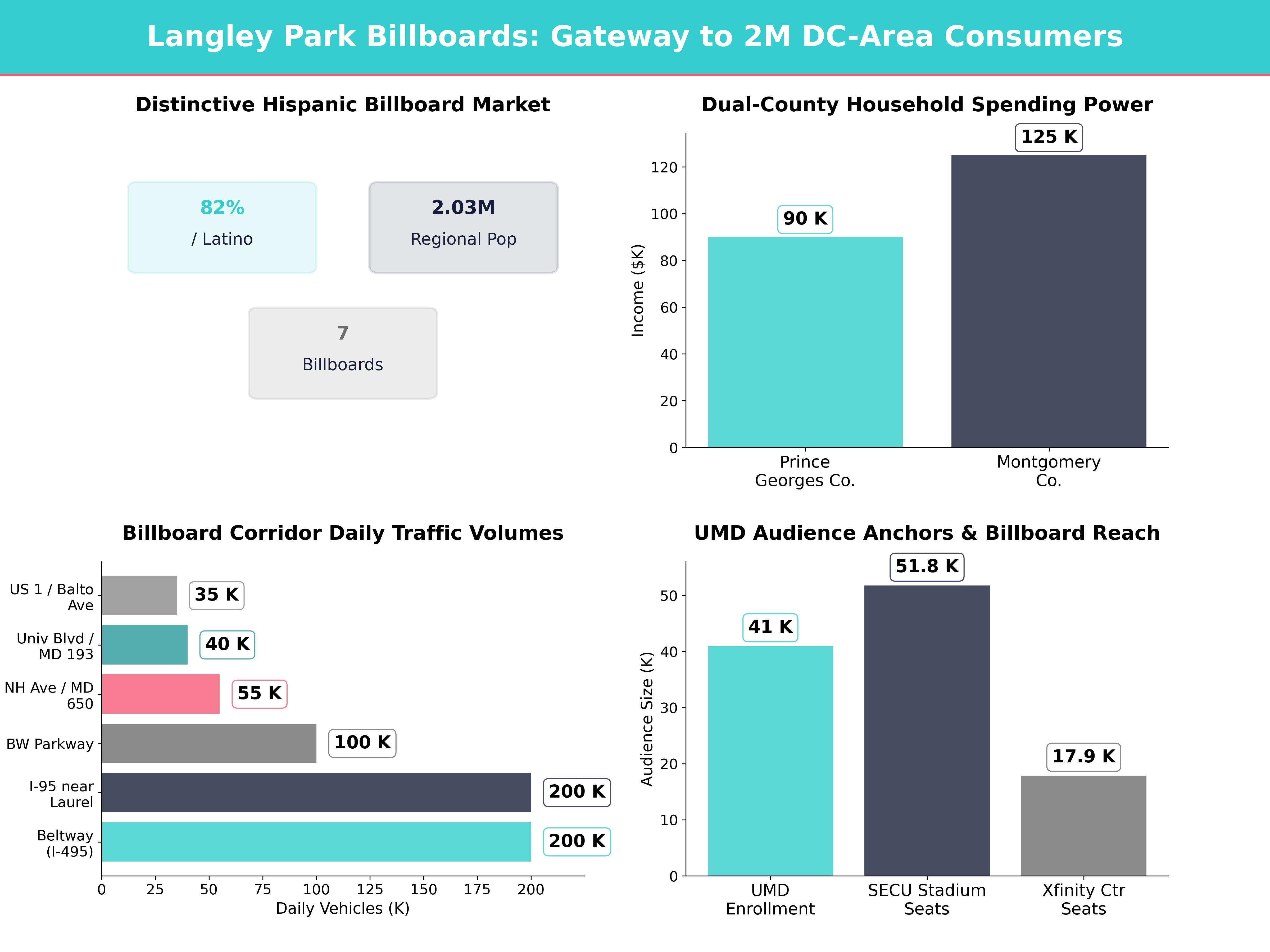
The Langley Park area sits in a part of the Washington suburbs where county lines, university activity, and Beltway travel all overlap. On the Prince George’s County side, Prince George’s County 967,201 residents in the 2020 Census. Just across the line, Montgomery County had 1,062,061 residents. That means advertisers near Langley Park are not buying a tiny isolated market. We are buying into a high-density, cross-county trade area with nearly 2.03 million people across those two counties alone.
The nearby billboard cities add meaningful local reach. The 2020 Census counted 34,740 residents in College Park, and 25,060 residents in Laurel 3.0 miles from the Langley Park area. The Lanham boards are 7.4 miles away, and the Laurel boards are 9.4 miles away. For advertisers serving households, workers, and students near Langley Park, those are practical commuting distances, not far-flung outliers.
Demographics, income, and commute behavior
The immediate Langley Park area is known for its dense residential pattern and its large Latino community. Profiles compiled by Census Reporter more than 8 in 10 (roughly 82%) residents in the Langley Park area identify as Hispanic or Latino. That makes culturally relevant creative, bilingual messaging, and family-oriented offers especially important here.
Income also varies meaningfully across the broader reach. Census Reporter’s Prince George’s County profile places median household income at roughly $90,000, while Montgomery County’s profile is above $125,000. We see that as a major advantage. It gives advertisers near Langley Park a way to speak both to value-conscious everyday buyers and to higher-income households within the same commuting shed.
Driving remains dominant, even in a transit-rich part of the region. County commute profiles show that about 75% of Prince George’s County workers, and about 70% of Montgomery County workers, commute by car, truck, or van. That is the core reason outdoor advertising works so well serving the Langley Park area. People still spend a large share of their workday travel time on roads.
At the same time, the area is a real transit node. WMATA, TheBus Ride On all serve the market, and the Takoma/Langley Crossroads Transit Center Purple Line 16.2-mile light-rail corridor with 21 stations, including a station serving the Langley Park area. Even before that line opens, the roadway and transit overlap already creates repeat exposure opportunities.
Key traffic corridors near Langley Park
The commuter roads that serve the Langley Park market
Few inner-suburban markets near Washington have as many overlapping commuter routes as the Langley Park area. Recent traffic maps from the Maryland Department of Transportation State Highway Administration vary by segment and count station, but the pattern is consistent:
- The Capital Beltway near the New Hampshire Avenue side of this market commonly runs above 200,000 vehicles per day.
- New Hampshire Avenue / MD 650 near the Langley Park area often carries roughly 50,000 to 60,000 vehicles per day.
- University Boulevard / MD 193 regularly lands around 35,000 to 45,000 vehicles per day on nearby segments.
- US 1 / Baltimore Avenue near College Park typically falls in the 30,000 to 40,000 vehicles per day range.
- I-95 near Laurel commonly runs above 200,000 vehicles per day.
- The Baltimore-Washington Parkway near Laurel often approaches 100,000 vehicles per day.
- MD 198 near Laurel frequently carries around 40,000 to 50,000 vehicles per day.
Those counts matter because they map directly to how people near Langley Park live. Local residents move east-west on University Boulevard, north-south on New Hampshire Avenue, and regionally on the Beltway, I-95, US 1, and the Baltimore-Washington Parkway. Our nearby boards in College Park, Lanham, and Laurel intercept that full pattern.
How each corridor contributes reach near Langley Park
We usually think about the road network serving the Langley Park area in three layers.
The first layer is local frequency. New Hampshire Avenue, University Boulevard, and connected arterials such as Riggs Road feed daily errands, school trips, bus transfers, food runs, and service calls. These are ideal for advertisers that need repeated exposure among nearby households, including healthcare providers, grocery-adjacent brands, quick-service restaurants, legal services, and local retailers.
The second layer is commuter scale. The Capital Beltway and the Lanham-side interchanges add people who live near Langley Park but work elsewhere, and people who pass the Langley Park market on the way to jobs in College Park, Greenbelt, Silver Spring, New Carrollton, and farther south toward Washington. This is where regional retail, auto, insurance, higher education, telecom, and home services campaigns usually expand best.
The third layer is north-south regional flow. Laurel Anne Arundel County, Howard County, and Baltimore-bound commuting patterns. For advertisers near Langley Park that want broader awareness without leaving the core market story, Laurel helps extend reach without losing relevance.
Audience segments serving the Langley Park area
Commuters and working adults
The most obvious audience near Langley Park is the commuter base. With countywide car, truck, and van commute rates still around 70% to 75%, roadside media remains one of the most dependable ways to reach adults during routine travel. We can target morning commuting windows around 6 a.m. to 10 a.m., evening return windows around 3 p.m. to 7 p.m., or broader weekday coverage depending on the category.
This audience includes public-sector employees, education workers, healthcare staff, tradespeople, retail employees, and office commuters moving between Prince George’s County and Montgomery County. It also includes science and technology workers. Nearby NASA Goddard in Greenbelt supports more than 10,000 civil servants, contractors, and partners, which contributes to the professional workforce moving through adjacent roads near Langley Park.
Students, faculty, and campus event traffic
The University of Maryland, College Park is one of the biggest audience engines near Langley Park. The university enrolls more than 40,000 students (roughly 41,000), and that count does not include faculty, staff, visitors, parents, vendors, and event attendees. For advertisers, that creates a powerful second market layered on top of the residential base.
Game and event traffic adds another major exposure source. SECU Stadium seats 51,802, and the Xfinity Center holds 17,950. The Clarice Smith Performing Arts Center adds year-round cultural traffic. That mix makes the Langley Park market especially useful for brands in food, entertainment, telecom, student housing, healthcare, recruiting, and financial services.
Families, multilingual households, and neighborhood shoppers
Because the Langley Park area has such a strong Latino presence, family-focused and bilingual campaigns can perform especially well. We often recommend separate English, Spanish, and bilingual creative tests rather than assuming one version fits every segment. A family dental office, grocery-adjacent concept, tax preparer, school, pediatric clinic, or wireless brand can all benefit from authentic language choices here.
The shopping pattern also matters. Residents near Langley Park often travel between neighborhood commercial strips and larger retail destinations in College Park, Hyattsville, Greenbelt, and Laurel
Visitors, event-goers, and destination traffic
The market near Langley Park also benefits from visitor movement tied to Experience Prince George’s, UMD athletics, performances, graduation, youth sports, festivals, and destination dining all create non-routine spikes that advertisers can time around.
We also see strong value in reaching people who may not live near Langley Park but regularly pass through its orbit. That includes residents from Takoma Park Hyattsville College Park, Greenbelt, and Laurel
Seasonal and timing opportunities near Langley Park
School, sports, and university calendar timing
The academic calendar is one of the clearest timing advantages near Langley Park. Late August and September bring back-to-school buying, student move-in, and a noticeable surge in campus and commuter activity. We usually like that window for restaurants, apartments, banks, wireless providers, urgent care, tutoring, and local entertainment.
Football season from September through November creates event-based traffic tied to SECU Stadium’s 51,802 seats. Basketball season from roughly November through March creates recurring exposure opportunities tied to the Xfinity Center’s 17,950 capacity. Graduation and commencement activity in May also work well for restaurants, hotels, florists, photographers, beauty services, and celebratory retail.
Retail, family, and service-season timing
Seasonality near Langley Park is not just about the university. The community’s family orientation makes several consumer categories especially calendar-sensitive:
- Spring campaigns from March through May work well for home improvement, HVAC, landscaping, tax services, and health screenings.
- Summer campaigns from June through August work well for camps, family attractions, cooling services, beverages, and casual dining.
- Holiday retail from November through December benefits from strong commuter exposure and gift-oriented shopping trips.
- Early-year campaigns in January and February often work for healthcare, fitness, education, and financial services.
We also like to build around culturally relevant moments. The period from September 15 to October 15, which marks Hispanic Heritage Month, can be especially meaningful for brands using thoughtful Spanish-language or bicultural creative serving the Langley Park area.
From a daypart perspective, we usually start commuter-focused brands on weekdays from 6 a.m. to 10 a.m. and 3 p.m. to 7 p.m.. For food, retail, clinics, and family entertainment, we often test broader midday and weekend windows, especially from 11 a.m. to 7 p.m. Thursday through Sunday.
Billboard design tips for the Langley Park market
Language, relevance, and message structure
The best creative near Langley Park is usually simple, culturally aware, and direct. Because the local market is strongly bilingual, we generally recommend one of three approaches:
- We run a Spanish-first message when the product naturally skews to Spanish-dominant households.
- We run an English-first message when the audience is broader or more cross-county.
- We test separate English and Spanish versions when we want clearer learning.
We rarely recommend cramming two full messages into one billboard. A stronger approach is one brand, one idea, and one call to action. As a rule, we like headlines in the 5- to 7-word range for these roads, especially on faster corridors such as I-495, I-95, and the Baltimore-Washington Parkway.
Specificity also helps. Drivers near Langley Park think in landmarks and roads, not abstract marketing language. Copy such as “Off New Hampshire,” “Near Route 1,” “College Park Pickup,” or “Serving Prince George’s and Montgomery” often feels more useful than generic phrases.
Visual choices that fit this geography
The local driving environment favors strong contrast and fast readability. Tree cover, overcast Mid-Atlantic weather, and early winter darkness can all reduce visual clarity. We usually recommend bold color separation, one dominant image, and large type. Reds, yellows, whites, and deep blues often stand out well on these corridors.
Authentic human imagery also matters here. The Langley Park market responds well to creative that feels local and practical, including families, food, healthcare professionals, service technicians, and students. Generic luxury imagery tends to feel less grounded unless the category truly supports it.
For campus-oriented campaigns, we like more energetic designs with urgency, dates, or limited-time offers. For family and neighborhood-service campaigns, we prefer warmth, trust, and immediate usefulness. In both cases, we keep URLs short, avoid small disclaimers, and make sure the brand is visible within the first second or two of the ad.
Regional strategies around Langley Park
College Park strategy for closest reach
Our College Park boards are the closest to the Langley Park area at 3.0 miles away, so we often use them for campaigns that need the strongest local relevance. These boards are especially useful for: Restaurants, quick-service brands, and grocery-adjacent concepts; Student housing, banks, telecom, and retail; Urgent care, dental, vision, and other neighborhood healthcare; Job recruitment tied to education, hospitality, retail, and services.
Because College Park also connects to the College Park Partnership business corridor and the university audience, these boards can blend neighborhood awareness with student and faculty reach better than almost any other placement serving the Langley Park area.
Lanham strategy for Beltway and interchange scale
Our Lanham boards sit 7.4 miles from the Langley Park area and are ideal when we need more interchange-driven scale. This cluster is usually our first choice for advertisers that want to capture Beltway commuters before they disperse into local roads.
Lanham works especially well for regional healthcare systems, auto dealers, home services, legal brands, community colleges, recruiting campaigns, and larger retailers. If the goal is broad awareness across Prince George’s County while still serving the Langley Park area, Lanham usually earns a meaningful share of the plan.
Laurel strategy for north-south reach
Our Laurel 9.4 miles from the Langley Park area and add strong reach on north-south travel patterns. We use Laurel when an advertiser wants exposure to commuters on I-95, the Baltimore-Washington Parkway, and MD 198 while staying connected to the same broader consumer base.
Laurel is especially useful for regional employers, healthcare, logistics recruiting, auto, entertainment, and destination retail. It also helps campaigns near Langley Park stay visible during longer work and shopping trips that extend beyond the immediate inner-Beltway zone.
Best use of all 7 billboards serving the Langley Park area
For many advertisers, the smartest regional strategy is not choosing one cluster. It is combining all 7 digital billboards. We often build plans like this:
- We use College Park for local relevance and frequency.
- We use Lanham for commuter scale.
- We use Laurel for broader north-south reinforcement.
That three-part structure is especially effective for brands with service areas spanning the Langley Park area, College Park, Greenbelt, Hyattsville, Takoma Park, and Laurel
Using Blip tools for Langley Park area campaigns
Choosing the right campaign approach
When we want broad coverage across the full market near Langley Park, we often start with a Blip-optimized campaign. That approach works well when traffic patterns change by day, event calendar, and time of day, because the system can automatically allocate spend across our nearby inventory.
When we want tighter control, we use a manual campaign. That is especially useful if we only want the closest College Park boards, if we want to concentrate on Lanham for Beltway traffic, or if we want to run event-driven bursts around UMD athletics or seasonal retail weekends.
Budget flexibility, timing control, and fast learning
Blip’s flexibility is valuable in a market like this because the audience mix shifts constantly between commuters, students, shoppers, and families. We can test commute-only schedules, weekend-heavy schedules, or bilingual creative rotations without committing to a rigid traditional format.
That matters for smaller advertisers. Pricing starts at $0.01 per display, and each ad is a 7.5- to 10-second blip. We can launch with a modest budget, see how the campaign behaves, and then lean harder into the board groups, times, and creative that match the Langley Park market best.
We also use real-time analytics to compare results by daypart, creative version, and location cluster. In a multilingual, multi-corridor market near Langley Park, that learning loop is often more valuable than trying to guess the perfect setup on day one.
Getting started with billboard rental near Langley Park
What to expect when renting a billboard serving this market
The easiest way to start near Langley Park is to define the real business goal first. We usually sort campaigns into three buckets: We want neighborhood-level awareness among households near Langley Park; We want broader commuter reach across Prince George’s County and Montgomery County; We want a mix of local frequency and regional scale.
Once that goal is clear, location choices become much easier. If the business mainly serves the immediate Langley Park area, we usually begin with College Park because it is just 3.0 miles away. If the business serves a wider commuter market, we add Lanham and Laurel. If the brand needs strong top-of-mind awareness across the whole corridor, we use all 7 boards.
How Blip simplifies the rental process
Traditional billboard companies often push advertisers toward fixed-term buys, slower negotiations, and limited flexibility. Many traditional campaigns are sold in 4-week (28-day) blocks or longer, which can be hard for a local business testing a new message or promotion.
We take a simpler approach. We can select boards on a map, upload creative, set a daily budget, choose times and days, and launch without a long contract. We can also pause, revise, or expand quickly if the campaign objective changes.
When we evaluate which billboard locations fit best, we usually ask four practical questions:
- Do we need local household frequency, commuter scale, or both?
- Are we trying to reach drivers near College Park, interchange traffic near Lanham, or north-south regional travelers near Laurel?
- Is the best timing weekday commute, weekend shopping, event spikes, or an all-day presence?
- Should the creative be English, Spanish, or tested in both versions?
For many first campaigns serving the Langley Park area, we recommend starting with one strong creative concept, one bilingual strategy, and a focused test window of 1 to 2 weeks. From there, we can look at delivery, adjust timing, and decide whether to concentrate more heavily on College Park, expand further through Lanham and Laurel, or keep a balanced regional mix.
The biggest advantage near Langley Park is that we do not have to guess our way into the market with a one-size-fits-all buy. With 7 digital billboards in nearby cities, flexible scheduling, and fast optimization, we can build a billboard campaign that matches how people near Langley Park actually move through their day.