Billboards in Laurel, MD
No Minimum Spend. No Long-Term Contracts. Just Results.
Trusted by Leading Brands


Billboard advertising
in Laurel has never been easier



How much is a billboard in Laurel?
Why Choose Blip for Billboard Advertising in Laurel
-
Blip lets Laurel advertisers launch self-serve in minutes and reach I-95, the Baltimore-Washington Parkway, and Route 1 without the usual buy-ahead hassle.
-
Use Blip-optimized campaigns in Laurel to auto-bid across commuter, student, and BWI-area traffic while staying aligned to your budget.
-
No contracts or minimums make Laurel ideal for testing spring Laurel Main Street events or back-to-school traffic on MD 198 and Route 1.
-
Daypart your Laurel ads for weekday I-95 commutes, then shift to weekend shoppers heading to Towne Centre at Laurel or Laurel Park.
-
Blip's real-time analytics help Laurel brands see what works near I-95, MD 295, and MD 32, then adjust fast as traffic changes.
-
Create sharper Laurel billboards with Blip's creative tools and tailor copy to local drivers between Washington, Baltimore, and Fort Meade.
Frequently Asked Questions About Billboard Advertising in Laurel
How much does a billboard cost in Laurel with Blip?
With Blip, billboard advertising in Laurel is designed to fit a wide range of budgets. Each “blip” is a 7.5-to-10-second display, with pricing starting at just $0.01 per display. Because costs change based on time of day, location, and advertiser demand, Blip helps stretch your budget to maximize reach.
Where can I advertise with Blip in Laurel?
Laurel’s digital billboards can give your brand a bright, quick-hit boost with Blip. Laurel is a strong billboard market because it combines a local community feel with regional-scale traffic. We also benefit from Laurel’s location about 20 to 25 miles from both downtown Washington and downtown Baltimore, near Interstate 95, the Baltimore-Washington Parkway, and BWI Marshall Airport.
Why is Laurel a good billboard market for local and regional reach?
Laurel works best when we think beyond city limits. The city sits in Prince George’s County, but it functions as a shared commercial zone for southern Howard County and western Anne Arundel County. That combined base of 1.89 million people gives billboard advertisers far more scale than Laurel’s municipal population alone suggests.
What roads get the most billboard traffic in Laurel?
Near Laurel, I-95 generally carries about 220,000 to 250,000 vehicles per day, depending on the segment. The Baltimore-Washington Parkway generally runs in the 140,000 to 190,000 AADT range near the Laurel area, and Maryland Route 32 near I-95 generally carries about 90,000 to 110,000 vehicles per day. U.S. Route 1 and Maryland Route 198 also provide useful local and regional traffic for advertisers.
When is the best time to run Laurel billboard ads with Blip?
Laurel rewards advertisers that match campaign timing to real travel behavior. Spring is a strong season for local events and retail, summer broadens the audience, and late July through September is a major back-to-school reset period. In late fall and winter, earlier darkness increases the visual impact of digital boards during the evening commute.
Do I need a contract to advertise with Blip in Laurel?
No, Blip has no long-term contracts or minimum commitments. You can start, pause, or stop your campaign at any time.
How fast can I launch a billboard campaign with Blip in Laurel?
You can have your campaign live in minutes. Create a free account, select your locations, set your budget, upload your design, and start running once approved.
Where can I advertise with Blip in Laurel?
Blip has digital billboards in Laurel. You can browse available locations on a map, choose the ones that fit your audience, and start advertising right away.
Still have questions? Launch a campaign in minutes — no contracts, no commitments.
Start Your CampaignLaurel Billboard Advertising Guide
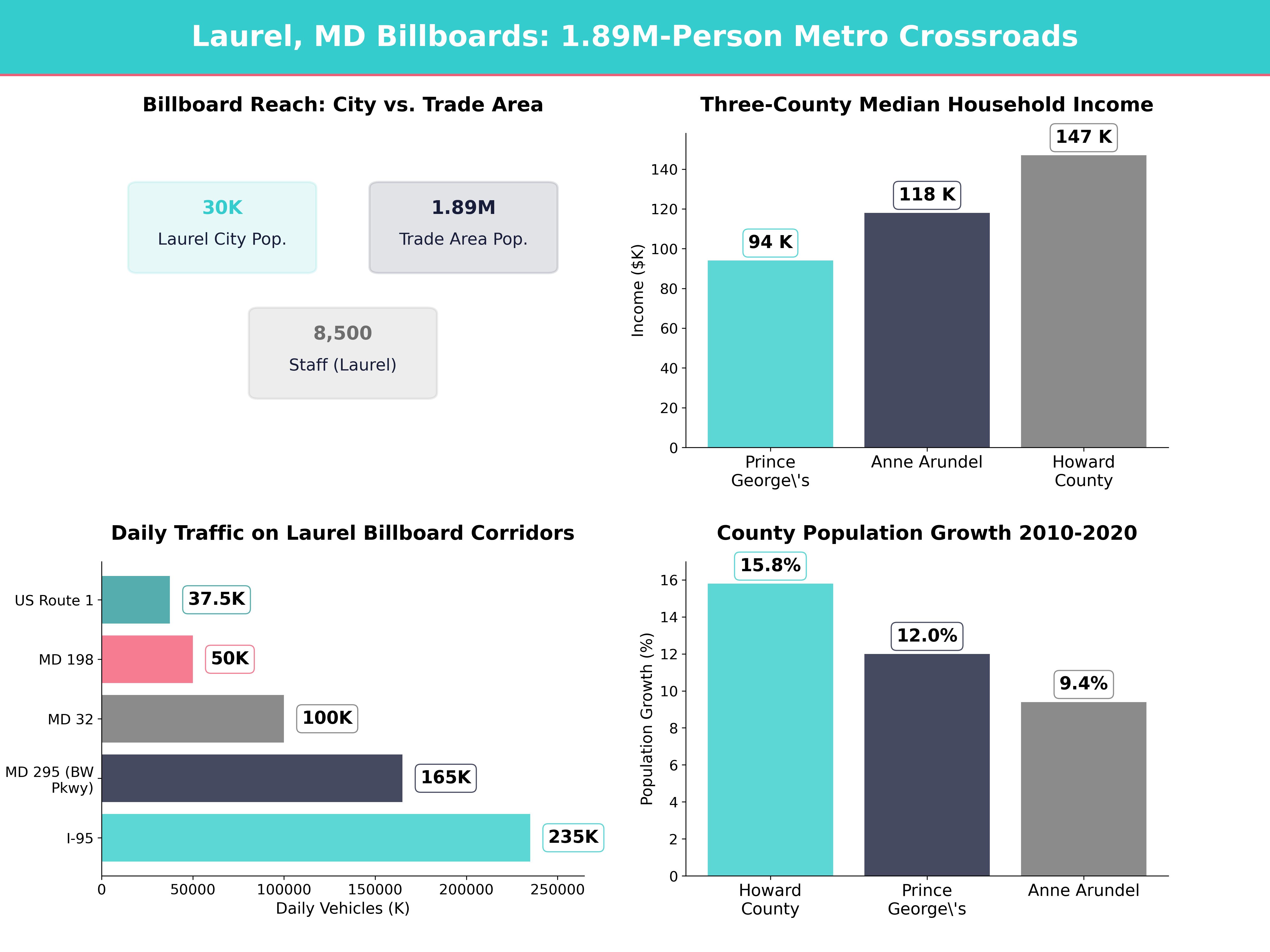
Laurel, Maryland City of Laurel 30,000 residents, but its practical advertising trade area stretches across Prince George’s County Howard County, and Anne Arundel County, which together hold 1,887,779 people. We also benefit from Laurel’s location about 20 to 25 miles from both downtown Washington and downtown Baltimore, near Interstate 95, the Baltimore-Washington Parkway, and BWI Marshall Airport
Market Overview for Laurel Advertisers
Laurel works best when we think beyond city limits. The city sits in Prince George’s County Howard County and western Anne Arundel County. In the 2020 Census, Prince George’s County had 967,201 residents, Howard County had 332,317, and Anne Arundel County had 588,261. That combined base of 1.89 million people gives billboard advertisers far more scale than Laurel’s municipal population alone suggests.
Laurel’s growth story is regional, not just local
The surrounding counties have all grown meaningfully in the last decade. From 2010 to 2020, Prince George’s County grew 12.0% (from 863,420 to 967,201), Howard County grew 15.8% (from 287,085 to 332,317), and Anne Arundel County grew 9.4% (from 537,656 to 588,261). That matters because population growth usually means more rooftops, more school enrollment, more retail trips, and more competition for consumer attention.
Laurel also benefits from being a midpoint market. We are not relying on one employer, one downtown, or one tourism driver. Instead, Laurel draws movement from College Park, Columbia, Bowie, Odenton, and the broader Washington-Baltimore corridor. For billboard advertisers, that creates a valuable overlap between hyperlocal relevance and regional frequency.
Income and commuting patterns support repeated exposure
Recent county economic profiles from the Prince George’s County Economic Development Corporation, the Howard County Economic Development Authority, and the Anne Arundel Economic Development Corporation $94,000 in Prince George’s County, $147,000 in Howard County, and $118,000 in Anne Arundel County. That is a healthy spread for advertisers selling everything from everyday services to higher-ticket healthcare, education, legal, home improvement, automotive, and financial products.
Commuting also favors out-of-home advertising. Across these three counties, about 72% to 82% of workers commute by car when we combine driving alone and carpooling, and average commute times generally land in the 31- to 38-minute range. Those longer drive times give digital billboards multiple chances to be seen during the same week. In practical terms, Laurel is a market where repeated impressions build quickly.
Key Traffic Corridors for Laurel Billboards
Laurel’s billboard value is driven by a small set of high-volume roads that carry both local and regional traffic. According to traffic maps from the Maryland Department of Transportation and the State Highway Administration, several corridors near Laurel consistently post strong AADT counts. When we align our campaign with the right corridor, we usually improve both reach and relevance.
Interstate 95 through Laurel
Near Laurel, I-95 generally carries about 220,000 to 250,000 vehicles per day, depending on the segment. That makes it the dominant regional reach corridor in the market. It links Baltimore, Laurel, College Park, and Washington, and it also captures drivers moving between suburban job centers rather than only central-city commuters.
This corridor is especially effective for advertisers that need scale. Regional healthcare systems, universities, entertainment venues, auto dealers, insurers, and major retail brands tend to benefit most. If we want broad awareness across multiple counties, I-95 is often the first corridor we evaluate.
Baltimore-Washington Parkway near Laurel
The Baltimore-Washington Parkway, also known as MD 295, generally runs in the 140,000 to 190,000 AADT range near the Laurel area. It is one of the best routes for reaching airport travelers, government-adjacent workers, hotel guests, and drivers heading between Washington, Laurel, and the BWI Marshall Airport
This is a particularly good corridor for hospitality, travel services, dining, entertainment, rental housing, and professional services. Because MD 295 traffic includes both routine commuters and discretionary travelers, we can use it for campaigns that need a broader mix of weekday and weekend performance.
U.S. Route 1 in Laurel
U.S. Route 1, or Baltimore Avenue, is one of Laurel’s most useful local-action roads. Traffic volumes often fall in the 30,000 to 45,000 vehicles per day range through Laurel’s commercial stretches. That is lower than I-95, but the audience is usually more local and often closer to making a purchase.
Boards on or near Route 1 are strong for restaurants, urgent care, dentists, attorneys, gyms, local retailers, churches, community events, and service businesses. This is also where directional copy matters most. Messages such as “Next light,” “Minutes away,” or “Main Street Laurel” can work especially well when tied to a real destination like Laurel Main Street Towne Centre at Laurel
Maryland Route 198
Maryland Route 198 is the east-west connector that ties together I-95, Route 1, and the Baltimore-Washington Parkway. Near Laurel, traffic counts commonly fall between 40,000 and 60,000 vehicles per day. That gives us a useful middle ground between regional highway volume and local purchase intent.
This route is ideal for retailers, grocery stores, medical offices, family attractions, home services, and brands that want to pull shoppers into Laurel from multiple directions. Because MD 198 feeds several major roads, it is often one of the smartest places to capture drivers before they choose where to stop.
Maryland Route 32 and the northern Laurel connection
Maryland Route 32 near I-95 generally carries about 90,000 to 110,000 vehicles per day. It matters because it connects Laurel to Columbia, Savage, Fort Meade Alliance
Advertisers with higher-income targets often do well along this corridor. Healthcare specialists, private schools, financial services, home remodeling firms, and business-to-business services can all benefit here. We also like MD 32 when we want to pair Laurel reach with the purchasing power of nearby Howard County households.
Audience Segments We Can Reach in Laurel
Laurel does not have just one audience. It has several overlapping audiences, and that is exactly why billboard advertising can be so productive here.
Commuters moving between Washington, Baltimore, and suburban job hubs
The first core audience is the daily commuter. Laurel sits between two major metros and beside some of Maryland’s busiest roads, so we can reach people traveling to Washington, Baltimore, College Park, Columbia, and the BWI Marshall Airport MARC Train, so road-based media still captures a large share of working adults.
For many advertisers, this is the foundation audience. Reaching the same drivers on Monday morning, Wednesday evening, and Saturday afternoon builds recall faster than a one-time digital impression.
Students, parents, and school households
Laurel also sits near a major education footprint. The University of Maryland, College Park enrolls more than 41,000 students, which supports demand for apartments, food, healthcare, telecom, furniture, and entertainment. On the K-12 side, Prince George’s County Public Schools serves more than 130,000 students, Anne Arundel County Public Schools serves more than 84,000, and the Howard County Public School System serves about 58,000.
That adds up to more than 272,000 K-12 students in the three-county ring, before we even count private schools or colleges. For advertisers, that creates dependable back-to-school, after-school, pediatric, tutoring, family dining, and youth activity demand.
Research, defense, and technology professionals
Laurel has a strong white-collar and technical employment base. The Johns Hopkins Applied Physics Laboratory in Laurel has more than 8,500 staff members, making it one of the area’s most important employers. The nearby Fort Meade Alliance
This audience often responds well to clear, credible, professional creative. Healthcare providers, graduate programs, financial advisors, luxury automotive brands, and business services can all find a good fit in this segment.
Families, shoppers, and leisure travelers
Laurel’s fourth major audience is the weekend and errand-driven consumer. Towne Centre at Laurel Laurel Park, Arundel Mills Live! Casino & Hotel Maryland, and Merriweather Post Pavilion BWI Marshall Airport 26.9 million passengers in 2023, which supports steady hotel, dining, parking, rental car, and travel-service demand across nearby corridors.
For retail, dining, and entertainment brands, this matters a lot. We are not only advertising to people who live in Laurel. We are also reaching people who pass through Laurel on the way to spend money elsewhere, and that gives strong billboards the chance to intercept them.
Seasonal and Timing Opportunities in Laurel
Laurel rewards advertisers that match campaign timing to real travel behavior. Because the market blends commuters, school families, and leisure traffic, there are several natural times to increase pressure.
Spring in Laurel favors events, home services, and local retail
Spring is a strong season for Laurel Main Street Laurel Park. This is when we typically see good opportunities for home improvement, lawn care, allergy care, dental, and weekend entertainment campaigns.
If our audience is local households, we should lean into Thursday-through-Sunday delivery and keep copy rooted in place. “In Laurel,” “Off Route 1,” and “Near MD 198” can outperform more generic brand-only messaging in this season.
Summer in Laurel expands the visitor and family audience
Summer broadens the audience. School is out, regional entertainment picks up, and airport traffic becomes more valuable. With 26.9 million annual passengers moving through BWI Marshall Airport
Summer is also a good time to target people heading toward Visit Howard County, Visit Annapolis & Anne Arundel County, and Experience Prince George’s destinations. We often like heavier Friday, Saturday, and Sunday scheduling for these campaigns.
Back-to-school season is one of Laurel’s best advertising windows
Late July through September is a major reset period. More than 272,000 K-12 students across the surrounding public school systems return to class, and the University of Maryland, College Park brings back a student body of more than 41,000. That creates a dense buying window for healthcare, tutoring, restaurants, mobile carriers, apartments, moving services, furniture, and everyday retail.
We should also remember that school-season traffic changes road behavior. Morning peaks become more predictable, and late-afternoon family traffic becomes more important for local businesses on Route 1 and MD 198.
Holiday and winter campaigns should lean into visibility and urgency
In late fall and winter, earlier darkness increases the visual impact of digital boards during the evening commute. That makes Laurel a good market for holiday retail, tax services, gyms, healthcare, urgent care, and weather-driven home services.
This is also when flexible scheduling becomes valuable. We can push harder around shopping weekends, airport travel bursts, and local event nights instead of paying for a flat, unchanging schedule.
Billboard Design Tips for the Laurel Market
Laurel responds best to creative that feels geographically aware. We should not design for “Maryland” in the abstract when the audience is actually choosing between Laurel, Columbia, College Park, Bowie, Fort Meade, and BWI-area destinations.
Use place-based copy that fits how Laurel drivers think
Laurel drivers navigate by road names, exits, and nearby destinations. Copy such as “Off MD 198,” “On Route 1,” “Next exit from I-95,” or “Minutes from Laurel Park” usually feels more actionable than generic citywide branding. This is especially true on Route 1 and MD 198, where many drivers are already making stop-or-pass decisions.
We should also recognize Laurel’s dual-metro identity. For some advertisers, it helps to signal regional convenience with phrases such as “Between DC and Baltimore” or “Easy from Fort Meade and Columbia,” as long as the claim is true.
Reflect the area’s diversity in casting, language, and offers
Laurel sits in a highly diverse part of Maryland. Prince George’s County 64% Black) and about 1 in 5 residents is Hispanic (roughly 19%), while Howard County is about 1 in 5 Asian (roughly 21%). Creative should reflect that reality in the people shown, the tone used, and, where appropriate, bilingual or multicultural messaging.
We do not need to make every board bilingual, but we should absolutely test it where the product and corridor justify it. Retail, healthcare, education, tax preparation, telecom, and community-service campaigns can benefit from English-and-Spanish variants in this market.
Match the creative style to the corridor
On commuter-heavy corridors such as I-95 and MD 295, we should keep the message clean, fast, and bold. A single offer, a single location cue, and a recognizable logo usually perform better than crowded layouts. On slower local roads such as Route 1, we can sometimes support slightly more detail, especially for restaurants, events, or service businesses.
The visual tone should also match the submarket. Near Johns Hopkins Applied Physics Laboratory, Maple Lawn Fort Meade Alliance Towne Centre at Laurel Laurel Main Street Laurel Park, brighter colors and more immediate retail imagery can feel more natural.
Emphasize convenience, not just awareness
Laurel is a market where convenience sells. Drivers are balancing work, errands, school pickups, and regional travel. Creative that answers “Why stop now?” often beats creative that only says “We exist.”
Messages about same-day service, evening hours, easy parking, quick access from I-95, or being just 5 minutes away can work very well here when they are true and easy to understand.
Regional Strategies Around Laurel
A smart Laurel campaign usually mixes more than one sub-area. The right blend depends on whether we want neighborhood action, regional awareness, or both.
Downtown Laurel and the Route 1 spine
If our goal is local foot traffic, Downtown Laurel and the Route 1 corridor should be near the top of the list. This area is ideal for restaurants, salons, dentists, boutique retail, events, churches, civic organizations, and neighborhood service businesses. Laurel Main Street Laurel Board of Trade, and the city’s event calendar all reinforce this local-commercial identity.
This is where hyperlocal copy tends to outperform broad branding. The audience is close enough to act immediately.
I-95, MD 198, and the regional retail draw
For campaigns that need scale, we should focus on the I-95 and MD 198 interchange area, plus routes feeding Towne Centre at Laurel Laurel Park. These placements are strong for regional shopping, healthcare systems, destination dining, and entertainment.
This submarket is especially useful when we want to pull customers from multiple counties into one destination.
North Laurel, Savage, Columbia, and Maple Lawn
North and northwest of Laurel, we move into a more affluent, professional household base. Savage Mill, Columbia, The Mall in Columbia, and Maple Lawn
We usually like this zone for premium healthcare, financial services, home remodeling, specialty retail, and upscale dining. If our customer value is high, these boards often deserve extra attention.
Maryland City, Russett, Fort Meade, and the BWI side
To the south and east, Laurel connects to workers and travelers moving through Maryland City, Russett, Fort Meade Alliance BWI Marshall Airport
Campaigns here often benefit from strong weekday commuting schedules, with selective weekend support for leisure and travel.
Using Blip Tools in Laurel
Blip is most useful in Laurel when we use its flexibility to mirror the market’s real travel rhythms instead of buying one fixed pattern and hoping for the best.
Use dayparting around Laurel’s strongest movement windows
For I-95, MD 295, and MD 32, we often get the best value by leaning into weekday morning and evening commute periods. For Route 1, MD 198, and retail-oriented boards, afternoon, evening, and weekend windows can be more important. Laurel is not a one-speed market, so our schedule should not be one-speed either.
Choose manual selection when route precision matters
If we know that our ideal customer comes from a specific corridor, such as MD 198, Route 1, or the Fort Meade side, manual campaign setup can make a lot of sense. We can choose the exact digital billboards that match our customer journey and exclude boards that are less relevant.
Let optimization work when we want broader three-county reach
If we want general awareness across Laurel’s wider trade area, a Blip-optimized campaign is often the easier path. Laurel’s audience spills across county lines, and optimization can help us distribute budget across the mix of commuter, retail, and regional boards that are delivering best at a given time.
Test local creative variants, then scale the winner
Laurel is a great market for creative testing. We can run 2 versions of the same message, such as one with a local road cue and one with a regional convenience cue, and then use performance data to decide which angle deserves more spend. Blip’s artwork tools make that kind of testing much easier than rebuilding assets from scratch.
Getting Started with Billboard Rental in Laurel
Renting a billboard in Laurel is easiest when we start with the customer journey rather than the map pin. We should ask where the customer is coming from, what road they use, what time they travel, and how soon they can act after seeing the ad.
Start with the action we want the ad to create
If we want immediate visits, we should favor boards close to the business, especially on Route 1, MD 198, or near major retail turns. If we want broader awareness, we should include I-95 or MD 295. A restaurant or clinic may want boards within 1 to 3 exits of the location, while a university, healthcare network, or regional retailer can cast a wider net.
Evaluate boards by route, direction, and decision point
In Laurel, the best board is not always the one with the biggest number on paper. We should look at which side of the road it sits on, whether drivers are heading toward or away from us, how close it is to an exit, and whether the surrounding land use matches our audience. A board near Towne Centre at Laurel
Launch with a practical test window
For many Laurel campaigns, a 2- to 4-week test across 2 to 3 corridors is a smart starting point. That gives us enough time to compare weekday commuters with weekend shoppers, and enough variety to see whether local or regional placements perform better. Once we identify the strongest pattern, we can shift more budget there.
Expect a simpler process than traditional billboard buying
Traditional billboard buying in a market like Laurel often means calls, proposals, fixed packages, and limited flexibility. Blip simplifies the process by letting us choose boards, launch quickly, change artwork, and adjust budget without going through a long negotiation cycle. That is particularly helpful in Laurel, where timing matters and where the right mix of boards can change based on school season, travel demand, racing weekends, or local retail pushes.
If we stay focused on Laurel’s real strengths, which are regional traffic, county-spanning reach, and highly repeatable commuter exposure, billboard rental here can be both efficient and scalable. The market rewards advertisers who think like local drivers, choose boards by corridor, and keep creative clear, relevant, and easy to act on.