Billboards in Milford Mill, MD
No Minimum Spend. No Long-Term Contracts. Just Results.
Trusted by Leading Brands


Billboard advertising
in Milford Mill has never been easier



How much is a billboard in Milford Mill?
Frequently Asked Questions About Billboard Advertising in Milford Mill
Do I need a contract to advertise with Blip in Milford Mill?
No, Blip has no long-term contracts or minimum commitments. You can start, pause, or stop your campaign at any time.
How fast can I launch a billboard campaign with Blip in Milford Mill?
You can have your campaign live in minutes. Create a free account, select your locations, set your budget, upload your design, and start running once approved.
Where can I advertise with Blip in Milford Mill?
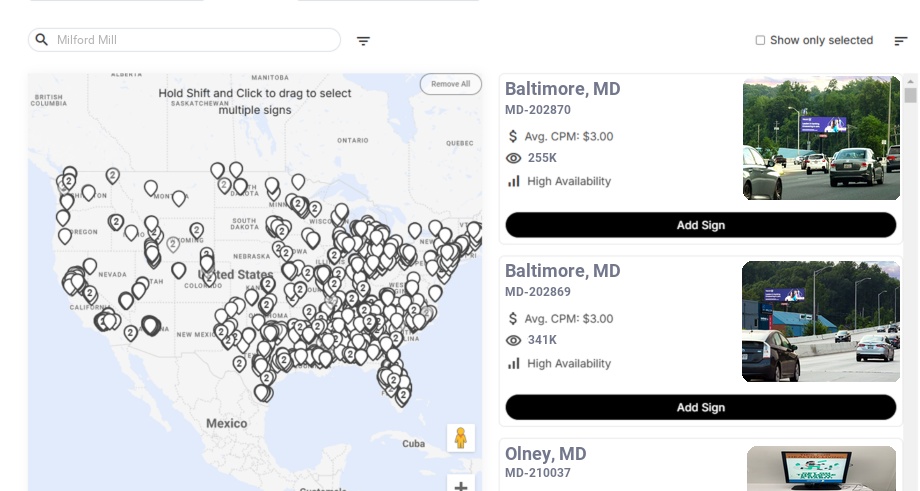
Blip has digital billboards in Milford Mill. You can browse available locations on a map, choose the ones that fit your audience, and start advertising right away.
Still have questions? Launch a campaign in minutes — no contracts, no commitments.
Start Your CampaignMilford Mill Billboard Advertising Guide
Milford Mill, Maryland sits at a powerful crossroads of suburban stability and urban access. Just northwest of Baltimore, this community of roughly 30,000–31,000 residents relies heavily on major corridors like I‑695 (Baltimore Beltway), Liberty Road, and Reisterstown Road for daily life. With three digital billboards near Milford Mill (in nearby Baltimore, within roughly 7 miles), these Milford Mill billboards can precisely target these high-traffic flows to reach shoppers, commuters, students, and families in the Milford Mill area at the moments they are most likely to act.
Understanding the Milford Mill Area Market
Milford Mill is part of western Baltimore County, a predominantly residential area characterized by dense neighborhoods, apartment communities, and strong commuter patterns into Baltimore City and surrounding employment centers. This concentrated, commuter-heavy environment makes billboard advertising near Milford Mill especially effective for brands that need repeated, high-frequency exposure.
Key data points to keep in mind:
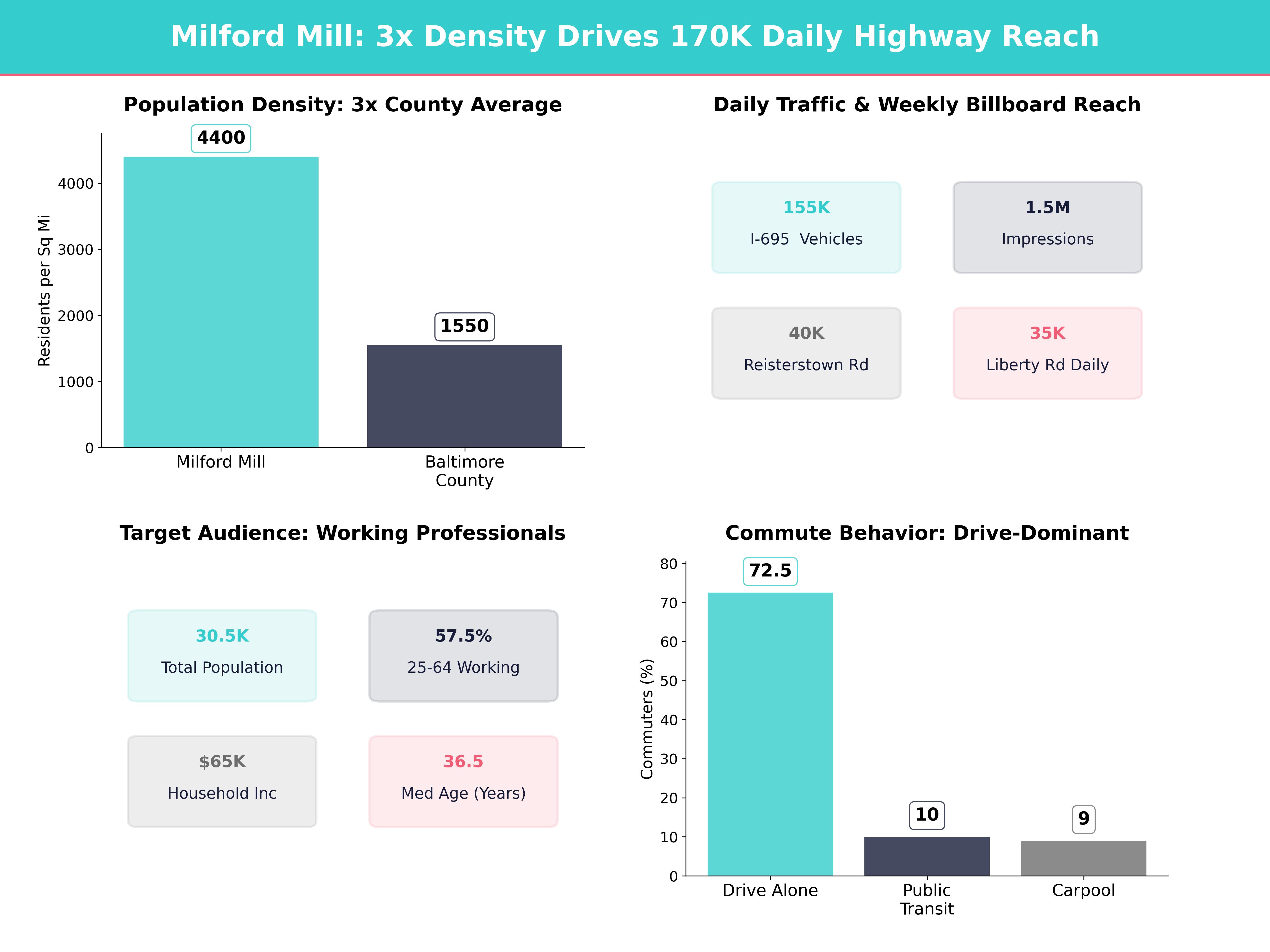
- Population density: Milford Mill’s population is about 30,000–30,700 residents spread over roughly 7 square miles, which translates to a density of around 4,300–4,500 residents per square mile. That’s nearly 3× the overall Baltimore County density (about 1,500–1,600 residents per square mile), which means a large volume of potential impressions from a relatively compact home base. Well-placed boards within 7–8 miles of the community can repeatedly reach the same households as they move through daily routines, maximizing the impact of Milford Mill billboards.
-
Age profile: Milford Mill skews relatively young and family-oriented. The median age is around 36–37 years, compared with roughly 40 years for Baltimore County overall. Around 55–60% of residents fall into the 25–64 working-age band, and roughly 22–25% are under age 18, supporting campaigns focused on:
- Family services (healthcare, childcare, enrichment programs)
- Quick-service restaurants and grocery
- Higher education, trade schools, and job training
-
Households and housing mix: The area includes a blend of apartments, townhomes, and single-family homes:
- About 60–65% of housing units are renter-occupied and 35–40% are owner-occupied, a higher renter share than Baltimore County overall (about 34% renters).
- Average household size is around 2.6–2.8 persons, with a meaningful share of multi-generational households, which drives higher usage of healthcare, family dining, and everyday services.
-
Income and spending power: Median household income in Milford Mill is in the $63,000–$67,000 range, compared with roughly $78,000–$80,000 for Baltimore County as a whole. About 45–50% of households earn between $35,000 and $100,000, a core middle-income band. This points toward value-conscious but still brand-aware consumers:
- Deals, promotions, and price-based messaging perform well.
- “Upgrade” and “treat yourself” messaging can still resonate, especially around paydays and weekends.
- Education levels: Roughly 85–90% of adults (25+) in the wider area have at least a high school diploma, and an estimated 25–30% have an associate degree or higher. This supports campaigns for credentialing programs, community colleges, and skills training that can be promoted efficiently using billboard advertising near Milford Mill.
-
Commuting behavior: A majority of Milford Mill residents commute by car:
- Around 70–75% drive alone, 8–10% carpool, and 8–12% use public transit (bus, Metro SubwayLink).
- Average commute times for this part of Baltimore County hover around 30–32 minutes, longer than the national average of about 27 minutes, which means more captive time in vehicles and more frequent exposure to billboards near major routes.
- Digital access: High-speed internet and smartphones are nearly ubiquitous. In the broader Baltimore metro, more than 90% of households have some form of internet, and smartphone adoption exceeds 80%, supporting call-to-action strategies that drive search, app installs, and mobile web visits after exposure.
For context on local planning, zoning, and road improvements that shape travel and retail patterns, advertisers should monitor the Baltimore County government Department of Public Works & Transportation
Where Digital Billboards Near Milford Mill Make the Biggest Impact
Our three digital billboards serving the Milford Mill area are positioned in nearby Baltimore, within about 7–8 miles. Along the I‑695 corridor and key arterials, that’s precisely where Milford Mill residents are driving daily for work, school, shopping, and entertainment. This proximity allows billboard advertising near Milford Mill to influence trips in and out of the community throughout the day.
Important corridors and traffic dynamics:
-
I‑695 (Baltimore Beltway):
- Western segments of I‑695 carry in the range of 140,000–170,000 vehicles per day, based on recent counts from the Maryland Department of Transportation State Highway Administration.
- This beltway connects Milford Mill residents to downtown Baltimore, Towson, Baltimore/Washington International Thurgood Marshall Airport (BWI)
- A digital board facing beltway traffic can easily generate 1–2 million weekly impressions when rotations are purchased during peak drive times.
-
Liberty Road (MD‑26):
- A principal arterial running just south of Milford Mill, connecting Randallstown, Gwynn Oak, and Baltimore City neighborhoods.
- Typical average daily traffic (ADT) volumes near the western city line and Baltimore County segments range from 30,000 to 40,000 vehicles per day.
- The corridor is lined with grocery anchors, shopping centers, national QSR chains, independent restaurants, salons, auto services, and local offices—making it ideal for neighborhood-scale retail and service campaigns using Milford Mill billboards to reach nearby drivers.
-
Reisterstown Road (MD‑140):
- Another major corridor near Milford Mill, funneling traffic between Owings Mills, Pikesville, and Baltimore City.
- ADT counts commonly run in the 35,000–45,000 vehicles per day range along key segments closer to the city.
- High exposure supports grocery, big-box retail, auto dealers, outpatient healthcare, and dining.
By leveraging Blip’s flexible buying model, we can concentrate impressions during the highest-traffic hours on these approaches near Milford Mill: weekday morning and evening rush (around 6:30–9:00 a.m. and 3:30–6:30 p.m.) and weekend midday shopping windows (11:00 a.m.–3:00 p.m.). In practice, shifting more of your budget into these windows can raise real-world exposure by 30–50% versus evenly spreading your blips across a full 24‑hour cycle, making your billboard rental near Milford Mill more efficient and cost-effective.
For broader regional traffic insight, advertisers can reference the Maryland Department of Transportation State Highway Administration, which publishes traffic volumes, congestion data, and construction alerts that affect drive times and billboard visibility. For bus and rail usage patterns that intersect with major roads, check the Maryland Transit Administration.
Who You’re Reaching in the Milford Mill Area
The Milford Mill area offers a mix of audiences, all passing through nearby Baltimore corridors each day:
-
Commuters to downtown Baltimore and county job centers
- Thousands of Milford Mill residents travel daily to downtown Baltimore, Towson, Owings Mills, and BWI‑area job hubs. In the broader Baltimore metro, more than 75% of workers commute outside their home community, and Milford Mill follows that pattern.
- Many residents work in healthcare, government, education, logistics, professional services, and hospitality. Regional anchors such as Johns Hopkins Medicine University of Maryland Medical System, State of Maryland agencies, and the Port of Baltimore corridor served by the Maryland Port Administration all draw workers from western Baltimore County.
Time ads to catch: - Early commuters (6:30–8:30 a.m.) with coffee, transit, and on-the-go services.
- Evening commuters (4:00–7:00 p.m.) with food, entertainment, and retail offers.
-
Students and education-focused households
Milford Mill families are closely connected to schools and higher education:- Baltimore County Public Schools 111,000 students county-wide, with multiple elementary, middle, and high schools feeding from the Milford Mill area. District calendars and boundary information are available from Baltimore County Public Schools.
- Within a 10–20 minute drive are institutions such as Coppin State University, University of Maryland, Baltimore County (UMBC), Baltimore City Community College, and branches of other colleges and training providers.
Education-related advertising (tutoring, test prep, technical colleges, financial aid services, childcare and enrichment) can perform well when flights emphasize: - Late-summer and January enrollment periods.
- After-school and early evening windows (2:30–6:30 p.m.) when families are on the road.
-
Families and multi-generational households
The housing stock in the Milford Mill area includes apartments, townhomes, and single-family homes, often with multi-generational living arrangements. In similar west-county neighborhoods, roughly 10–15% of households include three or more generations under one roof, which boosts demand for:- Healthcare, urgent care, dental, pediatric, and behavioral health services.
- Home improvement, furniture, appliances, and internet/streaming services.
- Grocery, discount retailers, family-friendly entertainment, and quick weeknight dining.
Local news outlets such as The Baltimore Sun and TV stations like WMAR‑2 News or WBAL‑TV 11 offer useful insight into neighborhood priorities, crime and safety updates, school coverage, and local events—topics that consistently drive engagement. Aligning billboard messaging with these themes (for example, tax-free shopping week, back‑to‑school, or local elections) can increase relevance and recall for anyone seeing Milford Mill billboards during their regular commutes.
Crafting Message and Design for Milford Mill Drivers
With digital billboards near Milford Mill, the core challenge is capturing a driver’s attention in under 6 seconds at highway or arterial speeds. On I‑695, vehicles commonly move at 55–65 mph, yielding only a few hundred feet of clear view; on Liberty Road and Reisterstown Road, typical speeds of 30–40 mph still limit cognitive load.
We recommend:
-
Speak the language of the corridor, not just the city
-
Call out routes residents recognize:
- “Just off Liberty Rd & …”
- “5 minutes from I‑695 Exit …”
- Use local landmarks they pass regularly, such as Security Square Mall, nearby shopping centers, parks, and major intersections.
- Referencing local points like the Milford Mill Metro Station or well-known plazas helps improve recognition and can lift response.
-
Call out routes residents recognize:
-
Highlight time-sensitive and value-driven offers
Given the area’s middle-income profile and long commute times, offers that save money or time resonate strongly. In similar suburban commuter markets, value-focused creatives can outperform generic branding by 20–40% in redemption or web-visit metrics:- “Tonight only: 2 pizzas for $12 – Exit 18 off I‑695”
- “Walk-in urgent care, open until 9 p.m. – 3 miles ahead on Liberty Rd”
- “Save $50 on brakes this week – Reisterstown Rd location”
-
Design for legibility at speed
- Limit copy to 7 words or fewer when possible, as studies of out-of-home recall show steep drop-offs beyond 8–10 words.
- Use high-contrast color schemes (e.g., dark text on light background or vice versa).
- Feature one bold visual element: a product image, a face, or a simple icon.
- Ensure your logo and call to action (CTA) are visible at a glance and at least 1/6 of the board’s height for clear recognition at highway distance.
-
Use clear CTAs that match mobile behavior
With smartphone usage above 80% in the region and mobile driving a majority of local search activity, focus on CTAs that are easy to act on later:- Short URLs and brand names that are easy to remember (avoid long tracking links).
- Phrases like “Search: [Brand Milford Mill]” or “Scan for coupon” if you pair the billboard with QR codes on print or in-store signage.
- Phone numbers only if they are extremely simple (e.g., vanity numbers), since research shows drivers rarely retain 10‑digit numbers viewed at speed.
Timing Your Campaign Around Local Rhythms
Milford Mill residents’ routines create predictable peaks in traffic. By selectively buying “blips” through the day, we can match message to mindset and squeeze more value from the same budget. In similar suburban commuter corridors, concentrating 60–70% of impressions in peak periods can raise effective reach by 25–35%.
Weekly rhythms to target:
-
Weekday mornings (6:30–9:00 a.m.)
- Focus: coffee shops, breakfast QSR, gas stations, auto services, traffic apps, radio stations, healthcare reminders, and school-related messages.
- Messaging such as “Open at 7 a.m.” or “On your way to work?” aligns with commuter mindsets and catches parents after school drop-off.
-
Midday and early afternoon (11:00 a.m.–2:00 p.m.)
- Focus: lunch spots, healthcare appointments, errands, B2B ads (since many workers pass through during off-peak hours), and senior services.
- Many service businesses report that 20–30% of same-day appointments are scheduled during this window, making it ideal for “Call now” or “Walk in today” messaging.
-
Evening rush (3:30–7:00 p.m.)
- Focus: grocery, big-box retail, restaurants, gyms, tutoring centers, entertainment, streaming services, and local events.
- Emphasize convenience and immediacy: “Dinner solved,” “Walk-ins welcome,” “Game night tonight.”
- In family-heavy corridors, a large share of weekday discretionary spending—often 40%+ of weekday restaurant and retail visits—occurs after 4 p.m.
-
Weekends
- Saturday midday/afternoon (11:00 a.m.–4:00 p.m.) is prime for shopping, errands, and leisure trips to malls, parks, and attractions.
- Sunday late afternoon (3:00–7:00 p.m.) is ideal for prompts about the upcoming week (school prep, healthcare, home services, and financial services).
For inspiration on events, festivals, and sports that affect weekend traffic and shopping behavior, keep an eye on Visit Baltimore Baltimore County events calendar Inner Harbor Baltimore Orioles games, or county fairs like the Maryland State Fair
Seasonal Opportunities in the Milford Mill Area
Seasonality matters in the Milford Mill area, especially given its close ties to Baltimore’s regional events and academic calendar. Aligning your schedules with local peaks in demand can improve response rates by 15–30% compared with flat, year-round messaging.
-
Back-to-school (late July–September)
- Baltimore County Public Schools 111,000 students, and each August/September families in Milford Mill are in high-gear shopping mode.
- Heavy demand for clothing, school supplies, electronics, after-school programs, and healthcare (physicals, vaccinations, eye exams).
- Increase frequency near the start of the school year, which is detailed by Baltimore County Public Schools. Coordinate messaging around key milestones such as schedule pickup days, open houses, and sports tryouts.
-
Holiday season (November–December)
- Regional data show that 25–30% of many retailers’ annual sales occur in this window.
- Shoppers from Milford Mill frequent malls and shopping centers throughout Baltimore County and nearby Baltimore City, including Security Square Mall and larger destinations reachable via I‑695.
- Promote retail discounts, online ordering with local pickup, seasonal events, and charitable drives. Countdown-style creatives (“4 days left for 30% off”) often outperform generic holiday branding.
-
Tax season (January–April)
- Perfect for accountants, tax preparation services, loan providers, and financial planners.
- Roughly 70–75% of U.S. filers expect a refund, and many schedule big-ticket purchases (cars, furniture, travel) after receiving it, so finance and retail campaigns can overlap effectively here.
- Keep copy focused on deadlines and simple benefits: “Maximize your refund,” “Walk-in tax help,” “Same-day refund advance.”
-
Spring and summer (April–August)
- Emphasize home improvement, landscaping, HVAC, auto sales and service, and local attractions (zoos, museums, festivals).
- Warmer months typically see 10–20% more leisure trips and errands, increasing weekend impressions.
- Tie into regional events highlighted by county and city tourism sites—such as waterfront festivals, outdoor concerts, and sports seasons—for extra relevance and timely calls to action.
For outdoor recreation, parks, and community programs that draw Milford Mill residents on weekends, advertisers can also reference Baltimore County Recreation and Parks
Using Blip’s Flexibility to Test and Optimize
Because Blip allows advertisers to buy digital billboard space near Milford Mill one “blip” at a time, you can experiment aggressively without committing to long-term static buys. In practice, advertisers that run structured tests and rotate creative regularly often see 20–50% better performance on key metrics (promo code usage, website visits, store traffic).
This flexible, on-demand approach works particularly well for billboard rental near Milford Mill, where seasonal swings, local events, and construction can quickly change which corridors perform best.
Suggested testing strategy for this area:
-
A/B test offers by daypart
- Run a “% off” offer during evening commute and a “limited-time bundle” offer on weekends.
- Compare click-through or redemption data from your website, call center, or in-store codes by time of day and day of week.
-
Rotate creative for key milestones
- Use one creative leading up to a grand opening (“Coming Soon – 2 miles ahead”), then switch to a “Now Open” message once doors are open.
- For recurring events (monthly markets, recurring shows), change artwork each month to maintain freshness—studies show creative wear-out can begin as early as 4–6 weeks on digital out-of-home if artwork remains static.
-
Geo-align your creative to each board’s surroundings
- If one board is mainly seen by traffic heading toward downtown Baltimore, promote attractions or businesses closer to downtown, the Inner Harbor, or major medical campuses.
- If another is used by outbound commuters returning to Milford Mill area neighborhoods, emphasize local services and restaurants near home, highlighting easy exits and drive times (“5 minutes off Exit 20”).
-
Use short bursts for event-driven campaigns
- Promote concerts, sports games, local fairs, and open houses with higher intensity for 3–10 days rather than a low-frequency message spread over weeks.
- Pair these bursts with social media campaigns targeting ZIP codes around Milford Mill (e.g., 21244, 21208, 21209) for cross-channel reinforcement.
- Event-based bursts can drive 2–3× higher short-term response than always-on branding alone, especially when paired with deadlines and limited seating/ticket messaging.
For broader economic and workforce trends affecting who lives and works near Milford Mill, consult updates from Baltimore County’s Economic and Workforce Development
Industry Sectors Poised to Win Near Milford Mill
Based on local demographics, commuting patterns, and retail landscapes, we see strong potential for the following sectors:
-
Healthcare and wellness
- Urgent care, primary care, dental, vision, physical therapy, mental health, and fitness centers.
- In many west-county ZIP codes, emergency and urgent care visits have risen by 10–15% over the past decade, and healthcare remains one of the largest employment sectors in the Baltimore metro.
- Proximity to major systems like LifeBridge Health UMMS increases patient flows through these corridors.
-
Food and beverage
- Quick-service restaurants, delivery services, sit-down dining, and specialty grocers.
- National data show that households in the $60k–$70k income band spend roughly $3,000–$3,500 per year on food away from home; with roughly 10,000+ households in and around Milford Mill, that translates into tens of millions of dollars in annual dining spend.
- Billboards near evening commute routes and weekend shopping hubs can steer these discretionary dollars.
-
Auto-related
- Dealerships, repair shops, tire centers, car washes, and car insurance.
- In car-centric suburbs like Milford Mill, vehicle ownership typically exceeds 1.5 vehicles per household, and annual maintenance/repair spending per household often runs $800–$1,000+.
- I‑695, Liberty Road, and Reisterstown Road are ideal for “next exit” or “2 miles ahead” auto-focused creatives.
-
Education and training
- Community colleges, trade schools, credentialing programs, and enrichment services.
- With roughly 25–30% of adults possessing some college but no degree in comparable west-side communities, there is a sizeable pool of potential students for upskilling and certificate programs.
-
Home services
- HVAC, plumbing, roofing, landscaping, pest control, home security, and cleaning services.
- Older housing stock in surrounding communities, much of it built 40–60 years ago, increases demand for maintenance, upgrades, and energy-efficiency improvements—ideal for seasonal campaigns around spring, summer, and pre‑winter.
-
Financial services
- Credit unions, banks, tax prep, payday alternatives, and insurance agents.
- With a large share of households in the middle-income band and commuting to regional job centers, there is steady demand for checking, savings, auto loans, and mortgage products, along with tax and insurance advice.
Before building your campaign, review local economic development updates and small business resources from Baltimore County’s Economic and Workforce Development Pikesville-Owings Mills Regional Chamber of Commerce. These sources can help you understand which industries are growing and where new residents and businesses are clustering around Milford Mill so you can prioritize the best locations for billboard advertising near Milford Mill.
Integrating Billboards Near Milford Mill With Other Media
To maximize ROI in the Milford Mill area, billboards should be part of a broader media mix rather than a standalone tactic. Advertisers who integrate out-of-home with digital and broadcast often report 20–30% higher brand recall and stronger conversion rates.
Ideas for integration:
-
Pair with local TV or streaming
- Use consistent visuals and taglines across billboards and spots running on stations like WMAR‑2 News or WBAL‑TV 11 or on streaming platforms.
- In the Baltimore DMA, local TV still reaches well over 80% of adults weekly, so synchronized creative helps turn billboard impressions into recognition when viewers see your brand again on screen.
-
Retarget via digital ads
- Geo-fence the area around Milford Mill and key corridors so mobile and social campaigns reinforce billboard exposure.
- Use a radius of 3–5 miles around each board for mobile ads, and prioritize peak-drive-time delivery to mirror your Blip schedule.
-
Leverage local news and sponsorships
- Sponsor coverage or segments focused on community issues, weather, or events that align with your brand values on outlets like The Baltimore Sun, WMAR‑2 News, or WBAL‑TV 11.
- Mirror that positioning on your digital billboards (“Proud sponsor of…” or “Supporting Milford Mill families since…”), which can enhance trust and lift favorability.
-
Use trackable promotions
- Unique promo codes tied to ZIP codes (21244, etc.), landing pages (e.g., “/MilfordMill”), or dedicated phone numbers can help attribute responses directly to your outdoor campaign.
- In many campaigns, 20–40% of redemptions can be traced back to billboard-aware audiences using these tools, giving you clearer ROI data for future buys.
Bringing It All Together
The Milford Mill area offers a concentrated, commuter-heavy audience with strong family, service, and value-driven purchasing patterns. With three digital billboards positioned in nearby Baltimore to serve this corridor, we can:
- Reach a dense population of more than 30,000 people living just minutes from those boards and traveling I‑695, Liberty Road, and Reisterstown Road daily.
- Tap into heavy daily traffic volumes—upwards of 140,000–170,000 vehicles per day on I‑695 and 30,000–45,000 vehicles per day on key arterials—that translate into hundreds of thousands of weekly impressions for well-timed campaigns.
- Tailor messaging by time of day, day of week, and season to match how Milford Mill residents actually live, work, study, and shop.
By combining smart timing, locally resonant creative, real-world traffic and demographic data, and ongoing testing, advertisers can use Blip’s flexible platform for billboard rental near Milford Mill to build highly efficient, data-informed campaigns that consistently reach the Milford Mill area and convert impressions into measurable business results.