Billboards in Fort Washington, MD
No Minimum Spend. No Long-Term Contracts. Just Results.
Trusted by Leading Brands


Billboard advertising
in Fort Washington has never been easier



How much is a billboard in Fort Washington?
Why Choose Blip for Billboard Advertising in Fort Washington
Fort Washington, launch in minutes with Blip self-serve and reach MD 210 commuters, no contracts or minimums.
Blip optimizes Fort Washington campaigns to catch Beltway traffic near Woodrow Wilson Bridge and National Harbor's 15M visitors.
Set any daily budget in Fort Washington and Blip only spends when your ad runs—ideal for testing south county without a big commitment.
Use dayparting in Fort Washington to hit weekday car commuters and weekend National Harbor nightlife at the right times.
Track Fort Washington results in real time, then shift spend toward MD 5, MD 210, or Harbor-bound traffic that performs best.
Create standout Fort Washington billboards fast with Blip's creative tools for commuters, families, and event-goers near National Harbor.
Frequently Asked Questions About Billboard Advertising in Fort Washington
How much does a billboard cost in Fort Washington with Blip?
With Blip, the cost of billboard advertising in Fort Washington is designed to be flexible and approachable. You set a daily budget, and Blip’s algorithm uses it to bid for open ad slots on rotating digital billboards, so you only pay when your ad actually appears. Pricing can change based on time of day, location, and advertiser demand, and your total cost is simply the sum of the individual blips you receive.
Where can I advertise with Blip in Fort Washington?
Fort Washington sits in a high-value position between local neighborhoods, the Capital Beltway, Washington, D.C., Alexandria, and the entertainment district at National Harbor. Key traffic corridors include I-495 and I-95 near the Woodrow Wilson Bridge, MD 210, MD 5, and local arterials like MD 414, Fort Washington Road, and Livingston Road. That lets advertisers reach both repeat local drivers and regional travelers on the same campaign.
Why is Fort Washington a strong billboard market?
Fort Washington gives advertisers access to an affluent suburban residential base, heavy commuter traffic, and major visitor volume just minutes away at National Harbor. Roughly 80% of workers commute by car, and National Harbor draws 15 million annual visitors. That combination gives Fort Washington unusual reach for tourism, hospitality, retail, healthcare, and regional service campaigns.
What kind of traffic do Fort Washington billboards reach on the Beltway with Blip?
The I-495 and I-95 Beltway system near the Woodrow Wilson Bridge regularly carries well over 230,000 vehicles per day, and some nearby segments are commonly cited above 250,000 AADT. This is the biggest regional reach play in the Fort Washington area. It is ideal when you need scale more than hyperlocal precision.
When is the best time to run Fort Washington billboard ads with Blip?
Spring and summer are the strongest seasons for waterfront leisure and regional visitation, especially around National Harbor, The Capital Wheel, and the surrounding promenade. Fall is one of the most efficient times to advertise because school routines return and convention activity at Gaylord National remains strong. Holiday season is also unusually strong here because entertainment and shopping traffic lift evening and weekend visits.
Do I need a contract to advertise with Blip in Fort Washington?
No, Blip has no long-term contracts or minimum commitments. You can start, pause, or stop your campaign at any time.
How fast can I launch a billboard campaign with Blip in Fort Washington?
You can have your campaign live in minutes. Create a free account, select your locations, set your budget, upload your design, and start running once approved.
Where can I advertise with Blip in Fort Washington?
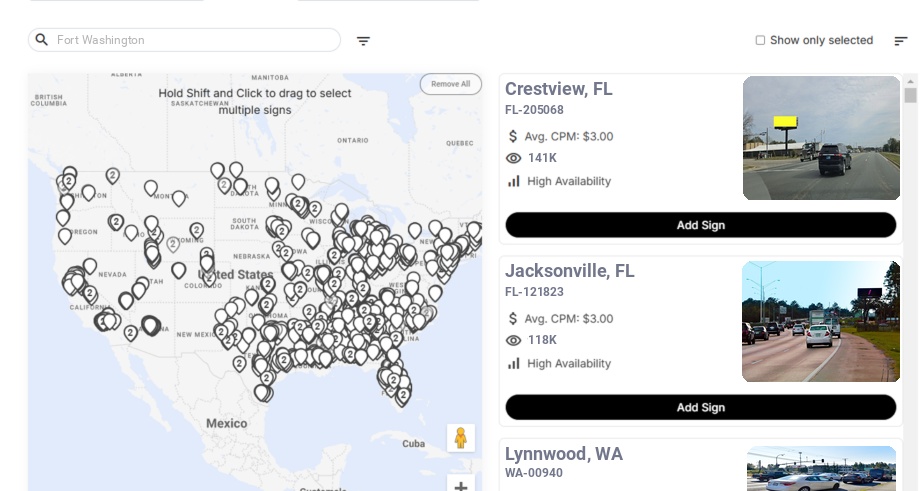
Blip has digital billboards in Fort Washington. You can browse available locations on a map, choose the ones that fit your audience, and start advertising right away.
Still have questions? Launch a campaign in minutes — no contracts, no commitments.
Start Your CampaignFort Washington Billboard Advertising Guide
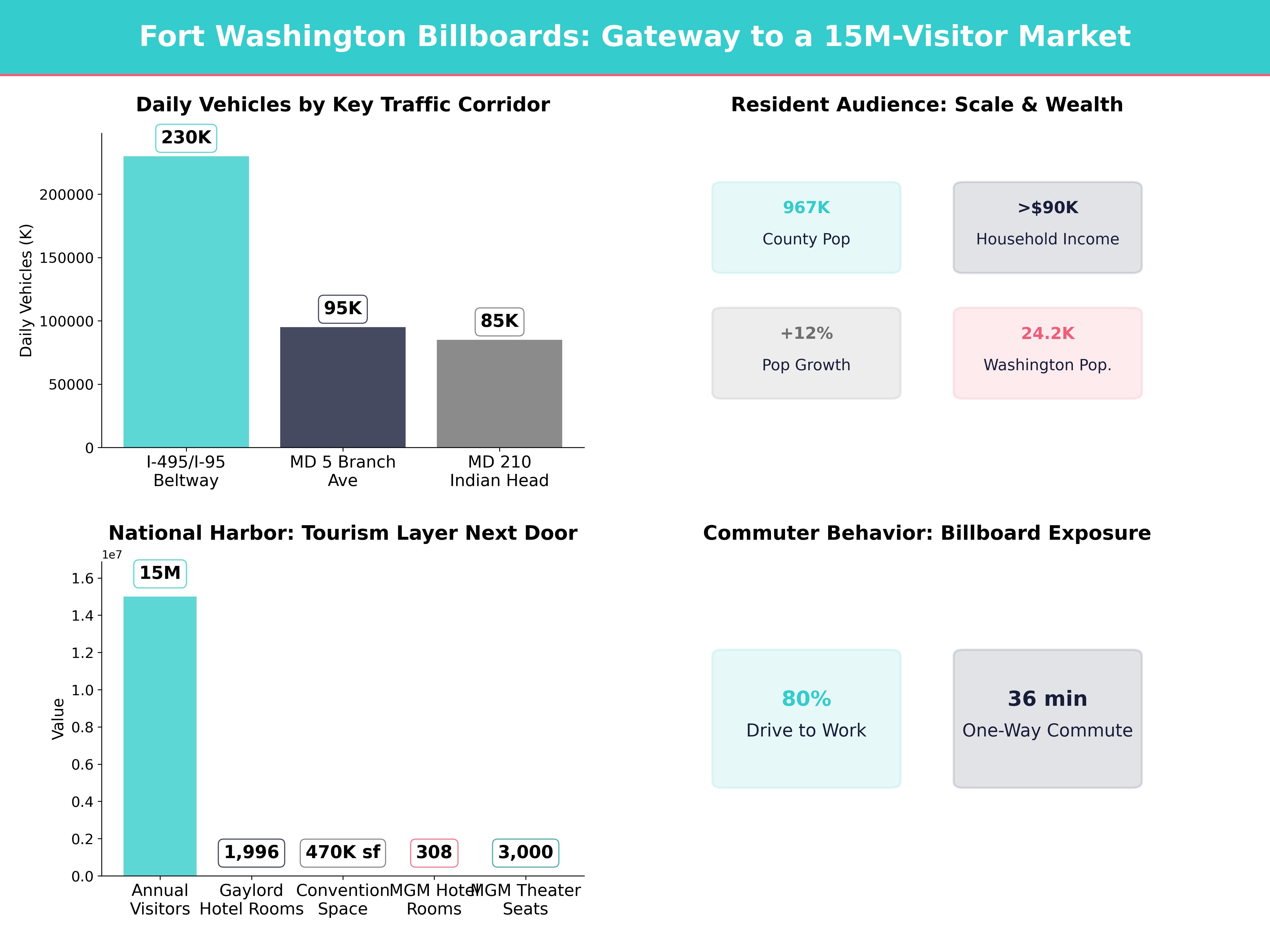
Fort Washington gives us access to one of the strongest billboard mixes in the Washington region: an affluent suburban residential base, heavy commuter traffic (roughly 80% of workers commute by car), and major visitor volume just minutes away at National Harbor, which draws 15 million annual visitors and sits beside a Beltway corridor carrying well over 230,000 vehicles per day near the Woodrow Wilson Bridge. Fort Washington itself had 24,192 residents in 2020, and it sits inside Prince George's County 967,201 residents in 2020 after adding 103,781 people since 2010. Because south county travel is still overwhelmingly car-based, digital billboards can build frequency on the same drivers every weekday. At the same time, nearby National Harbor reports 15 million annual visitors, which gives advertisers in Fort Washington unusual reach for tourism, hospitality, retail, healthcare, and regional service campaigns.
Fort Washington Market Overview
Fort Washington works well for billboard advertising because it is not an isolated suburb. It sits in a high-value position between local neighborhoods, the Capital Beltway Washington, D.C., Alexandria, and the entertainment district at National Harbor, where I-495/I-95 carry well over 230,000 vehicles per day near the Woodrow Wilson Bridge. That combination lets us reach both repeat local drivers and regional travelers on the same campaign.
Fort Washington has a local base and countywide scale
Fort Washington’s 24,192 residents are only part of the story. The broader Prince George's County 967,201 residents, and the county grew by about 12.0% from 863,420 in 2010 to 967,201 in 2020. For advertisers, that means Fort Washington billboards do not only serve one neighborhood. They serve a large and growing county, plus spillover traffic from Charles County Washington, D.C., and Northern Virginia.
The county also brings meaningful purchasing power. Recent countywide income estimates place median household income at more than $90,000, which supports categories such as healthcare, home services, financial services, education, auto, restaurants, and premium retail. Fort Washington itself is known for higher-income households and stable residential neighborhoods, which makes nearby billboard inventory especially useful for brands that need trust, repetition, and household decision-maker reach.
Car dependence strongly favors billboard visibility in Fort Washington
Fort Washington does not have a Metrorail station inside the community, so daily movement is still shaped by cars and highway funnels. County commuting data shows that roughly 80% of workers commute by car, either driving alone or carpooling, and the average one-way commute is about 36 minutes. Those are excellent conditions for out-of-home advertising because long, repeated drives create multiple chances to notice, remember, and act on a message.
Even transit users often begin their trip in a vehicle before connecting at Branch Avenue Station, Southern Avenue Station, or Naylor Road Station WMATA. That reinforces a simple local truth: in Fort Washington, road exposure still dominates daily attention.
Tourism adds a second audience beyond residents
Fort Washington advertisers also benefit from a nearby tourism engine that most suburbs do not have. National Harbor is a 350-acre waterfront district that reports 15 million annual visitors. Within that district, Gaylord National Resort & Convention Center 1,996 guest rooms and about 470,000 square feet of meeting and event space. MGM National Harbor 308 rooms and suites, a 125,000-square-foot casino floor, and a 3,000-seat theater.
The Capital Wheel 180 feet over the Potomac, and Tanger Outlets National Harbor adds more than 80 outlet brands. For billboard advertisers, those numbers matter because they create a second rhythm on top of the commuter market. Fort Washington campaigns can speak to residents during the day, then reach eventgoers, shoppers, and overnight guests in the evening and on weekends.
Key Traffic Corridors for Fort Washington Billboards
Fort Washington’s travel patterns are dominated by a short list of very important roads. When we understand those corridors, we can match each location to the right kind of advertiser and the right kind of message.
I-495 and I-95 on the Capital Beltway
According to traffic maps from the Maryland Department of Transportation State Highway Administration Woodrow Wilson Bridge well over 230,000 vehicles per day, and some nearby segments are commonly cited above 250,000 AADT. This is the biggest regional reach play in the Fort Washington area.
This corridor connects south Prince George’s County with Washington, D.C., Alexandria, and the broader Beltway employment market. It is ideal when we need scale more than hyperlocal precision.
- Healthcare systems and specialty clinics. We can reach residents across south county before they choose where to book appointments.
- Colleges, trade schools, and workforce recruiting. We can capture workers and career changers moving between Maryland, D.C., and Virginia.
- Regional retail, entertainment, and attractions. We can build awareness among both local repeat drivers and destination-bound visitors.
MD 210, Indian Head Highway
MD 210 is the most important Fort Washington commuter funnel. MDOT SHA roughly 80,000 to 90,000 vehicles per day on the heaviest stretches near the Beltway and Oxon Hill area, with somewhat lower but still strong counts as the route continues south. For Fort Washington residents, MD 210 is the road that structures everyday movement.
This corridor is especially strong for businesses that benefit from repeated weekday frequency and practical calls to action.
- Home services. We can stay in front of homeowners who make decisions about roofing, HVAC, remodeling, landscaping, and plumbing.
- Auto dealers, service centers, and insurance brands. We can reach drivers in the exact context where vehicle needs feel immediate.
- Quick-service restaurants, grocery, and convenience retail. We can influence stop decisions on the commute home.
- Healthcare, urgent care, and dental offices. We can use proximity-based messaging that names exits, neighborhoods, or short drive times.
MD 5, Branch Avenue, and Beltway connectors
MD 5 is another powerful regional route for Fort Washington campaigns, especially when we want to reach central and southern Prince George’s County drivers moving toward the Beltway, Suitland Clinton roughly 90,000 to 100,000 vehicles per day.
This route is useful for advertisers that need countywide awareness, not just Fort Washington awareness. It is a smart choice for higher-education recruiting, hospital systems, legal services, financial brands, and regional employers.
MD 414, Oxon Hill Road, Fort Washington Road, and Livingston Road
Fort Washington also depends on a network of local arterials that deliver more targeted household reach. MD 414, including St. Barnabas Road and nearby commercial segments, often posts roughly 20,000 to 35,000 daily vehicles depending on the exact location. Fort Washington Road and Livingston Road commonly run in the 15,000 to 25,000 daily vehicle range on busier sections.
These roads matter because they catch drivers close to decision points. They are often better than the Beltway for:
- Local medical practices. We can advertise close to where families actually live and schedule care.
- Real estate, senior living, and financial planning. We can speak to high-value residential households in a familiar setting.
- Restaurants, childcare, tutoring, and community services. We can target local routines instead of broad regional traffic.
Audience Segments We Can Reach in Fort Washington
Fort Washington billboard campaigns perform best when we think in audience layers rather than in one generic market. This area lets us reach several distinct groups with different reasons for being on the road.
Fort Washington commuters and cross-river workers
The first core audience is the daily commuter. With about 80% of workers traveling by car and an average one-way commute of about 36 minutes, Fort Washington drivers provide the repetition that makes billboard advertising memorable. Many head north toward the Beltway, Washington, D.C., and Alexandria, while others move east toward employment hubs in central Prince George’s County.
This audience responds well to clear offers, practical categories, and location-based relevance. We usually see the best fit for healthcare, legal services, home improvement, insurance, banking, education, and recruiting.
National Harbor visitors, convention attendees, and entertainment seekers
The second audience is the visitor economy. National Harbor reports 15 million annual visitors, which is extraordinary given how close it is to Fort Washington. Those visitors come for conventions, concerts, dining, casino trips, outlet shopping, family entertainment, and waterfront leisure.
The area’s anchor properties create several micro-audiences of their own:
- Gaylord National Resort & Convention Center 1,996 rooms and 470,000 square feet of meeting space.
- MGM National Harbor 308 rooms, a 125,000-square-foot casino, and a 3,000-seat theater.
- The Capital Wheel 180 feet, and it operates with 42 gondolas.
- Tanger Outlets National Harbor adds more than 80 outlet brands that pull value-focused shoppers from around the region.
This segment is excellent for restaurants, hotels, attractions, nightlife, luxury services, premium retail, event promotion, and destination brands that want people before they arrive.
Families, students, and household decision-makers in south county
The third audience is the family market. Prince George's County Public Schools serves more than 130,000 students, making it one of Maryland’s largest school systems. That means the area is full of parents making decisions about healthcare, tutoring, childcare, after-school activities, grocery, wireless, financial planning, and family entertainment.
Fort Washington also sits near healthcare and community anchors such as MedStar Southern Maryland Hospital Center, and it connects easily to education providers such as Prince George's Community College. For these advertisers, repeated local exposure matters more than one-time tourist impressions, so neighborhood-facing boards often outperform purely regional placements.
Southern Maryland drivers moving north
A fourth audience comes from the south. MD 210 and MD 5 both bring northbound drivers from Accokeek, Waldorf
This audience is especially valuable for healthcare, higher education, employers, auto, and retail that draws from a multi-county trade area.
Seasonal and Timing Opportunities in Fort Washington
Fort Washington is not a one-speed billboard market. Traffic patterns change with tourism, conventions, shopping cycles, school calendars, and entertainment schedules. We can improve results when we line our campaign timing up with those local rhythms.
Spring and summer in Fort Washington
Spring and summer are the strongest seasons for waterfront leisure and regional visitation. National Harbor, The Capital Wheel
Graduation season also matters. Local families spend heavily in late spring and early summer, and advertisers in dining, beauty, apparel, photography, event services, and education can benefit from that cycle. Home services also tend to rise in warmer months as homeowners address projects before peak summer heat.
Fall in Fort Washington
Fall is one of the most efficient times to advertise in Fort Washington because several audiences overlap. Prince George's County Public Schools returns in late August, commuting normalizes, and convention activity at Gaylord National 470,000 square feet of event space. Healthcare open enrollment, higher-education recruiting, fitness, financial services, and business services all tend to perform well in this period.
This is also a good time to market to local families with more structured routines. Regular weekday traffic becomes more predictable, which makes commuter dayparting especially useful.
Holiday and winter opportunities near Fort Washington
Holiday season is unusually strong here because Fort Washington sits beside one of the region’s biggest entertainment and shopping clusters. Gaylord National MGM National Harbor Tanger Outlets National Harbor shopping all lift evening and weekend traffic.
Digital billboards are especially effective in this period because more trips happen after dark, and bright creative can stand out in a crowded retail and entertainment environment. We should consider heavier weighting on Thursday through Sunday, plus later dayparts for dining, nightlife, shows, and gift-oriented retail.
Billboard Design Tips for Fort Washington Advertisers
Good billboard creative in Fort Washington should feel local, not generic. This is a market where the audience can quickly tell whether a message is meant for south county residents, National Harbor visitors, or broad Beltway traffic.
Use different visual styles for commuters and visitors in Fort Washington
Commuter-facing boards on MD 210 and the Beltway should emphasize speed, clarity, and immediate usefulness. These drivers are often in routine mode, so they respond well to one clear promise and one simple action. A strong Fort Washington commuter board often includes a service category, a trust marker, and a location cue.
Visitor-facing boards near National Harbor, MGM National Harbor Gaylord National
Reference local place names that people actually use
Fort Washington audiences respond to familiarity. Copy that names Fort Washington, Oxon Hill, National Harbor, Clinton, Branch Avenue, or MD 210 often feels more immediate than copy aimed at the vague “D.C. metro.” Local references signal convenience and relevance.
Messages such as “Minutes from National Harbor,” “Right off MD 210,” or “Serving Fort Washington and Oxon Hill” usually work better than abstract branding alone. This is especially true for healthcare, home services, legal, auto, and restaurants.
Reflect the community’s demographic and cultural reality
Prince George's County
Design for evening visibility near National Harbor
Because so much local entertainment traffic happens after work, high-contrast layouts often perform especially well here. Deep blues, black, gold, white, and other high-contrast palettes can read cleanly at night and fit the waterfront and entertainment feel of the market. If the target is affluent households or visitors headed to MGM National Harbor
Regional Strategies Around Fort Washington
A smart Fort Washington campaign usually works best when we treat the area as several connected submarkets instead of one uniform zone.
Fort Washington neighborhoods and local retail corridors
In Fort Washington proper, we should prioritize boards that serve homeowners, families, and repeat neighborhood traffic. This is where home services, medical practices, dental offices, tutoring, childcare, real estate, senior services, and grocery-adjacent businesses often perform best. Messaging should emphasize convenience, trust, and local credibility.
Oxon Hill and National Harbor
In Oxon Hill and around National Harbor, we should shift toward hospitality, entertainment, dining, events, nightlife, and premium retail. Campaigns here can lean more aspirational because the audience includes tourists, convention guests, date-night traffic, and people already planning to spend. Evening and weekend weighting is especially important in this submarket.
MD 210 south toward Accokeek and Charles County
Southbound and northbound MD 210 strategies are ideal when we want regional commuter capture. This zone can work well for healthcare systems, colleges, recruiting, auto dealers, legal services, and retail that pulls from both south Prince George’s County and Charles County
Branch Avenue and central Prince George’s connectors
When we need broad county reach, we should expand beyond Fort Washington proper toward MD 5, Branch Avenue, and central county connectors. These locations are useful for countywide awareness campaigns, especially for public-facing institutions, major employers, hospitals, colleges, and financial brands.
Using Blip Tools for Fort Washington Campaigns
Fort Washington is a very good market for flexible digital buying because the area has such distinct traffic patterns by corridor and time of day. We can get better results when we let campaign structure follow local behavior.
We can daypart Fort Washington campaigns around real travel habits
Morning commuter traffic on MD 210 and I-495 is different from evening entertainment traffic near National Harbor. We should use weekday morning schedules for professional services, healthcare, education, and recruiting, then shift to late afternoon and evening for restaurants, nightlife, hotels, events, and retail.
We can separate commuter and visitor messaging
Fort Washington is one of those rare suburban markets where two creative strategies can both be correct. With Blip, we can run one set of boards and messages for MD 210 commuters, then a different set for Harbor-bound visitors. That is especially helpful for advertisers with multiple offers, such as a restaurant promoting lunch to workers and dinner to tourists.
We can test sub-areas without committing to one fixed footprint
Some advertisers will do best with manual billboard selection because they know they want Fort Washington Road, MD 210, or National Harbor approaches specifically. Others will do better with Blip-optimized buying because they want broad south county reach and want the platform to find efficient inventory across several corridors. Fort Washington is a strong place to test both approaches because local, commuter, and visitor traffic each behave differently.
We can use analytics to rebalance toward what works
If a Fort Washington campaign shows stronger lift around evening entertainment traffic than morning commuting, we can shift budget quickly. If one artwork version performs better with Harbor traffic and another performs better on MD 210, we can keep the stronger variant in each lane. That kind of ongoing adjustment is especially valuable in a mixed market like this one.
Getting Started with Billboard Rental in Fort Washington
Renting a billboard in Fort Washington is easiest when we begin with geography and audience, not with the board itself. The right location depends on whether we want neighborhood households, commuter repetition, tourism traffic, or countywide awareness.
Start with a Fort Washington trade-area decision
We should first decide which of these goals matters most:
- Fort Washington households. We should focus on local arterials such as Fort Washington Road, Livingston Road, and nearby commercial connectors.
- South county commuters. We should focus on MD 210, I-495, and MD 5.
- National Harbor visitors. We should focus on Harbor approaches, Oxon Hill, and evening-oriented placements.
- Regional brand awareness. We should combine Beltway inventory with one or two local boards for reinforcement.
Evaluate Fort Washington billboard locations by context, not just cost
A less expensive board is not always the better board. In Fort Washington, we should consider whether the audience is traveling fast or slow, whether the board is close to an exit or decision point, whether the traffic is repeated or one-time, and whether the surrounding area is residential, commuter-driven, or entertainment-oriented.
A board near MD 210 can be excellent for home services because it reaches the same households repeatedly. A board closer to National Harbor may be better for restaurants or attractions because it reaches people who are ready to spend now. A Beltway board can be strongest for broad awareness because of its sheer scale.
Expect faster setup and easier testing with Blip than with traditional billboard buying
Traditional billboard buying often pushes advertisers into fixed packages, longer commitments, and slower revision cycles. Fort Washington is a market where that can be limiting because traffic value changes by sub-area, season, and time of day. Blip simplifies that process by letting us launch quickly, test specific boards or broader optimized coverage, change artwork when needed, and scale based on what we learn.
Launch small, learn, and expand inside Fort Washington
For many advertisers, the best Fort Washington strategy is to start with one clear objective, one or two audience segments, and a manageable initial flight. We can then review which corridors, dayparts, and creative themes perform best. Once we see whether commuters, local households, or Harbor visitors respond most strongly, we can expand with much more confidence.
Fort Washington is not just a neighborhood buy. It is a strategic south-county gateway with 24,192 local residents, access to a county of 967,201 people, commuter routes topping 230,000-plus vehicles per day on the Beltway, and a visitor district drawing 15 million people a year. When we match the right message to the right corridor, it becomes one of the most versatile billboard markets in the Maryland side of the Washington region.