Billboards near Camp Springs, MD
No Minimum Spend. No Long-Term Contracts. Just Results.
Trusted by Leading Brands


Billboard advertising
near Camp Springs has never been easier




How much is a billboard near Camp Springs?
Why Choose Blip for Billboard Advertising near Camp Springs
Blip lets you launch fast in Camp Springs and target the Beltway, Branch Ave, and MD 210 commuter flow without contracts or delays.
In Camp Springs, a Blip-optimized campaign can auto-shift spend to weekday rush hours or weekend National Harbor traffic to match your goals.
Set any budget in Camp Springs and only pay when your ad plays, so you can test south county reach near Fort Washington, Brandywine, and Lanham.
Track Camp Springs billboard results in real time and adjust creative or timing as school, retail, and visitor traffic changes.
Use Blip's creative tools to build clear, fast-read ads for Camp Springs drivers on the Beltway, WMATA stations, and local shopping corridors.
Frequently Asked Questions About Billboard Advertising near Camp Springs
How much does a billboard cost in Camp Springs with Blip?
Each 7.5-to-10-second display, or “blip,” starts at just $0.01, and the cost can vary based on time of day, location, and advertiser demand. That dynamic pricing helps stretch your budget while maximizing reach. Since your total spend is simply the sum of your individual blips over time, there are no minimums or contracts — you can start small, adjust your budget anytime, and pause whenever you want.
Where can I advertise with Blip near Camp Springs?
Our 6 digital billboards in nearby Fort Washington, Brandywine, and Lanham are all within 10.0 miles of Camp Springs, which gives advertisers practical coverage of the market without relying on a single road or one neighborhood. Fort Washington can help capture Beltway and MD 210 traffic, Brandywine can reach southbound and cross-county drivers, and Lanham can add regional frequency from the north and northeast. That approach is especially useful for advertisers who want awareness across a wider portion of Prince George’s County rather than a single corridor.
Why is Camp Springs a strong market for Blip billboard advertising?
The Camp Springs area is a strong billboard market because it sits where Prince George’s County commuter traffic, regional retail trips, and Washington-area destination travel all overlap, including nearby Beltway segments that carry 180,000+ vehicles per day and National Harbor, which attracts 15 million+ visitors annually. Daily movement is spread across the Capital Beltway, WMATA rail stations, suburban shopping corridors, and entertainment destinations like National Harbor. For brands that want repeat visibility with commuters, families, students, and visitors, billboard advertising serving the Camp Springs area offers both scale and flexibility.
What kind of people do Blip ads reach in Camp Springs?
The Camp Springs area sits inside Prince George’s County, which had 967,201 residents at the 2020 Census and remains one of Maryland’s largest counties, up about 12% from 2010. Prince George’s County is one of the nation’s largest majority-Black counties, with Black residents making up about 64% of the population, and it is also highly diverse, with roughly 1 in 5 residents identifying as Hispanic or Latino. The county’s median household income is roughly $95,000, which supports strong demand for healthcare, higher education, financial services, home improvement, automotive, dining, and family entertainment.
When is the best time to run billboard ads in Camp Springs with Blip?
For commuter-focused brands, morning runs from 6 a.m. to 9 a.m. and afternoon runs from 3 p.m. to 7 p.m. usually deserve first attention. For lunch and errand-based advertisers, 11 a.m. to 1 p.m. can also be productive, especially on corridors tied to offices, government traffic, and neighborhood retail. Weekend timing often matters more for destination audiences, and Friday afternoon through Sunday evening can outperform a traditional Monday-through-Friday plan.
Do I need a contract to advertise with Blip near Camp Springs?
No, Blip has no long-term contracts or minimum commitments. You can start, pause, or stop your campaign at any time.
How fast can I launch a billboard campaign with Blip near Camp Springs?
You can have your campaign live in minutes. Create a free account, select your locations, set your budget, upload your design, and start running once approved.
Where can I advertise with Blip near Camp Springs?
Blip has digital billboards near Camp Springs. You can browse available locations on a map, choose the ones that fit your audience, and start advertising right away.
Still have questions? Launch a campaign in minutes — no contracts, no commitments.
Start Your CampaignCamp Springs Billboard Advertising Guide
The Camp Springs area is a strong billboard market because it sits where Prince George’s County 180,000+ vehicles per day and National Harbor, which attracts 15 million+ visitors annually. Our 6 digital billboards in nearby Fort Washington, Brandywine, and Lanham are all within 10.0 miles of Camp Springs, which gives advertisers practical coverage of the market without relying on a single road or one neighborhood. That matters near Camp Springs because daily movement is spread across the Capital Beltway, WMATA rail stations, suburban shopping corridors, and entertainment destinations like National Harbor. For brands that want repeat visibility with commuters, families, students, and visitors, billboard advertising serving the Camp Springs area offers both scale and flexibility.
Camp Springs area market overview
Population, diversity, and buying power near Camp Springs
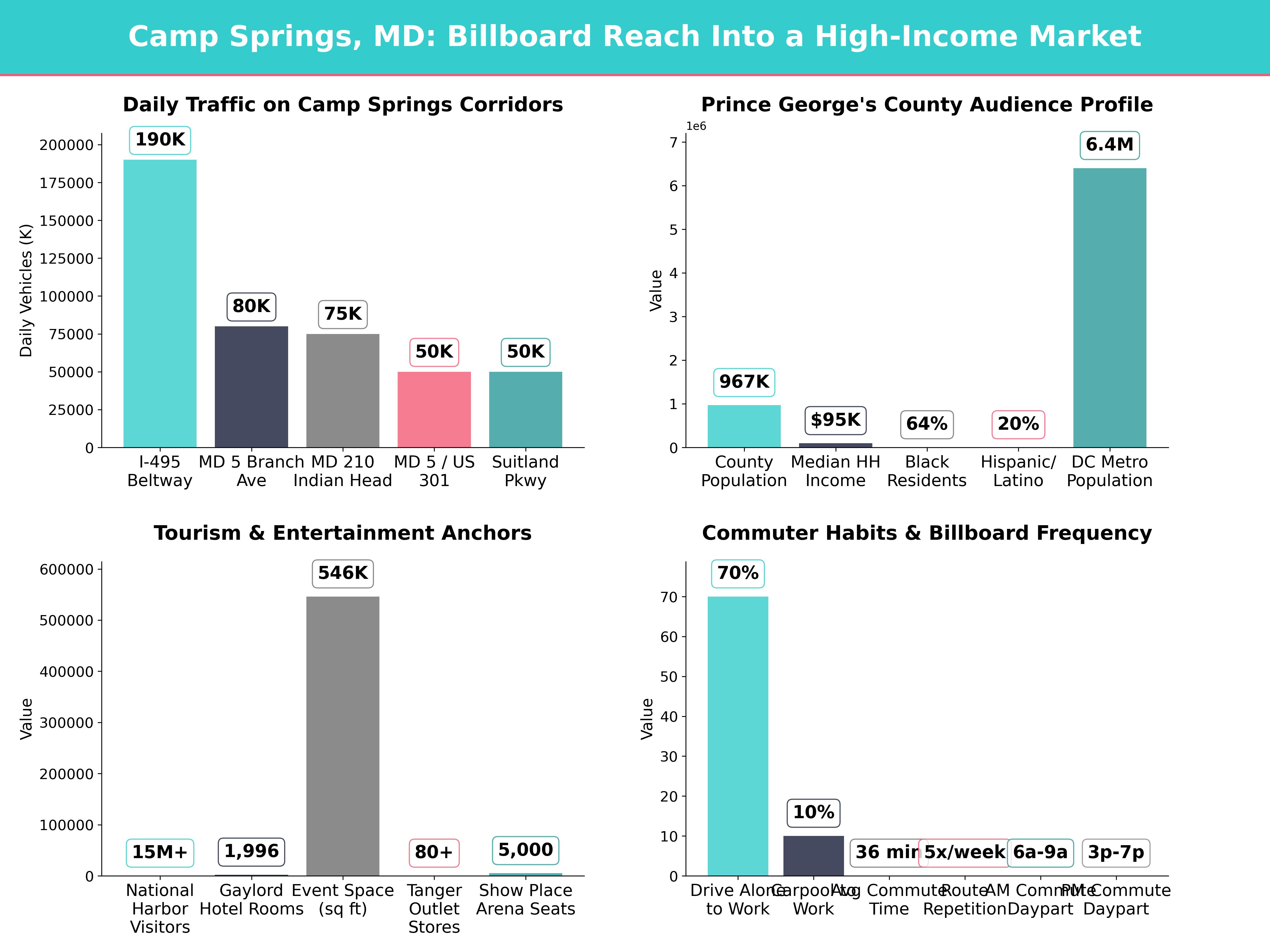
The Camp Springs area sits inside Prince George’s County 967,201 residents at the 2020 Census and remains one of Maryland’s largest counties, up about 12% from 2010. It also benefits from the broader Washington regional economy, with the metropolitan population at about 6.4 million people, roughly 14% higher than 2010. That means advertisers near Camp Springs are not limited to one suburban pocket. They are speaking to a large, constantly moving audience that lives in south county, works across the metro, and shops throughout the region.
Prince George’s County is one of the nation’s largest majority-Black counties, with Black residents making up about 64% of the population, and it is also highly diverse, with roughly 1 in 5 residents identifying as Hispanic or Latino. That diversity matters for billboard strategy. Creative that feels local, practical, and inclusive usually performs better than generic one-size-fits-all messaging.
The county’s median household income is roughly $95,000, which supports strong demand for healthcare, higher education, financial services, home improvement, automotive, dining, and family entertainment. The Prince George’s County Economic Development Corporation regularly highlights the county’s professional workforce, strategic location, and access to major employment centers. For billboard advertisers, that translates into a market with meaningful purchasing power and frequent repeat exposure.
Our local footprint is concentrated in three nearby nodes that help us cover the Camp Springs market from multiple directions. We have boards in Fort Washington, which is 6.1 miles away, in Brandywine, which is 6.6 miles away, and in Lanham, which is 9.7 miles away. Because these boards sit on real commuter and shopping routes, they serve the Camp Springs area well even though they are not physically inside the community.
Commuting behavior and mobility serving the Camp Springs area
The Camp Springs area is a road-first market. County commuting data show that roughly 7 in 10 workers drive alone, and about 1 in 10 carpool. Average travel time to work is about 36 minutes, which is long enough for roadside advertising to build useful frequency over time.
That commuting pattern is why nearby digital boards can work so efficiently. A driver who lives near Camp Springs may head north toward the Beltway, west toward employment centers, south toward shopping, or east toward county destinations, often on the same routes week after week. When we place campaigns across Fort Washington, Brandywine, and Lanham, we can mirror that movement. Transit still matters, too.
Branch Avenue Station, the southern terminus of the Green Line, helps anchor park-and-ride behavior serving the Camp Springs area. Suitland Station, Naylor Road Station TheBus
Key traffic corridors serving the Camp Springs area
The Beltway, Branch Avenue, and Indian Head Highway near Camp Springs
The Capital Beltway is the backbone of visibility serving the Camp Springs area. The full loop is 64 miles long, and Maryland State Highway Administration traffic counts regularly put nearby Prince George’s County segments above 180,000 vehicles per day. On some stretches, counts rise past 200,000 vehicles per day. That is exactly the kind of sustained exposure that makes digital billboard campaigns valuable for awareness, store traffic, and brand recall.
MD 5 Branch Avenue is one of the most important feeders for the Camp Springs market. Key segments near the Beltway commonly fall in the 70,000 to 90,000 vehicles per day range, depending on the exact section. Branch Avenue serves commuters, Metro riders, Joint Base Andrews traffic, and shoppers moving between Camp Springs-area neighborhoods and the rest of south county.
Fort Washington helps us cover the southwest side of the Camp Springs market, especially traffic influenced by MD 210 Indian Head Highway, the Beltway, and the approach to National Harbor. Major stretches of MD 210 near the Beltway often land around 70,000 to 80,000 vehicles per day. For advertisers, that corridor is especially useful when the goal is to reach commuters plus evening and weekend destination traffic.
Suitland Parkway, Allentown Road, and the northeast approach to Camp Springs
The Camp Springs area also depends on a network of arterial routes that distribute traffic between neighborhoods, Metro stations, and retail centers. Suitland Parkway remains one of the best examples. Depending on the segment, it often operates in a broad 40,000 to 60,000 vehicles per day range. That makes it important for campaigns targeting government workers, military households, healthcare users, and daily-service shoppers.
Allentown Road, Auth Road, and nearby local connectors matter because they carry the last-mile trips that tie the Camp Springs area to the Beltway and Branch Avenue. These roads may not have Beltway-scale counts, but they channel highly relevant local audiences who are making repeat weekly trips for schools, grocery runs, quick-service dining, healthcare, and errands.
Brandywine extends our reach south of Camp Springs along one of the county’s most important retail and growth corridors. The MD 5 and US 301 area near Brandywine regularly clears 50,000-plus vehicles per day on major commercial stretches, and it captures shoppers traveling between south county, Charles County, and the broader Prince George’s County market. Lanham gives us a different angle. It helps us reach the Camp Springs audience through the eastern Beltway, MD 295
Audience segments advertisers can reach near Camp Springs
Government, military, and contractor commuters serving the Camp Springs area
The Camp Springs area has a substantial base of government, military, and contractor commuting activity because of its position near Joint Base Andrews and its easy access to Washington employment centers. This audience is valuable because it is habitual. Many commuters use the same route 5 days a week, often at roughly the same times, which helps digital billboards build recognition through repetition.
For this group, weekday scheduling matters most. Morning visibility from about 6 a.m. to 9 a.m. can work well for coffee, breakfast, healthcare, auto service, staffing, and recruitment. Afternoon and early evening visibility from about 3 p.m. to 7 p.m. is often stronger for restaurants, urgent care, legal services, grocery, telecom, colleges, and local retailers.
If we want broad commuter coverage serving the Camp Springs area, we usually think in layers. Fort Washington can help capture Beltway and MD 210 traffic. Brandywine can reach southbound and cross-county drivers. Lanham can add regional frequency from the north and northeast. That approach is especially useful for advertisers who want awareness across a wider portion of Prince George’s County rather than a single corridor.
Families, homeowners, and everyday-service buyers near Camp Springs
The Camp Springs market includes a large suburban family audience. Prince George’s County Public Schools serves about 133,000 students across 200-plus schools and centers, making it Maryland’s second-largest school system. That means a huge share of weekly local travel is shaped by school drop-offs, after-school pickups, sports, tutoring, grocery stops, and family errands.
This is a great audience for dentists, pediatric care, urgent care, insurance, banks, automotive service, HVAC, plumbing, grocery, fast casual dining, youth programs, and home improvement brands. Because families usually travel within routines, billboard exposure can reinforce the same message several times before a purchase decision is made.
For this audience, clear utility beats abstract branding. Offers like “Same-Day Appointments,” “Free Estimate,” “Now Open Near Branch Ave,” or “Enroll for Fall” tend to fit the local decision style better than vague image-only creative. The Camp Springs area is practical, busy, and commute-heavy. Advertising that respects that mindset usually performs better.
Students and emerging adults in the Camp Springs area orbit
The Camp Springs market is also influenced by nearby higher education traffic. The University of Maryland enrolls more than 40,000 students, and Bowie State University enrolls roughly 6,300 students. Prince George’s Community College adds another significant pool of credit, workforce, and continuing-education learners serving the county.
This audience matters for more than just education brands. Students and young professionals are strong targets for apartments, wireless plans, entertainment, quick-service food, banking, healthcare, rideshare-adjacent services, and entry-level recruiting. Lanham is especially helpful when we want to catch countywide student circulation tied to College Park, Bowie, New Carrollton
Timing matters here, too. The strongest windows are usually late summer move-in, back-to-school, spring recruitment, graduation season, and internship-heavy periods in May and June. If the goal is response rather than pure awareness, we generally recommend creative with one simple action, one URL, and one reason to act now.
Tourists, entertainment seekers, and weekend visitors near Camp Springs
One of the best features of billboard advertising serving the Camp Springs area is access to destination traffic. National Harbor alone attracts more than 15 million visitors annually. Nearby entertainment and hospitality anchors include MGM National Harbor 308-room hotel, and Gaylord National Resort & Convention Center 1,996 rooms and 546,000 square feet of meeting and event space.
Retail also adds volume. Tanger Outlets National Harbor features 80-plus stores, and The Capital Wheel 180 feet above the waterfront. Nearby county entertainment venues help round out the audience mix. Show Place Arena 5,000, and Six Flags America offers more than 100 rides, slides, and attractions.
These destination audiences are ideal for restaurants, attractions, hotels, entertainment venues, retail, event promotion, rideshare alternatives, and premium services. Weekend timing often matters more here than weekday commuting. For some advertisers, Friday afternoon through Sunday evening can outperform a traditional Monday-through-Friday plan.
Seasonal and timing opportunities near Camp Springs
Strong weekly timing patterns serving the Camp Springs area
The Camp Springs area gives us very clear daypart opportunities. For commuter-focused brands, morning runs from 6 a.m. to 9 a.m. and afternoon runs from 3 p.m. to 7 p.m. usually deserve first attention. For lunch and errand-based advertisers, 11 a.m. to 1 p.m. can also be productive, especially on corridors tied to offices, government traffic, and neighborhood retail.
Winter and late fall usually make evening visibility even stronger because darkness arrives earlier and illuminated digital creative stands out more. Tax services, healthcare, legal campaigns, and home services often benefit from January through April. Spring is strong for colleges, events, outdoor services, and graduation-related promotions.
Tourism, school, and retail seasonality near Camp Springs
Summer opens up a different pattern serving the Camp Springs area. Leisure traffic increases around National Harbor, MGM National Harbor Tanger Outlets National Harbor, and Six Flags America. This is a smart time for restaurants, attractions, family entertainment, hotels, and consumer brands that benefit from out-of-home weekend audiences.
Back-to-school season is especially important because of the county’s 133,000-student public school system and nearby colleges. August and September are good months for healthcare, optical, tutoring, telecom, banking, apparel, and quick-service dining. Fall also works well for community events, local festivals, and enrollment campaigns.
Holiday retail is another major opportunity. National Harbor decorations, outlet shopping, conventions, and entertainment activity raise travel volume late in the year. If we are advertising near Camp Springs for giftable products, seasonal experiences, dining, or urgent services, November and December usually justify a stronger share of budget.
Billboard design tips for the Camp Springs market
Creative choices that fit Camp Springs-area driving behavior
The first rule for the Camp Springs market is speed of comprehension. Blip ads display for 7.5 to 10 seconds, so we want the message understood almost instantly. On high-speed roads like the Beltway, Branch Avenue, and MD 210, we usually recommend one idea, one brand cue, and one call to action.
Large numerals often work well in this market. Prices, percentages, dates, phone extensions, and short offers can stand out better than longer descriptive copy. If the message is local, say so clearly. Phrases like “Near Branch Ave,” “Off the Beltway,” “Minutes from National Harbor,” or “Serving Prince George’s” can make the ad feel immediately relevant.
High contrast is especially important near Camp Springs because so much exposure happens against gray pavement, winter skies, brake lights, and cluttered commuter environments. Deep blue, bright white, red, gold, black, and vivid green often read better than low-contrast pastels. Night-friendly creative matters because evening commute windows are so valuable.
Visual and messaging styles that resonate near Camp Springs
The best local creative usually looks authentic to Prince George’s County life. Images of professionals, families, healthcare providers, students, local dining, cars, and real neighborhood activity often perform better than generic skyline shots. Washington cues can help, but we generally avoid making the ad feel downtown-only unless the offer really is aimed at downtown workers.
Because the county is diverse, multicultural casting and bilingual creative can be a smart choice. That does not mean every ad needs two languages. It means the creative should reflect the audience honestly. In a county where roughly 20% of residents are Hispanic or Latino and the broader consumer base is highly diverse, inclusive visuals can improve local fit.
We also recommend direct, useful language. “Book Today,” “Open Late,” “Free Consultation,” “Apply Now,” and “Enroll for Fall” align with the practical decision-making that often drives responses serving the Camp Springs area.
Regional strategies on boards serving the Camp Springs area
Fort Washington strategy for southwest Camp Springs coverage
Our Fort Washington boards sit just 6.1 miles from Camp Springs and are especially useful when we want to capture traffic flowing toward the Beltway, National Harbor, MGM National Harbor
Fort Washington works especially well for advertisers who benefit from both weekday and weekend patterns. On weekdays, commuters dominate. On evenings and weekends, destination travelers add extra audience depth. That combination can make Fort Washington one of the most versatile billboard nodes serving the Camp Springs area.
Brandywine strategy for southbound retail and residential growth
Our Brandywine boards are 6.6 miles from Camp Springs and line up well with the MD 5 and US 301 corridor. This is one of the best options for campaigns aimed at shoppers, families, homeowners, and people traveling between Prince George’s County and southern Maryland. It is also helpful for brands connected to Brandywine Crossing
We like Brandywine for advertisers whose customers are making planned trips rather than pure commuter trips. Home improvement, furniture, dental, pediatric care, auto dealerships, banking, and family entertainment all fit well here. If the message is about convenience, value, or a weekend purchase, Brandywine often deserves meaningful weight.
Lanham strategy for broader county and cross-metro reach
Our Lanham boards are 9.7 miles from Camp Springs, and they help extend campaigns beyond south county into the larger Prince George’s and east-of-D.C. commuter network. That is useful when the target audience lives near Camp Springs but works, studies, or shops across a wider geography.
Lanham is often a smart add-on for colleges, hospitals, regional retailers, telecom, staffing, legal services, and broad awareness campaigns. It can also help when we want more countywide repetition without putting every impression on the same south county corridor. For businesses serving the Camp Springs area, Lanham is often less about hyperlocal immediacy and more about scale, reinforcement, and regional movement patterns.
Blip tools for billboard campaigns near Camp Springs
How we use Blip features to match Camp Springs-area strategy
Blip works well near Camp Springs because the market has distinct commuter windows, destination peaks, and corridor differences. If we want tight control, we can run a manual campaign and pick specific boards in Fort Washington, Brandywine, and Lanham on the map. If we want efficiency, we can let a Blip-optimized campaign distribute budget across the local network based on goals, timing, and available inventory.
That flexibility matters in a market like this. A healthcare clinic might prioritize weekday commute periods. A restaurant or attraction might shift spend toward Friday evenings and weekends. A college might emphasize late summer and spring recruitment windows. Because Blip is digital and self-serve, we can adjust those choices without the friction that usually comes with traditional out-of-home buying.
Blip’s pay-per-play model, with pricing that starts at $0.01 per display, also makes testing realistic. An advertiser serving the Camp Springs area can start small, compare Fort Washington against Brandywine, rotate different creative in Lanham, and then scale based on actual performance. Real-time analytics help us refine that process instead of guessing.
Getting started with billboard rental near Camp Springs
How we recommend evaluating billboard options serving the Camp Springs area
When advertisers ask us where to start near Camp Springs, we usually walk through a simple decision framework.
- We first identify whether the goal is commuter reach, family retail traffic, tourism visibility, or broad county awareness.
- We then match that goal to the right nearby node. Fort Washington usually fits Beltway, MD 210, and destination traffic. Brandywine usually fits south-county retail and residential shopping trips. Lanham usually fits countywide reinforcement and cross-metro circulation.
- We choose dayparts based on buying behavior. Morning and afternoon are usually best for commuters. Midday can work for quick-service, healthcare, and errands. Friday through Sunday is often strongest for entertainment and destination brands.
- We build creative that can be understood in a glance. The ad should communicate one idea clearly and look strong both in daylight and after dark.
- We track response using a dedicated landing page, vanity URL, promo code, or lift in branded search so that the campaign can be evaluated against real business goals.
What to expect when renting digital billboard space near Camp Springs
Traditional billboard buying often involves long lead times, fixed contracts, and limited flexibility. Blip simplifies that process for advertisers serving the Camp Springs area. We can launch faster, test more easily, change creative without printing vinyl, and pause or adjust campaigns whenever the business needs change.
That is especially helpful in a market with so many moving parts. A local urgent care can increase spend during flu season. A retailer can lean into holiday shopping. A college can promote enrollment windows. A home-services company can react to weather events or seasonal demand.
For most advertisers, the best first campaign is not the biggest campaign. It is the clearest one. Start with the audience, choose the nearby corridors that best serve that audience, run creative built for fast comprehension, and use the data to learn which locations and times drive the strongest response. That approach is usually the fastest path to finding the right billboard mix for the Camp Springs area.