Billboards in Willards, MD
No Minimum Spend. No Long-Term Contracts. Just Results.
Trusted by Leading Brands


Billboard advertising
in Willards has never been easier



How much is a billboard in Willards?
Why Choose Blip for Billboard Advertising in Willards
-
Blip lets you launch in Willards fast and self-serve, reaching US 50 beach traffic and lower Shore commuters without sales calls.
-
No contracts or minimums in Willards mean you can test ads for Ocean City visitors, Salisbury shoppers, or Berlin commuters and adjust anytime.
-
Use Blip-optimized campaigns in Willards to auto-pick timing and boards for US 50, then shift budget as beach season or shoulder traffic changes.
-
Track real-time analytics in Willards to see what works on commuter hours, Friday eastbound beach runs, and Sunday return traffic.
-
Blip's creative tools help Willards ads stand out for Ocean City-bound travelers and car-heavy local audiences on the Eastern Shore.
Frequently Asked Questions About Billboard Advertising in Willards
How much does a billboard cost in Willards with Blip?
With Blip, billboard advertising in Willards can be surprisingly affordable because you only pay when your ad actually appears. Pricing starts at just $0.01 per display, and you set a daily budget while Blip’s algorithm bids for open ad slots. The cost per blip changes based on time of day, location, and advertiser demand, so you can start small, adjust anytime, and pause whenever you want.
Where can I advertise with Blip in Willards, Maryland?
US 50 is the signature corridor for Willards and is the road that links inland households to the resort economy. Around Salisbury, busier urban sections of US 50 and US 13 regularly exceed 40,000 AADT, and US 113 around Berlin commonly runs in the high-20,000s to low-30,000s AADT range. MD 90 near West Ocean City also carries around 20,000 AADT on key approach segments and reaches travelers making late-stage resort decisions.
Why is Willards, Maryland a good place for Blip billboard advertising?
Willards sits on the lower Eastern Shore corridor that ties Salisbury, Berlin, and Ocean City together, which gives advertisers access to commuters, shoppers, students, workers, and beach travelers in one market. Roughly 85% to 90% of workers in the surrounding counties commute by car, truck, or van, and Ocean City typically attracts more than 8 million visitors each year. That combination of regional drive traffic, nearby population centers, and destination travel makes Willards a strong gateway location.
When is the best time to run Willards billboard ads for beach traffic?
From Memorial Day through Labor Day, US 50 becomes a much more tourism-driven corridor, and July and August are the most intense months. Eastbound messaging is especially strong on Thursdays, Fridays, and Saturdays, while westbound messaging becomes more valuable on Sundays, holiday return days, and late-afternoon departure windows. Shoulder season from May into October can also be excellent because resort traffic stays active with events and festivals.
What kind of audience can Willards, Maryland billboards reach with Blip?
The strength of Willards is not just traffic count, but audience variety. A well-planned campaign here can reach year-round residents, summer visitors, students, and workforce audiences without changing markets. The area also supports commuters, beach tourists, and workers tied to healthcare, agriculture, retail, hospitality, and higher education.
Do I need a contract to advertise with Blip in Willards?
No, Blip has no long-term contracts or minimum commitments. You can start, pause, or stop your campaign at any time.
How fast can I launch a billboard campaign with Blip in Willards?
You can have your campaign live in minutes. Create a free account, select your locations, set your budget, upload your design, and start running once approved.
Where can I advertise with Blip in Willards?
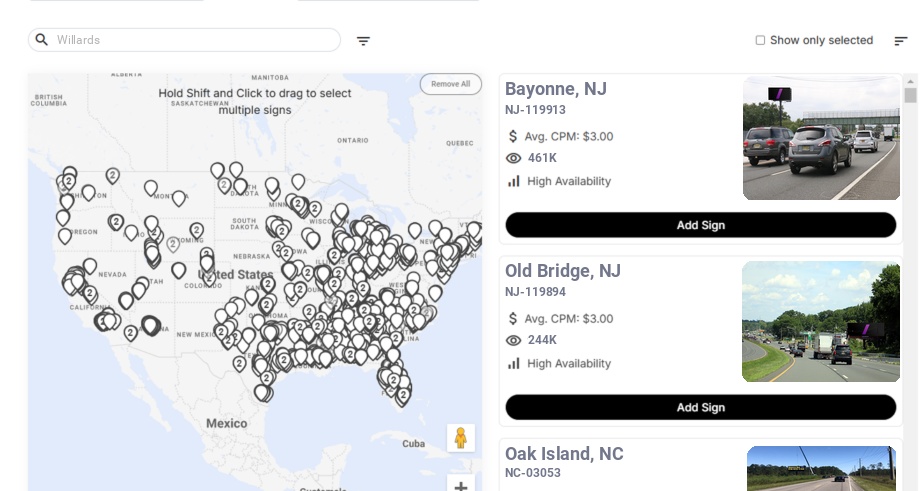
Blip has digital billboards in Willards. You can browse available locations on a map, choose the ones that fit your audience, and start advertising right away.
Still have questions? Launch a campaign in minutes — no contracts, no commitments.
Start Your CampaignWillards Billboard Advertising Guide
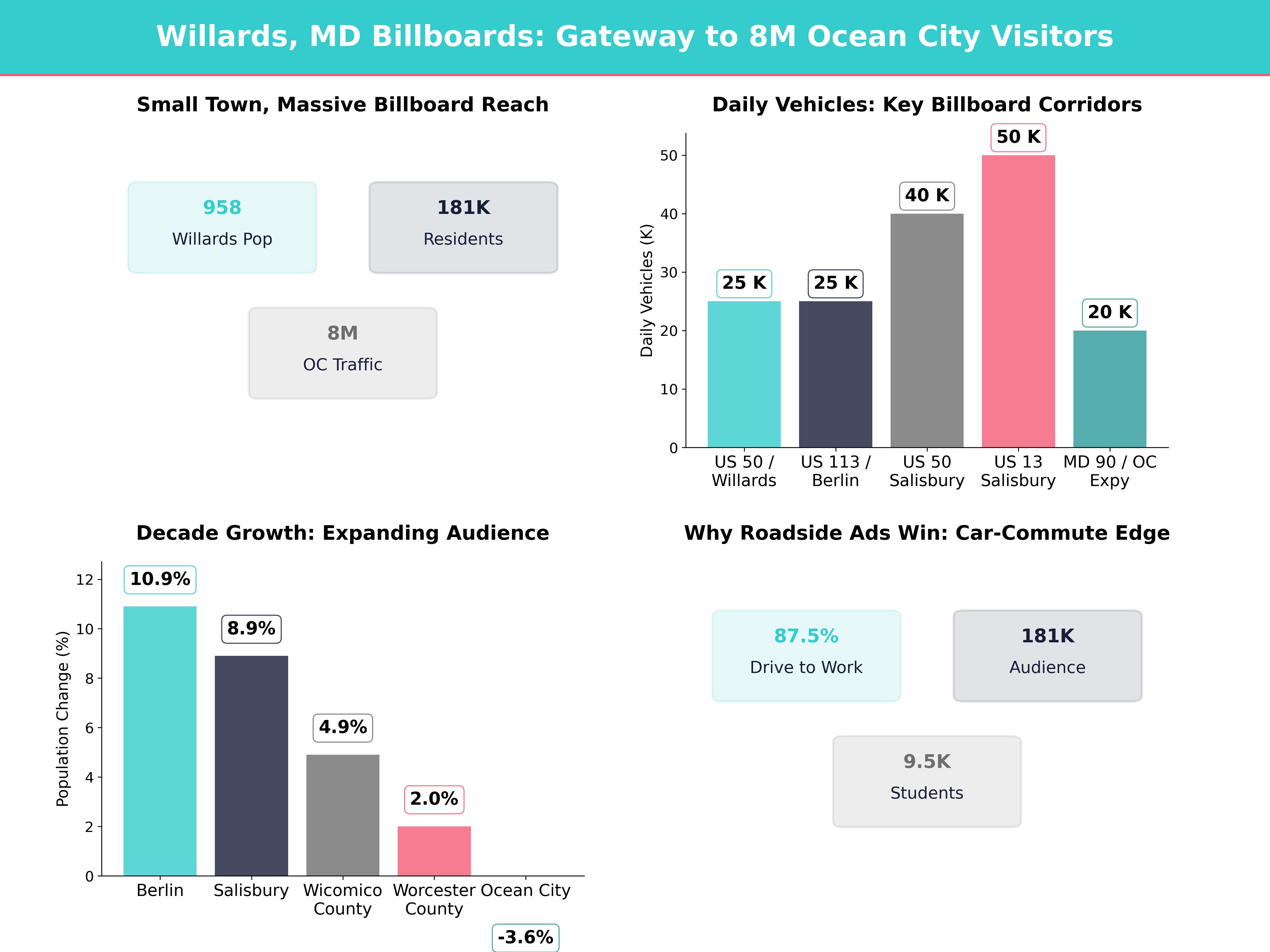
Willards 958 residents in the 2020 Census, but it sits on the lower Eastern Shore corridor that ties Salisbury, Berlin, and Ocean City together, which gives us access to commuters, shoppers, students, workers, and beach travelers in one market. This is a deeply car-oriented part of Maryland, with roughly 85% to 90% of workers in the surrounding counties commuting by car, truck, or van, and seasonal tourism adds another layer of scale because Ocean City typically attracts more than 8 million visitors each year. For billboard advertisers, that combination of regional drive traffic, nearby population centers, and destination travel makes Willards a strong gateway location.
Market Overview for Willards, Maryland
Why Willards Matters Beyond Its Town Limits
Willards Wicomico County 103,588 residents in 2020. Immediately to the east, Worcester County had 52,460 residents, and nearby Somerset County had 24,620. Together, those three lower-shore counties total 180,668 residents before we even count student populations, second-home users, or resort visitors.
The nearby population centers matter just as much as the county totals. Salisbury reached 33,050 residents in 2020, Berlin reached 4,973, and Ocean City had 6,844 year-round residents. Those numbers confirm that Willards is not a stand-alone micro-market. It is part of a regional trade area with a small-town core, a city-sized service hub, and one of the East Coast’s best-known beach destinations.
Growth patterns also support billboard investment. From 2010 to 2020, Wicomico County grew 4.9%, adding 4,855 residents, from 98,733 to 103,588. Worcester County grew 2.0%, adding 1,006 residents, from 51,454 to 52,460. Salisbury grew 8.9%, adding 2,707 residents, from 30,343 to 33,050, and Berlin grew 10.9%, adding 488 residents, from 4,485 to 4,973. Ocean City’s permanent population declined 3.6%, or 258 residents, from 7,102 to 6,844, but that does not weaken the advertising case because its economic power comes from tourism volume, not year-round population alone.
What the Willards Numbers Mean for Advertisers
For billboard planning, we should think in trade areas rather than municipal borders. Willards itself is small, but it sits in a corridor where residents travel frequently for work, healthcare, shopping, school, and recreation. Recent ACS commuting profiles indicate that roughly 85% to 90% of workers in both Wicomico and Worcester counties commute by car, truck, or van. Even with Shore Transit serving 3 counties, road travel remains the dominant habit.
That driving behavior is reinforced by the region’s economy. Perdue Farms was founded in 1920 and remains headquartered in Salisbury, while TidalHealth Salisbury University, University of Maryland Eastern Shore, retail corridors, and tourism businesses keep people moving across county lines. Local business activity is supported by organizations such as the Salisbury Area Chamber of Commerce, the Ocean City Chamber of Commerce, and the Berlin Chamber of Commerce.
For advertisers, that means Willards can support two strategies at once. We can use it as a local reach market for Eastern Shore households, and we can use it as a gateway market for beach-bound travel. Few towns under 1,000 residents offer both.
Key Traffic Corridors for Willards Billboards
Willards travel patterns are shaped by a handful of roads that carry the region’s daily life and seasonal surges. According to MDOT SHA traffic volume maps mid-20,000s to low-30,000s AADT range near Willards and Salisbury-area segments that can exceed 40,000 AADT, which is exactly what gives this market its billboard value.
US 50 Through Willards and Toward Ocean City
US 50 is the signature corridor for Willards. Many segments east of Salisbury and around Willards fall in the mid-20,000s to low-30,000s AADT range on MDOT SHA maps, and practical exposure rises during beach season as weekend traffic builds. This is the road that links inland households to the resort economy.
We should treat US 50 near Willards as a high-value decision corridor for several advertiser types.
- Eastbound placements work especially well for hotels, vacation rentals, breakfast spots, convenience stores, beach retailers, and attractions that benefit from last-minute decisions.
- Westbound placements work especially well for dinner, outlet shopping, urgent care, home services, and reminder messaging aimed at travelers heading back inland.
- Both directions work for brand-building campaigns that want repeated frequency with local commuters and seasonal visitors.
Because US 50 traffic includes both routine local trips and destination travel, it is often the most versatile corridor in the market.
US 50 and US 13 in Salisbury
When we want pure volume and daily repetition, Salisbury matters. Busier urban sections of US 50 and US 13 regularly exceed 40,000 AADT, and some US 13 retail stretches sit in roughly the 30,000 to 50,000+ AADT band. Those are strong numbers for a smaller metro, and they reflect Salisbury’s role as the lower shore’s primary service and shopping hub.
This corridor is especially useful for:
- Healthcare systems, medical groups, and specialty practices tied to TidalHealth
- Retailers, auto dealers, banks, attorneys, and home-service brands that need high local frequency.
- Employers recruiting from across Wicomico, Worcester, and Somerset counties.
- Colleges, trade schools, and student-oriented services targeting Salisbury University and Wor-Wic Community College.
If our goal is household reach rather than tourism reach, Salisbury usually deserves a major share of the plan.
US 113 Around Berlin and North-South Shore Travel
US 113 is the north-south complement to US 50. Around Berlin, MDOT SHA counts commonly run in the high-20,000s to low-30,000s AADT range. That gives us access to traffic flowing between lower-shore towns, Delaware-bound travel, Worcester County communities, and the beach market.
US 113 works well for advertisers that need regional coverage across multiple counties. Furniture stores, home improvement brands, auto repair, equipment dealers, healthcare providers, and regional employers often benefit most from this route. It is also effective for hospitality brands that want to catch travelers before they choose between Berlin, West Ocean City, and Ocean City proper.
MD 90 and the West Ocean City Split
MD 90, the Ocean City Expressway, is a smaller corridor than US 50, but it still carries around 20,000 AADT on key approach segments and reaches travelers making late-stage resort decisions. This is important because message timing changes as visitors get closer to the water. Early on US 50, they are still planning. Near MD 90, they are choosing where to eat, park, shop, and stay.
That makes MD 90 and the surrounding West Ocean City area especially effective for:
- Lodging and same-day availability messaging.
- Restaurants and family attractions.
- Outlets Ocean City Ocean Downs Casino
- Parking, marina, and weather-contingency offers.
Local Roads Around Willards
Local roads such as MD 354 do not compete with US 50 for raw reach, but they still matter for frequency. When we are advertising a local service business, a community event, or a countywide brand that wants repeated exposure among nearby residents, feeder roads can support the larger corridor strategy. We should use them selectively rather than as the primary reach engine.
Audience Segments We Can Reach from Willards
The strength of Willards is not just traffic count. It is audience variety. A well-planned campaign here can reach year-round residents, summer visitors, students, and workforce audiences without changing markets.
Commuters and Regional Households
The lower-shore population base of 180,668 residents gives us a reliable daily audience, and the region’s 85% to 90% car-commute pattern makes roadside advertising highly relevant. Salisbury, Snow Hill Pocomoke City, Princess Anne Ocean Pines
This audience is ideal for categories such as:
- Healthcare, dentistry, and urgent care.
- HVAC, roofing, plumbing, and other home services.
- Grocery, banking, insurance, and legal services.
- Auto dealers, tire stores, and maintenance brands.
These are repeat-trip customers, which means billboard frequency can do a lot of work.
Beach Tourists and Weekend Visitors
The tourism segment is what makes Willards special. Ocean City typically draws more than 8 million visitors a year, offers 10 miles of beach, and features a nearly 3-mile boardwalk. The Roland E. Powell Convention Center 214,000 square feet of meeting and exhibit space, which helps keep traffic flowing beyond the core summer season.
That visitor mix supports a wide range of advertisers, including hotels, restaurants, bars, amusement operators, outlet retailers, marinas, fishing businesses, and weather-sensitive indoor attractions. It also supports practical categories such as urgent care, pharmacies, towing, and repair services because travelers often need immediate solutions while they are away from home.
Students and Young Adults
Higher education matters more here than many advertisers realize. Salisbury University enrolls roughly 7,000 students, and University of Maryland Eastern Shore enrolls roughly 2,500 more. Wor-Wic Community College adds another commuter-heavy education audience that moves between campuses, jobs, and home.
This segment is valuable for apartments, mobile carriers, fitness brands, entertainment, healthcare, financial services, part-time hiring, and graduate programs. It is also highly seasonal, which gives us clear timing windows in August, January, and late spring.
Industry Workers and Job Seekers
The lower Eastern Shore economy is still shaped by poultry, agriculture, logistics, healthcare, construction, retail, and hospitality. Perdue Farms, Delmarva Chicken Association, TidalHealth
Recruiting campaigns can perform especially well here because people regularly drive across county lines for work. Billboards on US 50, US 13, and US 113 are useful for staffing firms, industrial employers, CDL recruiting, healthcare hiring, and trade apprenticeships.
Seasonal and Timing Opportunities in Willards
Seasonality is one of the biggest reasons to use digital billboard inventory in Willards. The audience changes meaningfully by month, by weekday, and even by direction of travel.
Summer Beach Season in Willards
From Memorial Day through Labor Day, US 50 becomes a much more tourism-driven corridor. July and August are the most intense months, and eastbound messaging is especially strong on Thursdays, Fridays, and Saturdays. Westbound messaging becomes more valuable on Sundays, holiday return days, and late-afternoon departure windows.
Because Ocean City has only 6,844 year-round residents, summer demand is overwhelmingly visitor-driven. That is why creative about lodging, dining, family fun, beach supplies, and convenience performs so well in this season. It is also why flexible scheduling matters. A sunny beach weekend and a rainy one can produce very different traveler behavior.
Spring and Fall Shoulder Seasons Around Willards
Shoulder season is a major opportunity on the lower shore. The Ocean City events calendar, White Marlin Open, car shows, motorcycle rallies, and festivals keep resort traffic active from May into October. The convention center’s 214,000-square-foot footprint also helps fill shoulder periods with meetings, sports, and trade events.
These months are often excellent for advertisers because the audience is still active, but the clutter can be lower than peak summer. We can use that window for:
- Regional attractions and entertainment.
- Outlet and restaurant promotions.
- Real estate, homebuilding, and retirement-oriented messaging.
- Healthcare, banking, and professional services that want affluent visitor and second-home audiences.
We should also remember that the Delmarva Shorebirds season runs from spring into early fall, which adds another family and event audience around Salisbury.
Back-to-School, Holidays, and Winter Service Windows in Willards
Late August, early September, and January line up with college move-ins and term starts at Salisbury University and UMES. November and December are strong for Salisbury retail and gift-driven categories. January through March can be efficient for healthcare, tax preparation, gyms, education, recruiting, and home services because the market is less crowded with tourist advertisers.
For local brands, winter can actually be one of the smartest times to advertise. The audience is smaller than in July, but it is more purely local and often more responsive to practical offers.
Billboard Design Tips for the Willards Market
Willards creative should reflect the fact that this is both an Eastern Shore local market and a beach-access market. The best design choices acknowledge which audience we are addressing and where they are in the trip.
Creative for Eastbound Tourist Traffic in Willards
For tourism messaging, we should lean into coastal cues without becoming visually cluttered. Blues, teals, sand tones, sun imagery, seafood visuals, and family-friendly photography fit naturally in a market oriented toward Ocean City, Jolly Roger Amusement Parks, outlet shopping, and beach lodging.
Specific Willards-area creative usually works best when it does all of the following:
- It focuses on one clear action, such as booking, dining, parking, or stopping.
- It uses local shorthand, such as “before Ocean City,” “West OC,” or “on your way to the beach,” when that phrasing is accurate.
- It highlights practical proof points, such as parking, breakfast, indoor seating, family value, or same-day availability.
On high-speed US 50, we should favor big type, bold contrast, and one memorable promise.
Creative for Local Eastern Shore Households
Willards 1930, and the surrounding market still responds well to grounded, community-oriented messaging. For local services, we usually do better with straightforward language than with overly polished national-style copy.
Design themes that often fit this market include:
- Trustworthy faces, owner names, or service guarantees.
- Clear mentions of local place names, such as Salisbury, Berlin, Snow Hill, Pocomoke, and Ocean Pines.
- Practical imagery tied to homes, vehicles, health, schools, farms, and trades.
If our campaign targets workforce recruitment or broad household services, separate creative versions can help. One version can speak to commuters and residents, and another can speak to visitors or hospitality workers.
Offers and Proof Points That Fit Willards Behavior
The local audience often responds to utility, and the tourist audience often responds to convenience. That means our strongest Willards offers are usually concrete rather than abstract. “Same-day appointments,” “free estimates,” “now hiring,” “family specials,” and “rooms available tonight” are the kinds of messages that match real travel behavior here.
Regional Strategies Around Willards
A strong Willards campaign usually becomes even stronger when we treat the area as a set of connected sub-markets rather than a single dot on a map.
Willards and the Immediate US 50 Gateway
Willards is best for first-contact or mid-journey messaging. It sits within roughly 30 minutes or less of both the Salisbury core and the Ocean City resort area, which makes it ideal for brands that want to influence travelers before they lock in a stop. Hotels, restaurants, travel plazas, convenience stores, attractions, and urgent-care providers often benefit most from this zone.
Salisbury and the North-South Retail Spine
If our objective is broad household reach, Salisbury deserves special focus. Its population of 33,050 makes it the region’s largest city, and its heavier US 13 and US 50 traffic creates strong frequency for retail, healthcare, higher education, financial services, and recruiting. We should use Salisbury when we need repeated impressions and steady local demand more than beach-bound spontaneity.
Berlin, West Ocean City, and Resort Access
Berlin’s 4,973 residents understate its strategic value because the town sits in the path of beach, retail, and recreation travel. This area is ideal for advertisers tied to Outlets Ocean City Ocean Downs Casino
Rural Lower Shore Coverage Beyond Willards
For countywide services, we should extend the plan across lower-shore communities instead of relying only on resort routes. Snow Hill Pocomoke City, Princess Anne Ocean Pines
Using Blip Tools in Willards
Blip is especially useful in a place like Willards because audience conditions change quickly. Traffic direction matters, season matters, weather matters, and nearby sub-markets behave differently.
When Blip-Optimized Campaigns Fit Willards Best
A Blip-optimized approach makes sense when we want the platform to balance inventory across Salisbury commuter boards, Willards gateway boards, and resort-access boards based on availability and performance. That is often the best starting point when our audience includes both local residents and seasonal visitors, or when we are still learning which corridor responds best.
When Manual Willards Planning Makes More Sense
A manual setup can be stronger when our timing is highly specific. A hotel may want eastbound US 50 on Friday afternoons. A healthcare provider may want weekday commuter hours on Salisbury corridors. A university program may want August and January emphasis near Salisbury University and UMES. In those cases, choosing boards directly on the map can give us tighter control.
How We Can Use Dayparting, Analytics, and Artwork in Willards
Willards is a great market for time-based strategy. We can weight spend toward breakfast and check-in windows for tourism, commuter hours for services and recruiting, and evening periods for restaurants and entertainment. We can also compare corridor performance in real time. If US 50 eastbound produces better exposure than US 113, or if a local-service message beats a summer tourism message after Labor Day, we can adjust quickly.
Creative flexibility matters here too. A beach-season version, a commuter version, and a recruiting version can all live under the same campaign logic without forcing us into one static message all year.
Getting Started with Billboard Rental in Willards
Renting a billboard in Willards is mostly about matching route behavior to business goals. The geography is small, but the audience patterns are not.
Start With the Real Trade Area Around Willards
Because Willards has only 958 residents, our first step should be defining whether we are targeting local households, the broader lower shore, or beach-bound traffic. A Salisbury dentist, an Ocean City hotel, a countywide HVAC company, and a regional employer all need different board mixes even if they share the same general geography.
Evaluate Willards Billboard Locations by Travel Behavior
When we compare billboard options, we should ask a few practical questions.
- Does the board face eastbound, westbound, or commuter-heavy traffic?
- Does the message appear before the audience can act on it?
- Is the route driven for work, shopping, tourism, or all three?
- Will performance change sharply by season, weekday, or weather?
In this market, the best board is not always the one closest to the business. The better board is usually the one that reaches people early enough to influence the stop, call, booking, or visit.
Launch Small, Learn Quickly, and Scale in Willards
Willards is an excellent market for testing. We can start with one corridor, one audience, and one or two creative versions, then expand once we see which mix performs best. That process is much simpler than the longer commitments and slower change cycles common with traditional billboard buying, and it matters in a market where July beach traffic, October events, and January local-service demand can behave very differently.
If we approach Willards as a gateway rather than just a small town, we can build campaigns that reach far beyond the municipal population. That is what makes billboard rental here so appealing.