Billboards near Glenn Dale, MD
No Minimum Spend. No Long-Term Contracts. Just Results.
Trusted by Leading Brands


Billboard advertising
near Glenn Dale has never been easier

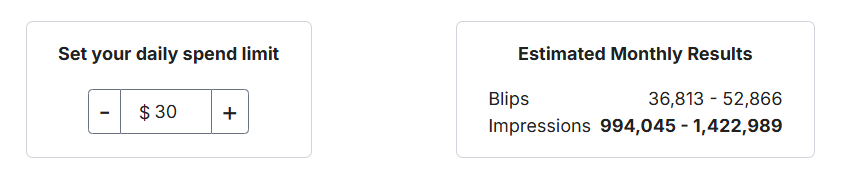
How much is a billboard near Glenn Dale?
Why Choose Blip for Billboard Advertising near Glenn Dale
-
Blip lets Glenn Dale advertisers launch self-serve fast, reaching I-495, US 50, and MD 450 commuters without a sales cycle.
-
Use Blip-optimized campaigns in Glenn Dale to auto-place ads around Beltway rush, Laurel traffic, and UMD game days.
-
No contracts or minimums in Glenn Dale mean you can start small, then scale for back-to-school and holiday traffic.
-
With real-time analytics, Glenn Dale campaigns can shift spend as I-95, US 50, and local connector routes perform best.
-
Blip's creative tools help Glenn Dale ads stay bold and clear for 45-65 mph roads, from families to College Park students.
Frequently Asked Questions About Billboard Advertising near Glenn Dale
How much does a billboard cost in Glenn Dale with Blip?
Blip makes billboard advertising in the Glenn Dale area flexible and affordable. Each “blip” is a 7.5-to-10-second display, with pricing that changes based on time of day, location, and advertiser demand, starting at just $0.01 per display. There are no minimums or contracts, and you can adjust or pause your budget anytime.
Where can I advertise near Glenn Dale with Blip?
Our 7 digital billboards serving the Glenn Dale area are located in nearby Lanham, College Park, and Laurel, all within 10.0 miles of Glenn Dale. That placement lets us reach the Glenn Dale audience where it actually travels, along major commuter routes, retail corridors, and university-influenced traffic patterns. For local businesses, regional brands, healthcare providers, schools, events, and service companies, the Glenn Dale area offers a strong mix of daily repetition, family households, and high-volume roadway exposure.
Why is billboard advertising effective in Glenn Dale, Maryland?
Commuting in the Glenn Dale area is still strongly car-based, and more than 80% of Prince George's County workers use a car when drive-alone and carpool trips are combined. Drive-alone commuting by itself accounts for roughly 7 in 10 workers countywide, which is one of the clearest reasons outdoor advertising remains effective serving the Glenn Dale area. Residents move between Glenn Dale, Bowie, Lanham, Greenbelt, College Park, New Carrollton, and Laurel for work, school, healthcare, recreation, and shopping.
What traffic corridors near Glenn Dale does Blip reach?
The eastern side of I-495, the 64-mile Capital Beltway, carries well over 200,000 vehicles per day near the US 50 and MD 450 system serving Lanham and the Glenn Dale area. US 50 near Lanham commonly carries around 180,000 vehicles per day, making it one of the strongest east-west approach corridors for reaching Glenn Dale households moving toward Washington, Bowie, or the Beltway. I-95 near Laurel regularly carries more than 200,000 vehicles per day, and the nearby Baltimore-Washington Parkway often carries about 120,000 vehicles per day or more depending on segment.
What kinds of businesses work well for Glenn Dale billboard ads with Blip?
The Glenn Dale area is especially strong for brands that need multiple touches rather than one perfect moment across our 7 nearby digital billboards. Audience categories that fit well include banking, healthcare, legal services, insurance, higher education, recruiting, and automotive. Family-oriented campaigns also perform well for home improvement, pediatric and family healthcare, grocery, retail, quick-service restaurants, private schools, tutoring, and camps.
Do I need a contract to advertise with Blip near Glenn Dale?
No, Blip has no long-term contracts or minimum commitments. You can start, pause, or stop your campaign at any time.
How fast can I launch a billboard campaign with Blip near Glenn Dale?
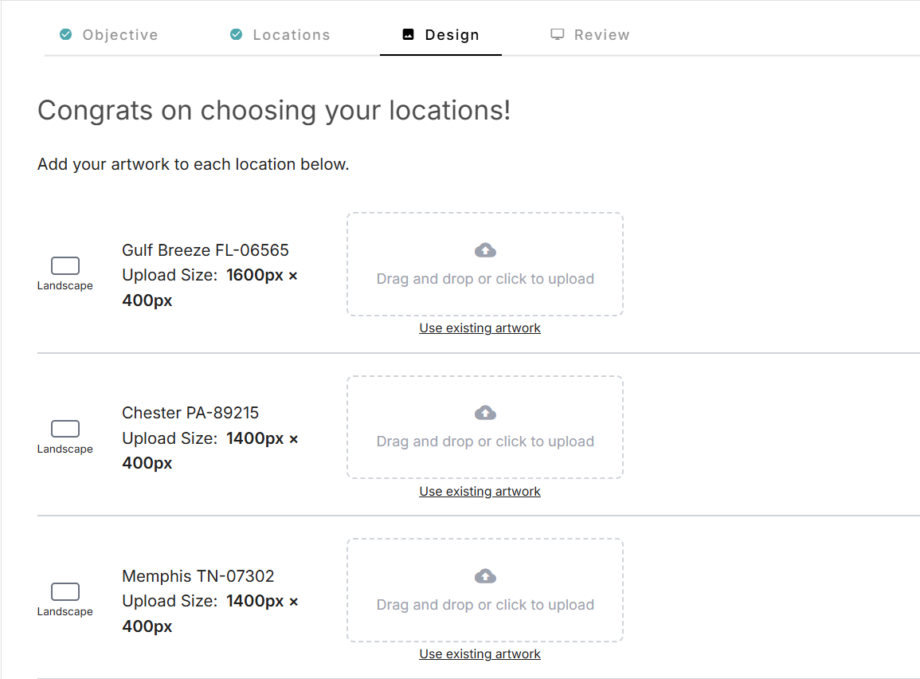
You can have your campaign live in minutes. Create a free account, select your locations, set your budget, upload your design, and start running once approved.
Where can I advertise with Blip near Glenn Dale?
Blip has digital billboards near Glenn Dale. You can browse available locations on a map, choose the ones that fit your audience, and start advertising right away.
Still have questions? Launch a campaign in minutes — no contracts, no commitments.
Start Your CampaignGlenn Dale Billboard Advertising Guide
When we advertise near Glenn Dale, Maryland, we tap into a market that is larger than one neighborhood and more connected than many suburban advertisers realize, with 90,780 residents across Glenn Dale, Lanham, College Park, and Laurel 7 digital billboards serving the Glenn Dale area are located in nearby Lanham, College Park, and Laurel 10.0 miles of Glenn Dale, including boards just 4.4 miles, 6.7 miles, and 7.8 miles away. That placement lets us reach the Glenn Dale audience where it actually travels, along major commuter routes, retail corridors, and university-influenced traffic patterns. For local businesses, regional brands, healthcare providers, schools, events, and service companies, the Glenn Dale area offers a strong mix of daily repetition, family households, and high-volume roadway exposure.
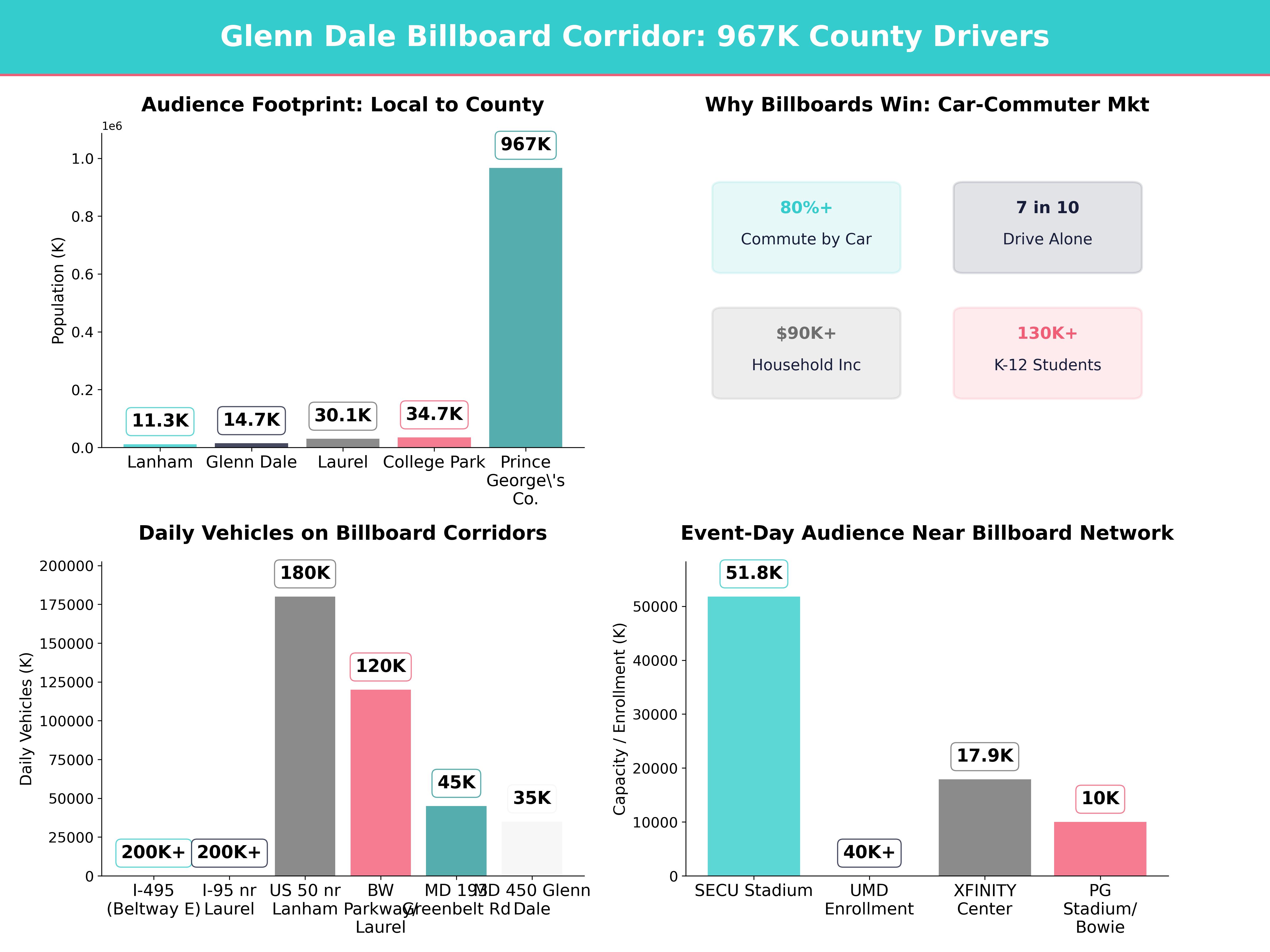
Glenn Dale area market overview
By the numbers near Glenn Dale
- Glenn Dale itself had 14,698 residents in the 2020 Census, which gives us a meaningful suburban base before we add surrounding communities.
- Prince George's County 967,201 residents in the 2020 Census, making it Maryland's second-most-populous county.
- The nearby billboard communities add substantial local scale, with Lanham at 11,282 residents, College Park at 34,740, and Laurel 30,060.
- Taken together, Glenn Dale plus those three nearby billboard communities total 90,780 residents in the immediate local footprint.
- Recent ACS estimates place Prince George's County median household income at above $90,000, which supports strong categories such as healthcare, automotive, financial services, higher education, home improvement, and retail.
- Commuting in the Glenn Dale area is still strongly car-based, and more than 80% of Prince George's County workers use a car when drive-alone and carpool trips are combined.
- Drive-alone commuting by itself accounts for roughly 7 in 10 workers countywide, which is one of the clearest reasons outdoor advertising remains effective serving the Glenn Dale area.
- The University of Maryland in nearby College Park enrolls more than 40,000 students, adding a large education, sports, research, and event audience close to Glenn Dale.
Why the Glenn Dale market matters
We see the Glenn Dale area as a classic suburban decision-making market. Residents move between Glenn Dale, Bowie, Lanham, Greenbelt, College Park, New Carrollton 7 nearby digital billboards.
The local economy also benefits from being close to several employment and activity centers. Prince George's County Economic Development Corporation promotes the county's mix of government, education, healthcare, logistics, and professional services, and Glenn Dale sits close to many of those flows. Nearby College Park adds university traffic and research activity, while Laurel Luminis Health Doctors Community Medical Center
From a billboard strategy standpoint, that means we are not buying a single isolated suburb. We are buying access to a connected cluster of suburban households, commuters, students, professionals, and families who move through the Glenn Dale area every day.
Key traffic corridors serving the Glenn Dale area
The Beltway and US 50 gateway near Glenn Dale
Traffic count data from the Maryland Department of Transportation and the State Highway Administration show why this market works so well for outdoor. The eastern side of I-495, the 64-mile Capital Beltway, carries well over 200,000 vehicles per day near the US 50 and MD 450 system serving Lanham and the Glenn Dale area. US 50 near Lanham commonly carries around 180,000 vehicles per day, making it one of the strongest east-west approach corridors for reaching Glenn Dale households moving toward Washington, Bowie, or the Beltway.
This corridor matters most for advertisers that need broad suburban awareness. Auto dealers, healthcare groups, injury law firms, universities, insurance brands, home services, and major retail campaigns all benefit from Beltway and US 50 visibility because those routes catch repeated exposure across weekday commuting and weekend errands.
North-south commuter reach from Laurel
The Laurel side of the footprint gives us a second powerful access point serving the Glenn Dale area. I-95 near Laurel regularly carries more than 200,000 vehicles per day, and the nearby Baltimore-Washington Parkway often carries about 120,000 vehicles per day or more depending on segment. Those are major regional corridors for commuters traveling between Washington-area suburbs, central Maryland, job centers, and retail districts.
When we use billboard inventory near Laurel, we are not only reaching Laurel drivers. We are also reaching Glenn Dale area residents who head north for work, travel, shopping, or logistics-related trips, and we are intercepting regional traffic flowing back toward Prince George's County. That makes Laurel especially useful for campaigns that need a wider trade area, such as hospitals, regional attractions, colleges, employment recruiting, furniture stores, or business-to-business services.
Local connector roads that feed the Glenn Dale market
The local arterials are just as important because they convert regional traffic into Glenn Dale-area exposure. MD 193, better known as Greenbelt Road on much of this stretch, carries around 45,000 vehicles per day on busy segments near College Park and Greenbelt. MD 450 carries roughly 35,000 vehicles per day on key stretches near Glenn Dale and Lanham. Those roads are essential because they tie neighborhood movement to the Beltway, US 50, shopping centers, schools, and community destinations.
For advertisers with a tighter service radius, these connector routes often matter more than the interstate itself. A pediatric office, urgent care clinic, church, local restaurant group, HVAC company, or tutoring center may get better practical value from a board that sits on a corridor Glenn Dale families use every week than from a board aimed only at long-distance through traffic.
Transit hubs still reinforce the road network
The Glenn Dale area also benefits from strong regional transit access through WMATA and MTA Maryland, especially at New Carrollton Greenbelt, and College Park. Even when people finish a trip by train or Metro, many of them begin and end that trip by car. That means billboards near Glenn Dale still gain value from park-and-ride traffic, station access roads, and multimodal commuter patterns.
Audience segments advertisers can reach near Glenn Dale
Commuters and working professionals
The first major audience is the daily commuter. Because more than 80% of county workers commute by car, we can use boards near Lanham and Laurel to build repeated weekday frequency with drivers heading to offices, hospitals, campuses, public-sector employment centers, and service businesses across the region. This audience responds well to categories with immediate relevance, including banking, healthcare, legal services, insurance, higher education, recruiting, and automotive.
The Glenn Dale area is especially strong for brands that need multiple touches rather than one perfect moment across our 7 nearby digital billboards. Repetition matters on habitual routes, and suburban commuters tend to see the same boards over and over again.
Students, faculty, and university event audiences
Nearby The University of Maryland gives the Glenn Dale area an audience many suburbs do not have. With more than 40,000 students in College Park, plus faculty, staff, visitors, alumni, and sports fans, the market has an ongoing stream of younger adults and educated professionals. Maryland Athletics adds game-day surges, with SECU Stadium seating 51,802 and the XFINITY Center seating 17,950.
That audience is ideal for apartments, restaurants, delivery brands, retailers, telecom, entertainment, medical services, financial apps, and graduate education. It also creates timing opportunities around move-in periods, commencement, football weekends, and basketball season.
Families, homeowners, and school-centered households
Glenn Dale is also a strong family market. The surrounding residential pattern is suburban, vehicle-oriented, and heavily tied to schools, recreation, and homeownership. Prince George's County Public Schools serves more than 130,000 students, which means the broader market has a large concentration of parents, grandparents, and guardians making purchase decisions all year long.
For advertisers, that translates into strong potential for:
- Home improvement and repair services.
- Pediatric, dental, and family healthcare.
- Grocery, retail, and quick-service restaurant campaigns.
- Private schools, tutoring, camps, and enrichment programs.
- Automotive maintenance and replacement cycles.
Family-oriented audience targeting also aligns well with the parks and recreation network managed by the Department of Parks and Recreation, Prince George’s County, including community centers, athletic fields, and seasonal family programming throughout the county.
Regional shoppers, diners, and leisure visitors
The Glenn Dale area is not only residential. It also sits near shopping, dining, and entertainment movement from Bowie, Laurel, College Park, and the wider county. Experience Prince George’s promotes the area’s sports, arts, dining, and attractions, and those trips create valuable billboard audiences outside the workweek commute.
A few notable examples stand out:
- Six Flags America offers more than 100 rides, shows, and attractions, which boosts family and youth-oriented travel during the operating season.
- Laurel Park creates recurring event traffic for racing and entertainment audiences.
- The Clarice Smith Performing Arts Center brings arts and performance traffic to College Park.
- The Chesapeake Baysox play at 10,000-seat Prince George’s Stadium in Bowie, adding spring and summer sports traffic close to Glenn Dale.
Seasonal and timing opportunities in the Glenn Dale area
Spring campaigns near Glenn Dale
Spring is one of the best times to advertise serving the Glenn Dale area because commuting is consistent, weather improves, and consumer decision-making picks up. We like spring for home services, landscaping, roofing, real estate, tax help, elective healthcare, and education campaigns. College audiences are also active through the end of the spring semester, and graduation-related spending builds in April and May.
If we want to reach homeowners and families, spring creative should emphasize readiness, upgrades, and appointments. If we want to reach students and young adults, spring is a good window for apartments, internships, retail, moving services, and food brands.
Summer travel and family timing
Summer changes the traffic mix. Work commuting remains important, but leisure, parks, sports, and family outings increase. This is the season when attractions, camps, restaurants, ice cream, quick service, retail promotions, and healthcare walk-in services can perform well. Summer is also a strong time for regional awareness campaigns because people make more discretionary trips across the county.
Boards near Laurel and Lanham are useful during summer because they catch cross-county travel and shopping movement, while College Park placements can support dining, events, and student transition campaigns. Summer also tends to be a smart period for testing broader geographic reach before back-to-school competition rises.
Back-to-school and fall football
Late August through October is one of the clearest seasonal windows near Glenn Dale. Prince George’s County Public Schools restart, The University of Maryland brings back more than 40,000 students, and Maryland Athletics football draws crowds to 51,802-seat SECU Stadium. We often see this period work well for healthcare providers, wireless carriers, restaurants, apartments, retailers, tutoring brands, and local service businesses.
The Prince George’s County Fair
Holiday retail and winter service demand
From mid-November through December, the Glenn Dale area shifts toward shopping, dining, gifting, and year-end service decisions. This is a strong window for retailers, toy and gift categories, healthcare enrollment, legal services, home services, and financial brands. Winter also increases demand for urgent practical categories such as heating, tire service, urgent care, and plumbing.
Because daylight is shorter and weather can turn quickly, winter creative near Glenn Dale should be especially legible. High contrast, simple offers, and bold branding matter even more when drivers are seeing a board during early darkness, rain, or cold-weather traffic.
Billboard design tips for campaigns near Glenn Dale
Design for fast roads, not slow scrolling
The Glenn Dale market is road-driven, so we should design for drivers moving 45 to 65 mph, not for people standing still. That means one message, one offer, and one action. If a board is serving Beltway, US 50, or I-95 traffic, we should keep copy extremely short and let the brand do most of the work.
We generally recommend:
- 6 to 8 words of primary copy at most.
- A single focal image.
- A short URL, a simple brand name, or a memorable call to action.
- No dense paragraphs, small disclaimers, or complicated location directions.
Use local cues that feel right for Prince George’s County
Creative near Glenn Dale works best when it feels grounded in suburban Maryland rather than generic national stock art. We often see stronger resonance when ads use visual cues that fit the region, such as:
- Clean reds, golds, blacks, and whites that nod to Maryland color palettes without becoming cluttered.
- Family, home, school, and neighborhood imagery for Glenn Dale, Bowie, and Laurel-facing messages.
- Younger, more contemporary visual styling for College Park and university-oriented campaigns.
- Seasonal imagery that matches local reality, including spring lawns, summer outings, fall game days, and winter service needs.
A local market with both families and students rewards relevance. The same creative does not always need to run everywhere.
Match the offer to the corridor
Offers near Glenn Dale should reflect why people are on that road. Commuter-heavy boards do well with convenience, urgency, and trust. Retail and family corridors do well with savings, proximity, and everyday usefulness. University-influenced boards do well with immediacy, value, mobile actions, and event relevance.
For example, we would often tailor copy like this:
- Near Lanham and Beltway corridors, we would use fast credibility messages such as “Open Late,” “Free Estimate,” or “Book Today.”
- Near College Park, we would use audience-specific angles such as student discounts, game-day offers, or apartment availability.
- Near Laurel, we would lean into broader regional service lines, shopping destinations, or healthcare access.
Rotate creative instead of forcing one ad to do everything
Because digital inventory lets us change messages quickly, we do not need one static design to cover every use case. We can rotate 2 or 3 creative versions across the week, or even by time of day, so the campaign stays relevant to commuters, students, or family audiences at different moments. That approach is especially helpful in a market like Glenn Dale where traffic purpose changes noticeably between mornings, afternoons, evenings, and weekends.
Regional strategies around Glenn Dale
Use Lanham for broad suburban reach
Lanham-facing boards are some of the best options when we want mass suburban visibility serving the Glenn Dale area. This cluster is effective for campaigns that depend on Beltway movement, US 50 traffic, and high-frequency commuter exposure. We like this approach for healthcare systems, legal services, auto dealers, universities, financial brands, and larger retail campaigns.
Lanham also works well when the goal is not just Glenn Dale, but Glenn Dale plus Bowie, New Carrollton, and east-of-DC traffic patterns.
Use College Park for education, youth, and mixed-use audiences
College Park gives us a different tone. Here, the Glenn Dale area overlaps with university energy, dining traffic, rentals, cultural events, and young professionals. This is the best nearby cluster for brands that want a younger audience or a message tied to campus life, sports, entertainment, technology, or food.
If we are promoting restaurants, apartments, wireless service, events, tutoring, urgent care, or employer recruiting, College Park boards can be a very efficient part of a Glenn Dale-area media mix.
Use Laurel for north-south regional movement
Laurel is the best nearby cluster for extending reach up and down the corridor while still serving the Glenn Dale area. We like Laurel for brands with a wider trade radius, including hospitals, furniture stores, travel-related businesses, regional retailers, and B2B services. Because I-95 and the Baltimore-Washington Parkway carry so much regional traffic, Laurel placements can help a Glenn Dale-area campaign scale beyond a purely neighborhood audience.
This is also a smart cluster for advertisers that need people who are willing to travel a little farther for a destination offer.
Combine corridor types for better frequency
One of the biggest strategic advantages near Glenn Dale is that we do not have to choose only one type of road. We can combine a Lanham board for Beltway scale, a College Park board for university influence, and a Laurel board for north-south reach. That creates repeated exposure across multiple trip types instead of relying on a single route.
For many advertisers, that regional blend works better than putting all spend into one location. It mirrors how Glenn Dale households actually move through the area.
Using Blip tools for Glenn Dale area campaigns
How we can execute these local strategies
Blip’s platform is especially useful near Glenn Dale because the market rewards flexibility. If we want hands-on control, we can build a manual campaign, choose specific boards in Lanham, College Park, and Laurel, and align each one to a different audience or corridor strategy. If we want automation, we can use a Blip-optimized campaign and let the system distribute spend across the nearby network based on our goals and budget.
That flexibility helps us do several practical things:
- We can weight morning and evening rush hours more heavily for commuter categories.
- We can push evenings and weekends for entertainment, dining, and family offers.
- We can rotate different creative for Beltway commuters, College Park students, and Laurel regional travelers.
- We can watch results in real time and shift budget toward the boards or times that fit the Glenn Dale-area goal best.
Because pricing is dynamic, we can also be efficient with smaller budgets instead of assuming we need a large traditional outdoor buy to get started.
Getting started with billboard rental near Glenn Dale
What to expect when renting a billboard serving the Glenn Dale area
The best way to start is to define what success looks like. If we need broad awareness, we should prioritize Lanham and Laurel corridors with heavy regional traffic. If we need younger adults or university-related demand, we should make College Park part of the mix. If we need nearby families and homeowners, we should emphasize local connector routes and suburban commercial movement.
We usually recommend that advertisers evaluate each billboard option with four questions:
- Does this board match our real audience, or just our preferred audience?
- Does it align with the time of day people are most likely to respond?
- Is the surrounding corridor commuter-heavy, family-oriented, student-driven, or destination-focused?
- Are we trying to build awareness, drive immediate visits, recruit employees, or support a promotion with a clear deadline?
Why Blip simplifies the rental process
Traditional billboard buying often involves long sales cycles, fixed commitments, and limited flexibility. Blip changes that by letting us launch online, adjust anytime, and pay only when the ad actually runs. Pricing starts at $0.01 per display, each blip runs for about 7.5 to 10 seconds, and there are no contracts or minimum spend requirements. That makes it much easier to test the Glenn Dale area, learn which nearby corridors respond best, and scale up only after we see what is working.
A practical first campaign plan near Glenn Dale
For many advertisers, a smart first campaign looks like this:
- We choose 2 or 3 nearby board clusters rather than all 7 at once.
- We run one clean creative version for commuters, and one variation for either families or students.
- We concentrate spend around the hours that matter most, such as weekday rush hour, weekend retail periods, or event windows.
- We review performance after the first stretch of data, then add more boards, more dayparts, or more creative versions as the campaign proves itself.
That approach keeps risk low and learning high. In a connected suburban market like Glenn Dale, we do not need to guess our way into a large billboard commitment. We can start small, stay flexible, and build a campaign that matches how people actually travel near Glenn Dale.