Billboards near Clinton, MD
No Minimum Spend. No Long-Term Contracts. Just Results.
Trusted by Leading Brands


Billboard advertising
near Clinton has never been easier




How much is a billboard near Clinton?
Why Choose Blip for Billboard Advertising near Clinton
Blip lets you self-serve a Clinton campaign in minutes, reaching MD 5 and I-95/I-495 commuters without sales calls or contracts.
Use Blip-optimized campaigns in Clinton to let the platform auto-place ads across Brandywine and Fort Washington around your goals and budget.
No minimums make Blip ideal for Clinton's changing traffic, from weekday school runs to weekend shoppers near National Harbor and Tanger Outlets.
Daypart your Clinton ads for rush hour on Branch Ave or evening traffic by MD 210, so your message hits drivers when they're most attentive.
Track real-time results in Clinton and shift spend fast as traffic peaks on MD 5, US 301, and the Beltway.
Build and launch Clinton creative with Blip's tools, then keep it sharp for car-first commuters, families, and hospital traffic.
Frequently Asked Questions About Billboard Advertising near Clinton
How much does a billboard cost in Clinton, Maryland with Blip?
Blip makes billboard advertising in the Clinton area flexible and accessible by using a pay-per-play model, so you only pay when your ad actually displays. Pricing starts at just $0.01 per display, and the cost per blip can vary based on time of day, location, and advertiser demand. Your total cost is simply the sum of the blips you receive over time, with no minimums or contracts.
Where can I advertise with Blip near Clinton, Maryland?
Our 4 digital billboards in nearby Brandywine and Fort Washington sit just 2.8 miles and 4.7 miles from Clinton, and every location is within 10.0 miles of the community. The Brandywine boards are especially useful for the southern approach into the market, while the Fort Washington boards catch west-side movement and destination traffic. By combining boards in nearby Brandywine and Fort Washington, we can cover multiple approach patterns instead of assuming every prospect enters the Clinton area from the same direction.
Why is Clinton, Maryland a good market for billboard advertising with Blip?
The area near Clinton is a strong billboard market because we can reach a large, high-frequency suburban audience of roughly 39,000 Clinton residents inside a broader Washington metro of about 6.3 million people without relying on a walkable downtown core. We also benefit from the way people travel in the Clinton area, with major roads such as MD 5, I-95/I-495, MD 210, and US 301 carrying corridor volumes often ranging from 20,000 to 150,000+ vehicles per day. That mix of residential stability, commuter traffic, retail trips, healthcare demand, and visitor flow makes advertising near Clinton a smart fit for local businesses and regional brands alike.
What kind of people can Blip reach in Clinton, Maryland?
Prince George's County is about 62% Black or African American, and nearly 1 in 5 residents is Hispanic or Latino, which makes the area especially valuable for brands that want to reach multicultural households with mainstream, professional, family-oriented messaging. The Clinton area also has a strong family profile, with Prince George's County Public Schools serving more than 130,000 students across more than 200 schools. That supports demand for pediatric care, tutoring, after-school programs, grocery, orthodontics, youth sports, family dining, and back-to-school retail.
What roads around Clinton, Maryland get the most billboard traffic?
The most important advertising spine serving the Clinton area is MD 5, Branch Avenue, which connects local neighborhoods to the Beltway, Suitland, Camp Springs, and Washington. Nearby sections commonly land in the 50,000 to 70,000 vehicles per day range, and Beltway segments near the Branch Avenue interchange are typically well above 150,000 vehicles per day. Our Fort Washington inventory also catches movement on MD 210, Indian Head Highway, which commonly carries about 60,000 to 80,000 vehicles per day.
Do I need a contract to advertise with Blip near Clinton?
No, Blip has no long-term contracts or minimum commitments. You can start, pause, or stop your campaign at any time.
How fast can I launch a billboard campaign with Blip near Clinton?
You can have your campaign live in minutes. Create a free account, select your locations, set your budget, upload your design, and start running once approved.
Where can I advertise with Blip near Clinton?
Blip has digital billboards near Clinton. You can browse available locations on a map, choose the ones that fit your audience, and start advertising right away.
Still have questions? Launch a campaign in minutes — no contracts, no commitments.
Start Your CampaignClinton Billboard Advertising Guide
The area near Clinton is a strong billboard market because we can reach a large, high-frequency suburban audience of roughly 39,000 Clinton residents inside a broader Washington metro of about 6.3 million people without relying on a walkable downtown core. Our 4 digital billboards in nearby Brandywine and Fort Washington sit just 2.8 miles and 4.7 miles from Clinton, and every location is within 10.0 miles of the community, which gives us efficient coverage of the surrounding trade area.
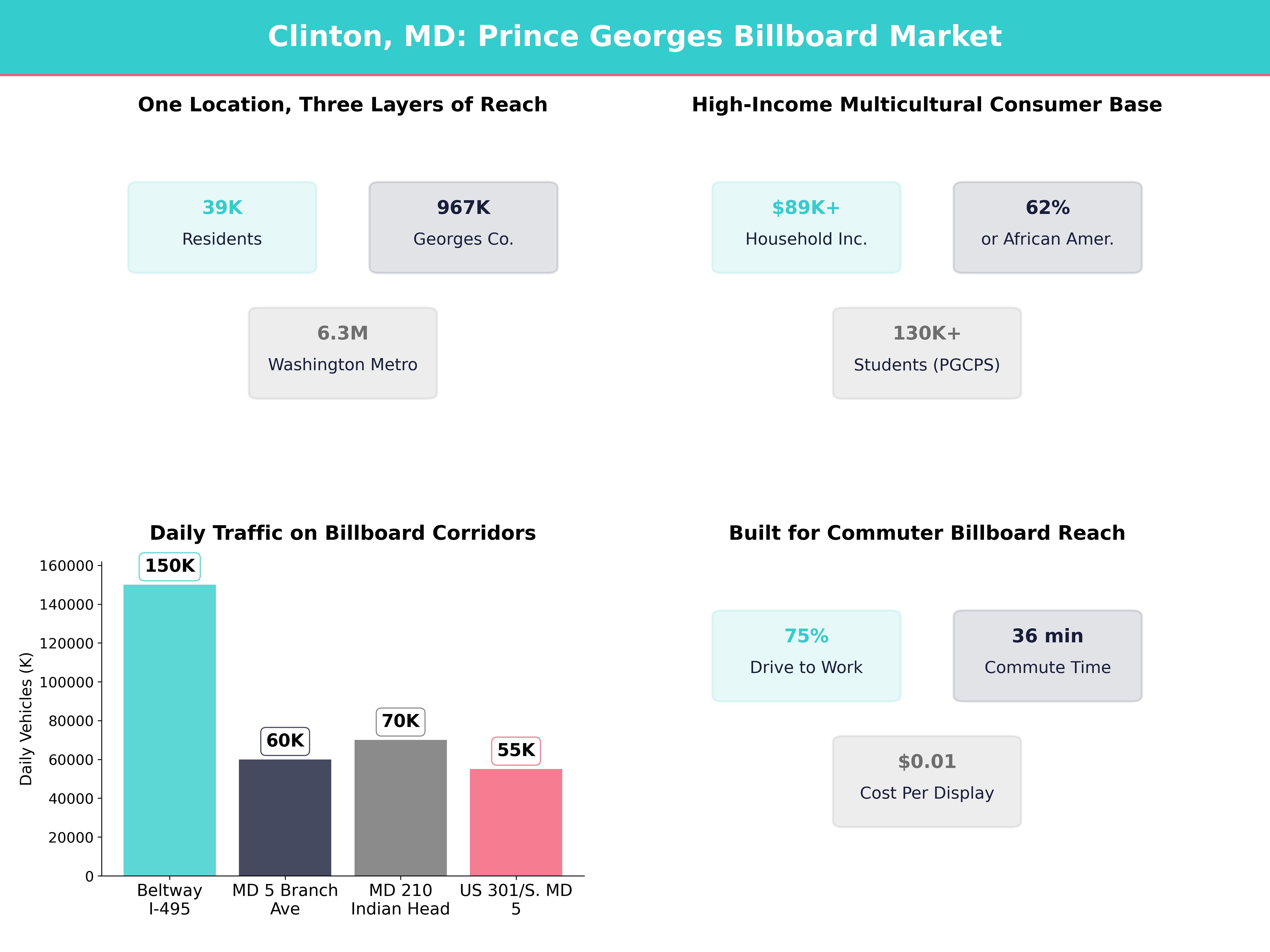
We also benefit from the way people travel in the Clinton area: most daily activity runs through major roads such as MD 5, I-95/I-495, MD 210, and US 301, with corridor volumes often ranging from 20,000 to 150,000+ vehicles per day, so repeated driver exposure is realistic. That mix of residential stability, commuter traffic, retail trips, healthcare demand, and visitor flow makes advertising near Clinton a smart fit for local businesses and regional brands alike.
Market overview for the Clinton area
The Clinton area sits inside a large Washington-region consumer base
The Clinton area is an unincorporated community in Prince George's County 39,000 residents, while Prince George's County had 967,201 residents in the 2020 count, according to planning sources such as the Maryland Department of Planning and the Prince George's County Planning Department.
Clinton is also only about 13 miles from downtown Washington, DC, so the surrounding audience includes not only local households, but also commuters and service buyers who move across the wider metro every day. That broader county context matters.
Prince George's County is one of the largest counties in Maryland, and it gives advertisers near Clinton access to a diverse, established suburban population with strong household purchasing power. Countywide demographics are also meaningful for message strategy.
Prince George's County is about 62% Black or African American, and nearly 1 in 5 residents is Hispanic or Latino, which makes the area especially valuable for brands that want to reach multicultural households with mainstream, professional, family-oriented messaging.
Income and household stability support local spending near Clinton
The Clinton area benefits from the same economic fundamentals that make much of south Prince George's County attractive to advertisers. Prince George's County's median household income is above $89,000, which gives us a market where healthcare, home services, dining, auto, education, insurance, financial services, and retail offers can all compete effectively.
We also see a strong concentration of owner-occupied neighborhoods, established subdivisions, and long-term family households in the broader Clinton area, which usually favors repeat-exposure media such as digital billboards. There are also several important demand anchors serving the Clinton area.
MedStar Southern Maryland Hospital Center drives healthcare traffic. Prince George's County Public Schools serves more than 130,000 students across more than 200 schools, which supports year-round demand for family services, youth programs, tutoring, urgent care, grocery, and quick-service restaurants.
County business activity is reinforced by groups such as the Prince George's Chamber of Commerce and the Prince George's County Economic Development Corporation, both of which reflect the area's depth beyond pure bedroom-community status.
The Clinton area is still a car-first market
Even with access to Washington Metropolitan Area Transit Authority rail and bus service in the wider region, the Clinton area behaves like a road-driven suburb. County commuting profiles typically show roughly 3 out of 4 workers traveling by car, whether driving alone or carpooling, and average commute times are around 36 minutes.
For billboard advertisers, that is exactly the pattern we want: long, repeated roadway exposure across weekday peaks, school runs, shopping trips, and weekend recreation. This is especially important because much of the local audience does not stay within one municipal footprint.
People in the Clinton area regularly circulate among Camp Springs, Suitland, Fort Washington, Brandywine, Oxon Hill, Largo, Waldorf, and Washington. That means our nearby billboards can perform well even though they are placed outside Clinton itself.
Key traffic corridors serving the Clinton area
MD 5 and the Beltway are the core commuter funnel for the Clinton area
The most important advertising spine serving the Clinton area is MD 5, Branch Avenue. It connects local neighborhoods to the northbound flow toward the Capital Beltway, Suitland, Camp Springs, and Washington, and it also connects southbound traffic toward Brandywine and Charles County
On nearby sections, Maryland State Highway Administration traffic counts on MD 5 commonly land in the 50,000 to 70,000 vehicles per day range. Where MD 5 meets I-95/I-495, the scale becomes even larger.
Beltway segments near the Branch Avenue interchange are typically well above 150,000 vehicles per day, which gives us access to broad regional circulation rather than purely local neighborhood traffic. If we want reach across the Clinton area among commuters, healthcare visitors, and service buyers, this is the first corridor to prioritize.
Fort Washington routes help us reach westbound and leisure traffic near Clinton
Our Fort Washington inventory matters because it catches movement on the west side of the Clinton area, especially traffic tied to MD 210, Indian Head Highway, the Beltway, and the Oxon Hill/National Harbor cluster. Nearby MD 210 segments commonly carry about 60,000 to 80,000 vehicles per day, which is strong volume for restaurants, entertainment, attractions, retail, healthcare, and destination businesses.
This corridor is especially valuable because it links the Clinton area to National Harbor, MGM National Harbor Gaylord National Resort & Convention Center Tanger Outlets National Harbor. In other words, Fort Washington is not just a residential route.
It is a consumer-intent route, and that changes what kind of messaging works there.
Brandywine routes give us the south-side approach to the Clinton area
Our Brandywine billboards are only 2.8 miles from Clinton, so they are especially useful when we want to cover the southern approach into the market. The Brandywine side benefits from traffic on US 301 and the southern MD 5 split, with nearby segments often carrying around 50,000 to 60,000 vehicles per day.
That makes Brandywine a strong fit for campaigns aimed at retail trips, weekend errands, southbound commuters, and households moving between the Clinton area and Waldorf. We also like Brandywine for businesses that sell to shoppers rather than just workers.
Brandywine Crossing
Secondary connectors still matter because they feed the major roads
Not every useful route is a freeway. Roads such as MD 223, Woodyard Road, and MD 337, Allentown Road, often carry roughly 20,000 to 35,000 vehicles per day on many nearby segments, and those roads are important because they feed residents from neighborhoods into the larger commuter network.
If we are advertising near Clinton, we should remember that frequency often comes from repetition across a chain of roads, not a single heroic highway hit. That is one reason our four-board footprint is useful.
By combining boards in nearby Brandywine and Fort Washington, we can cover multiple approach patterns instead of assuming every prospect enters the Clinton area from the same direction.
Audience segments we can reach near Clinton
We can reach daily commuters and government-adjacent workers near Clinton
The Clinton area is deeply tied to regional commuting. With roughly 75% of workers traveling by car and average travel times near 36 minutes, the audience is well suited for repeated weekday billboard exposure.
We can use that pattern to reach people heading toward Washington, Suitland, Camp Springs, the Beltway, and major employment centers across Prince George's County. This audience usually responds best to practical offers.
Auto dealers, urgent care clinics, dental groups, legal services, staffing firms, community colleges, wireless brands, insurance agencies, and banks all benefit from commuter-focused messaging. Short travel-oriented copy such as “Near Clinton,” “Off MD 5,” or “Next Exit Savings” often performs better than abstract branding alone.
We can reach families and household decision-makers in the Clinton area
The Clinton area has a strong family profile, and that matters for categories built around recurring household decisions. Prince George's County Public Schools serves more than 130,000 students, so the area naturally supports demand for pediatric care, tutoring, after-school programs, grocery, orthodontics, youth sports, family dining, and back-to-school retail.
Healthcare is especially relevant because MedStar Southern Maryland Hospital Center anchors a significant share of everyday medical traffic serving the Clinton area. For these households, billboard advertising near Clinton works best when it feels useful rather than flashy.
We usually want to highlight convenience, trust, hours, same-day availability, price transparency, or distance from familiar roads. Family audiences often make decisions while already on the road, so the medium matches the mindset.
We can reach shoppers, diners, and entertainment visitors moving through the Clinton area
The west side of the market brings in a visitor economy that is larger than many advertisers realize. National Harbor is a 350-acre waterfront destination.
Gaylord National Resort & Convention Center 2,000 guest rooms and roughly 470,000 square feet of meeting and event space. MGM National Harbor 308-room resort and a 3,000-seat theater.
The Capital Wheel 180 feet over the waterfront, and Tanger Outlets National Harbor features 85+ stores. Those numbers matter because they create ongoing cross-traffic through Fort Washington and the larger south county road network.
Businesses based in the Clinton area can use that movement to attract diners, eventgoers, tourists, and weekend shoppers who may not live nearby, but who still travel through the same corridors our boards serve.
We can also reach students and younger adults across the wider county market
The Clinton area is not just families and commuters. Prince George's County also includes major student demand.
The University of Maryland, College Park enrolls more than 40,000 students, and institutions such as Prince George's Community College add more education-driven activity across the county. That supports categories like mobile service, banking, apartments, fast casual dining, job recruitment, and entertainment.
Younger audiences also respond well to digital billboard campaigns when we align timing to actual behavior. Afternoon, evening, and weekend schedules usually make more sense than early-morning commuter blocks for these segments.
Seasonal and timing opportunities in the Clinton area
Holiday travel is one of the best windows near Clinton
From mid-November through late December, the roads serving the Clinton area pick up added shopping and entertainment traffic. National Harbor holiday programming, Gaylord National Resort & Convention Center MGM National Harbor Tanger Outlets National Harbor all contribute to a stronger leisure pattern on the Fort Washington side.
Early winter sunsets also mean evening commute periods are already dark near 5 p.m., which tends to help digital screens stand out. This is a prime season for retail, dining, events, healthcare, home services, and gift-oriented campaigns.
It is also a good period for broad awareness if we want to reach both residents in the Clinton area and visitors passing through.
Spring works well for home, healthcare, and graduation messaging
Spring is a strong practical-buying season near Clinton. Tax refunds, home improvement projects, spring cleaning, lawn care, and family healthcare all line up well with the area's suburban household profile.
Late spring also brings graduations, school-year wrap-up, and more family movement across the county. For that reason, we often recommend testing creative tied to appointments, estimates, seasonal specials, or family milestones from March through June.
Service businesses usually perform well when we pair weekday commuter inventory with Saturday retail hours.
Summer favors destination businesses and weekend traffic
Summer shifts more traffic toward leisure, shopping, and entertainment. The Fort Washington side benefits from continued activity tied to National Harbor, The Capital Wheel
The Brandywine side often benefits from household errands, dining, and weekend retail circulation tied to the broader south county and Waldorf trade areas. If we are promoting restaurants, attractions, hotels, family fun, or weekend events, we usually lean into Thursday-through-Sunday schedules during summer.
Midday and early evening can outperform traditional rush-hour windows for those categories.
Back-to-school and fall routines create another dependable campaign window
Late August and September are especially important because Prince George's County Public Schools serves more than 130,000 students. That creates concentrated demand for school supplies, urgent care, optical, tutoring, family dining, hair services, wireless plans, and grocery.
Fall also marks the return of more regular weekday commuting patterns, which helps professional services and healthcare campaigns. We also watch election years in the Washington media market.
Even-numbered years often bring heavier demand for premium commuter-facing inventory, so businesses that want strong fall coverage near Clinton should plan earlier rather than later.
Billboard design tips for the Clinton area
We should design for speed, not for reading comfort
Drivers serving the Clinton area are usually moving at suburban arterial or highway speeds, often around 45 to 65 mph. That means our best creative is fast, bold, and instantly legible.
One headline, one offer, one brand cue, and one action is usually enough. We generally recommend avoiding dense copy, long URLs, disclaimers, or multiple product shots.
A digital board near Clinton should communicate the point in a glance. If we need more than 7 to 10 seconds of concentration to understand the ad, we have already asked too much of the audience.
We should use geography the local audience already recognizes
The most effective Clinton-area billboard creative usually names roads, destinations, or nearby communities people actually use. Copy that references Branch Avenue, MD 5, Brandywine, Fort Washington, National Harbor, Waldorf, or the Beltway can outperform generic metro messaging because it feels immediately relevant.
We also recommend travel-time language when it is accurate. Statements such as “Minutes from MD 5,” “Near Clinton,” or “Off Branch Ave” help convert awareness into action.
The key is precision. If we use a location claim, it should be verifiably true.
We should choose colors that stand out against local road conditions
The roads serving the Clinton area are often lined with trees, wide medians, concrete, and gray winter skies. Because of that, muted greens, tans, and dark earth tones can disappear into the background.
High-contrast palettes usually work better. White on navy, yellow on black, red on white, and bright brand colors with simple type are often safer choices.
This geography also rewards bright nighttime design. In late fall and winter, when darkness arrives early, strong contrast can materially improve readability during the evening commute.
We should match the tone to a professional, family-oriented suburban audience
The Clinton area tends to respond well to clear, trustworthy, useful advertising. We usually see stronger performance when messages feel credible and service-oriented rather than overly clever.
Price points, appointment availability, financing, hours, and proximity all matter. For example, lines like “Urgent Care Near Clinton,” “Family Dental Off MD 5,” and “Brandywine Deals This Weekend” are simple, but they match how people make decisions on these roads.
We would rather be instantly understood than creatively admired.
Regional strategies around the Clinton area
We should use a northbound commuter strategy for weekday reach
If our goal is to reach workers heading toward Washington and central Prince George's County, we should prioritize weekday schedules built around the northbound commute. A practical starting window is 5 a.m. to 10 a.m., with a second block from 3 p.m. to 7 p.m. for the return drive.
This strategy works well for healthcare, recruiting, legal, insurance, education, financial services, and auto categories. It is also where frequency matters most.
People in the Clinton area often repeat the same route several times a week, so consistency can beat novelty.
We should use a southbound Brandywine strategy for shopping and household errands
Our Brandywine inventory is especially effective when we want to catch south-side trips tied to retail and household spending. That is where we can lean into Thursday-through-Sunday schedules, late-morning to early-evening timing, and messages built around deals, convenience, inventory, or family outings.
This approach tends to fit furniture, mattresses, grocery, quick-service dining, auto repair, wireless, and home improvement very well. Because Brandywine is only 2.8 miles from Clinton, it can function almost like a southern gateway to the market.
We should use a Fort Washington strategy for destination and entertainment traffic
Fort Washington gives us the west-side angle on the Clinton area and connects especially well to people moving toward National Harbor, MGM National Harbor
For these campaigns, afternoon, evening, and weekend scheduling often makes more sense than early-morning commuting windows. If the goal is to drive a dinner decision, a concert ticket, or a same-day visit, we should advertise close to the moment of action.
We should layer corridor strategies instead of relying on one board type
The biggest mistake advertisers make near Clinton is assuming one nearby road tells the whole story. The smarter approach is to layer routes by intent.
We can use Brandywine for southern household traffic, Fort Washington for leisure and west-side movement, and both together for broader frequency. That layered approach is especially useful for businesses with more than one audience.
A hospital, college, furniture store, auto dealer, or regional restaurant chain may need commuters on weekdays, families on Saturdays, and visitors on weekends. Our four nearby digital billboards make that kind of split strategy practical.
Blip tools and capabilities for campaigns serving the Clinton area
We can choose the exact nearby boards when location matters most
When we already know the corridor we want, Blip's manual campaign setup makes the Clinton-area strategy straightforward. We can select the specific digital billboards in nearby Brandywine and Fort Washington, align artwork to each route, and schedule time blocks that match commuter, shopping, or entertainment traffic.
That is especially useful when geography matters more than broad scale. A healthcare clinic may want the most commuter-heavy route.
A restaurant may want evening traffic near Fort Washington. A furniture store may want weekend household flow near Brandywine.
We can let Blip optimize when the goal is broad reach across the Clinton area
If the real objective is efficient market coverage rather than hand-picking each board, Blip-optimized campaigns can distribute budget across the nearby inventory automatically. That works well when we want the platform to balance timing, demand, and reach while still focusing on the Clinton-area audience we care about.
This is often the simplest way to start. We can set a goal, launch with a modest budget, and then evaluate whether Brandywine or Fort Washington is carrying more of the campaign's value.
We can test timing, creative, and corridor mix without traditional friction
Digital billboard campaigns near Clinton do not have to be locked in for long periods before we learn anything. We can change artwork, shift dayparts, add or remove nearby boards, and respond to what the data says.
Because pricing is pay-per-play, with ads starting at $0.01 per display, we can also test ideas without committing to the kind of large, fixed buy that traditional billboard companies often require. That flexibility is especially useful in a market like Clinton, where weekday commuters, weekend shoppers, and leisure travelers do not all behave the same way.
We can adjust for that instead of guessing once and hoping it works.
Getting started with billboard rental serving the Clinton area
We should begin by defining the real audience, not just the nearest board
The first step is deciding who we actually need to reach in the Clinton area. If we want local households, we should emphasize family-serving routes and weekend timing.
If we want commuters, we should emphasize peak periods on the strongest arterial corridors. If we want visitors, we should lean toward Fort Washington and entertainment hours.
That distinction matters more than map distance alone. A billboard 4.7 miles from Clinton can outperform a closer-feeling location if it sits on the route our customer actually uses.
We should match nearby billboard locations to specific goals
A simple way to evaluate the Clinton-area inventory is to ask what each nearby cluster does best. The Brandywine boards, at 2.8 miles from Clinton, are usually strongest for southbound traffic, shopping trips, household errands, and broad suburban retail demand.
The Fort Washington boards, at 4.7 miles from Clinton, are usually strongest for west-side circulation, destination traffic, Beltway-connected movement, and National Harbor-related leisure demand. All 4 boards together make the most sense when we want repeated exposure across multiple trip types.
This is also the right moment to think about direction of travel, time of day, and trip purpose. Those three variables usually tell us more than a raw ZIP-code radius.
We should expect a simpler process than traditional billboard rental
Traditional billboard buying often involves availability calls, fixed 4-week periods, production coordination, and larger upfront commitments. That model can still work, but it is slower and less flexible.
With Blip, we can launch digitally, control the campaign ourselves, and make changes without waiting through a long sales process or locking into a contract. For advertisers serving the Clinton area, that matters because the market is dynamic.
Promotions change. Seasons change. Traffic intent changes between weekdays and weekends. A self-serve digital platform is simply better suited to that reality.
We should start small, learn quickly, and scale what works
Our best recommendation is to start with a focused test. We can launch one message on the nearby Brandywine and Fort Washington boards, watch how delivery and timing look, and then expand once we know which corridor is carrying the strongest response.
We can also test different offers for different audiences, such as commuter copy on weekdays and retail copy on weekends. If we keep the objective clear, the Clinton area is very workable.
The market has roughly 39,000 local residents, sits inside a county of 967,201 people, depends heavily on car travel, and is supported by major corridors, schools, healthcare anchors, and visitor destinations. That gives us plenty of reasons to advertise near Clinton, and plenty of ways to do it intelligently.