Billboards near Fairland, MD
No Minimum Spend. No Long-Term Contracts. Just Results.
Trusted by Leading Brands


Billboard advertising
near Fairland has never been easier




How much is a billboard near Fairland?
Why Choose Blip for Billboard Advertising near Fairland
-
Blip lets you launch fast in Fairland and target I-95/I-495 commuters without a long buy or contract.
-
Use Blip-optimized campaigns in Fairland to auto-place ads near Laurel, College Park, and Olney based on your goal and budget.
-
Fairland’s 180K+ I-95 and 200K+ I-495 traffic makes Blip’s real-time analytics ideal for tuning weekday reach.
-
Set flexible daily budgets in Fairland and only pay when your ad plays on rotating screens serving local drivers.
-
Daypart your Fairland campaign for rush hours, campus events, or summer family trips along US 29 and MD 200.
-
Blip’s creative tools help your Fairland ad stand out for commuters, students, and families in a glance.
Frequently Asked Questions About Billboard Advertising near Fairland
How much does a billboard cost in Fairland, Maryland with Blip?
You only pay when your ad actually appears, with each 7.5-to-10-second display, or “blip,” starting at just $0.01 per play. Because pricing changes based on time of day, location, and advertiser demand, the cost can scale to fit different budgets while helping maximize your reach. In the end, your total cost is simply the sum of the blips you receive.
Where can I advertise with Blip near Fairland, Maryland?
We can reach this audience through 6 digital billboards in nearby Laurel, College Park, and Olney, all within 10.0 miles of Fairland. The nearest billboard locations are in Laurel, just 5.0 miles from Fairland, College Park, about 5.8 miles away, and Olney, about 8.0 miles away. That means we can help advertisers build reach around Fairland without wasting coverage far outside the local decision zone.
Why is Fairland, Maryland a strong market for billboard advertising with Blip?
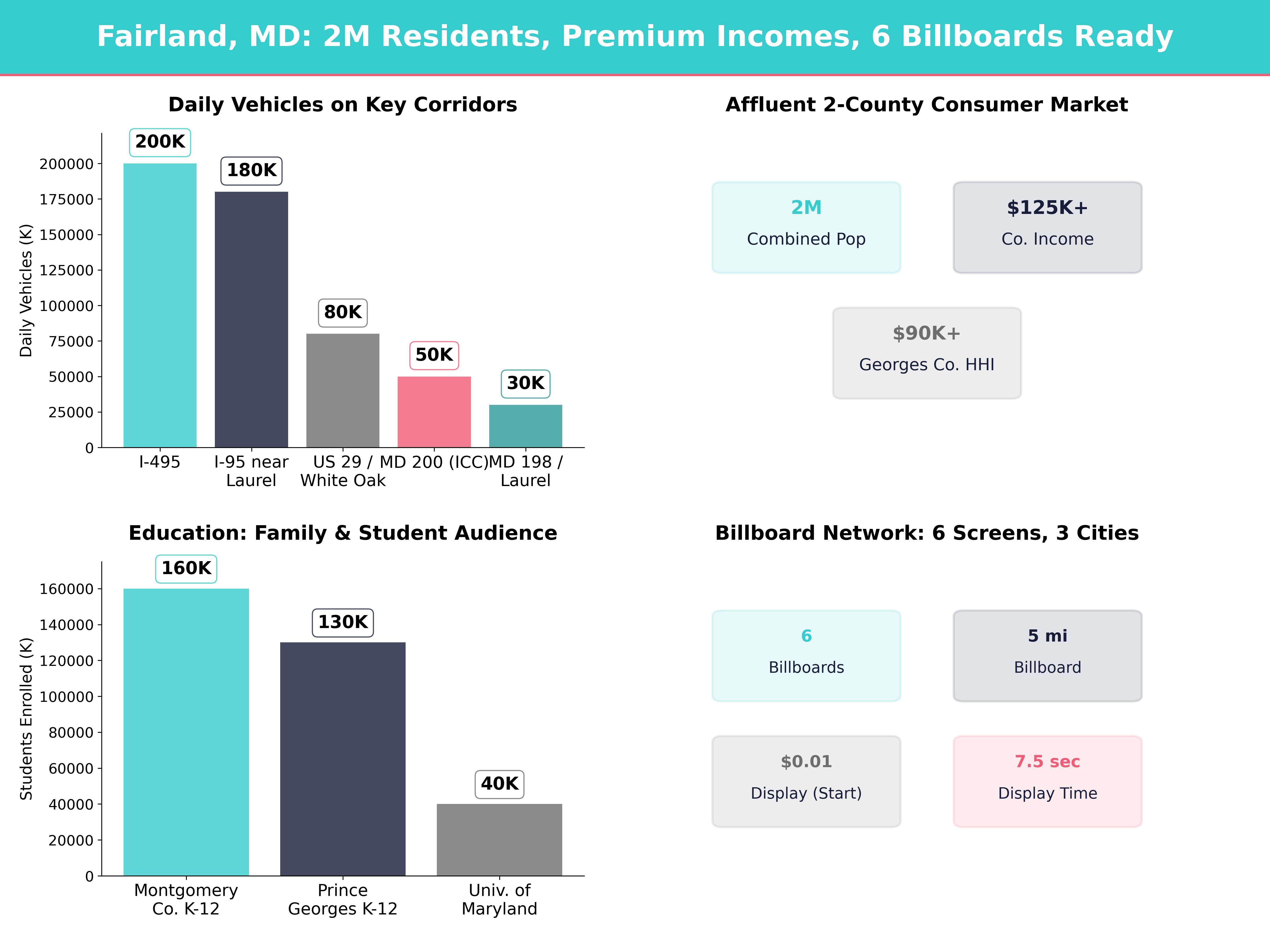
The Fairland area is a strong billboard market because it sits at the intersection of suburban Montgomery County buying power, Prince George’s County commuter flow, and the broader Baltimore-Washington travel corridor. Nearby I-95 segments carry 180,000-plus vehicles per day and I-495 segments exceed 200,000. That scale matters because brands serving the Fairland area are rarely speaking to just one neighborhood.
What kinds of people can Blip reach in Fairland, Maryland?
The Fairland area is full of working adults who split their time between home, office, school, and errands, and many travel toward Silver Spring, White Oak, College Park, Laurel, and other employment centers several times each week. Nearby University of Maryland, College Park is one of the biggest audience generators in the region, with more than 40,000 students enrolled. The Fairland area is also a family-heavy suburban market, with Montgomery County Public Schools serving more than 160,000 students and Prince George’s County Public Schools serving about 130,000 students.
When is the best time to advertise in Fairland, Maryland with Blip?
Fall is usually the best window for advertisers who want repeated weekday frequency, because school resumes, University of Maryland starts fall semester, and commuter patterns become more predictable again. Winter also changes visibility in a helpful way, since sunset often falls before 5:00 p.m., which means evening commuters see digital boards in darker conditions during prime drive time. Spring is another strong time to build momentum, especially for home improvement, healthcare, and graduation-related campaigns.
Do I need a contract to advertise with Blip near Fairland?
No, Blip has no long-term contracts or minimum commitments. You can start, pause, or stop your campaign at any time.
How fast can I launch a billboard campaign with Blip near Fairland?
You can have your campaign live in minutes. Create a free account, select your locations, set your budget, upload your design, and start running once approved.
Where can I advertise with Blip near Fairland?
Blip has digital billboards near Fairland. You can browse available locations on a map, choose the ones that fit your audience, and start advertising right away.
Still have questions? Launch a campaign in minutes — no contracts, no commitments.
Start Your CampaignFairland Billboard Advertising Guide
The Fairland area is a strong billboard market because it sits at the intersection of suburban Montgomery County buying power, Prince George’s County commuter flow, and the broader Baltimore-Washington travel corridor (with nearby I-95 segments carrying 180,000-plus vehicles per day and I-495 segments exceeding 200,000). We can reach this audience through 6 digital billboards in nearby Laurel College Park, and Olney, all within 10.0 miles of Fairland. That gives advertisers access to residents, workers, students, and visitors moving along some of Maryland’s busiest roads without needing a large traditional out-of-home commitment. For brands that want flexible visibility near Fairland, this is the kind of market where repeated digital exposure can build awareness quickly.
Fairland area market overview
A two-county market with real scale
The Fairland area benefits from its position near both Montgomery County and Prince George’s County more than 1.1 million residents, and Prince George’s County has roughly 970,000 residents, so the broader trade area around Fairland reaches a combined population of about 2 million people. That scale matters because brands serving the Fairland area are rarely speaking to just one neighborhood. They are usually trying to influence movement across eastern Montgomery County, northern Prince George’s County, and the daily corridor between Washington and Baltimore.
Our nearby inventory is also tightly positioned around the market. The nearest billboard locations are in Laurel 5.0 miles from Fairland, College Park, about 5.8 miles away, and Olney, about 8.0 miles away. That means we can help advertisers build reach around Fairland without wasting coverage far outside the local decision zone.
Economic strength and everyday spending power
The Fairland area sits near one of the most affluent and educated parts of Maryland. Montgomery County Economic Development Corporation promotes a county economy anchored by life sciences, technology, healthcare, education, professional services, and government contracting. Montgomery County’s median household income is above $125,000, while Prince George’s County’s median household income is above $90,000. Those figures give advertisers a useful mix of volume and purchasing power.
This is also a practical, errand-driven market. Residents near Fairland regularly travel toward White Oak, Burtonsville, Laurel, College Park, Silver Spring, and Olney for work, shopping, healthcare, dining, and school-related trips. For billboard advertisers, that means the opportunity is not limited to one destination. It is built on repeated exposure across a broad suburban routine.
Commute behavior supports billboard visibility
The Fairland area remains highly car-dependent. Across Montgomery and Prince George’s counties, driving alone generally accounts for roughly 60% to 70% of commute trips, and the share rises well above 70% when we add carpools. Typical travel times are often about 30 to 35 minutes, which creates enough road time for repeated digital impressions to matter.
That pattern is especially useful for businesses with local consideration cycles, such as healthcare providers, home services, retail, legal services, schools, restaurants, and community events. When people see the same message near Fairland several times during a multiweek campaign, recall improves because the ad becomes part of an existing travel habit.
Key traffic corridors serving the Fairland area
I-95 and the Laurel gateway near Fairland
For many campaigns serving the Fairland area, Interstate 95 is the most important long-distance corridor. Near Laurel, I-95 commonly carries 180,000-plus vehicles per day, connecting the market to both Washington and Baltimore. That makes nearby Laurel boards especially effective for brands that want regional commuter exposure, logistics-related visibility, or frequency with north-south travelers.
This corridor is a good fit for:
- Healthcare systems serving the Fairland area.
- Retail and restaurant brands trying to catch routine commuters.
- Colleges, trade schools, and training programs.
- Home services that need broad household awareness across multiple ZIP codes.
I-495 and the College Park approach
The Capital Beltway is another core route for Fairland-area reach, especially where I-95 and I-495 overlap near College Park. On some segments of that interchange zone, traffic regularly exceeds 200,000 vehicles per day, making it one of the highest-volume approaches available for advertisers who want to serve the Fairland area through nearby boards.
College Park adds something more than raw traffic. It brings university, event, and regional destination trips into the same roadway mix. For advertisers, that means campaigns near Fairland can reach both daily commuters and high-intent visitors headed toward University of Maryland, College Park, athletic venues, hotels, restaurants, and conference destinations.
US 29, MD 200, and local Fairland connectors
For more locally focused campaigns, US 29 is one of the best spines serving the Fairland area. Traffic on US 29 near the White Oak and Fairland side of the market often lands in the 60,000 to 80,000 vehicles per day range. That makes it valuable for brands that want familiarity among nearby households rather than only long-haul freeway reach.
The Intercounty Connector, MD 200 50,000 vehicles per day, and it helps connect Olney, Burtonsville, Gaithersburg, and other suburban demand pockets. For advertisers using our boards near Olney, this corridor can be especially useful for reaching northern and eastern Montgomery County drivers serving the Fairland area.
We also pay attention to MD 198 through Laurel, which often exceeds 30,000 vehicles per day. It is a strong support route for campaigns aimed at local shopping, dining, medical appointments, and neighborhood services.
Audience segments advertisers can reach near Fairland
Commuters, professionals, and service buyers
The Fairland area is full of working adults who split their time between home, office, school, and errands. Many travel toward Silver Spring, White Oak, College Park, Laurel, and other employment centers several times each week. Because the market combines county government, healthcare, education, and contractor-oriented employment, we often recommend billboard creative that emphasizes convenience, trust, and proximity.
This audience responds well to offers that answer a practical question quickly. We see strong strategic alignment for:
- Urgent care, dental, vision, and specialty clinics.
- Financial services and insurance.
- Auto services and dealerships.
- Home improvement, HVAC, roofing, plumbing, and solar.
- Legal, real estate, and tax services.
Healthcare is especially relevant near Fairland because Adventist HealthCare White Oak Medical Center 180-bed hospital serving this side of Montgomery County.
Students, faculty, and event-driven visitors
Nearby University of Maryland, College Park is one of the biggest audience generators in the region, with more than 40,000 students enrolled. That number does not even include faculty, staff, parents, alumni, research partners, athletic fans, and conference attendees. For campaigns serving the Fairland area, that gives us an important younger and more mobile segment through our nearby College Park boards.
Event traffic matters here too. SECU Stadium seats more than 50,000, and the XFINITY Center seats nearly 18,000. When football, basketball, commencement, orientation, and major campus events are on the calendar, the College Park side of the Fairland market gets a meaningful surge in attention.
This audience is especially useful for:
- Apartments and student housing.
- Restaurants, entertainment, and nightlife.
- Telecom, banking, and consumer apps.
- Career programs, grad schools, and certification providers.
- Retail tied to move-in, game day, and back-to-school timing.
Families, schools, and youth activity households
The Fairland area is also a family-heavy suburban market. Montgomery County Public Schools serves more than 160,000 students, and Prince George’s County Public Schools serves about 130,000 students. Together, that is roughly 290,000 students in the surrounding two-county market, which translates into a large audience of parents, caregivers, and family decision-makers.
Family-oriented advertisers can also benefit from the area’s recreation culture through Montgomery Parks Fairland Sports and Athletics Complex The Gardens Ice House, and destinations such as Olney Theatre Center. These places keep residents moving on evenings and weekends, which makes dayparting especially useful.
Seasonal and timing opportunities in the Fairland area
Spring near Fairland: home services, healthcare, and graduation
Spring is one of the best times to build momentum near Fairland. Warmer weather increases local mobility, and families start planning for graduations, camps, travel, and home projects. University of Maryland activity rises through April and May, and Maryland Day creates added visibility in the College Park side of the market.
During spring, we often like:
- Home improvement and landscaping campaigns.
- Healthcare and elective procedure messaging.
- College, career, and training enrollment pushes.
- Senior living and family services.
- Restaurants and local attractions.
Summer in the Fairland area: camps, recreation, and regional movement
Summer is different because the audience becomes less purely commuter-driven and more family-and-destination oriented. School is out, families spend more time on local roads, and evening activity becomes more important. Campaigns tied to camps, aquatics, youth sports, entertainment, and travel can perform well when we shift emphasis from strict rush-hour delivery to broader daytime and early-evening windows.
The Montgomery County Agricultural Fair is a 9-day event each August and creates useful late-summer energy across the county. Summer is also a strong fit for messages connected to Visit Montgomery
Fall near Fairland: back-to-school, football, and routine reset
From late August through November, the Fairland area snaps back into structured routines. Montgomery County Public Schools and Prince George’s County Public Schools resume classes, University of Maryland starts fall semester, and commuter patterns become more predictable again. This is usually the best window for advertisers who want repeated weekday frequency.
Fall is also excellent for:
- After-school programs and tutoring.
- Auto, healthcare, and legal services.
- Retail promotions tied to football weekends and tailgates.
- Home services before winter.
- Holiday campaign ramp-ups starting in October.
Winter serving the Fairland area: darkness, urgency, and planning cycles
Winter changes visibility in a helpful way. From roughly November through February, sunset often falls before 5:00 p.m., which means evening commuters see digital boards in darker conditions during prime drive time. That supports strong creative impact for urgent care, tax services, fitness, retail, and seasonal promotions.
Winter is also a planning season. Consumers in the Fairland area often use January and February for health goals, financial cleanup, education decisions, and home project research. If we pair those categories with reliable commuter routes near Laurel, College Park, and Olney, the timing can be very efficient.
Billboard design tips for campaigns near Fairland
Keep creative fast for Fairland-area commuters
The first rule near Fairland is speed. These roads move quickly, so we recommend creative that can be understood in a glance. In most cases, we want:
- 1 clear idea.
- 1 offer or benefit.
- 1 call to action.
- About 6 to 8 words of primary copy.
- A maximum of 2 to 3 dominant colors.
That kind of simplicity works well on high-volume commuter routes like I-95, I-495, and US 29. If a driver cannot understand the ad in a few seconds, the message is doing too much.
Match the suburban and educated tone of the Fairland market
The Fairland area responds well to practical, trustworthy, specific messaging. We usually find that local audiences prefer “what problem do you solve?” over clever but vague slogans. Copy like “Same-Day Appointments,” “Now Leasing Near Work,” “Roof Quote This Week,” or “After-School Care Enrolling Now” tends to fit this market better than abstract branding alone.
Because the audience is diverse across Montgomery and Prince George’s counties, bilingual or culturally inclusive creative can also be smart. We do not need every campaign to be multilingual, but brands with broad consumer appeal should at least consider whether English-only messaging leaves reach on the table.
Use imagery that feels close to Fairland
Creative for this market should look like the life people actually live near Fairland. Images of suburban families, campus-age adults, healthcare professionals, home projects, and local dining generally feel more relevant than generic downtown skylines. We also recommend visual cues that fit the region’s character, such as:
- Clean, modern layouts for Montgomery County professionals.
- Family-oriented visuals for school-year routines.
- Campus-energy concepts for College Park-facing campaigns.
- Clear directional or convenience messaging for Laurel commuter routes.
If a campaign is aimed at students or fans near University of Maryland, we can evoke college energy without relying on official school marks. If a campaign is aimed at families near Olney or Burtonsville, warmer neighborhood-oriented visuals usually feel stronger.
Regional strategies around Fairland
Laurel strategy for broad commuter reach serving Fairland
We like Laurel-facing boards when the goal is scale. Because Laurel sits just 5.0 miles from Fairland and benefits from I-95 and MD 198 traffic, it is an efficient choice for brands that want widespread commuter visibility. This is often the best starting point for healthcare systems, retailers, real estate groups, and regional service businesses.
A Laurel strategy works especially well when we want to reach:
- North-south commuters.
- Residents traveling between work and home.
- Shoppers moving across county lines.
- Businesses with a broad delivery or service radius.
College Park strategy for regional traffic and student demand near Fairland
College Park is only 5.8 miles from Fairland, but the audience profile is distinct. We use College Park boards when campaigns need Beltway-scale traffic, university relevance, or event-based surges. This is ideal for education, entertainment, hospitality, dining, apartments, and brands that want younger adult reach.
A College Park strategy is often strongest when we align with:
- University semester starts.
- Football and basketball schedules.
- Graduation and orientation.
- Weekend leisure and dining traffic.
Olney strategy for northern suburban households serving the Fairland area
Olney sits about 8.0 miles from Fairland and brings a more residential, family-oriented audience into the mix. We often use nearby Olney boards for home services, healthcare, local retail, schools, and community-focused brands that want eastern Montgomery County household reach.
Olney works well when we want to emphasize:
- Family decision-makers.
- Homeownership-oriented categories.
- School-year frequency.
- ICC-driven suburban circulation.
Combining all three nearby cities for Fairland coverage
For many advertisers, the best plan is not choosing one nearby city. It is using all 6 boards together. That approach lets us layer commuter, student, and family audiences across Laurel, College Park, and Olney, which gives the campaign broader frequency throughout the Fairland area. If the goal is general awareness, launch coverage across the full cluster. If the goal is more specialized, we can weight one corridor more heavily and still keep a presence in the others.
Blip tools and capabilities for the Fairland area
We can build either a precise local map or a broader Fairland-area campaign
Some advertisers know exactly which nearby roads matter most, and others simply want efficient coverage serving the Fairland area. Blip supports both approaches. In a manual campaign, we can choose specific digital billboards in Laurel, College Park, and Olney and control timing around weekday commute periods, event windows, or weekend family traffic. In a Blip-optimized campaign, we can set the goal, budget, and targeting, then let the platform distribute spend across the best opportunities.
That flexibility matters near Fairland because different categories need different patterns. A restaurant may want lunch and early evening emphasis. A university program may want back-to-school bursts. A roofer may want sustained weekday commuter exposure across several weeks.
Budget flexibility helps us test the Fairland market intelligently
Blip’s pay-per-play structure is especially useful for the Fairland area because it lets us test multiple nearby corridors without committing to a fixed long-term buy. Ads display in 7.5-to-10-second blips, pricing starts at $0.01 per display, and we can scale up or down based on what we learn. That makes it easy to compare a Laurel-heavy strategy against a College Park-heavy strategy, or to add Olney when household reach becomes more important.
We also like the ability to:
- Increase spend around rush hour.
- Shift creative by season.
- Pause underperforming concepts.
- Update artwork quickly for events, offers, or deadlines.
- Watch campaign analytics in real time.
Getting started with billboard rental near Fairland
Start with the objective, not the board
The smartest way to rent digital billboard space near Fairland is to define the objective first. We usually recommend choosing one primary goal: awareness, local traffic, event attendance, recruiting, lead generation, or brand reinforcement. Once we know the goal, it becomes easier to decide whether we need Laurel for scale, College Park for regional and campus traffic, Olney for residential reach, or a mix of all three.
Choose locations based on how people move through the Fairland area
Traditional billboard companies often sell fixed inventory in long blocks, whether the location truly matches your audience or not. Blip makes the process simpler because we can evaluate nearby boards based on actual movement patterns and adjust quickly. For example:
- If we want broad awareness serving the Fairland area, we can start with all 6 nearby boards.
- If we want student and event audiences, we can lean toward College Park.
- If we want commuter-heavy household reach, we can emphasize Laurel.
- If we want family and home-service relevance, we can include Olney more heavily.
Launch a test, measure, and optimize
For most advertisers, a 2-to-4-week test is a practical starting point. That is usually long enough to establish frequency, compare nearby corridors, and review performance trends without overspending early. We can then use real-time data to refine timing, creative, and location mix.
When we evaluate results near Fairland, we look for a few simple signs:
- Are we seeing stronger response during morning or evening commute windows?
- Does student-oriented creative perform better near College Park?
- Are home-service messages stronger on Laurel or Olney approaches?
- Does one nearby city produce better lead quality or store traffic?
Because Blip is self-serve and contract-free, we can make those decisions faster than with a traditional billboard rental process. That is a major advantage in a market like Fairland, where commuter flow, school calendars, and seasonal demand can shift quickly. For advertisers that want measurable, flexible digital billboard exposure near Fairland, that combination of nearby inventory and adaptable buying makes it easy to get started.