Billboards in Waldorf, MD
No Minimum Spend. No Long-Term Contracts. Just Results.
Trusted by Leading Brands


Billboard advertising
in Waldorf has never been easier



How much is a billboard in Waldorf?
Why Choose Blip for Billboard Advertising in Waldorf
-
Blip lets you launch fast in Waldorf and target US 301 or MD 5 commuters without traditional billboard contracts.
-
In Waldorf, daypart your ads for the 6-9 a.m. and 3-7 p.m. rush; Blip helps you hit long-drive traffic when it matters.
-
Use Blip-optimized campaigns in Waldorf to auto-pick the best boards and timing for Berry Rd shoppers and St. Charles families.
-
Waldorf advertisers can start small and adjust anytime—Blip’s flexible budgets fit seasonal spikes from back-to-school to holiday retail.
-
Track Waldorf billboard results in real time and shift spend toward US 301, MD 228, or MD 210 as local traffic responds.
Frequently Asked Questions About Billboard Advertising in Waldorf
How much does a billboard cost in Waldorf with Blip?
Billboard advertising in Waldorf with Blip is designed to fit a range of budgets because you only pay when your ad actually appears. Pricing starts at just $0.01 per display, and each “blip” is a 7.5-to-10-second display on a rotating digital billboard. Cost per blip changes based on time of day, location, and advertiser demand, so your total cost is simply the sum of the blips you receive over time.
Where can I advertise with Blip in Waldorf?
Waldorf’s key traffic corridors include US 301, MD 5, MD 228, and MD 210. US 301 is the backbone corridor, MD 5 is the other major north-south spine, and Berry Road and local arterials like Smallwood Drive and St. Charles Parkway are useful for neighborhood targeting. If you want broader reach beyond central Waldorf, MD 210 also connects northern Charles County into the Waldorf trade area.
Why is Waldorf a strong market for Blip billboard ads?
Waldorf gives us one of Southern Maryland’s strongest billboard opportunities because it combines suburban scale, heavy car travel, and steady regional draw. Mean commute times are about 42 minutes, and roughly 4 out of 5 work trips are made by private vehicles. Waldorf also reached 81,410 residents in 2020, up from 67,752 in 2010, and it sits about 25 miles south of Washington, D.C.
What kinds of audiences can I reach in Waldorf with Blip?
Waldorf’s strongest audience segment is still the commuter base, but the market also includes families, homeowners, students, educators, regional shoppers, sports fans, and entertainment visitors. Charles County Public Schools serves about 28,000 students, and College of Southern Maryland operates 3 campuses. The area’s retail, healthcare, and entertainment traffic creates a broad mix of consumers across the Waldorf trade area.
When is the best time to run billboard ads in Waldorf?
Dayparting is especially useful in Waldorf because commute patterns are predictable, with strong exposure during the 6:00 to 9:00 a.m. inbound rush and the 3:00 to 7:00 p.m. return window. Seasonally, August through October is one of the best windows because schools return, fall sessions begin, and local traffic becomes more routine. November and December are also valuable for holiday shopping around St. Charles Towne Center and nearby retail corridors.
Do I need a contract to advertise with Blip in Waldorf?
No, Blip has no long-term contracts or minimum commitments. You can start, pause, or stop your campaign at any time.
How fast can I launch a billboard campaign with Blip in Waldorf?
You can have your campaign live in minutes. Create a free account, select your locations, set your budget, upload your design, and start running once approved.
Where can I advertise with Blip in Waldorf?
Blip has digital billboards in Waldorf. You can browse available locations on a map, choose the ones that fit your audience, and start advertising right away.
Still have questions? Launch a campaign in minutes — no contracts, no commitments.
Start Your CampaignWaldorf Billboard Advertising Guide
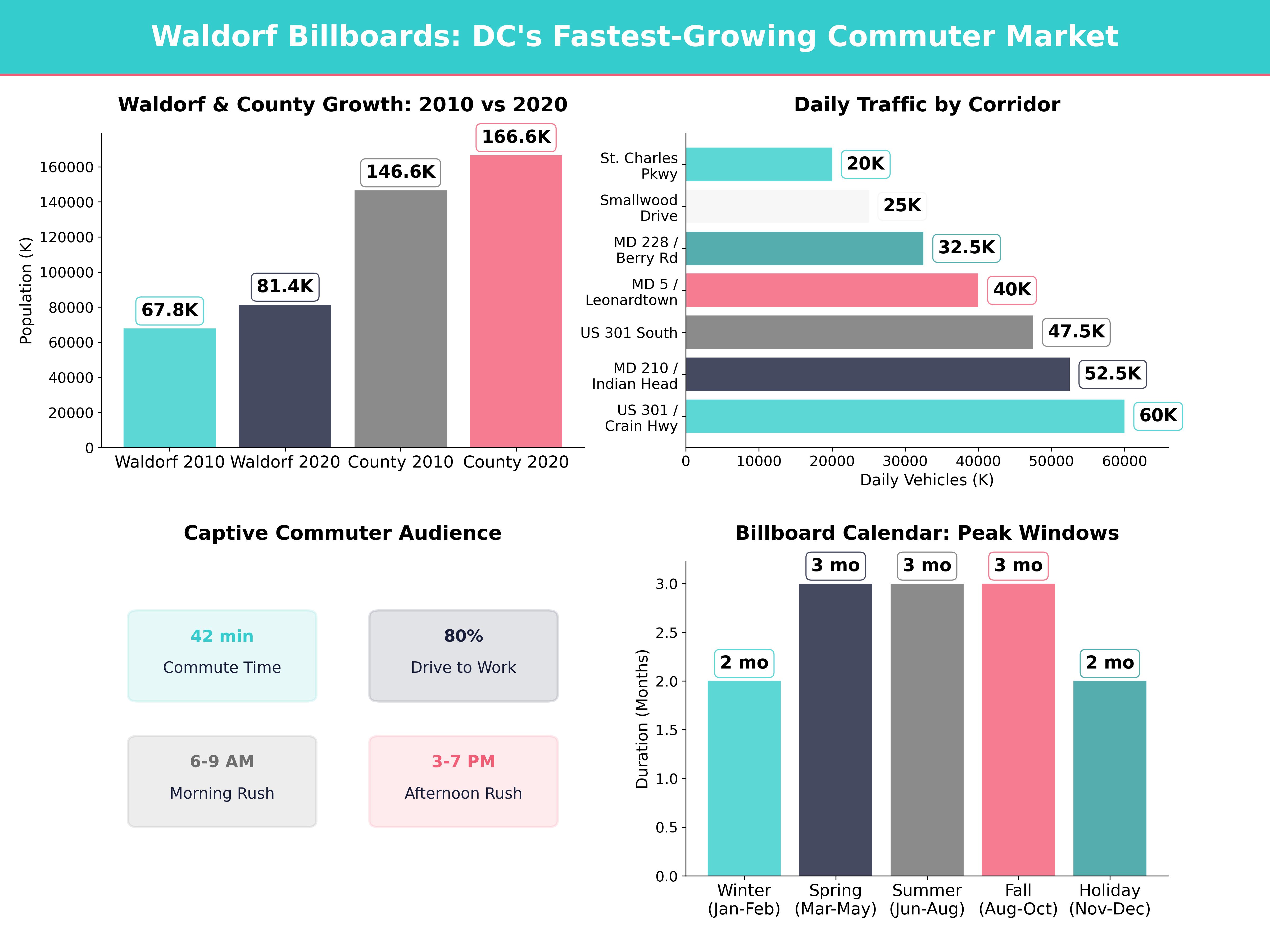
Waldorf gives us one of Southern Maryland’s strongest billboard opportunities because it combines suburban scale, heavy car travel—mean commute times of about 42 minutes and roughly 4 out of 5 work trips made by private vehicles—and steady regional draw. Population totals compiled through the Maryland Department of Planning show that Waldorf reached 81,410 residents in 2020, up from 67,752 in 2010, while Charles County 146,551 to 166,617 residents over the same decade. That means Waldorf grew by about 13,658 people, or 20.2%, and Charles County added about 20,066 residents, or 13.7%. We also benefit from Waldorf’s position roughly 25 miles south of Washington, D.C., where everyday trips funnel onto a limited set of major roads like US 301, MD 5, MD 228, and MD 210 that keep billboard visibility high.
Waldorf Market Overview
Population growth, household formation, and local scale
Waldorf is not a small roadside town anymore. With 81,410 residents, it is one of Maryland’s largest unincorporated population centers, and it functions as the commercial heart of Charles County. That matters for us because billboard performance improves when a place combines residential density, repeat errands, and commuter flow in the same trade area.
The broader county story reinforces that opportunity. Charles County’s jump from 146,551 residents in 2010 to 166,617 in 2020 means more rooftops, more school traffic, more healthcare demand, and more consumer spending across Waldorf, White Plains, Bryans Road, and La Plata 9,100-acre St. Charles master-planned community has also helped keep Waldorf in growth mode rather than in pure replacement mode.
Commuting patterns and economic signals
Waldorf is fundamentally an auto-oriented market. County commuting data show mean travel times of about 42 minutes, and private vehicles account for roughly 4 out of 5 work trips. That long-drive pattern is valuable for billboard advertisers because it creates repeated weekday exposure on the same high-volume roads, especially during morning and evening rush windows.
The local economy is also broad enough to support many ad categories. We see steady demand tied to healthcare at University of Maryland Charles Regional Medical Center, education through Charles County Public Schools and College of Southern Maryland, regional shopping at St. Charles Towne Center Charles County Chamber of Commerce. Charles County Public Schools alone serves about 28,000 students, which expands the reach of family-focused, youth-oriented, and service-based campaigns well beyond standard commuter messaging.
For billboard planning, that translates into a market where we can reach multiple audiences without changing geographies. We can speak to professionals heading north, families staying local, students moving between campuses, and regional shoppers crossing county lines from Prince George’s County Calvert County
Key Traffic Corridors for Waldorf Digital Billboards
Waldorf’s travel patterns are concentrated on a few major roads, which makes corridor strategy especially important. Recent traffic maps from the Maryland Department of Transportation State Highway Administration
US 301 / Crain Highway
US 301 is the backbone corridor. In and around Waldorf, the busiest sections commonly run between 50,000 and 70,000 AADT, and volumes south of town often remain in the 40,000 to 55,000 AADT range as traffic continues toward La Plata
This road works especially well when we want broad awareness because it captures several trip types at once. It carries daily commuters, local shoppers, medical visits, school traffic, and pass-through drivers headed deeper into the region.
- Retail, restaurants, and auto services perform well on US 301 because the corridor captures both routine weekday traffic and weekend errand traffic.
- Healthcare, legal, and financial brands benefit because repeated exposure on a long commute builds familiarity and trust.
- Regional attractions and events benefit because US 301 is a logical path for travelers moving between Waldorf, La Plata, and destination sites promoted by Explore Charles County
MD 5 / Leonardtown Road / Branch Avenue connection
MD 5 is the other major north-south spine. Around Waldorf, especially near the split and merge with US 301, MD 5 segments generally fall in the 30,000 to 50,000 AADT range. That is substantial volume for brands that want to catch commuters moving toward Prince George’s County
MD 5 tends to skew slightly more commuter-heavy than some retail-heavy stretches of US 301. We often like it for campaigns that need weekday consistency rather than just shopper traffic.
- Professional services and higher-consideration purchases benefit here because commuters see the message repeatedly on a familiar route.
- Political, public awareness, and community messaging fits well because MD 5 reaches residents who are highly engaged with regional commuting and civic life.
- Employers and training programs benefit because workers heading north are often evaluating new opportunities during long drive times.
MD 228 / Berry Road
Berry Road is one of Waldorf’s best family-and-neighborhood corridors. MDOT SHA counts often place MD 228 in the 25,000 to 40,000 AADT range through the Waldorf trade area. That volume is meaningful because Berry Road connects residential growth, youth sports traffic, schools, retail, and entertainment venues.
This is where we often lean into practical consumer categories. The audience is highly local, highly repeat, and often in purchase mode.
- Home services perform well because Berry Road reaches homeowners in established and growing subdivisions.
- Healthcare, dental, and urgent care providers benefit because family decision-makers travel this corridor frequently.
- Youth enrichment, camps, tutoring, and family entertainment fit naturally because the road serves school pickups, sports traffic, and recreation trips.
Smallwood Drive, St. Charles Parkway, and Western Parkway
Local arterials matter in Waldorf because they bridge the regional highways to the neighborhoods where purchases actually happen. Smallwood Drive commonly carries about 20,000 to 30,000 AADT, while St. Charles Parkway often lands in the 15,000 to 25,000 AADT band depending on segment. Those are not interstate-level counts, but they are excellent for high-frequency local targeting.
This cluster is useful when we want to sharpen geographic relevance. It gives us access to shoppers headed toward St. Charles Towne Center St. Charles, and event traffic moving toward Regency Furniture Stadium Capital Clubhouse
- Local restaurants and quick-service brands benefit because decisions are often made just minutes before arrival.
- Schools, childcare providers, and after-school programs benefit because parents are already in planning mode on these roads.
- Retail centers and service businesses benefit because these arterials capture high-intent neighborhood traffic rather than distant pass-through traffic.
MD 210 / Indian Head Highway and the northern Charles County feeder market
If we want to expand beyond central Waldorf, MD 210 deserves attention. In northern Charles County, Indian Head Highway regularly reaches about 45,000 to 60,000 AADT, making it an important feeder for commuters traveling between Bryans Road, Indian Head National Harbor, MGM National Harbor
This corridor is not “Waldorf only,” but it is very relevant for Waldorf advertisers that draw from the whole county. It is especially useful for brands that want northern Charles County residents to choose Waldorf as their shopping, healthcare, or service destination.
- Regional retailers and entertainment venues benefit because MD 210 captures residents heading toward larger commercial nodes.
- Auto dealers, furniture stores, and specialty medical providers benefit because consumers are willing to drive longer for these categories.
- Waldorf-based businesses with countywide appeal benefit because MD 210 can funnel audiences into the Waldorf trade area.
Audience Segments We Can Reach in Waldorf
Daily commuters and long-drive professionals
Waldorf’s strongest audience segment is still the commuter base. With average work trips around 42 minutes, many residents spend enough time on the road for message repetition to matter. We can use billboard advertising to stay visible during both the 6:00 to 9:00 a.m. inbound rush and the 3:00 to 7:00 p.m. return trip.
These commuters are useful for more than just awareness. They respond well to practical categories such as healthcare, insurance, home improvement, banking, legal services, and fast dining because those purchases can be planned during routine drives.
Families, homeowners, and school-connected households
Waldorf’s suburban profile makes families a core audience. The size of St. Charles, the county’s continuing residential growth, and the presence of about 28,000 Charles County Public Schools students create a strong base for family-oriented campaigns.
This audience is especially valuable for us because it is active all year. Families generate school commuting, weekend errands, youth sports travel, medical visits, and holiday shopping cycles. That steady movement supports categories such as pediatric care, orthodontics, tutoring, home services, grocery, family dining, and local events.
Students, educators, and continuing-education audiences
College of Southern Maryland adds another dimension. The college operates 3 campuses, and its La Plata 90,000-square-foot Capital Clubhouse
For advertisers, this segment is useful for education, technology, value retail, food, fitness, telecom, and workforce training. It also responds well to shorter promotional cycles tied to semester starts, registration windows, and summer camps.
Regional shoppers, sports fans, and entertainment visitors
Waldorf serves as a regional shopping and entertainment center for much of Charles County’s 166,617 residents. Traffic tied to St. Charles Towne Center Southern Maryland Blue Crabs games at Regency Furniture Stadium
This matters because billboard audiences in Waldorf are not only local residents. We also reach countywide shoppers, weekend visitors, and event-driven traffic that can convert quickly when the creative includes a nearby landmark, a timely offer, or a same-day call to action.
Military, industrial, and skilled-trade workers
Northern Charles County and adjacent employment centers also feed Waldorf demand. Workers connected to Indian Head, construction trades, logistics, public safety, and county services often move along MD 210, US 301, and MD 5. This audience tends to respond to straightforward messaging, clear pricing, job offers, certifications, truck and equipment sales, and dependable service brands.
Seasonal and Timing Opportunities in Waldorf
Spring in Waldorf
Spring is a strong season for home services, healthcare, landscaping, tax-related services, and local retail. As weather improves from March through May, residents spend more time on weekend errands and home projects, and that makes Berry Road, Smallwood Drive, and central Waldorf retail corridors more productive.
We also like spring for healthcare and education campaigns. Families are planning summer activities, school transitions, and deferred appointments, so repeated billboard presence can move consumers from awareness to action before summer distraction sets in.
Summer in Waldorf and Southern Maryland
Summer campaigns should lean into movement and recreation. From June through August, school is out, local families are more mobile, and event traffic picks up around Regency Furniture Stadium Southern Maryland Blue Crabs, parks, dining, and regional day trips promoted by Explore Charles County Maryland Office of Tourism
This is a good time for restaurants, entertainment, camps, sports programming, auto care, cooling services, and tourism-related messaging. It is also a good season for high-contrast creative because thunderstorms and haze can reduce legibility if the design is too soft.
Back-to-school and fall in Waldorf
Late summer and early fall are especially productive in Waldorf. Charles County Public Schools return in late August, College of Southern Maryland starts fall sessions, and the Charles County Fair August through October one of the best windows for family retail, tutoring, healthcare, grocery, telecom, and local services.
We also see strong performance in fall because routines become more predictable again. Commute patterns tighten, school traffic normalizes, and audiences start paying closer attention to messages that help them save time.
Holiday and winter timing in Waldorf
From November through December, Waldorf’s retail nodes become especially valuable. Holiday shopping around St. Charles Towne Center
January and February can still work well for practical categories. We often like winter for tax services, fitness, healthcare, career programs, furniture, and value retail because consumers are making reset decisions even when leisure travel slows.
Waldorf Billboard Design Tips
Use Waldorf place language that feels instantly local
In Waldorf, local specificity matters. We usually get stronger relevance when creative names recognizable places such as “Crain Hwy,” “Berry Rd,” “St. Charles,” “La Plata,” or “near St. Charles Towne Center.” A message that feels geographically anchored is easier for drivers to process in a fast suburban corridor.
We also recommend keeping the structure disciplined. In this market, 1 offer, 1 location cue, and 1 action usually outperform crowded layouts. If we can say it in 6 to 8 words, we are usually in a strong place.
Match the tone to Waldorf’s suburban and professional audience
Waldorf is family-oriented, practical, and commuter-heavy. That means overly abstract or ironic creative often underperforms compared with direct, useful, confidence-building messaging. Home services, healthcare, education, and finance campaigns usually work best when they feel reliable rather than flashy.
Color choices should also reflect the road environment. High-contrast blues, reds, whites, and deep greens tend to hold up well against tree cover, overcast skies, and the visual clutter of suburban retail strips. Thin fonts and low-contrast beige palettes are harder to read during rain or dusk.
Design for long commutes, not leisurely browsing
Drivers on US 301 and MD 5 are often managing traffic, signals, and merge decisions. We should assume only a brief glance. That is why route-specific creative matters more than clever copywriting in Waldorf.
We usually recommend building 2 or 3 localized versions of the same campaign. One version can speak to commuters, one can speak to local families, and one can push an event or weekend offer. That approach is especially useful when we are splitting spend across US 301, MD 228, and neighborhood arterials.
Regional Strategies Across Waldorf and Charles County
Central Waldorf retail core
The US 301, MD 5, and Smallwood Drive cluster is the best zone for broad reach. We use it when we want maximum frequency among commuters, shoppers, and general consumers. Regional retail, healthcare systems, banks, legal services, furniture, and auto categories usually fit well here.
St. Charles, Berry Road, and neighborhood-serving corridors
The Berry Road and St. Charles Parkway area is where we narrow the message and raise local relevance. We like this part of the market for dentists, childcare, schools, tutoring, home improvement, urgent care, gyms, churches, and family restaurants. The audience here is more residential, more routine-driven, and more likely to act on a nearby offer.
Southbound US 301 toward White Plains and La Plata
Southbound strategy matters if our business draws from the broader county, not just Waldorf. This approach works well for College of Southern Maryland, University of Maryland Charles Regional Medical Center, countywide events, and any advertiser trying to pull traffic from southern Charles County into Waldorf or La Plata
Northern Charles County and MD 210 feeders
If our service area stretches toward Bryans Road, Indian Head National Harbor side of the region, we should not limit ourselves to central Waldorf boards alone. Northern corridor coverage can build demand upstream and then convert it in Waldorf’s retail and service districts.
Using Blip Tools in Waldorf
When we want corridor-level control
Waldorf is a good market for manual selection because the roads are so clearly segmented. If we already know that our customers come from US 301 commuters, Berry Road families, or MD 210 feeders, we can select those boards directly and align artwork to each route.
When we want to learn the market quickly
Waldorf is also a smart place to use a Blip-optimized campaign first. Because the market has a mix of commuter, retail, and neighborhood traffic, optimized delivery can help us identify whether US 301, MD 5, or MD 228 is doing the most work before we narrow in.
When timing matters
Dayparting is especially useful here. We often see logical schedule splits between the 6:00 to 9:00 a.m. commute, the 3:00 to 7:00 p.m. return window, and weekend midday shopping. Real-time analytics help us compare which boards and time blocks are actually producing the strongest reach, and artwork tools make it easy to generate localized variants without rebuilding the whole campaign.
Getting Started With Billboard Rental in Waldorf
Start with the business goal, not the map
Before we choose inventory, we should define what success looks like in Waldorf. If the goal is broad awareness, we should prioritize US 301 and MD 5. If the goal is local action, such as same-day visits or family service inquiries, we should lean harder into Berry Road, Smallwood Drive, and St. Charles Parkway.
Evaluate locations by direction, audience, and trip purpose
In Waldorf, two boards that are only a short distance apart can behave very differently. One may face morning commuters, while the other may reach evening shoppers. One may be surrounded by retail, while the other is mostly a pass-through route. We should review direction of travel, nearby anchors, and likely trip purpose before we commit budget.
Expect a simpler process than traditional billboard buying
Traditional billboard buying often means fixed packages, longer commitment windows, and slower creative changes. With Blip, we can enter the Waldorf market more practically. We can start small, test multiple corridors, pause underperforming placements, and shift spend toward the roads and dayparts that are proving their value.
Build, measure, and expand
A good Waldorf launch often starts with 2 or 3 corridor strategies rather than a single all-or-nothing bet. We can run one commuter-focused creative on US 301, one family-focused creative on Berry Road, and one broader awareness message in central Waldorf. After a short learning period, we can use performance data to expand into the best-performing route, add new creative for seasonal events, or widen coverage into La Plata Indian Head
Waldorf rewards advertisers that stay local, stay legible, and stay flexible. If we match the corridor to the audience, use creative that sounds native to Southern Maryland, and adjust timing around commuting and seasonal routines, we can turn Waldorf’s everyday traffic into consistent billboard value.