Billboards near Maryland City, MD
No Minimum Spend. No Long-Term Contracts. Just Results.
Trusted by Leading Brands


Billboard advertising
near Maryland City has never been easier




How much is a billboard near Maryland City?
Why Choose Blip for Billboard Advertising near Maryland City
Blip's self-serve platform lets Maryland City advertisers launch fast on Laurel or College Park boards near I-95 and MD 198.
In Maryland City, Blip-optimized campaigns can auto-shift spend to I-95, the Parkway, and Beltway traffic as commuter demand changes.
No contracts or minimums make Maryland City billboard testing easy—ideal for Fort Meade, UMD, and local retail campaigns.
Use Blip dayparting in Maryland City to hit morning and evening commuters on I-95, MD 198, and U.S. 1 when they're most likely to act.
Track Maryland City results in real time and adjust your budget around school seasons, BWI travel spikes, and weekend shopping traffic.
Frequently Asked Questions About Billboard Advertising near Maryland City
How much does a billboard cost in Maryland City with Blip?
Blip makes billboard advertising in the Maryland City area flexible and affordable. With pay-per-play pricing, you only pay when your ad actually displays, starting at just $0.01 per blip. There are no minimums and no contracts, so you can set, adjust, or pause your spend anytime.
Where can I advertise with Blip near Maryland City?
For advertisers that want visibility near Maryland City, our 5 digital billboards in nearby Laurel and College Park create practical access to the audience that lives, works, shops, and commutes in the Maryland City area. Those screens are only 3.1 miles away in Laurel and 9.7 miles away in College Park, all within 10.0 miles of Maryland City. Laurel is the closest option, and College Park extends the reach farther south.
Why is Maryland City a good place for billboard advertising?
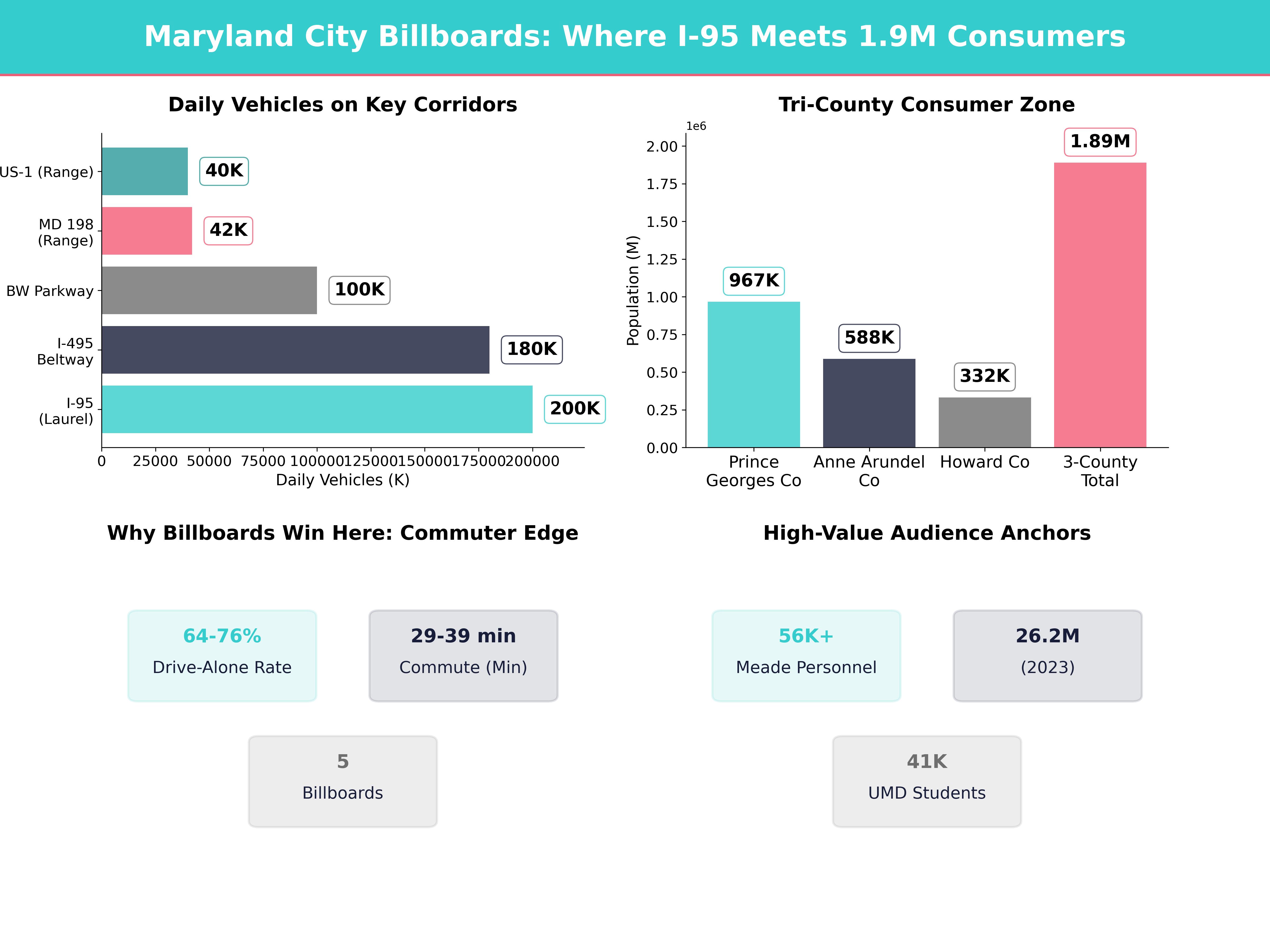
Maryland City is a strong billboard market because it sits on one of central Maryland’s busiest commuter and retail seams, with nearby I-95 segments exceeding 200,000 vehicles per day and the Baltimore-Washington Parkway and I-495 carrying 100,000+ and 180,000+ vehicles per day, respectively. Maryland City is a car-first market, and roughly 64% to 76% of workers commute by driving alone. That combination is ideal for billboard advertising because it creates repeated, habitual exposure on the same roads, at the same times, across the same nearby corridors.
What nearby audiences can Blip reach around Maryland City?
The Maryland City area operates as a connected market spanning Anne Arundel County, Prince George's County, and nearby Howard County. Fort Meade supports more than 56,000 military and civilian personnel, and the University of Maryland, College Park enrolls roughly 41,000 students. Combined, nearby school systems represent roughly 274,000 students, giving advertisers a large audience for tutoring, healthcare, family dining, youth sports, after-school programs, colleges, camps, and retail categories tied to school calendars.
When should I run billboard ads in Maryland City with Blip?
Because the market is so commuter-oriented, timing matters as much as location. We usually recommend morning commute for coffee, healthcare, recruiting, automotive, and service reminders, and afternoon and evening commute for restaurants, retail, entertainment, urgent care, and family services. Holiday campaigns should usually begin 4 to 6 weeks before the desired shopping push.
Do I need a contract to advertise with Blip near Maryland City?
No, Blip has no long-term contracts or minimum commitments. You can start, pause, or stop your campaign at any time.
How fast can I launch a billboard campaign with Blip near Maryland City?
You can have your campaign live in minutes. Create a free account, select your locations, set your budget, upload your design, and start running once approved.
Where can I advertise with Blip near Maryland City?
Blip has digital billboards near Maryland City. You can browse available locations on a map, choose the ones that fit your audience, and start advertising right away.
Still have questions? Launch a campaign in minutes — no contracts, no commitments.
Start Your CampaignMaryland City Billboard Advertising Guide
Maryland City is a strong billboard market because it sits on one of central Maryland’s busiest commuter and retail seams, with nearby I-95 segments exceeding 200,000 vehicles per day and the Baltimore-Washington Parkway and I-495 carrying 100,000+ and 180,000+ vehicles per day, respectively, where traffic flows between Laurel College Park, Fort Meade, and the wider Baltimore-Washington corridor. For advertisers that want visibility near Maryland City, our 5 digital billboards in nearby Laurel and College Park create practical access to the audience that lives, works, shops, and commutes in the Maryland City area. Those screens are only 3.1 miles away in Laurel and 9.7 miles away in College Park, all within 10.0 miles of Maryland City. We can use that close-in footprint to build campaigns that feel local to Maryland City, while still benefiting from the scale of major regional highways.
Maryland City area market overview
Maryland City sits inside a three-county consumer zone
We view the Maryland City area as more than one neighborhood. It operates as a connected market spanning Anne Arundel County, Prince George's County Howard County. At the 2020 Census, Anne Arundel County had 588,261 residents, Prince George's County had 967,201, and Howard County had 332,317, for a combined nearby county population of 1,887,779.
That scale matters because Maryland City sits close to county lines, major highways, and regional shopping patterns. The nearby City of Laurel 30,060 residents in 2020, and College Park had 34,740, giving advertisers nearly 64,800 additional residents in the two closest billboard cities alone. For businesses serving Maryland City, those nearby communities are not side markets. They are part of the same everyday movement pattern.
Workforce and economic drivers near Maryland City
The Maryland City area benefits from several large, stable demand generators. Fort Meade supports more than 56,000 military and civilian personnel, which helps drive weekday commuting, contractor traffic, housing demand, and everyday retail spending around Laurel, Maryland City, and surrounding corridors. BWI Marshall Airport 26.2 million passengers in 2023, reinforcing the region’s travel and hospitality activity.
Education is another major engine. The University of Maryland, College Park enrolls roughly 41,000 students, which makes nearby College Park especially useful for reaching students, faculty, staff, sports fans, and visiting families. On the business side, the region is supported by organizations such as the Anne Arundel Economic Development Corporation Prince George's County Economic Development Corporation, and the Howard County Economic Development Authority, all of which reflect the area’s mix of logistics, education, healthcare, government contracting, retail, and professional services.
Why auto commuting dominates the Maryland City area
Maryland City is a car-first market. Recent American Community Survey patterns across Anne Arundel, Howard, and Prince George's counties show that roughly 64% to 76% of workers commute by driving alone, and average commute times generally fall in the 29- to 39-minute range. That combination is ideal for billboard advertising because it creates repeated, habitual exposure on the same roads, at the same times, across the same nearby corridors.
Even where MTA Maryland and WMATA offer rail and bus options, many trips still begin or end in a vehicle. For advertisers serving Maryland City, that means outdoor advertising near the main commuter paths can influence both daily routines and planned shopping decisions.
Key traffic corridors serving the Maryland City area
I-95 and MD 198 are the core Maryland City commuting routes
If we start with the single most important roadway pattern near Maryland City, it is the I-95 and MD 198 network. Recent Maryland State Highway Administration traffic counts show that nearby segments of Interstate 95 around Laurel commonly exceed 200,000 vehicles per day. That is the backbone corridor for commuters moving between northern Prince George's County, Anne Arundel County, Baltimore-bound employment, and Washington-bound offices.
MD 198 is the local connector that ties Maryland City to Laurel, Fort Meade, and surrounding residential and employment areas. Depending on the segment, traffic on MD 198 is commonly in the 35,000 to 50,000 vehicles per day range. For advertisers, this is where local intent and regional traffic overlap. Drivers on that corridor are often headed to work, school, errands, dining, and retail stops that are directly relevant to the Maryland City area.
The Baltimore-Washington Parkway, U.S. 1, and I-495 expand reach
The Baltimore-Washington Parkway gives advertisers another major north-south corridor serving Maryland City. Nearby parkway segments around Laurel frequently exceed 100,000 vehicles per day, which makes the route especially valuable for brands that want broad regional awareness.
U.S. Route 1 adds a different type of audience. Through Laurel and College Park, U.S. 1 often falls into the 30,000 to 50,000 vehicles per day range, depending on the segment. That road carries a denser mix of local shoppers, students, restaurant traffic, apartment residents, and neighborhood service customers. It is especially useful when we want to target consumers closer to purchase or event activity.
Around College Park, the Capital Beltway, I-495, is another scale driver. Nearby segments often run above 180,000 vehicles per day, which helps College Park inventory serve southbound commuters, Beltway traffic, and University of Maryland audiences moving through the market.
Why Laurel and College Park billboards work for Maryland City
Our Laurel inventory is the closest to Maryland City at 3.1 miles, so it is the natural first choice when we want tight geographic relevance. It is especially useful for local services, healthcare, dining, retail, and brands that depend on repeated weekday reach among nearby residents.
Our College Park inventory at 9.7 miles extends that strategy farther south. It connects the Maryland City audience to Beltway movement, Route 1 traffic, and the University of Maryland environment. Together, these two nearby cities let us cover both close-in household traffic and broader commuter circulation serving the Maryland City area.
Audience segments near Maryland City
Commuters and working professionals
The Maryland City area has a high concentration of repeat weekday travelers. We can reach office workers, healthcare employees, defense and contractor personnel, retail staff, and service professionals who move through Laurel, Maryland City, Fort Meade, and College Park on a fixed schedule. Because surrounding counties show drive-alone commute rates in the 64% to 76% range, billboard exposure can build frequency quickly.
This audience responds well to practical offers and high-clarity messaging. We often see strong local-market alignment for:
- Healthcare providers.
- Auto services.
- Home services.
- Insurance agencies.
- Financial services.
- Local restaurants.
- Retail promotions.
- Hiring and recruiting campaigns.
Students, parents, and education households
Education audiences are larger than many advertisers realize near Maryland City. The University of Maryland, College Park brings roughly 41,000 students into the nearby market, and that number does not include faculty, staff, alumni visitors, and game-day traffic connected to Maryland Athletics.
K-12 households are also a major factor. Anne Arundel County Public Schools serves about 84,000 students, Prince George's County Public Schools serves more than 130,000, and the Howard County Public School System serves about 57,000. Combined, those three nearby systems represent roughly 274,000 students. That gives us a large audience for tutoring, healthcare, family dining, youth sports, after-school programs, colleges, camps, and retail categories tied to school calendars.
Families, homeowners, and suburban consumers
Maryland City is fundamentally a suburban household market. Families in the area are making recurring decisions about groceries, urgent care, childcare, dentistry, home improvement, HVAC, pest control, legal services, and recreation. Because the market sits near large residential concentrations in Anne Arundel, Prince George's, and Howard counties, billboard campaigns can support both brand familiarity and immediate action.
For household-focused advertisers, Laurel is often the strongest close-in choice because it sits nearest to Maryland City and captures local shopping movement. College Park becomes especially useful when we also want younger renters, university households, and south-corridor traffic.
Travelers, shoppers, and entertainment audiences
The Maryland City area also benefits from strong destination traffic. BWI Marshall Airport 26.2 million passengers in 2023, which supports hotels, parking, dining, travel services, and regional retail. Arundel Mills 200+ stores, and Maryland Live! Casino
Closer to the Maryland City area, Laurel Park, Laurel Main Street, Laurel Town Centre Downtown College Park create event, dining, and shopping pockets that can influence weekend traffic. For advertisers, that means campaigns do not have to rely only on weekday commuters. We can also target leisure activity and discretionary spending.
Seasonal and timing opportunities around Maryland City
Spring and summer in the Maryland City area
Spring is one of the best times to advertise near Maryland City for home services, healthcare, events, and family-focused businesses. Warmer weather brings more visible retail movement, more weekend activity, and a fresh buying cycle for landscaping, roofing, patios, pest control, and remodeling. Graduation season also matters because the Maryland City area sits close to University of Maryland, College Park and multiple large public-school systems.
Summer campaigns work well for:
- Camps and youth programs.
- Family attractions.
- Restaurants and quick-service brands.
- Travel and airport parking.
- Home improvement and moving services.
- Back-to-school retail starting in late July and August.
The airport effect is especially important in summer because BWI travel spikes support hotel, restaurant, transportation, and tourism-related messaging.
Fall and holiday opportunities near Maryland City
Late August through October is a prime back-to-routine window. K-12 schools return, university traffic normalizes, and commute patterns become more consistent after summer vacations. That makes fall a strong period for healthcare, financial services, tutoring, recruiting, fitness, and retail campaigns.
College Park inventory becomes especially valuable during the academic year because of university traffic, The Clarice Smith Performing Arts Center, and fall sports tied to Maryland Athletics. Holiday campaigns should usually begin 4 to 6 weeks before the desired shopping push. That timing helps us build familiarity before Black Friday, December travel, and year-end spending.
Best dayparts for campaigns serving Maryland City
Because the market is so commuter-oriented, timing matters as much as location. We usually recommend:
- Morning commute for coffee, healthcare, recruiting, automotive, and service reminders.
- Afternoon and evening commute for restaurants, retail, entertainment, urgent care, and family services.
- Thursday through Sunday for events, shopping, and dining pushes.
- School-year weekday schedules for education, tutoring, youth programs, and parent-focused brands.
Laurel boards are often strongest for close-in commuter repetition, while College Park boards can add southbound commuter and student-heavy timing. We can adjust those patterns week by week instead of locking into one rigid schedule.
Billboard design tips for the Maryland City market
Use fast, route-aware messaging
Drivers near Maryland City are often navigating interchanges, merging lanes, or moving between suburban errands and longer commutes. That means we should design for speed and clarity. We recommend keeping billboard copy to 6 to 8 words when possible, using one idea per ad, and emphasizing a single action or promise.
Location-aware language performs well in this geography. Phrases like “Off 198,” “Near Laurel,” “Next Stop After Work,” or “Minutes From Route 1” can feel immediately relevant, as long as the claim is accurate. We should also use large type, strong contrast, and a clear brand mark so the message survives a quick roadside glance.
Make creative feel local to central Maryland
The Maryland City area sits between suburban family neighborhoods, major interstates, and the university energy of College Park. Generic creative often feels out of place here. We usually recommend visual cues that match the local environment, such as clean suburban imagery, polished professional branding, campus-oriented energy, or convenient commuter framing.
Maryland-specific color palettes can also help. Red, gold, black, and white, drawn from the state flag, can create instant local recognition when used well. For family and homeowner audiences near Laurel, we often favor trustworthy, service-oriented creative. For student and young professional audiences near College Park, bolder color, sharper calls to action, and event-style urgency tend to work better.
Match the offer to the audience cluster
The best-performing billboard message near Maryland City is usually not the broadest one. It is the one that matches the nearby audience segment.
- In Laurel, we often lean into convenience, family value, healthcare access, home services, and neighborhood retail.
- In College Park, we often lean into student relevance, food and beverage, entertainment, apartments, admissions, events, and recruiting.
- For commuter-heavy categories, we keep the message direct, with one clear value point, such as speed, savings, availability, or proximity.
If the audience spans multiple communities, we can rotate creative versions by location or time of day. We can also test English and Spanish variants when that fits the brand and the target market.
Regional strategies for billboard advertising near Maryland City
Start with Laurel for the closest Maryland City reach
Because Laurel is only 3.1 miles from Maryland City, we usually treat it as the anchor market for close-in campaigns. Laurel boards are a strong fit when the goal is to reach nearby residents repeatedly during daily routines. That is especially true for:
- Dentists, doctors, and urgent care.
- Home improvement companies.
- Auto repair and dealerships.
- Local restaurants.
- Gyms and wellness brands.
- Community banks, insurance agencies, and service businesses.
If the advertiser serves northern Anne Arundel County first and foremost, Laurel is often the most efficient starting point.
Add College Park for southern expansion and younger audiences
College Park is only 9.7 miles from Maryland City, but it adds a different audience mix. We use it when we want more exposure to Prince George's County commuters, University of Maryland traffic, Beltway drivers, and younger adult consumers. This is where campaigns for education, recruiting, food service, entertainment, mobile apps, retail, and events often gain momentum.
College Park is also useful when the advertiser’s service area extends south toward Greenbelt, Beltsville, Hyattsville, or the Route 1 corridor. In those cases, the Maryland City audience is still part of the plan, but the campaign benefits from a wider regional footprint.
Build layered coverage when the goal is market share
Many advertisers do best when they combine both nearby cities. A layered plan can work like this:
- Laurel supplies repeated local exposure near Maryland City.
- College Park expands reach to southern commuters and student-driven traffic.
- A shared creative theme builds memory across both corridors.
- Time-of-day targeting shifts the budget toward the highest-value moments.
This strategy is especially effective for multi-location healthcare groups, colleges, regional retailers, entertainment brands, and recruiting campaigns. If we want to own the conversation near Maryland City rather than just appear once in a while, using all 5 nearby digital billboards is often the strongest move.
Blip tools for campaigns serving the Maryland City area
Use Blip-optimized campaigns for broad local efficiency
When we want reach across all nearby inventory without micromanaging every screen, Blip-optimized campaigns are usually the simplest way to cover the Maryland City area. We can set the target, define the budget, and let the system distribute spend across the Laurel and College Park billboards based on timing, availability, and performance conditions.
That matters in a market like Maryland City because traffic patterns shift by weekday, season, and corridor. Optimization helps us stay flexible without losing geographic focus.
Use manual selection when precision matters most
If the advertiser cares deeply about one nearby city or one audience segment, manual selection can be the better choice. We may choose Laurel only for a hyperlocal home-services push, or College Park only for a student and campus campaign. We may also combine both, but weight them differently based on the business objective.
This is especially useful for narrow service areas, event promotions, or businesses testing the market for the first time.
Let pricing flexibility support timing strategy
Blip’s pay-per-play model makes local testing easier because we do not need to buy a long fixed package just to get started. Ads run as 7.5- to 10-second digital displays, and pricing starts at $0.01 per display. That gives us room to concentrate spend around commuter peaks, retail weekends, or school-calendar windows instead of paying for low-value hours.
Real-time analytics also help us refine location mix, dayparts, and creative. In a corridor-driven market like Maryland City, that flexibility is often more useful than a rigid traditional buy.
Getting started with billboard rental near Maryland City
Begin with the real business goal
Before we pick boards, we should define what success means. Near Maryland City, the most common goals are:
- Building broad local awareness.
- Driving store visits.
- Supporting a sales promotion.
- Recruiting employees.
- Promoting an event.
- Reaching students or families.
- Generating leads for local services.
The goal shapes everything else. A home-services company usually needs close repetition near Laurel. A university-adjacent restaurant may need College Park. A regional healthcare brand may need both.
Evaluate billboard locations by audience fit, not just distance
The closest board is not always the only right board. We recommend evaluating each nearby location using four questions:
- Does the corridor match our customer’s routine?
Commuters, families, students, and shoppers move differently. - Is the surrounding land use aligned with the offer?
Residential, campus, retail, and interchange zones each support different messages. - Does the timing match the product?
Morning, evening, weekend, and school-year patterns can change performance. - Can we say something locally relevant?
Ads that feel connected to Maryland City, Laurel, Route 1, or MD 198 usually land better than generic regional copy.
For most advertisers serving Maryland City, we suggest starting with Laurel if proximity is the priority, adding College Park if audience breadth is the priority, and using both if the goal is stronger regional repetition.
Expect a simpler process than traditional billboard buying
Traditional billboard buying often involves long sales cycles, fixed packages, limited flexibility, and larger commitments than a local advertiser really needs. With Blip, we can launch without contracts, start with almost any budget, adjust creative quickly, and change locations or timing as we learn.
A practical way to start near Maryland City is to:
- Launch with one clear offer.
- Run close to commute periods first.
- Start with Laurel, College Park, or both based on audience fit.
- Test 2 to 3 creative versions.
- Review results and reallocate budget toward the best-performing times and locations.
That approach keeps risk low and learning high. For advertisers trying to grow in the Maryland City area, it is usually the fastest way to find out which nearby billboards, messages, and schedules actually move the market.