Billboards near Pikesville, MD
No Minimum Spend. No Long-Term Contracts. Just Results.
Trusted by Leading Brands


Billboard advertising
near Pikesville has never been easier



How much is a billboard near Pikesville?
Why Choose Blip for Billboard Advertising near Pikesville
-
Blip's self-serve setup lets Pikesville brands launch fast on I-695 and Reisterstown Road, reaching daily commuters in minutes.
-
Pikesville campaigns can daypart by rush hour, midday errands, or school pickup to match the area's commuter and family traffic.
-
No contracts mean Pikesville advertisers can test holiday, back-to-school, or Passover creative and shift budget anytime.
-
Use Blip's real-time analytics in Pikesville to see what works, then tune timing and creative around Baltimore-bound traffic.
-
Blip's creative tools help Pikesville businesses build bold ads for affluent families, seniors, and kosher community audiences.
Frequently Asked Questions About Billboard Advertising near Pikesville
How much does a billboard cost near Pikesville, Maryland with Blip?
With Blip, you choose a daily budget that works for you, and your ads play on digital Pikesville billboards for short 7.5 to 10-second “blips.” Each blip is priced individually based on when and where you advertise and on current advertiser demand, so you always stay in control of your spend. Blip lets you start with any budget, adjust it at any time, and pay only for the blips you receive on billboards near Pikesville, Maryland.
Where can I advertise with Blip near Pikesville, Maryland?
We have 3 digital billboards serving the Pikesville area, located in nearby Baltimore, Maryland, roughly 5.9 miles from Pikesville. These units sit along high-traffic corridors that Pikesville-area residents use for commuting, shopping, and entertainment, so they effectively function as Pikesville billboards from an audience coverage standpoint. Pikesville’s main outbound arteries, especially Reisterstown Road (MD‑140), I‑695 interchanges, and cross-town routes toward downtown, feed directly into the Baltimore roadway network where our billboards are positioned.
What kind of people do Pikesville billboards with Blip reach?
Pikesville sits just northwest of Baltimore and offers advertisers a rare combination of high household incomes, dense commuter traffic, and tight-knit community life. The Pikesville census-designated place has roughly 34,000–35,000 residents, with median household income typically estimated in the $80,000–$95,000 range. The area also has a balanced mix of families, professionals, and older adults, which makes it strong for both family- and senior-focused messaging.
When is the best time to run billboards near Pikesville with Blip?
Weekday morning commute, midday, evening commute, and late night all offer different advantages in the Pikesville area. Heavy outbound flows run from 6–9 a.m., while major flows return toward the Pikesville area from 3–7 p.m. Blip’s ability to schedule by hour and day lets us align your campaign to those patterns instead of running flat 24/7.
What local businesses work best on Pikesville billboards with Blip?
Because of its demographic mix and location, the Pikesville area is ideal for affluent suburban families, Jewish community and faith-oriented audiences, healthcare and senior services users, and commuting professionals. This favors campaigns for home improvement, medical specialists, financial services, real estate, kosher food, event services, and religious education. The area’s commuter patterns and community rhythms make billboard advertising near Pikesville especially useful for both everyday awareness and seasonal promotions.
Do I need a contract to advertise with Blip near Pikesville?
No, Blip has no long-term contracts or minimum commitments. You can start, pause, or stop your campaign at any time.
How fast can I launch a billboard campaign with Blip near Pikesville?
You can have your campaign live in minutes. Create a free account, select your locations, set your budget, upload your design, and start running once approved.
Where can I advertise with Blip near Pikesville?
Blip has digital billboards near Pikesville. You can browse available locations on a map, choose the ones that fit your audience, and start advertising right away.
Still have questions? Launch a campaign in minutes — no contracts, no commitments.
Start Your CampaignPikesville Billboard Advertising Guide
Pikesville sits just northwest of Baltimore and offers advertisers a rare combination of high household incomes, dense commuter traffic, and tight-knit community life. With Blip’s digital billboards near Pikesville—primarily on busy routes in nearby Baltimore—we can help you capture daily attention from residents, commuters, and regional visitors moving through the greater Pikesville area. If you are weighing the value of Pikesville billboards versus other nearby options, this guide shows how boards positioned in Baltimore still function as highly effective local coverage.
Understanding the Pikesville Area Market
Pikesville is one of Baltimore County
Key demographic and economic context:
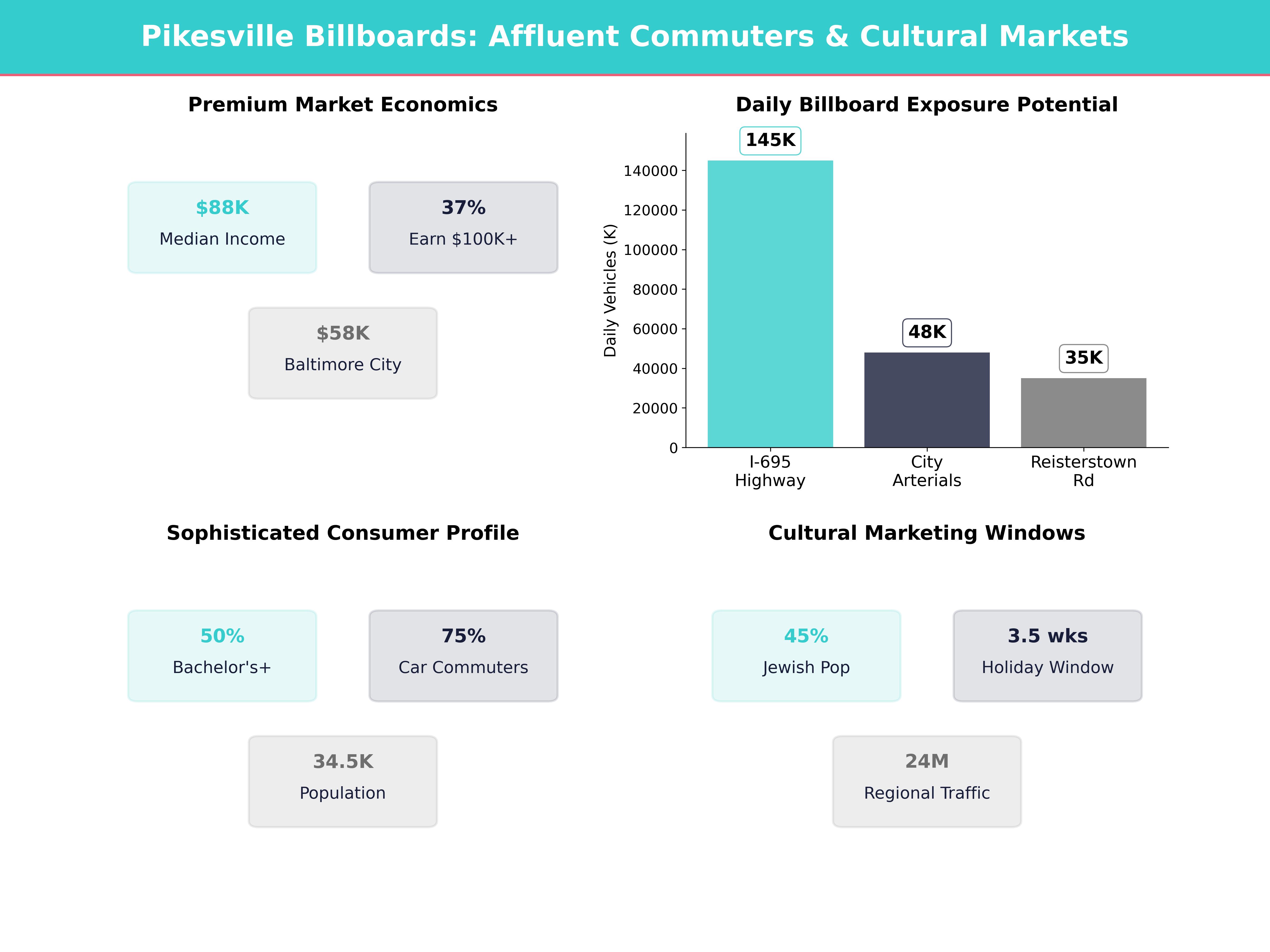
- Population: The Pikesville census-designated place has roughly 34,000–35,000 residents, concentrated within about 12 square miles, giving it a population density of nearly 2,800–3,000 residents per square mile—high for a suburban area and ideal for geographically focused advertising.
- Age profile: A balanced mix of families, professionals, and older adults. In much of the surrounding area, about 22–25% of residents are under 18, while 18–20% are 65+, which is several points higher than the overall Baltimore County 65+ share (around 16%). This makes the market particularly strong for both family- and senior-focused messaging.
- Income: Median household income in the Pikesville area is typically estimated in the $80,000–$95,000 range, compared with a Baltimore City median closer to the $55,000–$60,000 range. Roughly 35–40% of households in and around Pikesville report incomes above $100,000, supporting campaigns for higher-ticket services (home improvement, medical specialists, financial services, real estate).
- Education and professions: In many Pikesville-area tracts, an estimated 45–55% of adults 25+ hold a bachelor’s degree or higher, outpacing both Baltimore County and Maryland averages. A large share of workers are employed in management, business, finance, healthcare, education, and government roles associated with major nearby employers in Baltimore City, Towson
- Commuting patterns: Across Baltimore County, more than 75% of workers commute by car, with average commute times around 30 minutes. In some Pikesville-adjacent tracts, solo driving rates top 80%, with only 5–8% using transit. A significant portion of Pikesville-area residents travel daily toward Baltimore City and surrounding employment centers, funneling onto the Baltimore Beltway (I‑695) and radial routes like Reisterstown Road (MD‑140) and Park Heights Avenue (MD‑129).
The Pikesville area is also well known for its sizable Jewish community, with estimates often placing the Jewish population at 40–50% of residents in some neighborhoods. Numerous synagogues, schools, and kosher businesses create strong community cohesion. That cultural concentration translates into clear peaks in local retail, travel, and event demand around major religious holidays and school calendars, which billboard advertising near Pikesville can tap into with well-timed, community-aware messaging.
For broader regional context and data, advertisers can reference the Baltimore County Government Baltimore County Department of Economic and Workforce Development Department of Planning
Where Our Digital Billboards Reach the Pikesville Area
We have 3 digital billboards serving the Pikesville area, located in nearby Baltimore, Maryland, roughly 5.9 miles from Pikesville. These units sit along high-traffic corridors that Pikesville-area residents use for commuting, shopping, and entertainment, so they effectively function as Pikesville billboards from an audience coverage standpoint.
Why this matters for reach:
- The Baltimore metropolitan area I‑695 near northwest Baltimore, average annual daily traffic (AADT) often ranges from 120,000 to over 170,000 vehicles per day, while busy arterials into the city commonly handle 35,000–60,000 vehicles per day, according to the Maryland Department of Transportation State Highway Administration.
- Pikesville’s main outbound arteries—especially Reisterstown Road (MD‑140), I‑695 interchanges, and cross‑town routes toward downtown—feed directly into the Baltimore roadway network where our billboards are positioned. On some stretches of Reisterstown Road, AADT regularly exceeds 30,000–40,000 vehicles per day, meaning a high frequency of repeat exposure to the same local drivers seeing billboard advertising near Pikesville on a daily basis.
- Many Pikesville-area residents travel to destinations such as downtown Baltimore, Towson, Owings Mills, and the Inner Harbor 23–25 million visitors annually in recent years, according to tourism reports summarized by Visit Baltimore
This means you can:
- Speak to Pikesville-area residents both on their way to work and on their way home, even though the physical billboard structures sit in Baltimore.
- Reach both local residents and regional visitors—for example, those heading toward attractions highlighted by Visit Baltimore or events at major venues like Oriole Park at Camden Yards and the Inner Harbor—while still zeroing in on Pikesville-area demand (healthcare, schools, retail, professional services, etc.).
When planning, think of your campaign as “wrapping” the daily patterns of Pikesville-area residents as they move through the Baltimore road network, using billboards near Pikesville as a consistent touchpoint along their most common routes.
Key Audience Segments Near Pikesville
Because of its demographic mix and location, the Pikesville area is ideal for several specific advertiser categories. Understanding who you’re reaching helps shape both creative and scheduling:
-
Affluent Suburban Families
- Many households are dual-income; in some nearby tracts, both spouses work full‑time in over 50% of married-couple households.
- Strong demand for after-school programs, tutoring, youth sports, family dining, and healthcare. Baltimore County’s public school system, Baltimore County Public Schools 111,000 students, with several schools drawing from the greater Pikesville area.
- Homeownership rates in nearby suburbs often sit above 60–65%, and in many Pikesville-area neighborhoods, median home values exceed $350,000–$400,000, with a notable share above $500,000. This favors campaigns for mortgage lenders, realtors, roofing, HVAC, landscaping, and remodeling that want consistent billboard advertising near Pikesville families.
-
Jewish Community & Faith-Oriented Audiences
- The Pikesville area is home to numerous synagogues, Jewish day schools, kosher markets, and cultural organizations, many of which are profiled by local outlets like the Baltimore Jewish Times.
- This creates strong seasonal rhythms around Rosh Hashanah, Yom Kippur, Sukkot, Hanukkah, Passover, and other observances. For example, High Holiday periods concentrate multiple services and community events into roughly a 3–4 week window in early fall.
- Advertisers offering kosher food, event services, religious education, and holiday-related retail can benefit by time-targeting messages around these dates and focusing campaigns in the 2–3 weeks leading up to major holidays when shopping and planning peak.
-
Healthcare and Senior Services Users
-
With nearly one-fifth of residents in some nearby tracts aged 65+, there is high demand for:
- Primary care & specialists
- Senior living and assisted living communities
- In-home care and therapy services
- Mobility, hearing, and vision products
- Baltimore County’s population aged 65+ has grown by an estimated 25–30% over the past decade, and nearby medical anchors such as LifeBridge Health’s Sinai Hospital of Baltimore
- Many of these customers (or their adult children) commute through Baltimore daily, making billboards near the city an ideal awareness tool to influence provider and facility choice.
-
With nearly one-fifth of residents in some nearby tracts aged 65+, there is high demand for:
-
Commuting Professionals
- Professionals working in downtown Baltimore, Towson, Owings Mills, and other office corridors. In the broader region, professional and business services account for roughly 15–20% of total employment.
- Higher propensity for financial services, legal services, gym memberships, continuing education, and convenience retail.
- Because 60–70% of commuters in many local tracts travel during standard rush hours, they often see the same digital billboard twice daily, turning consistent impressions into strong recall when we maintain repetition.
To deepen your understanding of local interests and issues, it’s useful to monitor outlets such as The Baltimore Sun, WBAL-TV 11, WYPR 88.1 for public radio coverage, and community-focused publications like the Baltimore Jewish Times, which frequently cover topics relevant to Pikesville-area residents and what they expect from local Pikesville billboards.
Traffic Patterns and Optimal Timing
In the Pikesville area, daily travel patterns shape when your impressions are most valuable. Blip’s ability to schedule by hour and day lets us align your campaign to those patterns instead of running flat 24/7.
Typical patterns to consider:
-
Weekday Morning Commute (6–9 a.m.)
- Heavy outbound flows from Pikesville toward Baltimore and surrounding job centers. On some Beltway segments, upwards of 40–45% of daily traffic volume is concentrated in the combined morning and evening peaks.
- Best for: coffee shops, quick breakfast, transit and rideshare services, traffic/commute-related apps, news and media, financial or legal brands seeking top-of-mind awareness.
- Short, direct calls to action work best: “Book before 9 a.m. for today’s discount,” “Call on your way to work.”
-
Midday (10 a.m.–3 p.m.)
- Mix of workers on errands, retirees, stay-at-home parents, and shift workers. In many suburban markets, midday volumes still represent 35–45% of total weekday traffic, just more spread out.
- Best for: healthcare visits, retail shopping, restaurants and fast casual, car services, and professional appointments that can be done during the day.
- This is often a less competitive inventory window, so your budget can stretch further with lower effective cost per thousand impressions.
-
Evening Commute (3–7 p.m.)
- Major flows back toward the Pikesville area as people return home from Baltimore. In some corridors, outbound p.m. peak-hour volumes match or exceed morning levels.
- Best for: restaurants (dine-in and takeout), grocery, child activity centers, entertainment, local events, and political or public-service messaging.
- This is a prime time for reminder-style creative: “Tonight only,” “Stop on your way home,” or “Enroll before Friday.”
-
Late Night (8 p.m.–12 a.m.)
- Lower total traffic—often 20–30% below daytime volumes—but great for nightlife, streaming services, food delivery, and brands targeting younger or shift-working audiences.
- If you’re budget-conscious, you can pick these off-peak times for extended reach at lower cost-per-impression.
We can use Blip’s scheduling tools to emphasize your chosen windows. For example, a Pikesville-based pediatric practice could focus 7–9 a.m. and 3–6 p.m. on weekdays to hit both sides of the school commute, while a Friday-night restaurant special might concentrate Thurs–Sat 4–8 p.m. only.
For up-to-date roadway trends and traffic volumes, refer to the Maryland DOT State Highway Administration traffic data resources and interactive maps, which publish AADT counts for major routes throughout Baltimore County and help you validate when billboards near Pikesville are likely to be seen most often.
Seasonal Opportunities Around Pikesville
The Pikesville area experiences pronounced seasonal shifts in behavior. Aligning your creative and scheduling with these rhythms can significantly lift campaign performance.
Spring (March–May)
- Home services surge as weather improves; across many Mid-Atlantic suburbs, contractors report 20–30% of annual revenue coming from spring months.
- Tax season drives financial-services demand, with most returns filed by mid-April; financial planners, CPAs, and tax prep services see pronounced spikes in inquiries during the 6–8 weeks before the federal deadline.
- Families research summer camps, tutoring, and sports programs; local camps and enrichment programs often fill 60–80% of their capacity by late May.
- Jewish holidays like Purim and Passover often fall in this window—prime time for kosher food campaigns, event venues, and community programs.
-
Strategy:
- Launch home improvement, landscaping, and contractor campaigns starting in March as soon as daytime highs regularly cross 50°F.
- Promote tax prep and financial planning leading up to April deadlines; consider heavier rotation in late March and early April.
- Use countdown messaging (“2 weeks left for early-bird camp pricing”) to capture early planners.
Summer (June–August)
- School breaks free up family schedules; Baltimore County Public Schools are typically out for 10–11 weeks, creating long windows for camps and youth activities.
- Many residents travel, but local day camps, swim clubs, and attractions remain busy; regional tourism peaks, with summer months often accounting for 35–40% of annual visitor volume to Baltimore, as noted by Visit Baltimore.
- Restaurants, ice cream shops, and entertainment venues see strong demand, especially on weekends and holiday weeks (Memorial Day, July 4, Labor Day).
-
Strategy:
- Run short, recurring bursts around weekends and holidays; consider elevating your budget by 25–50% in the 3–5 days leading into July 4 and major summer events.
- Promote local attractions and events, aligning with Visit Baltimore event calendars and Baltimore County’s tourism and cultural resources
- Target midday and afternoon for families out and about, plus early evenings for dining and entertainment.
Fall (September–November)
- Back-to-school for both public and private schools in and near Pikesville. Back-to-school shopping nationwide often represents 15–20% of annual retail sales for some categories (apparel, school supplies, electronics).
- High activity in the Jewish calendar (e.g., Rosh Hashanah, Yom Kippur, Sukkot), typically clustered within a 4–6 week period. Local synagogues and schools pack calendars with services, events, and fundraisers.
- Strong season for healthcare checkups, flu shots, and elective medical procedures as families reset schedules and prepare for winter; pharmacies and clinics commonly administer a large share of annual flu shots between September and November.
-
Strategy:
- Emphasize education, tutoring, and after-school programs from late August to early October.
- Time culturally sensitive campaigns around major Jewish holidays—consider respectful, informational messaging and avoid overtly promotional tones on solemn days.
- Promote healthcare, dental, and vision services as families reset schedules; consider “use your benefits before year-end” messaging starting in October.
Winter (December–February)
- Holiday shopping, charitable giving, and end-of-year financial planning peak in December. Many retailers see 20–30% of annual sales in November–December alone.
- January–February are strong for fitness, wellness, and “new year, new you” services; gyms routinely report 30–40% of new annual memberships initiated in the first quarter.
- Cold weather drives demand for HVAC, plumbing, and snow-related services; in severe years, a few major storms can generate significant double-digit spikes in service calls week over week.
-
Strategy:
- Retail and e-commerce brands should run intense, short campaigns in early and mid-December, with daily budgets elevated for Black Friday–Cyber Monday and the 10–14 days before Christmas.
- Gyms, wellness centers, and counseling services can concentrate messaging in late December through February, with “limited-time” offers to drive immediate action.
- For snow-dependent services (plowing, roofing repair, HVAC), be ready with quick-activate creative as storms are forecast, using Blip to ramp up impressions within hours; consider doubling your daily budget during and immediately after significant snowfall.
Crafting Effective Creative for the Pikesville Area
Digital billboard space is limited, and drivers usually have 4–7 seconds to absorb your message. For the Pikesville area, we recommend tailoring your creative to both local culture and commuter behaviors.
Design and Message Best Practices
-
Use ultra-clear hierarchy
- 1 main headline (6–8 words max)
- 1 supporting visual or icon
- 1 simple call to action (CTA) or key detail (URL, phone, or location).
-
Leverage local identifiers
- Phrases like “Serving the Pikesville area,” “Minutes from Pikesville,” or “On Reisterstown Road near the Beltway” help connect the viewer’s mental map and signal that your campaign is truly billboard advertising near Pikesville, not a generic regional buy.
- If you have locations in nearby Owings Mills, Towson, or downtown Baltimore, mention the nearest to Pikesville-area drivers. Local geographic references increase relevance, and even a 1–2 word mention (“Owings Mills,” “Towson”) can significantly improve recall.
-
Show people like your audience
- Family-focused imagery for suburban households; roughly 30–35% of area households include children under 18.
- Respectful, authentic visuals when targeting Jewish community audiences—avoid stereotypes and prioritize real, community-centered visuals when possible.
-
Use high-contrast colors
- Dark backgrounds with bright text or vice versa.
- Avoid thin fonts and small details that will blur at highway speeds; aim for a minimum text height of 12–18 inches on the actual board, which translates to clean, bold typography in your design file.
-
Include a clear next step
- “Exit at Reisterstown Rd”
- “Book at PikesvilleDentist.com”
- “Call today: 410‑XXX‑XXXX”
- Short URLs or vanity domains can boost recall; studies routinely show that shortening URLs can increase direct-visit rates by 10–20% compared with long, complex addresses.
Localized Examples
-
A Pikesville-area kosher restaurant:
- Headline: “Kosher Dining Near Pikesville Tonight”
- Visual: Mouth-watering dish, clean branding
- CTA: “Order Online – Exit Reisterstown Rd”
-
A local financial advisor:
- Headline: “Retirement Planning for Pikesville Families”
- Visual: Family on a front porch
- CTA: “Schedule a Free Consult – [BrandName].com”
We can easily rotate multiple creatives within one campaign—e.g., one emphasizing “near Pikesville” and another highlighting a specific nearby Baltimore or Owings Mills location—to test which resonates most. Even simple A/B tests can reveal 15–30% performance differences between creative variants, helping you refine which messages belong on your Pikesville billboards long-term.
Using Blip’s Flexibility to Target the Pikesville Area
Blip’s pay-per-“blip” model and scheduling controls make it easier to craft hyper-targeted campaigns for the Pikesville area without locking into long-term, inflexible contracts, and they simplify billboard rental near Pikesville into a straightforward, self-serve process.
Practical strategies:
-
Dayparting by Audience
- Commuters: Focus 6–9 a.m. and 3–7 p.m. on weekdays, which together can capture 50–60% of weekday commuter traffic.
- Seniors and stay-at-home parents: Emphasize 10 a.m.–2 p.m. Monday–Friday, when discretionary trips and medical appointments are common.
- Nightlife and takeout food: 6–11 p.m. Thursday–Saturday, aligning with the highest late-evening dining and entertainment demand.
-
Budget Pacing
- Start with a modest daily budget (for example, $10–$30/day) and monitor impressions and website traffic.
- Increase bids and daily caps during key periods (e.g., a two-week holiday sale or back-to-school season) to dominate share of voice near Pikesville-area routes. Many advertisers see the best ROI when they temporarily raise budgets by 25–50% during their highest-margin windows instead of spreading spend thinly year-round.
-
Creative Rotation and Testing
-
Run 2–3 variations simultaneously, changing:
- Headline angle (price vs. quality vs. location)
- Imagery (product vs. people vs. icon)
- CTA (“Call today” vs. “Book online”)
- Use landing page traffic, URL parameters, or coupon codes tied to each creative to estimate which approach drives more action. It’s common to see the top-performing creative deliver 1.2–1.5x the response of the weakest variation—data you can use to refine future campaigns and decide which creative should get the most exposure on your billboards near Pikesville.
-
Run 2–3 variations simultaneously, changing:
-
Short Bursts Around Events
-
Time campaigns around:
- Community festivals and local events promoted by Visit Baltimore.
- High school sports seasons, graduations, and school open houses publicized by Baltimore County Public Schools.
- Major religious holidays, while respecting community sensibilities.
- Intensify impressions 5–7 days before each event, then taper off in the 1–3 days after, when last-minute planners and follow-up needs (e.g., photos, thank-you gifts) are highest.
-
Time campaigns around:
-
Geographic Strategy
-
Even though our boards are physically located in Baltimore, select units whose traffic flows align with Pikesville-area travel:
- Corridors used by drivers heading between Pikesville and downtown Baltimore.
- Routes toward shopping hubs that serve Pikesville-area residents (e.g., Owings Mills, Towson, and regional malls).
- Combining multiple boards on complementary routes can boost unique reach by 20–40%, compared with using a single board alone, while still delivering repetition to core commuters looking for billboard advertising near Pikesville that they encounter day after day.
-
Even though our boards are physically located in Baltimore, select units whose traffic flows align with Pikesville-area travel:
Local Sensitivities, Regulations, and Goodwill
Baltimore County and Maryland have specific outdoor advertising regulations, but with digital boards already installed and approved, your main responsibility is creative compliance and community respect.
Guidelines to keep in mind:
-
Respect religious and cultural norms
- Given the significant Jewish population near Pikesville, avoid insensitive scheduling or imagery around solemn observances like Yom Kippur and Tisha B’Av.
- Community-focused or informational messages tend to be better received than aggressive commercial pitches during those periods; consider shifting more promotional content to the week before or after the most solemn days.
-
Avoid misleading geographic claims
- Phrase carefully: “Serving the Pikesville area” or “Minutes from Pikesville,” especially if your physical business is in Baltimore, Owings Mills, or another nearby community.
- Clear wayfinding (“10 minutes from Pikesville via I‑695”) improves trust and reduces confusion; local surveys often show that over 60% of consumers value accurate location information when choosing local services.
-
Follow content standards
- Avoid explicit, inflammatory, or unsafe content that could violate state or local guidelines.
- When in doubt, we can help you adjust your design to meet accepted norms and to align with general outdoor advertising practices used throughout Baltimore County.
For any questions related to broader development and business regulations in the region, the Baltimore County Government and its Department of Permits, Approvals and Inspections
Measuring Success and Refining Your Campaign
To get the most from digital billboards near the Pikesville area, it’s essential to connect your Blip activity to real outcomes:
-
Track online behavior
- Watch for website traffic lifts during active campaign windows using analytics tools; many advertisers see 10–30% increases in direct and branded search traffic when boards go live in a new market.
- Use short, memorable URLs or dedicated landing pages specifically promoted on your billboard creative to clearly attribute spikes in visits or leads.
-
Use promo codes and call tracking
- Offer a billboard-only promo code (“PIKESVILLE10”) or dedicated phone line to quantify response. Even if only 5–15% of customers use the code, it can provide a clear directional indicator of effectiveness.
- Simple call tracking numbers can show changes in call volume by hour and day that correspond directly to your chosen dayparts.
-
Watch store and office metrics
- Track appointment volume, walk-ins, or sales during and after your campaign. Look for changes of 10% or more compared with similar periods without billboard support.
- Ask new customers, “How did you hear about us?” and log billboard mentions. If even 1 in 10 new customers cite the billboard, that’s strong evidence of top-of-funnel impact.
-
Iterate quickly
- If a particular message or time window underperforms, shift your blip schedule or creative within days—not months.
- Compare results across different seasonal pushes (e.g., spring vs. fall back-to-school) to refine your annual playbook. Over time, many advertisers are able to concentrate 60–70% of their annual spend into the 3–4 windows that produce the highest returns.
By combining local insights about the Pikesville area with Blip’s flexible digital billboards in nearby Baltimore, we can systematically build awareness, drive response, and strengthen your brand’s presence in one of Baltimore County’s most influential suburban markets. Whether you need full-scale billboard advertising near Pikesville year-round or short-term billboard rental near Pikesville for a specific promotion, this approach keeps your message in front of the right drivers at the right times.