Billboards near Westphalia, MD
No Minimum Spend. No Long-Term Contracts. Just Results.
Trusted by Leading Brands


Billboard advertising
near Westphalia has never been easier

How much is a billboard near Westphalia?
Why Choose Blip for Billboard Advertising near Westphalia
-
Blip lets Westphalia advertisers launch self-serve campaigns fast, reaching I-495/I-95 and MD 4 commuters without the usual billboard back-and-forth.
-
With Blip-optimized campaigns, Westphalia brands can let the platform pick the best mix of Lanham and Brandywine timing for Beltway and US 301 traffic.
-
Westphalia budgets stay flexible with pay-per-play buying—start small, adjust anytime, and scale around school, hospital, or retail rushes.
-
Use dayparting in Westphalia to hit 6-10 a.m. commuters and 3-7 p.m. return trips, when MD 5 and Suitland Parkway traffic is strongest.
-
Blip gives Westphalia campaigns real-time analytics, so you can shift spend as spring events, football season, or holiday traffic changes.
-
Create and update Westphalia billboard art quickly with Blip's creative tools, ideal for simple, high-contrast messages on fast-moving county roads.
Frequently Asked Questions About Billboard Advertising near Westphalia
How much does a billboard cost in Westphalia with Blip?
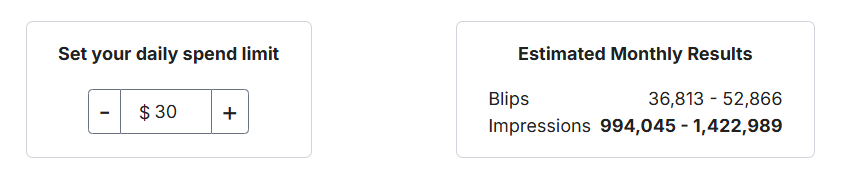
Blip makes billboard advertising in the Westphalia area flexible and budget-friendly. With pay-per-play pricing starting at just $0.01 per display, no contracts, and no minimums, it’s easy to start small, adjust anytime, and scale up as needed. Your total cost is simply the sum of the blips you receive.
Where can I advertise with Blip near Westphalia, Maryland?
We serve that market with 4 digital billboards in nearby Lanham and Brandywine, just 7.2 miles and 8.8 miles from Westphalia, so campaigns stay close to local decision-makers without needing inventory directly inside the community. The Lanham-side inventory is especially effective when we want reach from Beltway and I-95 traffic. The Brandywine-side inventory is especially useful for south-county and weekend-oriented movement.
What makes the Westphalia area a strong market for billboard ads with Blip?
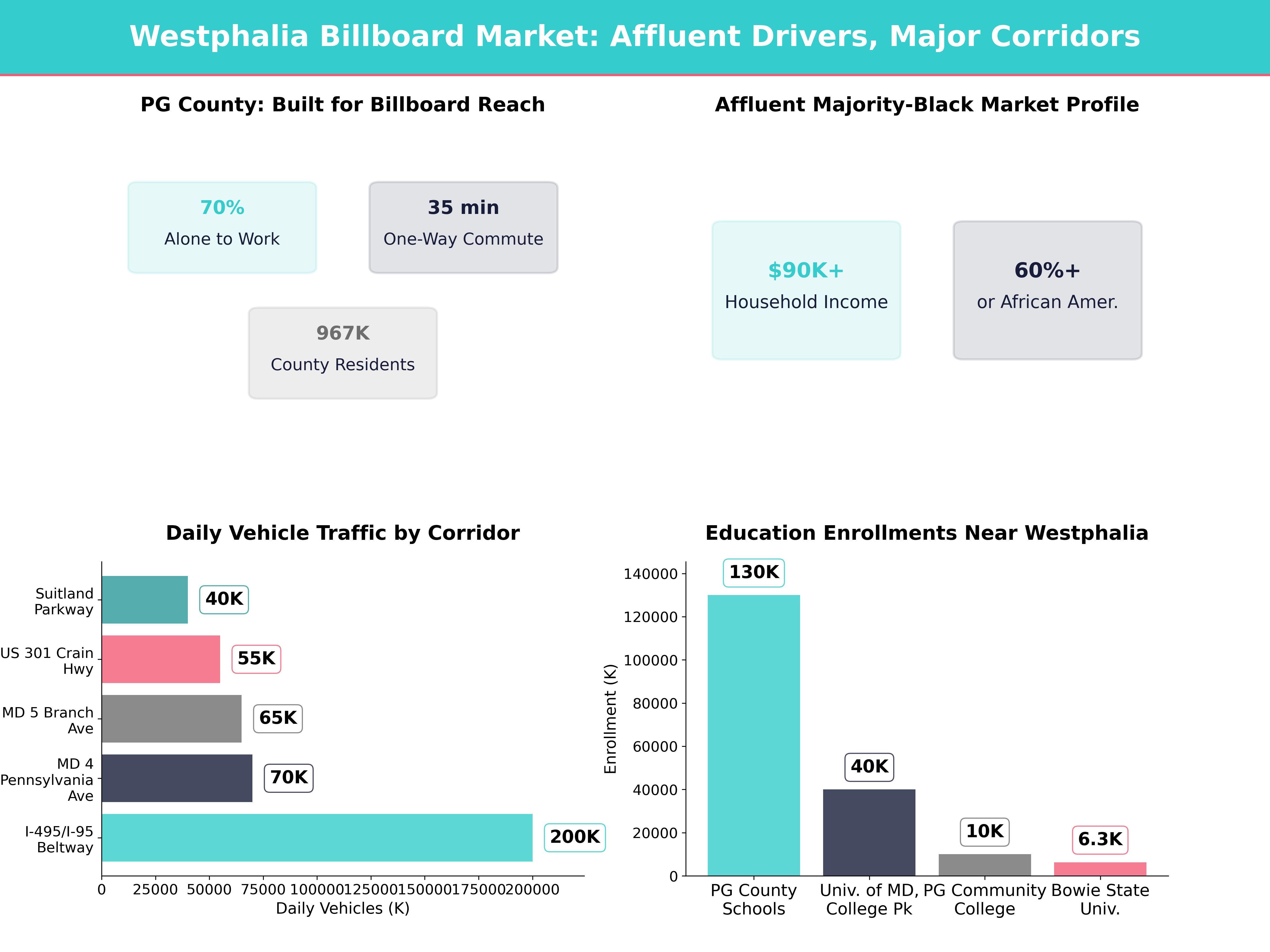
We like advertising near Westphalia because the market combines suburban household buying power, Washington-area commuting patterns, and steady regional travel across central and southern Prince George's County. Prince George's County is home to about 967,000 residents and a network of corridors that can carry 40,000 to 200,000+ vehicles per day depending on the road. Businesses serving the Westphalia area are competing for attention on the roads people already use for work, school, healthcare, shopping, and entertainment.
What roads around Westphalia get the most traffic for billboard advertising?
The strongest billboard strategy is usually built around the roads that connect the area to Washington, Largo, Upper Marlboro, Bowie, and southern Prince George's County. The I-495/I-95 Capital Beltway near Lanham carries more than 200,000 vehicles per day on some segments, and MD 4, Pennsylvania Avenue commonly runs in the 50,000 to 90,000 vehicles per day range. MD 5, Branch Avenue and US 301, Crain Highway also bring strong exposure for commuters, shoppers, and families moving through the county.
When is the best time to run a billboard campaign in Westphalia with Blip?
Timing matters near Westphalia because the audience changes shape throughout the year. August, September, and January are especially strong for school-related campaigns, while May and June are important for graduations, summer programs, and family purchases. November through February also make evening commutes especially important, when illuminated digital boards stand out earlier in the day.
Do I need a contract to advertise with Blip near Westphalia?
No, Blip has no long-term contracts or minimum commitments. You can start, pause, or stop your campaign at any time.
How fast can I launch a billboard campaign with Blip near Westphalia?
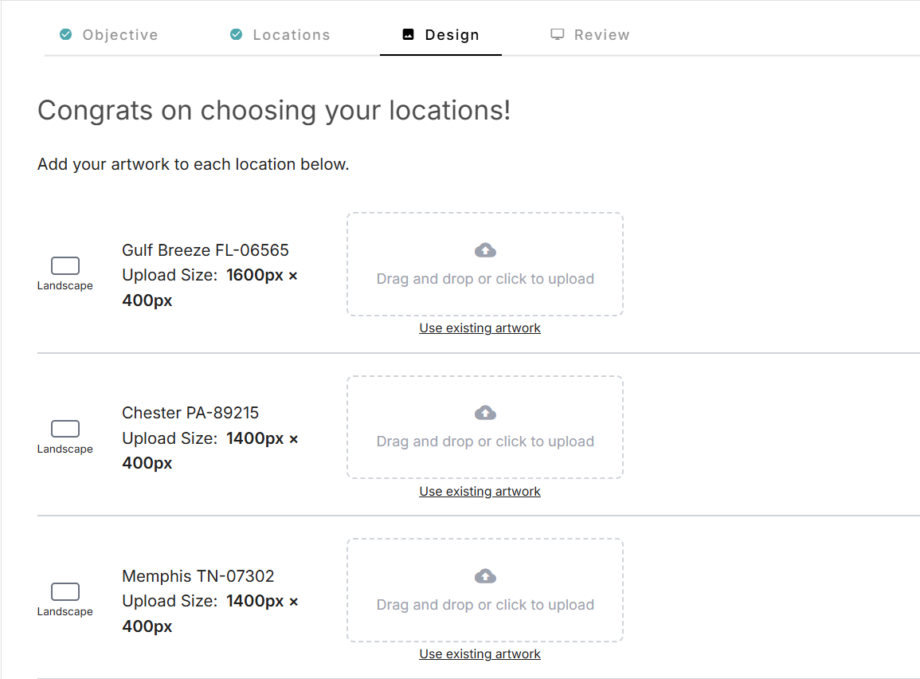
You can have your campaign live in minutes. Create a free account, select your locations, set your budget, upload your design, and start running once approved.
Where can I advertise with Blip near Westphalia?
Blip has digital billboards near Westphalia. You can browse available locations on a map, choose the ones that fit your audience, and start advertising right away.
Still have questions? Launch a campaign in minutes — no contracts, no commitments.
Start Your CampaignWestphalia Billboard Advertising Guide
We like advertising near Westphalia because the market combines suburban household buying power, Washington-area commuting patterns, and steady regional travel across central and southern Prince George's County 967,000 residents and a network of corridors that can carry 40,000 to 200,000+ vehicles per day depending on the road. Businesses serving the Westphalia area are competing for attention on the roads people already use for work, school, healthcare, shopping, and entertainment, not only at a single downtown storefront. We serve that market with 4 digital billboards in nearby Lanham and Brandywine, just 7.2 miles and 8.8 miles from Westphalia, so campaigns stay close to local decision-makers without needing inventory directly inside the community. That setup is especially strong for retail, restaurants, healthcare, education, home services, real estate, and event-driven brands that want repeated exposure near Westphalia.
Westphalia area market overview
Population, income, and trade area dynamics near Westphalia
The market near Westphalia works best when we think beyond the neighborhood boundary and focus on the surrounding trade area. Westphalia itself is a relatively small community with fewer than 10,000 residents, but it sits inside a county of about 967,000 people, which gives advertisers a much larger audience base than the place name alone suggests.
For campaigns serving the Westphalia area, we usually think in terms of nearby communities such as Upper Marlboro, Bowie, Largo, Forestville, Clinton, Suitland, District Heights
The economic profile is also attractive. Prince George's County median household income is above $90,000, which supports strong demand for healthcare, financial services, auto, home improvement, education, dining, and family entertainment. The county is also one of the country's best-known affluent majority-Black communities, and more than 6 in 10 residents identify as Black or African American. For advertisers, that means authentic representation is not optional; it is part of making creative feel local and credible.
The long-term development story also helps. The Prince George's County Planning Department has treated the Westphalia corridor as a strategic growth area for years, which makes the surrounding road network especially important for brands that want to establish recognition early.
Commuting patterns that shape the Westphalia area
The Westphalia area is a road-oriented market. While WMATA serves the county through the Blue, Green, Orange, and Silver Lines, or 4 Metrorail lines, most everyday errands and many work trips still begin and end in personal vehicles.
For commuting workers in Prince George's County, roughly 7 in 10 drive alone. Many others carpool, which keeps roadway visibility highly relevant for local advertising. Average one-way commute times are around 35 minutes, so the market gives us meaningful repeat exposure during morning and afternoon drive times.
That combination of higher-income households, dense regional travel, and long weekday exposure windows is why billboard campaigns near Westphalia can work for both broad awareness and more immediate response goals. If we need to reach people multiple times before they choose a restaurant, urgent care center, school, dealership, or event, the Westphalia area gives us the right travel behavior for it.
Westphalia area key traffic corridors
The highest-volume routes serving the Westphalia area
Maryland Department of Transportation and Maryland State Highway Administration traffic maps consistently show why the market near Westphalia is valuable. The strongest billboard strategy is usually built around the roads that connect the area to Washington, Largo, Upper Marlboro, Bowie, and southern Prince George's County.
Here are the corridors that matter most:
- The I-495/I-95 Capital Beltway near Lanham carries more than 200,000 vehicles per day on some segments, which makes it the biggest-reach option for weekday commuter campaigns serving the Westphalia area.
- MD 4, Pennsylvania Avenue commonly runs in the 50,000 to 90,000 vehicles per day range on busy Prince George's County segments, and it is one of the most important east-west spines for trips tied to Upper Marlboro, Forestville, Suitland, and the Westphalia area.
- MD 5, Branch Avenue often carries roughly 50,000 to 80,000 daily vehicles on key segments near Camp Springs and Clinton, which makes it valuable for south-county retail and service audiences.
- US 301, Crain Highway generally falls in the 40,000 to 70,000 vehicles per day range around Bowie, Upper Marlboro, and Brandywine, creating strong exposure for shoppers, commuters, and families moving through the county.
- Suitland Parkway adds another 40,000-plus daily vehicles on busy stretches connecting Prince George's County to Washington.
Those are the roads that feed the Westphalia market, even when the billboard face itself is in a nearby city.
How nearby Lanham and Brandywine billboards reach Westphalia-area drivers
Our billboards in nearby Lanham and Brandywine work because they line up with the travel patterns people near Westphalia already use.
The Lanham-side inventory is especially effective when we want reach from Beltway and I-95 traffic. That helps with campaigns targeting Washington-bound commuters, countywide professionals, healthcare users, students, and households traveling between north Prince George's County and the Westphalia area.
The Brandywine-side inventory is especially useful for south-county and weekend-oriented movement. It catches drivers using MD 5 and US 301 for shopping, dining, auto trips, family errands, and entertainment. That is helpful for brands serving the Westphalia area that depend on households making decisions after work or on weekends.
Local feeder roads also matter. Routes such as Westphalia Road, Marlboro Pike, and Woodyard Road may not carry Beltway-level volumes, but they channel neighborhood traffic toward the larger state highways managed by the Prince George's County Department of Public Works and Transportation
Westphalia area audience segments
Commuters, professionals, and service-oriented households near Westphalia
A large share of the audience near Westphalia is made up of working adults making repeated trips through Prince George's County corridors. These are ideal viewers for healthcare, financial services, legal services, insurance, restaurants, auto repair, home services, and professional education.
The University of Maryland Capital Region Medical Center 205-bed hospital in Largo, and it draws employees, patients, and visitors from across the county. That makes healthcare campaigns especially strong near Westphalia, including urgent care, primary care, dental, specialists, imaging, and wellness brands.
The county's business base is also broad enough to support B2B and recruiting campaigns. Organizations such as the Prince George's County Economic Development Corporation and the Prince George's Chamber of Commerce
Families, students, and education-focused audiences in the Westphalia area
The market near Westphalia is deeply family-oriented, which opens the door for schools, childcare, tutoring, youth sports, grocery, pediatric care, family dining, and household services.
Prince George's County Public Schools serves more than 130,000 students, which creates a huge recurring audience of parents, guardians, teachers, and school staff. Back-to-school, after-school, and family convenience messages all fit naturally here.
Higher education expands that audience even further. University of Maryland, College Park enrolls more than 40,000 students. Bowie State University enrolls about 6,300 students. Prince George's Community College serves more than 10,000 students in credit programs, plus many more workforce and continuing-education learners.
For advertisers serving the Westphalia area, those numbers matter because they create overlapping audiences of students, parents, staff, and recent graduates who move through county roads year-round. Education, apartments, banking, mobile plans, healthcare, restaurants, and entertainment all benefit from that concentration.
Entertainment, tourism, and event audiences that overlap the Westphalia area
We should not treat the market near Westphalia as purely residential. It also benefits from nearby entertainment and destination traffic.
A few notable examples stand out. National Harbor is a 350-acre waterfront destination. MGM National Harbor 308-room hotel. Six Flags America promotes 100-plus rides, shows, and attractions. The Show Place Arena 5,000-seat event venue in Upper Marlboro. The Washington Commanders schedule 8 or 9 regular-season home games each year, plus preseason dates and other stadium events near Landover.
Those audiences are not all traveling specifically to Westphalia, but their routes overlap the same Prince George's County roads that serve the Westphalia area. That creates opportunity for restaurants, retail, hotels, attractions, live events, and convenience-oriented brands that benefit from destination traffic.
Seasonal timing near Westphalia
School, sports, and consumer timing for the Westphalia area
Timing matters near Westphalia because the audience changes shape throughout the year.
Prince George's County Public Schools calendar usually runs from late August through mid-June. That makes August, September, and January especially strong for school-related campaigns, while May and June are important for graduations, summer programs, and family purchases.
College calendars create another rhythm. Campaigns tied to University of Maryland, College Park, Bowie State University, and Prince George's Community College usually perform best around semester starts, housing decisions, graduation season, and fall sports.
Sports and events bring additional surges. The Washington Commanders create 8 or 9 regular-season home dates in the fall, and the Prince George's County Fair 4 days around Labor Day weekend. Those dates are useful for food, retail, entertainment, parking, transportation, and hospitality-related messaging.
Tourism, weather, and retail moments near Westphalia
Tourism and leisure activity ramp up from spring into late fall. Experience Prince George's promotes county events year-round, but several stretches are especially valuable:
- April through June is strong for graduations, spring outings, weddings, and home services.
- June through August is strong for family entertainment, dining, travel, and attraction-driven campaigns connected to Six Flags America, National Harbor, and MGM National Harbor
- September through December is strong for football, fairs, fall festivals, and holiday retail.
- January through March is strong for healthcare, tax services, fitness, and resolution-driven offers.
Weather influences creative, too. Summer glare and winter darkness both reward simple, high-contrast design. Evening commutes become especially important from November through February, when illuminated digital boards stand out earlier in the day.
Billboard design tips for the Westphalia area
Build creative for speed, distance, and repeat viewing near Westphalia
The roads serving the Westphalia area are fast-moving, so the creative should do less, not more.
We usually recommend these practical rules:
- Keep the main message to 6 words or fewer when possible.
- Use 1 offer and 1 call to action.
- Show 1 website or 1 phone number, not both, unless the message is extremely short.
- Design for a 7.5- to 10-second digital billboard viewing window.
- Use bold contrast so the ad reads in bright summer light and dark winter afternoons.
A clean layout matters more here than a clever paragraph. Drivers near Westphalia are often making lane changes, navigating signals, or moving at highway speed. If the audience needs more than a glance to understand the ad, we should simplify it.
Make the message feel local to Prince George's County
Creative serving the Westphalia area should reflect who lives there and how they travel. Prince George's County is affluent, family-oriented, and majority Black, so visuals should feel current, inclusive, and recognizable to local households.
We often see stronger results when advertisers use:
- Authentic imagery of families, professionals, students, and healthcare users that resembles the county's real population.
- Local utility language such as “Near Largo,” “Off Route 301,” “Minutes from Branch Ave,” or “Easy Beltway access,” when those statements are accurate.
- Clear benefit-driven headlines tied to local behavior, such as convenience, same-day appointments, game-day offers, family savings, or quick detours.
Color choices can also be geography-specific. Deep blues, greens, gold, white, and black tend to read well against the wooded roadside environment common across Prince George's County. Loud color can still work, but we should use it intentionally for contrast rather than clutter.
For the Westphalia area, practical beats abstract. “Same-Day Care,” “Now Leasing,” “Game Day Specials,” or “Apply for Fall Classes” usually works better than a vague brand slogan with no local hook.
Regional strategies serving the Westphalia area
The northern approach from nearby Lanham
Lanham is just 7.2 miles from Westphalia, and that proximity makes it valuable for north-county and Beltway-oriented reach. We usually favor the Lanham-side boards when we want to intercept commuters, professionals, students, and travelers coming from I-495, I-95, College Park, New Carrollton
This approach is especially effective for:
- Healthcare and medical practices.
- Colleges, training programs, and recruiting.
- Financial, legal, and professional services.
- Countywide retail or restaurant brands.
- Major events that need broad weekday awareness.
For scheduling, we often prioritize 6 a.m. to 10 a.m. and 3 p.m. to 7 p.m. when the goal is work-trip visibility.
The southern approach from nearby Brandywine
Brandywine is 8.8 miles from Westphalia, and it is a strong choice for campaigns tied to shopping, family errands, dining, automotive, and weekend decision-making. The Brandywine-side boards connect well with MD 5 and US 301 traffic, which gives us reach into the south-county movement that also supports the Westphalia area.
This approach is especially effective for:
- Restaurants and quick-service brands.
- Retail promotions and seasonal sales.
- Home improvement and home services.
- Entertainment, attractions, and live events.
- Churches, schools, and family-oriented services.
For scheduling, we often see value in 11 a.m. to 8 p.m., plus stronger weight on Fridays, Saturdays, and Sundays when households are making discretionary trips.
Combining both sides for full-funnel coverage near Westphalia
Because we have 4 digital billboards serving the Westphalia area, we can also build layered campaigns instead of choosing only one direction.
A few examples show how that works:
- A healthcare brand can use Lanham for weekday commuter awareness and Brandywine for evening appointment reminders.
- A restaurant can use Lanham for lunch and after-work traffic, then emphasize Brandywine on weekends.
- A school or college can build broad awareness across all boards for 2 to 4 weeks, then tighten the schedule around deadlines or open houses.
- A live event can run countywide awareness first, then shift budget toward the route with the strongest last-minute traffic.
That flexibility matters because the Westphalia area is not a single-corridor market. It is a multi-directional suburban market, and the best strategy usually reflects that.
Blip tools for campaigns near Westphalia
When Blip optimization helps in the Westphalia area
For many advertisers serving the Westphalia area, the easiest place to start is a Blip-optimized campaign. If the goal is broad reach across nearby Lanham and Brandywine without micromanaging every board and time slot, optimization can distribute spend where the platform sees the best opportunity.
That is useful when we want to:
- Cover all 4 nearby digital billboards.
- Let the campaign adapt to different commute and retail windows.
- Learn which side of the Westphalia market responds best before we narrow in.
- Stretch budget efficiently with dynamic pricing.
Because pricing starts at $0.01 per display, we can test the market without committing to a traditional fixed block. Real-time analytics also make it easier to shift spend once we see what is happening.
When manual control makes more sense near Westphalia
Manual campaigns are better when we already know the audience behavior we want. If a brand only wants north-county commuters, only weekend retail traffic, or only school-hour visibility, manual selection gives us that control.
We often recommend manual setup when we want to:
- Focus only on the Lanham-side or Brandywine-side boards.
- Target specific dayparts such as 6 a.m. to 9 a.m., lunch, or evening drive.
- Rotate different creatives by time of day.
- Support a short-term local event, sale, enrollment window, or opening.
In both cases, the advantage is flexibility. We can start, stop, adjust, and test without the long contracts and slower back-and-forth that often come with traditional billboard buying.
Getting started with billboard rental near Westphalia
How to evaluate billboard locations serving the Westphalia area
When we rent a billboard near Westphalia, the first step is not choosing the prettiest board. The first step is matching the board to the trip pattern behind the purchase.
We usually start with four questions:
- Where does the customer begin the trip?
- Which road do they use before they decide?
- Is the goal awareness, store traffic, calls, leads, or event attendance?
- Does the message need a weekday commuter audience, a weekend family audience, or both?
If your customers are spread across the Beltway and north Prince George's County, the nearby Lanham boards are usually the right first look. If your customers skew toward southern retail movement and family trips, the nearby Brandywine boards may fit better. If the audience is broad, we should test both.
We also recommend matching the creative to the likely mindset on each corridor. Commuter traffic often responds better to utility, speed, trust, and appointment-based messages. Retail and family traffic often responds better to deals, convenience, fun, and immediate calls to visit.
What to expect from the rental process near Westphalia
Traditional billboard companies often rely on fixed proposals, limited flexibility, and longer reservation windows. Blip simplifies that process by letting us launch online, choose a manual or optimized campaign, upload creative, set a budget, and adjust whenever we need to.
A practical starting approach for the Westphalia area usually looks like this:
- We define one primary goal, such as awareness, foot traffic, or leads.
- We choose the nearby Lanham boards, the nearby Brandywine boards, or both.
- We start with a focused 2- to 4-week test so we can measure response.
- We review performance and shift timing, geography, or creative based on what the data shows.
As we evaluate results, we should pay attention to a few simple indicators. Did the campaign align with the right travel corridor? Did the message match the audience mindset? Did the schedule match actual decision times? Those questions matter more than raw impressions alone.
For advertisers serving the Westphalia area, billboard rental does not need to be complicated. With 4 nearby digital billboards, flexible scheduling, pay-per-play buying, and fast creative changes, we can build a campaign that fits local traffic patterns first, then scale it once we know which roads and time windows are doing the work.