Billboards in Cambridge, MD
No Minimum Spend. No Long-Term Contracts. Just Results.
Trusted by Leading Brands


Billboard advertising
in Cambridge has never been easier



How much is a billboard in Cambridge?
Why Choose Blip for Billboard Advertising in Cambridge
-
Blip lets Cambridge advertisers launch on U.S. 50 in minutes, with self-serve control and no contracts or minimums.
-
In Cambridge, Blip-optimized campaigns can auto-pick timing for commuter peaks, weekend Shore traffic, and race weekends.
-
Set flexible budgets in Cambridge and pay only when your ad plays, so you can start small and scale with demand.
-
Use Blip's real-time analytics in Cambridge to track results on downtown connectors and adjust fast as traffic shifts.
-
Create and test bold Cambridge creative with Blip, then tailor messages for visitors, healthcare workers, and local families.
Frequently Asked Questions About Billboard Advertising in Cambridge
How much does a billboard cost in Cambridge, Maryland with Blip?
With Blip, billboard advertising in Cambridge is more affordable than many people expect because you only pay when your ad actually appears. Each “blip” is a 7.5-to-10-second display on a rotating digital billboard, and pricing starts at just $0.01 per display. Costs can change based on time of day, location, and advertiser demand, but there are no minimums or contracts, so you can start small, adjust your budget anytime, or pause when needed.
Where can I advertise with Blip in Cambridge, Maryland?
Cambridge travel patterns are concentrated on a few highly important routes, which is exactly what we want in a billboard market. The busiest stretches of U.S. 50 carry roughly 25,000 to 35,000+ vehicles per day, making it the clear reach play in the market. Streets such as Maryland Avenue, Washington Street, and Race Street generally operate in the roughly 5,000 to 11,000 vehicles-per-day range, while MD 16 and MD 343 reach specialized waterfront and heritage traffic.
Why is Cambridge, Maryland a good market for billboard advertising with Blip?
Cambridge, Maryland gives us a billboard market that is modest in city size but outsized in real-world influence. The city has about 13,000 residents, yet it operates as the commercial center of Dorchester County, which has roughly 32,500 residents spread across a large, road-dependent Eastern Shore landscape. Because most daily trips happen by car and U.S. 50 channels commuters, tourists, and weekend visitors through town, our campaigns can build both reach and repetition.
When is the best time to run a billboard campaign in Cambridge, Maryland?
Cambridge rewards timing, and we can often do much better when we match our flights to the town’s seasonal rhythms. The clearest tourism window is summer, from June through August, and race weekends like IRONMAN Eagleman and IRONMAN Maryland create unusually concentrated demand. For event-driven businesses, we usually want to start 7 to 14 days before race weekend, stay live through the event, and then taper quickly.
What kind of people will see my Blip billboard in Cambridge, Maryland?
Cambridge succeeds as a billboard market because the audience is more layered than the city’s population suggests. We can reach local commuters, tourists and weekenders, families and school traffic, and science, healthcare, government, and maritime workers. This means the same geography can support campaigns for restaurants, healthcare, retail, lodging, recruitment, and community events.
Do I need a contract to advertise with Blip in Cambridge?
No, Blip has no long-term contracts or minimum commitments. You can start, pause, or stop your campaign at any time.
How fast can I launch a billboard campaign with Blip in Cambridge?
You can have your campaign live in minutes. Create a free account, select your locations, set your budget, upload your design, and start running once approved.
Where can I advertise with Blip in Cambridge?
Blip has digital billboards in Cambridge. You can browse available locations on a map, choose the ones that fit your audience, and start advertising right away.
Still have questions? Launch a campaign in minutes — no contracts, no commitments.
Start Your CampaignCambridge Billboard Advertising Guide
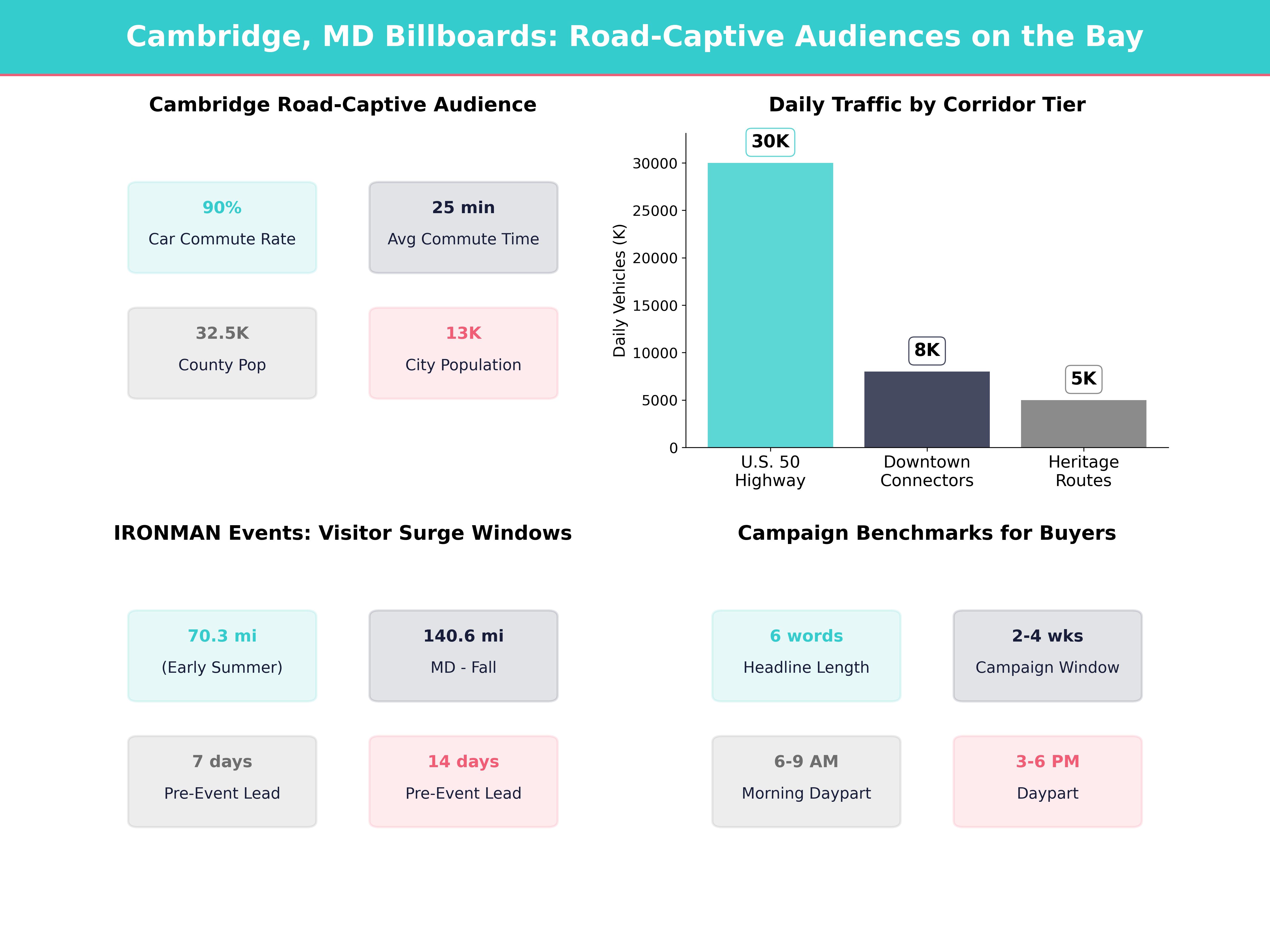
Cambridge, Maryland gives us a billboard market that is modest in city size but outsized in real-world influence. Cambridge 13,000 residents, yet it operates as the commercial center of Dorchester County, which has roughly 32,500 residents spread across a large, road-dependent Eastern Shore landscape. Because most daily trips happen by car—roughly 9 in 10 local workers commute by car, truck, or van—and because U.S. 50 channels commuters, tourists, and weekend visitors through town, our campaigns can build both reach and repetition. We also benefit from a mix of waterfront tourism, heritage travel, healthcare, environmental science, and local retail that keeps Cambridge active far beyond its population count.
Cambridge, Maryland Market Overview
When we advertise in Cambridge, we are not buying only city population. We are buying into a hub market that serves nearby rural communities, county government functions, waterfront visitors, and regional pass-through traffic. Planning profiles from the Maryland Department of Planning put Cambridge at roughly 13,000 residents (13,045 in the 2020 Census) and Dorchester County at roughly 32,500 residents (32,531 in the 2020 Census), which means the city captures a disproportionately large share of shopping, dining, medical, and service trips for the county.
Cambridge has also held up better than many small towns because it remains the county seat and a visible destination on the Shore. From 2010 to 2020, the city added roughly 720 residents, or about 6%, while county population was comparatively flat over the same 10-year period. That pattern matters for billboard planning because it suggests a stable regional base with a growing center of gravity inside Cambridge itself.
The geography amplifies outdoor advertising value. Dorchester County covers nearly 1,000 square miles when water is included, and Visit Dorchester highlights more than 1,700 miles of shoreline. In a place this spread out, trips are rarely short walks. They are drives between home, school, work, healthcare, marinas, stores, and attractions. State planning profiles also indicate that roughly 9 in 10 local workers commute by car, truck, or van, and average one-way commute time is about 25 minutes. For us, that means repeated exposure along a limited set of road corridors.
The local economy is diverse enough to support multiple billboard categories. University of Maryland Shore Regional Health, Dorchester County government, Dorchester Chamber of Commerce, Downtown Cambridge, the Hyatt Regency Chesapeake Bay Golf Resort, Spa and Marina University of Maryland Center for Environmental Science Horn Point Laboratory all contribute to year-round activity. Horn Point alone sits on an 800-acre campus, and the Hyatt adds a 400-room resort with an 18-hole golf course. That combination gives us a local audience, a visitor audience, and a professional audience in one market.
Key Traffic Corridors for Cambridge, Maryland Billboards
Cambridge travel patterns are concentrated on a few highly important routes, which is exactly what we want in a billboard market. Instead of chasing scattered traffic, we can focus on corridors that repeatedly capture residents, employees, and visitors.
U.S. 50, Ocean Gateway, and Sunburst Highway
Maryland Department of Transportation State Highway Administration traffic count maps consistently show that Cambridge’s busiest stretches of U.S. 50 carry roughly 25,000 to 35,000+ vehicles per day, with the Choptank River crossing and adjacent commercial segments often topping 30,000 AADT. That makes U.S. 50 the clear reach play in the market.
This corridor matters because it connects Cambridge with Annapolis Easton Salisbury, and Ocean City. It carries local errands on weekdays, beach and waterfront traffic on weekends, and year-round regional circulation across the Shore.
The best fits on U.S. 50 are straightforward.
- Restaurants, convenience stores, and fuel brands perform well here because many drivers are already in decision mode and can act within minutes.
- Hotels, attractions, and event promoters benefit because eastbound and westbound travelers often need a place to stop, stay, or explore.
- Healthcare providers, colleges, and major employers gain broad exposure because this route reaches both local residents and regional workers.
If our goal is pure impressions in Cambridge, U.S. 50 is usually the first corridor we evaluate.
Maryland Avenue, Washington Street, and Race Street
Once traffic leaves U.S. 50, it funnels into a smaller set of downtown and neighborhood connectors. On busier local segments, streets such as Maryland Avenue, Washington Street, and Race Street generally operate in the roughly 5,000 to 11,000 vehicles-per-day range, based on SHA count patterns. These are not beach-route numbers, but they are high-quality local-frequency numbers.
These streets are especially valuable when we want repeated visibility among residents who shop, work, attend appointments, or spend time in Downtown Cambridge. They also align better with slower driving environments, which gives our creative a longer read time than high-speed highway placements.
These connectors are especially strong for local categories.
- Healthcare, legal, and financial services benefit because these streets carry repeat local trips to appointments and county business.
- Retailers, restaurants, and events benefit because they can point people toward downtown, the waterfront, or same-day destinations.
- Home services and real estate benefit because local boards on these routes build trust through repetition rather than one-time pass-through exposure.
Heritage, waterfront, and destination routes south and west of Cambridge
The third layer of Cambridge strategy sits on lower-volume but highly intentional travel routes, including MD 16, MD 343, and the approach roads that feed waterfront communities and heritage attractions. Depending on the segment, these routes often run in the roughly 2,000 to 8,000 AADT range. That is smaller traffic, but it is specialized traffic.
This is where we reach boaters, anglers, outdoor travelers, second-home visitors, and heritage tourists exploring the Harriet Tubman Underground Railroad Scenic Byway 125 miles through Maryland’s Eastern Shore landscape. These roads are also useful for marinas, bait and tackle, lodging, dining, outdoor gear, farm and marine supply, and destination retail.
Lower-volume roads should not be treated as secondary by default. In Cambridge, they often reach audiences with stronger purchase intent than a general commuter corridor.
Audience Segments We Can Reach in Cambridge, Maryland
Cambridge succeeds as a billboard market because the audience is more layered than the city’s population suggests. We can build different campaigns for different motivations without leaving the same general geography.
Local commuters and routine errand traffic
The first audience is the everyday local market. Dorchester County’s road dependence means commuting, school drop-offs, medical appointments, shopping, and social visits all create repeat drive patterns. With roughly 9 in 10 workers commuting by car and an average travel time near 25 minutes, frequency becomes a major advantage. We can stay in front of the same residents several times per week without needing a huge market.
This audience works especially well for banks, insurance agencies, grocery, fast casual, healthcare, legal services, auto repair, telecom, home improvement, and civic campaigns. Cambridge’s role as the county seat also concentrates government-related trips that can support public notices, recruitment, and service awareness.
Tourists, weekenders, and Shore explorers
The second audience is the visitor market. Visit Dorchester promotes more than 1,700 miles of shoreline, strong paddling and fishing appeal, and a waterfront downtown that is very different from high-rise beach markets. We can use that distinction to our advantage. Cambridge draws travelers who want boating, heritage, nature, dining, and a slower Chesapeake experience.
Several anchors make this audience easier to target. The Hyatt Regency Chesapeake Bay 400 rooms and an 18-hole golf course to the local visitor economy. The Harriet Tubman Museum & Educational Center, Downtown Cambridge, and the 125-mile Harriet Tubman byway add cultural travel. For advertisers in hospitality, attractions, retail, food and beverage, and real estate, this segment is one of Cambridge’s biggest advantages.
Families, schools, and community life
The third audience is local families. Dorchester County Public Schools 4,500 students, which creates dependable travel rhythms for parents, grandparents, teachers, and school staff. Back-to-school, sports seasons, graduation periods, and family events all produce predictable advertising windows.
This audience is particularly important for pediatric care, tutoring, family dining, after-school programs, grocery, telecom, youth sports, dental care, and community events. In a smaller market like Cambridge, school-year timing often matters as much as raw traffic.
Science, healthcare, government, and maritime workers
The fourth audience is professional and industry-oriented. Horn Point Laboratory spans 800 acres and brings research, conservation, and environmental science into the market. University of Maryland Shore Regional Health brings healthcare employment and patient traffic. County government, education, agriculture, seafood, and marine industries round out a workforce that is highly local but not monolithic.
This segment supports recruitment, workforce training, B2B services, continuing education, banking, equipment sales, and healthcare outreach. Cambridge is one of those rare small markets where we can speak credibly to both watermen and research professionals.
Seasonal and Timing Opportunities in Cambridge, Maryland
Cambridge rewards timing. We can do well with always-on local campaigns, but we can often do much better when we match our flights to the town’s seasonal rhythms.
Summer in Cambridge, Maryland
The clearest tourism window is summer. From June through August, the area benefits from warm-weather waterfront traffic, weekend getaways, boating, golf, and hotel stays. On these boards, we usually emphasize dining, lodging, attractions, retail, real estate, and same-day activities.
Summer timing often works best when we lean harder into Thursday through Sunday and give extra weight to late-morning through early-evening hours. That schedule aligns better with visitor movement than an office-commute-only plan.
Race weekends and major event bursts
Cambridge’s endurance events create unusually concentrated demand for a market this size. IRONMAN 70.3 Eagleman brings a 70.3-mile race to Cambridge in early summer, and IRONMAN Maryland brings a full 140.6-mile race in the fall. Those weekends pull in athletes, support crews, spectators, and vendors, all of whom are highly mobile and highly attentive to lodging, restaurants, retail, healthcare, and logistics.
For event-driven businesses, we usually want to start 7 to 14 days before race weekend, stay live through the event, and then taper quickly. That window lets us influence both trip planning and on-the-ground spending.
Fall heritage and shoulder-season travel
Fall is an underrated Cambridge opportunity. The weather is more comfortable, the marsh and waterfront scenery are strong, and heritage travel remains active. This is a good period for byway-oriented campaigns, arts programming, local shopping, financial services, home improvement, and real estate. We are no longer competing with peak-summer clutter, but we are still reaching visitors and day-trippers.
School-year and winter timing
For local-service advertisers, the school calendar is almost as important as tourist season. The school year runs for roughly 10 months, creating predictable demand spikes in August, September, December, and May. We can use those moments for healthcare enrollment, family dining, tutoring, youth activities, home services, and retail.
Winter is quieter for tourism, but it can still be efficient for local frequency. Because days are shorter, we often see strong utility in late-afternoon and early-evening schedules, especially around 4 p.m. to 7 p.m. That is a practical fit for healthcare, tax preparation, gyms, churches, indoor attractions, and local retail.
Billboard Design Tips for the Cambridge, Maryland Market
Creative that works in Cambridge usually looks and sounds like Cambridge. We do better when we reflect Chesapeake identity, local pride, and the actual reasons people are driving here.
Use a Chesapeake visual language, not a generic beach look
Cambridge is a waterfront market, but it is not a boardwalk market. We should favor marsh greens, deep blues, sunrise oranges, workboat reds, and clean nautical neutrals over tropical palettes that feel more like an ocean resort. Images of docks, boats, crab dishes, paddles, heritage architecture, and open water feel authentic here. Neon beach clichés often miss the tone.
We should also think about seasonality in the artwork itself. In summer, strong contrast helps us cut through bright glare. In winter, richer colors and clean typography hold up better against gray skies and earlier darkness.
Write for two mindsets on the same roads
Cambridge traffic often falls into two mental modes. One driver is local and familiar with every turn. The other is passing through or exploring. That means our best copy is usually either hyper-local or highly directional.
For high-speed U.S. 50 placements, we usually keep the headline to 6 words or fewer and pair it with one clear takeaway, such as a category, an exit cue, or a short urgency prompt. For downtown-facing boards, we can be slightly more descriptive because traffic is slower and repeat exposure is stronger.
Let local identity do some of the persuasion
Cambridge has a powerful mix of maritime culture, Black history, environmental science, and small-town resilience. We should use that context respectfully. Heritage references connected to the Harriet Tubman Museum & Educational Center, waterfront imagery tied to Downtown Cambridge, and trust cues that feel local can all increase relevance.
Representation matters here as well. Our creative should reflect the multigenerational and racially diverse community that actually lives and works in Cambridge. When people see themselves and their landscape in the design, the billboard feels less like an interruption and more like a local message.
Regional Strategies Across Cambridge, Maryland
Cambridge works best when we stop thinking of it as one uniform market. Different parts of the area support very different advertising goals.
Downtown and waterfront Cambridge
Downtown is the frequency zone. We use it when we want residents to see us often and when we want to associate a brand with local culture, dining, events, or services. Campaigns for restaurants, boutiques, galleries, medical practices, attorneys, and community organizations usually fit well here.
If our message depends on familiarity and trust, downtown-facing inventory often matters more than the highest-traffic highway unit.
The U.S. 50 commercial corridor
The U.S. 50 corridor is the reach zone. We use it when we want to capture broad daily circulation, beach-route spillover, regional shoppers, and travelers making quick stop decisions. This is where quick-service dining, fuel, chains, healthcare systems, colleges, attractions, and event promotions often perform best.
This is also where eastbound and westbound messaging should be treated differently. Eastbound creative can lean into discovery, stops, and today’s plans. Westbound creative can lean into return trips, follow-up actions, appointments, and “next time you are in Cambridge” framing.
South Dorchester and heritage routes
The roads leading toward marshland, marinas, and Tubman-related travel are the intent zone. We use these boards for niche but valuable audiences, including boaters, outdoor enthusiasts, heritage tourists, and destination diners. They can also work for marine services, bait and tackle, lodging, second-home services, and rural home improvement.
Lower AADT does not mean lower value. In Cambridge, these routes often deliver a tighter fit between audience and offer.
Regional pull from the broader Shore
Cambridge does not operate in isolation. It competes and collaborates with nearby Eastern Shore destinations, including Easton Salisbury, and Ocean City. That means some campaigns should be framed as regional alternatives or add-on stops rather than purely local offers.
For example, a Cambridge restaurant, hotel, or attraction can position itself as a distinct Chesapeake experience for travelers already moving across the Shore. A healthcare provider or service business can position Cambridge as the convenient local option that reduces the need for longer regional trips.
Using Blip Tools in Cambridge, Maryland
Cambridge is a very good fit for flexible digital billboard planning because the market changes meaningfully by corridor, season, and daypart. We do not need a rigid one-size-fits-all approach.
Match campaign style to campaign goal
When we want tight control over specific corridors, a manual Blip campaign is useful. We can hand-pick U.S. 50 units for scale, downtown-facing units for local repetition, or a combination of both. When our goal is broader reach across the area without managing every location ourselves, a Blip-optimized campaign can do the heavy lifting and respond to inventory and timing changes.
Use dayparting to separate locals from visitors
Cambridge is one of those markets where timing changes audience meaningfully. We can lean into 6 a.m. to 9 a.m. and 3 p.m. to 6 p.m. for commuters, school traffic, and local routines. We can shift toward midday, evenings, and Thursday through Sunday for tourism and waterfront traffic. We can also increase weight in the 4 p.m. to 7 p.m. window during winter when darkness arrives earlier.
That kind of schedule control is especially helpful for restaurants, healthcare, local services, events, and weekend tourism.
Test creative by audience, not only by design preference
Because Cambridge has both local and visitor audiences, we often learn more by testing message angle than by testing colors alone. One version can speak to residents with trust and convenience language. Another can speak to visitors with discovery and destination language. Blip’s artwork tools and real-time reporting make that kind of fast local iteration realistic, even for smaller budgets.
Getting Started with Billboard Rental in Cambridge, Maryland
Renting a billboard in Cambridge is easiest when we begin with a very clear objective. In this market, location fit matters more than sheer quantity.
Start with one primary goal
Before we launch, we should decide which of these goals matters most.
- We can prioritize broad reach by focusing on U.S. 50.
- We can prioritize local frequency by adding downtown and neighborhood connectors.
- We can prioritize visitor intent by leaning into waterfront and heritage routes.
Trying to do all three at once is possible, but it usually works better after we have early performance data.
Evaluate each board by trip purpose
In Cambridge, a good board is not just the one with the biggest traffic number. It is the one that matches the audience’s reason for being on that road. We should ask whether the viewer is commuting, shopping, exploring, heading to the waterfront, or simply passing through. That question tells us whether we need brand repetition, immediate action, or directional clarity.
A practical Cambridge starting plan often includes one higher-reach U.S. 50 board and one more local board near downtown or a major connector. That gives us both scale and repetition without overcomplicating the launch.
Launch small, learn quickly, and refine
This is where Blip is especially useful compared with traditional billboard buying. We do not need to commit to a long fixed contract before we understand what works in Cambridge. We can start with a focused 2- to 4-week test, review performance by location and timing, refresh creative, and then increase budget around the corridors and dayparts that prove themselves.
For event or tourism campaigns, we can build short bursts around key weekends. For local services, we can maintain a lighter always-on presence and add budget during back-to-school, race weekends, holiday shopping, or spring demand. That flexibility is a real advantage in a market like Cambridge, where the best strategy can change from one season to the next.
If we stay disciplined about goal setting, corridor choice, and timing, Cambridge gives us an efficient way to reach residents, travelers, and high-intent destination traffic in one Eastern Shore market.