Billboards near White Oak, MD
No Minimum Spend. No Long-Term Contracts. Just Results.
Trusted by Leading Brands


Billboard advertising
near White Oak has never been easier




How much is a billboard near White Oak?
Why Choose Blip for Billboard Advertising near White Oak
Blip lets White Oak brands launch self-serve on Route 29 and New Hampshire Ave in minutes—no sales calls, just simple control.
Use Blip-optimized buys to reach White Oak commuters from US 29, I-95, and the ICC when traffic is strongest.
No contracts or minimums means White Oak advertisers can test budget on College Park, Laurel, or Olney and scale fast.
Daypart White Oak campaigns for 6-9 a.m. or 3-7 p.m. to catch FDA, medical, and suburban commuter traffic.
Track White Oak results in real time and shift spend as back-to-school, hospital, and holiday traffic patterns change.
Blip's creative tools help White Oak ads stand out on fast roads with clear, bold messages built for quick reads.
Frequently Asked Questions About Billboard Advertising near White Oak
How much does a billboard cost in White Oak with Blip?
Blip’s pay-per-play model starts at $0.01 per display, and each blip runs for about 7.5 to 10 seconds. Pricing is dynamic, so the cost per blip can vary by time of day, location, and advertiser demand. Your total cost is simply the sum of the blips your ad receives over time, and there are no minimums or contracts.
Where can I advertise near White Oak with Blip?
Blip has 6 digital billboards in nearby College Park, Laurel, and Olney, and they are all within 10.0 miles of the White Oak area. College Park is just 4.6 miles away, Laurel is 7.5 miles away, and Olney is 8.7 miles away. That gives campaigns practical access to the White Oak market from multiple directions.
Why is White Oak, Maryland a good place for billboard advertising?
Advertising near White Oak works because the community sits at the crossroads of eastern Montgomery County, northern Prince George’s County, and the commuter routes that connect them to the rest of the Washington suburbs. The area combines research and healthcare employment, university influence, family-heavy neighborhoods, and everyday retail traffic. Campaigns serving White Oak can reach people during repeated, real-world trips instead of relying on a single destination.
What kind of traffic corridors reach White Oak, Maryland?
Nearby segments of US 29 in the White Oak area regularly carry 90,000+ vehicles per day, and nearby segments of MD 650, or New Hampshire Avenue, carry 40,000+ vehicles per day. The Capital Beltway, I-95 near Laurel, and the Intercounty Connector also extend White Oak’s reach with major regional traffic. These roads support frequent message repetition and broad awareness across the market.
How long should I run a Blip campaign in White Oak to test it?
For many advertisers, the page recommends launching a 2-week test first. That gives enough time to observe weekday and weekend patterns, compare nearby city clusters, and evaluate which messages fit the White Oak audience best. Because digital buying is flexible, you can begin with a modest daily budget and expand what performs best.
Do I need a contract to advertise with Blip near White Oak?
No, Blip has no long-term contracts or minimum commitments. You can start, pause, or stop your campaign at any time.
How fast can I launch a billboard campaign with Blip near White Oak?
You can have your campaign live in minutes. Create a free account, select your locations, set your budget, upload your design, and start running once approved.
Where can I advertise with Blip near White Oak?
Blip has digital billboards near White Oak. You can browse available locations on a map, choose the ones that fit your audience, and start advertising right away.
Still have questions? Launch a campaign in minutes — no contracts, no commitments.
Start Your CampaignWhite Oak Billboard Advertising Guide
Advertising near White Oak works because the community sits at the crossroads of eastern Montgomery County, northern Prince George’s County 2.36 million residents across Montgomery, Prince George’s, and Howard counties. Our 6 digital billboards in nearby College Park, Laurel Olney are all within 10.0 miles of the White Oak area, which gives us practical access to this market from multiple directions. That matters because the White Oak area combines research and healthcare employment, university influence, family-heavy neighborhoods, and everyday retail traffic. When we build campaigns serving the White Oak area, we can reach people during repeated, real-world trips instead of relying on a single destination.
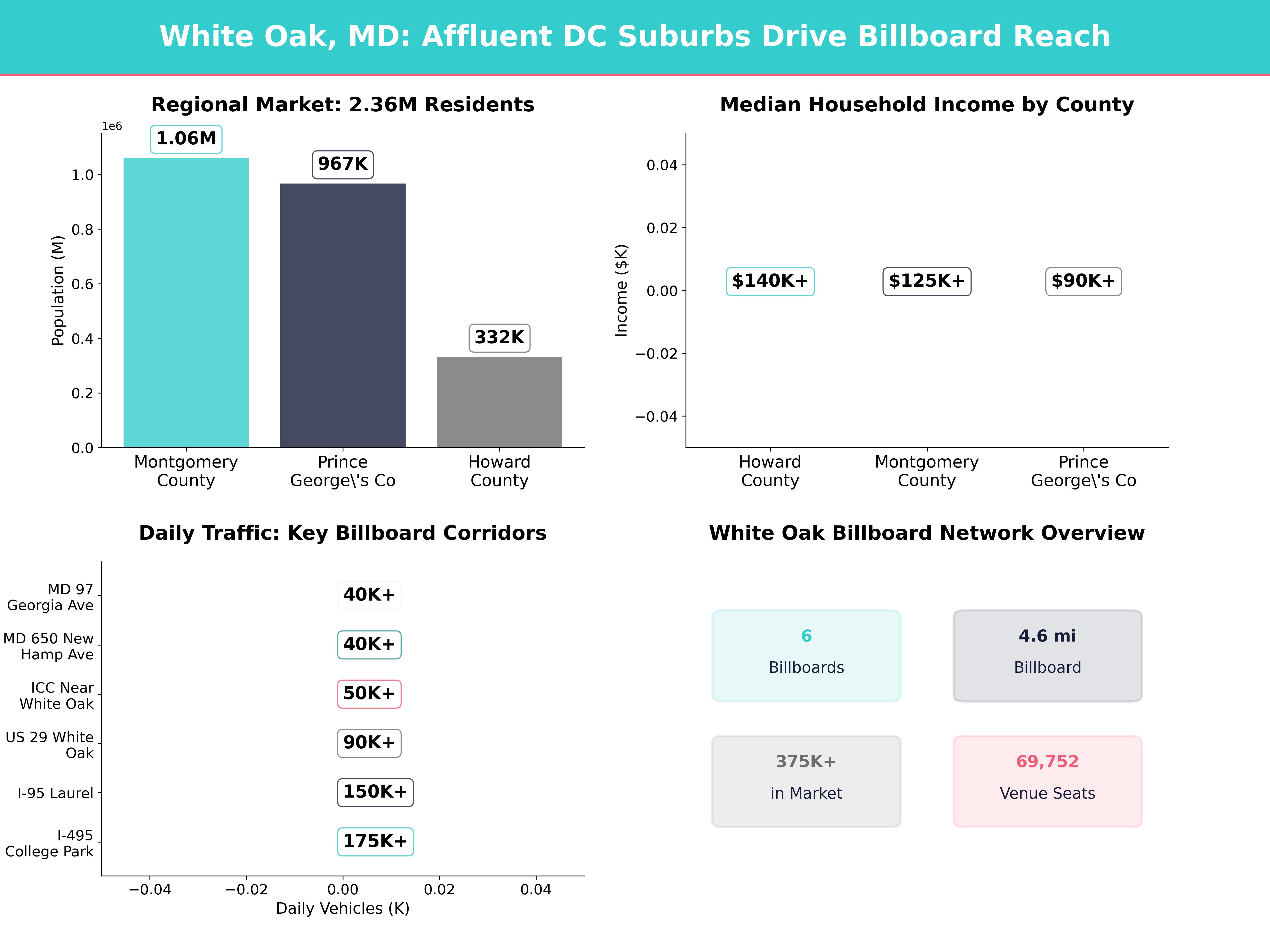
White Oak area market overview
The White Oak area sits inside a very large suburban trade area
The White Oak area is part of eastern Montgomery County, and that matters because Montgomery County is Maryland’s most populous county with 1,062,061 residents. Just to the east and southeast, Prince George’s County 967,201 residents, and to the north, Howard County adds 332,317 more. Taken together, those 3 counties account for 2,361,579 residents, which is a very large regional audience for brands serving the White Oak area.
We should think about White Oak as a corridor market, not a stand-alone neighborhood buy. The area is tied closely to Silver Spring, College Park, Laurel 40,000+ to 175,000+ vehicles per day. That means campaigns near White Oak can pull from several household types at once, including professionals, students, healthcare consumers, and families.
Recent estimates also show strong spending power around this market. Median household income is above $125,000 in Montgomery County, above $140,000 in Howard County, and above $90,000 in Prince George’s County. For advertisers, that supports categories like healthcare, higher education, legal services, home improvement, automotive, dining, and premium retail.
Commuting and employment patterns support roadside advertising near White Oak
The White Oak area is especially useful for billboard advertising because driving remains central to daily life. Recent survey data show that roughly 3 out of 4 workers in Montgomery County and Prince George’s County commute by car, truck, or van, and more than 4 out of 5 workers in Howard County do the same. Even with strong transit options from WMATA, Ride On, and MTA Maryland, the dominant audience near White Oak is still on the road.
The White Oak area also benefits from durable employment anchors. Montgomery Planning Adventist HealthCare White Oak Medical Center 2019 with 180 private patient rooms, which adds healthcare workers, patients, and visiting family traffic to the market.
On the broader economic side, Montgomery County Economic Development Corporation highlights a local life sciences cluster of 500+ companies. That life sciences footprint fits the White Oak area especially well, because the surrounding audience includes researchers, healthcare professionals, office workers, and service providers. When we advertise near White Oak, we are not only reaching residents. We are also reaching a large daytime workforce that moves between campuses, offices, hospitals, and retail centers.
White Oak area traffic corridors
Route 29 and New Hampshire Avenue are the core White Oak corridors
If we want to understand billboard performance serving the White Oak area, we start with Route 29 and New Hampshire Avenue. According to Maryland State Highway Administration traffic maps, nearby segments of US 29 in the White Oak area regularly carry 90,000+ vehicles per day. Nearby segments of MD 650, or New Hampshire Avenue, carry 40,000+ vehicles per day.
Those are exactly the kinds of corridors that support frequent message repetition. Route 29 links the White Oak area with Silver Spring, Burtonsville, and points farther north, while New Hampshire Avenue connects dense residential pockets with major employment and shopping areas. For local services, healthcare, schools, restaurants, and political or public-awareness campaigns, these roads deliver a steady, practical audience that sees the same routes repeatedly.
The Beltway, I-95, and the ICC extend White Oak’s reach
The White Oak area is also fed by the region’s biggest traffic infrastructure. The Capital Beltway is a 64-mile loop, and nearby segments by College Park often carry 175,000+ vehicles per day. I-95 near Laurel commonly carries 150,000+ vehicles per day on major segments. The Intercounty Connector is an 18-mile toll road, and central segments near White Oak-area access points carry 50,000+ vehicles per day.
These roads matter even when our advertiser’s destination is not directly on the highway. The White Oak area pulls commuters from northern Prince George’s County, eastern Montgomery County, and parts of Howard County. Our nearby billboard inventory in College Park and Laurel is well positioned for those longer regional trips, especially when we want broad awareness rather than hyperlocal stop-and-shop traffic.
Olney and northern feeder routes help us cover suburban household traffic
Our White Oak area strategy should also account for northern suburban flow. In nearby Olney, Georgia Avenue or MD 97 carries 40,000+ vehicles per day on major segments. That traffic helps us reach households moving south toward the White Oak area for work, healthcare, schools, and shopping, or moving north again in the afternoon.
This is one reason the Olney inventory is useful even though it is not the closest cluster. The White Oak area does not depend on one downtown core. It depends on repeated suburban circulation across multiple feeder routes, and the Olney boards give us a way to capture those north-south trips with strong family and homeowner relevance.
Audience segments near White Oak
Commuters and professionals are the foundation of the White Oak audience
The first audience we usually plan for near White Oak is the commuter-professional base. Weekday traffic is shaped by the FDA campus, Adventist HealthCare White Oak Medical Center Montgomery County and Prince George’s County 3 in 4 workers in both Montgomery and Prince George’s counties commute by car, roadside visibility remains especially strong for employers, colleges, medical groups, insurers, banks, and service businesses.
This audience responds well to useful, low-friction messages. We generally see the best fit with hiring campaigns, healthcare appointments, legal services, home services, financial products, and retail offers built around convenience. In the White Oak area, “close by,” “easy access,” and “on your route” are not just creative ideas. They reflect how people actually move through the market.
Students, faculty, and event crowds expand the reachable market
The White Oak area is not a pure commuter suburb. Nearby University of Maryland, College Park adds a major education audience with 40,000+ students, plus faculty, staff, visiting families, and sports fans. College Park also benefits from WMATA Metrorail service, MARC Train access, and year-round campus activity, which gives our nearby College Park billboards extra flexibility.
Event traffic matters too. Maryland Athletics brings surges around 51,802-seat SECU Stadium and the 17,950-seat Xfinity Center, for a combined 69,752 seats. For entertainment, food and beverage, telecom, apparel, rideshare, apartment leasing, and student services, those peaks can be highly productive for campaigns serving the White Oak area.
We should also remember that Montgomery College serves about 45,000 students each year across credit and workforce programs. That adds another education and career-development audience to the broader White Oak market, especially for continuing education, trade programs, healthcare recruiting, and local services.
Families, healthcare consumers, and weekend shoppers are a major White Oak segment
The White Oak area is surrounded by established neighborhoods, schools, parks, and family destinations. Montgomery County Public Schools serves 160,000+ students, and Prince George’s County Public Schools serves 130,000+ students, for more than 290,000 K-12 students across the two districts. Those enrollment figures help explain why family-focused categories perform well near White Oak, especially pediatric care, tutoring, after-school programs, grocery, restaurants, orthodontics, and home services.
Healthcare is another strong segment. A 180-room medical center near the White Oak area creates daily need for urgent care, specialists, pharmacies, imaging, physical therapy, counseling, and senior services. Weekend and afternoon traffic also picks up around shopping and recreation patterns tied to places like Brookside Gardens 50-acre public garden, National Capital Trolley Museum, Laurel Park, and the dining clusters promoted by Visit Montgomery Experience Prince George’s.
Seasonal opportunities for the White Oak area
Back-to-school is one of the strongest White Oak campaign windows
Late summer and early fall are especially effective near White Oak. Montgomery County Public Schools, Prince George’s County Public Schools, Montgomery College, and the University of Maryland, College Park all create back-to-school demand for healthcare, tutoring, apartments, storage, internet, restaurants, retail, and recruiting, for a combined audience of more than 375,000 students.
We usually like to start these flights before the first week of classes. Messaging in late July, August, and early September can catch move-ins, parent trips, school shopping, and new commuting routines. January is another good education window because spring-semester activity brings a smaller but still valuable reset in travel patterns.
Fall sports, fairs, and holiday shopping add reach near White Oak
The fall calendar gives us several ways to build frequency serving the White Oak area. University of Maryland football and basketball create recurring waves of event traffic in College Park, and holiday retail lifts commercial corridors throughout eastern Montgomery County and northern Prince George’s County. Countywide awareness campaigns can also benefit from the Montgomery County Agricultural Fair, which runs for 9 days and draws 200,000+ visitors annually.
We do not need every event to happen right next to White Oak for it to matter. The White Oak area sits inside a regional driving pattern, so county fairs, stadium events, seasonal dining, and holiday shopping all increase total trips on the roads that serve this market.
Spring and summer are strong for services, healthcare, and family entertainment
Spring tends to be productive for home services, landscaping, real estate, tax services, camps, and graduation-related offers. The White Oak area also benefits from seasonal leisure traffic to Brookside Gardens Olney Theatre Center, Downtown Silver Spring, and other regional attractions promoted by Visit Montgomery
Summer is especially useful when we want to reach families during more flexible schedules. Weekend and midday targeting can work well for camps, attractions, family dining, urgent care, cooling services, and retail promotions. In a market near White Oak, summer is not only about tourism. It is also about local households making more discretionary trips.
Billboard design tips for the White Oak market
We should design for fast roads and practical decision-making
The White Oak area is a driving market, so our creative needs to work at speed. On corridors like US 29, I-95, I-495, and MD 97, we usually recommend 1 core message, 1 clear call to action, and about 6 to 8 words of primary copy. If a viewer only has a few seconds, the ad should still communicate the brand, the offer, and the next step.
High contrast is especially important here. The roads serving the White Oak area include tree-lined stretches, variable weather, and a lot of visual clutter from retail signs and traffic infrastructure. Bold combinations like dark blue and white, black and yellow, or red and white tend to read better than subtle palettes.
Local references work well near White Oak
Creative tends to perform better when it sounds grounded in the actual market. We often recommend using directional language such as “Off Route 29,” “Near the ICC,” “Easy from Laurel,” or “Minutes from College Park,” as long as those claims are true. In the White Oak area, that kind of route-based relevance usually beats generic brand copy.
We also like creative that matches the area’s mix of professional and family life. Messages about same-day care, evening appointments, weekend availability, hiring, campus access, or free consultations often fit the White Oak audience better than abstract slogans. This is a practical market, so direct benefits usually win.
We should tailor the creative to each nearby city cluster
The best White Oak campaigns often use different creative angles by location. Near College Park, we may emphasize students, events, dining, or recruiting. Near Laurel Olney, we usually focus more on households, healthcare, education, and home services.
That does not mean we need entirely different brands or offers. It means we should adapt the tone. The same advertiser can keep one visual identity while changing the headline to better match the audience each corridor is most likely to deliver.
Regional strategies serving the White Oak area
College Park is our closest university-and-Beltway play for White Oak
Our College Park billboards are just 4.6 miles from the White Oak area, and they are especially useful when we want access to university energy, Beltway traffic, and young adult consumers. This cluster is a strong fit for restaurants, entertainment, wireless, apartment leasing, urgent care, staffing, higher education, and event-driven campaigns.
We typically like College Park for campaigns that benefit from stronger evening and weekend activity, or from the mix of students and professionals moving around campus and the Beltway. It is also an excellent complement to a White Oak-area healthcare or recruiting campaign because it adds scale beyond one employment node.
Laurel gives us I-95 access and broad commuter reach for White Oak
Our Laurel billboards are 7.5 miles from the White Oak area, and this cluster is valuable when we want to reach drivers moving between Montgomery County, Prince George’s County, and points north. Laurel captures the White Oak market through I-95, Route 198, and the wider residential-commercial blend around the City of Laurel
We usually recommend Laurel for home services, healthcare, retail, automotive, staffing, logistics, and regional awareness campaigns. The I-95 audience is less tied to one school or neighborhood and more useful for advertisers that need broad coverage of daily drivers.
Olney helps us reach northern households that use White Oak regularly
Our Olney billboards are 8.7 miles from the White Oak area, and they are well suited to suburban household campaigns. This cluster helps us reach families and homeowners traveling south on Georgia Avenue or using the ICC to connect with the White Oak area. For dentists, pediatric groups, home remodeling, HVAC, grocery, tutoring, and community events, Olney can be a very efficient extension of White Oak coverage.
We often like Olney when the advertiser wants to reach people who may not be downtown-oriented but still make repeated trips for healthcare, work, school, or shopping. That pattern is common in the White Oak market.
A multi-board strategy often works best for White Oak
Because we have 6 digital billboards serving the White Oak area, we do not have to treat this as a one-location decision. We can run a tighter cluster in 1 nearby city, or we can spread the budget across College Park, Laurel, and Olney to build stronger regional frequency.
A smart White Oak strategy often uses 2 to 3 route clusters at once. For example, we may use College Park for student and Beltway reach, Laurel for I-95 commuters, and Olney for household reinforcement. That kind of layered approach reflects how the White Oak area actually draws customers.
Blip tools for White Oak area campaigns
Optimization helps us cover White Oak efficiently
When we want broad area coverage near White Oak, a Blip-optimized campaign is often the easiest place to start. We can set our goals, audience targets, and budget, and then let the platform distribute spend across the White Oak-serving inventory based on opportunity and timing. That is especially helpful when traffic patterns shift by weekday, event calendar, or season.
This approach is useful for campaigns that care more about total reach across the market than about one exact board. It can be a strong fit for healthcare systems, regional retail, education, public awareness, and recruiting campaigns.
Manual control helps when route selection matters
If our strategy depends on specific travel patterns, we can also run a manual campaign. That lets us choose billboard locations on a map, select dayparts, and align messages with the White Oak corridors we care about most. For example, we may focus on 6 a.m. to 9 a.m. and 3 p.m. to 7 p.m. for commuters, or on 10 a.m. to 6 p.m. weekends for family and shopping traffic.
Manual control is especially helpful when we want different messages by nearby city. We may run one creative in College Park, another in Laurel, and a third in Olney while still keeping the campaign centered on the White Oak market.
Flexible buying and measurement make White Oak testing easier
Blip’s pay-per-play model starts at $0.01 per display, and each blip runs for about 7.5 to 10 seconds. That flexibility matters near White Oak because we can test multiple routes, dayparts, and creative angles without locking ourselves into a rigid long-term buy.
Real-time analytics also help us adjust quickly. If one cluster is clearly outperforming for the White Oak audience we want, we can shift budget, pause a weak time window, or refresh the message. In a corridor-based market like White Oak, that kind of agility is a real advantage.
Getting started with billboard rental near White Oak
We should begin with the business goal, not the board list
The right billboard rental strategy near White Oak depends on what we want the campaign to do. Awareness, store traffic, hiring, event attendance, healthcare appointments, and student outreach all need slightly different route choices and timing. Before we launch, we should define whether the goal is broad visibility across the White Oak area or repeated exposure on one corridor.
That first decision usually points us toward College Park, Laurel, Olney, or a blend of all three. If the campaign needs university and Beltway energy, we usually start with College Park. If it needs commuter scale, we often start with Laurel. If it needs household and family reach, Olney is often the right first test.
We should evaluate each White Oak-serving location like a local media buyer
When we compare billboards serving the White Oak area, we usually ask a short set of practical questions. Those questions help us match the location to the objective instead of buying inventory just because it is nearby.
- Does the board reach the audience on the way to or from the White Oak area?
- Does the surrounding route support commuter traffic, household traffic, or event traffic?
- Is the message best seen in a high-speed environment or a slower retail corridor?
- Do we need one nearby city, or do we need 2 to 3 clusters for better market coverage?
- Can we tailor the creative to the likely viewer mindset on that route?
A short test campaign is usually the smartest way to start near White Oak
For many advertisers, we recommend launching a 2-week test first. That gives us enough time to observe weekday and weekend patterns, compare nearby city clusters, and evaluate which messages fit the White Oak audience best. We can start with one strong creative concept, or test 2 variations if the offer and branding are already clear.
Because digital buying is flexible, we do not need to overcommit. We can begin with a modest daily budget, watch the data, and expand the boards or dayparts that perform best.
Blip simplifies billboard rental near White Oak
Traditional billboard buying often involves longer commitments, slower revisions, and back-and-forth sales conversations before a campaign ever goes live. Blip simplifies that process for campaigns serving the White Oak area by letting us launch online, manage budgets ourselves, update creative quickly, and change the plan whenever the market changes.
That simplicity is a strong fit for White Oak because this is a market with overlapping commuter routes, several audience types, and clear seasonal swings. We can start small, learn fast, and scale into the locations that truly fit our goals. When we approach billboard rental near White Oak that way, the nearby inventory in College Park, Laurel, and Olney becomes a flexible regional toolkit rather than a one-shot media buy.