Billboards near Seabrook, MD
No Minimum Spend. No Long-Term Contracts. Just Results.
Trusted by Leading Brands


Billboard advertising
near Seabrook has never been easier




How much is a billboard near Seabrook?
Why Choose Blip for Billboard Advertising near Seabrook
Blip's self-serve platform lets Seabrook advertisers launch fast on nearby Lanham, College Park, or Laurel routes without long sales cycles.
Let Blip auto-pick boards and timing for Seabrook goals, tapping I-495, US 50, and I-95 commuter flow without manual setup.
No contracts or minimums make Seabrook campaigns easy to start, pause, or scale as Beltway and university traffic shifts.
Use Blip's real-time analytics to see what works in Seabrook, then adjust around 6-10 a.m. and 3-7 p.m. rushes.
Blip's creative tools help Seabrook brands make bold 7.5-second ads that stand out for UMD students, families, and commuters.
Frequently Asked Questions About Billboard Advertising near Seabrook
How much does a billboard cost in Seabrook, Maryland with Blip?
Blip makes billboard advertising in the Seabrook area flexible and budget-friendly because you only pay when your ad actually displays. Pricing starts at just $0.01 per display. Your daily budget powers Blip’s algorithm, which bids on open ad slots to help maximize your reach, with costs that vary by time of day, location, and demand.
Where can I advertise with Blip near Seabrook, Maryland?
Our 7 digital billboards in nearby Lanham, College Park, and Laurel are all within 10.0 miles of Seabrook, which lets us reach drivers serving the Seabrook area without needing boards inside the community itself. We can cover the market with boards in Lanham at 3.0 miles, College Park at 4.3 miles, and Laurel at 7.4 miles from Seabrook. That 3.0-to-7.4-mile range is close enough to feel local, while still broad enough to capture multiple trip types.
Why is the Seabrook, Maryland area a strong place for billboard advertising with Blip?
The Seabrook area is a strong billboard market because it sits at the meeting point of Prince George’s County commuter routes, university travel patterns, and everyday suburban retail traffic from a county of about 967,000 residents. This market combines Beltway commuters, University of Maryland students and fans, and family households moving between school, work, and errands. For advertisers that need flexible local reach, the road network near Seabrook creates frequent, repeat exposure throughout the week.
What kinds of drivers and audiences does Blip reach in Seabrook, Maryland?
Commuters are the core billboard audience serving the Seabrook area. With roughly 80% of county workers commuting by car and average travel times near 36 minutes, people spend enough time on the road for billboard messages to register across repeated trips. The nearby University of Maryland adds more than 40,000 students, and Prince George’s County Public Schools serves more than 130,000 students, which points to a large parent-and-family audience across the county.
What roads around Seabrook, Maryland get the most billboard traffic for Blip campaigns?
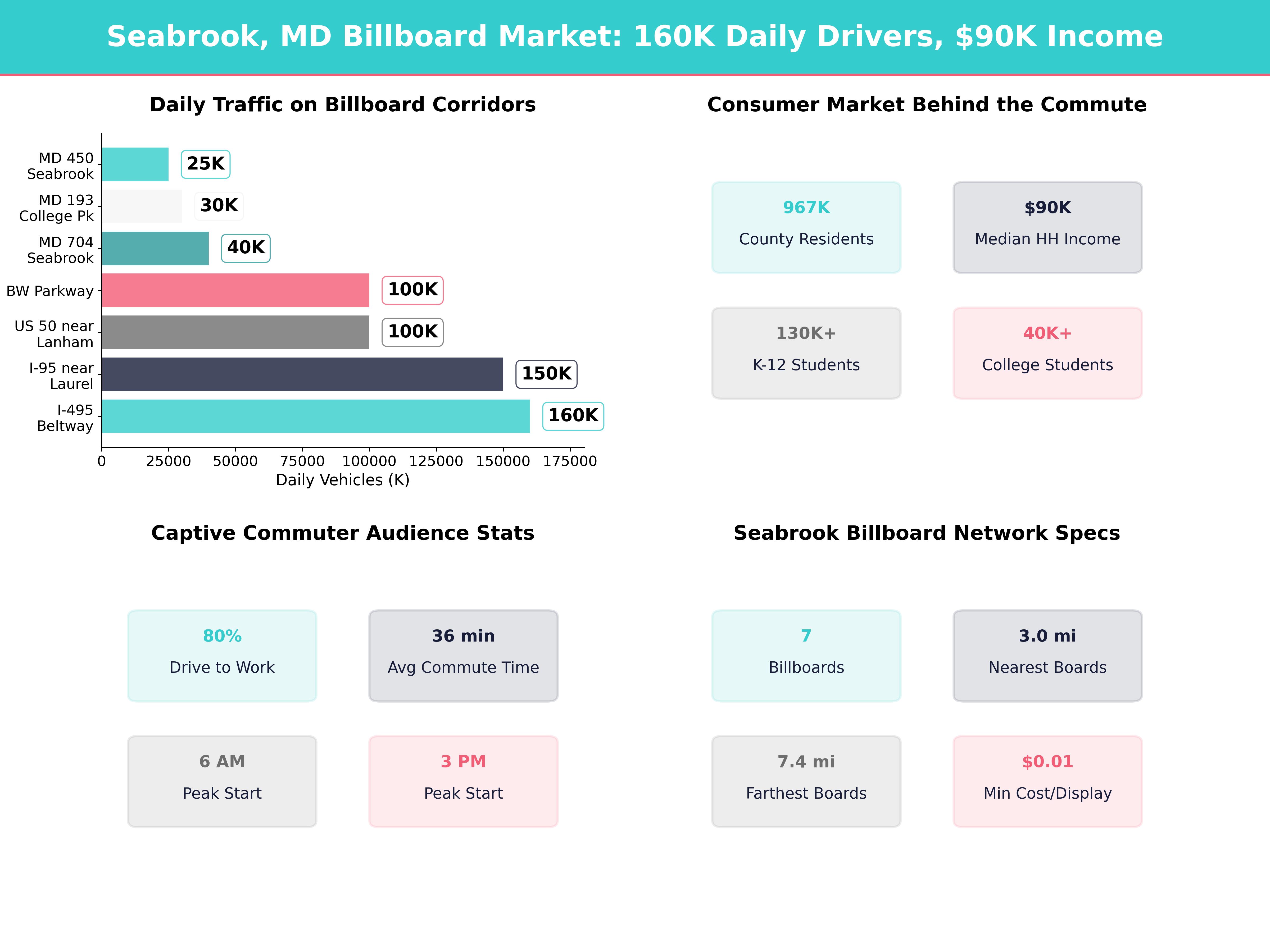
Near Seabrook, the interchange area around I-495 and US 50 is one of the market’s biggest traffic generators, with nearby Capital Beltway segments at 160,000+ vehicles per day and nearby US 50 segments commonly at 100,000+ vehicles per day. North of Seabrook, I-95 near Laurel routinely runs 150,000+ vehicles per day on heavily traveled sections. Roads such as MD 450 and MD 704 typically register tens of thousands of daily vehicles, with many segments in the 25,000 to 40,000 and 40,000+ ranges respectively.
Do I need a contract to advertise with Blip near Seabrook?
No, Blip has no long-term contracts or minimum commitments. You can start, pause, or stop your campaign at any time.
How fast can I launch a billboard campaign with Blip near Seabrook?
You can have your campaign live in minutes. Create a free account, select your locations, set your budget, upload your design, and start running once approved.
Where can I advertise with Blip near Seabrook?
Blip has digital billboards near Seabrook. You can browse available locations on a map, choose the ones that fit your audience, and start advertising right away.
Still have questions? Launch a campaign in minutes — no contracts, no commitments.
Start Your CampaignSeabrook Billboard Advertising Guide
The Seabrook area is a strong billboard market because it sits at the meeting point of Prince George’s County commuter routes, university travel patterns, and everyday suburban retail traffic from a county of about 967,000 residents. Our 7 digital billboards in nearby Lanham, College Park, and Laurel 10.0 miles of Seabrook, which lets us reach drivers serving the Seabrook area without needing boards inside the community itself. This market combines Beltway commuters, University of Maryland students and fans, and family households moving between school, work, and errands. For advertisers that need flexible local reach, the road network near Seabrook creates frequent, repeat exposure throughout the week, including corridors that regularly carry 100,000+ to 160,000+ vehicles per day.
Seabrook area market overview
The Seabrook area is part of central Prince George’s County about 967,000 residents. The surrounding economy is supported by education, healthcare, public-sector employment, professional services, and ongoing development activity tracked by the Prince George’s County Economic Development Corporation and the Maryland Department of Commerce. That blend matters for billboard advertisers because it creates a broad mix of daily drivers rather than one narrow audience. When we advertise near Seabrook, we are speaking to working households, campus-connected consumers, and regional travelers all at once.
What the numbers tell us about the Seabrook area
- Prince George’s County about 967,000 residents, which gives the Seabrook area a large surrounding consumer base.
- Median household income in the county is roughly $90,000, which supports strong demand for healthcare, retail, home services, education, and dining.
- Recent commuting estimates show that roughly 4 out of 5 workers in the county get to work by car, either driving alone or carpooling.
- Average commute time is about 36 minutes, which is long enough for roadside ads to build recognition through repetition.
- University of Maryland adds more than 40,000 students to the nearby market.
- Prince George’s County Public Schools serves more than 130,000 students, which points to a large parent-and-family audience across the county.
Why nearby billboard cities matter for Seabrook reach
Our boards are not inside Seabrook, and that is actually an advantage. The nearby placements intercept the routes Seabrook-area residents already use for work, shopping, school, and recreation. We can cover the market with boards in Lanham at 3.0 miles, College Park at 4.3 miles, and Laurel 7.4 miles from Seabrook. That 3.0-to-7.4-mile range is close enough to feel local, while still broad enough to capture multiple trip types.
Key traffic corridors serving the Seabrook area
The best billboard strategy near Seabrook starts with the roads people use every day. The Seabrook area is shaped by a mix of interstate, parkway, and arterial traffic, which means advertisers can choose between broad regional reach and tighter local relevance.
I-495 and US 50 near Lanham and New Carrollton
Near Seabrook, the interchange area around I-495 and US 50 is one of the market’s biggest traffic generators. Recent Maryland Department of Transportation State Highway Administration counts generally put nearby Capital Beltway segments at 160,000+ vehicles per day, while nearby US 50 segments are commonly 100,000+ vehicles per day. Those are the roads Seabrook-area residents use to reach Washington, Annapolis Bowie, New Carrollton
Baltimore-Washington Parkway, Route 1, and College Park access
Northwest of Seabrook, the Baltimore-Washington Parkway near College Park typically carries 100,000 or more vehicles per day on busy sections. Route 1 through College Park, MD 193, and campus access roads add another layer of student, faculty, staff, restaurant, and event traffic. On nearby segments of MD 193, recent counts are often in the 30,000 to 50,000 daily range. That mix gives College Park boards a different job, because they connect the Seabrook area to younger adults and event-driven trips rather than only commuter movement.
I-95 and Laurel for north-south travel
To the north, I-95 near Laurel 150,000+ vehicles per day on heavily traveled sections. Nearby MD 198 and MD 197 feed office, industrial, retail, and residential traffic into that corridor. Boards in Laurel help us reach Seabrook-area consumers on longer north-south trips, including commuting, weekend shopping, and family travel. They also extend frequency among households that split routines across multiple counties.
Local arterials that feed the Seabrook area
Not every valuable impression comes from an interstate. Roads such as MD 450 and MD 704 typically register tens of thousands of daily vehicles, with many segments in the 25,000 to 40,000 and 40,000+ ranges respectively. Those arterials matter because they connect the Seabrook area to neighborhood retail, schools, service businesses, and the larger highway system. They also funnel drivers toward major transit hubs used by WMATA and the Maryland Transit Administration, including New Carrollton. If your goal is store visits or local service calls, these feeder routes often provide better contextual relevance than a purely regional highway buy.
Audience segments near Seabrook
One reason billboard advertising works so well serving the Seabrook area is that the audience is varied, but still road-dependent. We can reach commuters, students, families, and regional visitors without leaving a relatively tight geographic zone.
Commuters and daily drivers near Seabrook
Commuters are the core billboard audience serving the Seabrook area. With roughly 80% of county workers commuting by car and average travel times near 36 minutes, people spend enough time on the road for billboard messages to register across repeated trips. Employers, healthcare systems, quick-service restaurants, legal firms, insurance brands, and home-service companies all benefit from that daily repetition. If your customer is deciding where to stop, call, or book on the way to or from work, this is exactly the kind of market where digital billboards can stay top of mind.
Students, faculty, and campus event traffic
The nearby University of Maryland gives the Seabrook area unusual access to a large student and young-adult audience. The university enrolls more than 40,000 students, and it also brings in faculty, staff, visiting families, and alumni throughout the year. According to Maryland Athletics, football at SECU Stadium seats 51,802, and basketball at the Xfinity Center seats 17,950. That creates reliable surges around game days, commencement weekends, and major campus events, which makes College Park boards especially useful for restaurants, apartments, entertainment, recruiting, and mobile-first brands.
Families, parents, and household decision-makers
Family households are another strong segment near Seabrook. Prince George’s County Public Schools serves more than 130,000 students, which points to a large base of parents making routine trips around school schedules, after-school activities, grocery runs, medical appointments, and weekend errands. Community destinations managed by M-NCPPC and the Prince George’s County Memorial Library System add even more afternoon and weekend movement. Advertisers that sell healthcare, tutoring, childcare, dining, retail, and home improvement can benefit from that recurring household travel.
Rail users, visitors, and regional pass-through traffic
Seabrook also benefits from proximity to one of the region’s most connected travel hubs. New Carrollton 3 major rail services today, including Metrorail, MARC, and Amtrak, and it is also on the future Purple Line 16.2-mile light-rail project with 21 stations. Even when people finish their trip by rail, many still begin or end it by car near the station. That means billboard exposure on approach routes can influence where they eat, shop, park, and book services.
Tourists and leisure travelers moving through the Seabrook area
Tourism near Seabrook is less about resort lodging and more about pass-through leisure traffic. US 50 is the Washington region’s main route toward Annapolis Maryland Office of Tourism College Park and Laurel 100,000+ daily vehicles on regular days also picks up discretionary weekend travel in warmer months and on holiday weekends. That creates strong windows for attractions, restaurants, entertainment brands, and retailers.
Seasonal and timing opportunities for the Seabrook area
Timing matters near Seabrook because traffic is shaped by both commuter routines and academic calendars. We usually see the best results when advertisers align their schedule with how the market actually moves rather than running the same plan all year.
Spring in the Seabrook area
Spring is one of the best campaign windows near Seabrook because the university semester is active, sports schedules are busy, and graduation season lifts family travel. Campaigns for apartments, storage, telecom, restaurants, beauty services, and financial services often perform well from March through May. If we want both commuter and student reach, we usually emphasize weekday mornings and late afternoons while adding weekend bursts around campus events. Spring creative also works well for healthcare screenings, home improvement, and seasonal retail.
Summer travel and weekend opportunities near Seabrook
Summer changes the mix. School is out, family errands shift later in the day, and US 50 picks up leisure traffic heading toward Annapolis and the Eastern Shore. Home services, urgent care, amusement destinations, travel-related offers, and quick-serve food brands often benefit from late-afternoon and Friday/Saturday placements. Laurel boards can also help catch northbound and southbound travelers on I-95 during summer weekends. If your business depends on families making flexible decisions on the road, summer is often stronger than many advertisers expect.
Fall back-to-school and sports momentum
Late August through November is another high-value stretch serving the Seabrook area. Prince George’s County Public Schools restart, University of Maryland returns to full activity, and football restores heavier weekend traffic patterns. Back-to-school campaigns, auto service, tutoring, urgent care, telecom, and retail offers fit the seasonal mindset especially well. This is also a smart time to layer Lanham and College Park together so the same household sees the message on both weekday and weekend routes.
Winter commuter dayparts and practical categories
Winter favors practical categories such as tax prep, healthcare, insurance, legal services, HVAC, and restaurants. Darker evenings can increase the visual punch of digital creative, especially during the 3 p.m. to 7 p.m. rush. For commuter-led goals, the most dependable dayparts are usually 6 a.m. to 10 a.m. and 3 p.m. to 7 p.m. For student, dining, and entertainment goals, afternoons, evenings, and weekends often work better. Holiday retail can also perform well when we keep copy short and the call to action immediate.
Billboard design tips for campaigns serving the Seabrook area
Creative should reflect the roads and audiences serving the Seabrook area. What works for a slow urban street does not always work on a Beltway approach or a US 50 commuter route.
Creative choices for high-speed Seabrook-area traffic
Because so much of this market moves at highway speed, we recommend keeping copy concise. On Beltway, US 50, and I-95 routes, we usually aim for 6 to 8 words, 1 clear offer, and 1 unmistakable brand cue. Drivers on roads posted around 55 to 65 mph need instant recognition rather than dense explanation. High-contrast color combinations such as white on red, white on deep blue, or black on bright yellow tend to stand out against tree cover, overcast skies, and nighttime commuting.
Messaging that feels local near Seabrook
Local references help a great deal. Copy like “Before Route 50,” “Near New Carrollton,” “Serving the Seabrook area,” or “Next stop after College Park” feels more relevant than generic Washington messaging. For family-oriented brands, practical benefits such as same-day appointments, weekend hours, easy parking, or fast pickup often outperform broad image slogans. For student-oriented brands, urgency and convenience usually matter more than long descriptions.
Visual styles that match nearby submarkets
Creative can also match the nearby board location. Near College Park, bold youthful colors and energetic visuals align with a university setting. Near Lanham and Laurel, straightforward visuals for healthcare, retail, finance, legal, and home services often feel more natural because the audience skews toward commuters, working adults, and families. Bilingual English-Spanish creative can also make sense for some categories because the surrounding market is diverse. Since each digital blip lasts 7.5 to 10 seconds, every element on the screen should support one main action.
Regional strategies near Seabrook
The best Seabrook-area campaigns usually do not treat every nearby board the same way. We get stronger results when we assign each nearby cluster a role.
Lanham strategy for Seabrook-area commuter coverage
Our Lanham positions are the fastest way to build broad frequency serving the Seabrook area. They sit only 3.0 miles from Seabrook and align well with Beltway and US 50 movement. We usually like Lanham for mass-market categories such as healthcare, auto, retail, grocery, home improvement, personal injury, and quick-service dining because the audience is broad and commute-heavy. If you want visibility across a wide slice of everyday drivers, Lanham is often the first place we start.
College Park strategy for youth, campus, and event reach
Our College Park positions are 4.3 miles from Seabrook and work best when the advertiser wants younger adults, university visibility, or event-based lift. Restaurants, apartments, financial apps, telecom, entertainment, education, and recruiting campaigns often fit here. If we need to promote time-sensitive offers around games, move-in periods, or commencement, College Park gives us a sharper context than a generic highway-only buy.
Laurel strategy for regional scale and I-95 movement
Our Laurel 7.4 miles from Seabrook and give campaigns more regional scale. They are especially useful for brands that draw customers from a wider trade area, including medical groups, specialty retailers, colleges, regional employers, and e-commerce pickup locations. Because I-95 and related arterials carry longer-distance commuters, Laurel adds a different trip purpose than the shorter Beltway movements near Lanham. That broader pattern helps when your customers are willing to travel for a larger purchase or appointment.
Using all 7 billboards as a coordinated Seabrook-area network
The strongest strategy is often a layered network across all 7 billboards. Lanham can supply dense commuter repetition, College Park can add student and event reach, and Laurel can extend north-south coverage. That combination works especially well for campaigns that need both brand recall and direct response, because the same person may see the message on multiple days and on multiple route types. When we want to own the market rather than just appear in it, this kind of coordinated coverage is hard to match.
Blip tools and capabilities for Seabrook-area campaigns
Blip is useful in the Seabrook area because the market itself is varied. Some advertisers want broad, automated coverage, while others want to choose individual boards near specific routes.
When Blip-optimized buying works best near Seabrook
If our goal is efficient coverage serving the Seabrook area, we can start with a Blip-optimized campaign and let the platform distribute spend across the network based on timing, demand, and availability. That approach works well when we want to reach commuters across Lanham, College Park, and Laurel
When manual billboard selection makes more sense
If our target is more specific, we can also build a manual campaign. A restaurant tied to University of Maryland events may put heavier weight on College Park. A medical practice seeking family visibility may prioritize Lanham and Laurel. Manual selection is helpful when geography, route type, or a specific audience segment matters more than overall automation.
Budget control, timing, and creative testing
Blip’s pay-per-play model starts at $0.01 per display, so advertisers can test the Seabrook area without a large upfront commitment. We can raise bids during peak windows like 6 a.m. to 10 a.m., lower them during softer periods, pause creative between promotions, and swap messages as seasons change. Because there are no contracts or minimums, we can react faster than with many traditional billboard arrangements. Real-time analytics also make it easier to compare which nearby corridor actually supports your goals.
Getting started with billboard rental near Seabrook
Renting a billboard serving the Seabrook area works best when we begin with business goals, not just map pins. The right nearby board depends on who we need to reach and what action we want them to take.
Step 1: Match your goal to the right Seabrook-area geography
We start by deciding whether the campaign is about awareness, store visits, appointments, recruiting, or event attendance. For broad awareness serving the Seabrook area, Lanham plus at least one supporting market is often a strong opening move. For youth or university goals, we usually give more weight to College Park. For regional services or north-south commuter reach, we add Laurel.
Step 2: Choose the campaign structure that fits your needs
Next, we decide whether a manual or optimized setup fits better. Traditional billboard companies often rely on longer negotiations, fixed inventory packages, and less daypart flexibility. With Blip, we can launch online, set a budget that matches the campaign rather than the vendor, and adjust locations or timing without rebuilding the entire buy. A 2- to 4-week test window is usually long enough to learn which submarket and daypart create the strongest response.
Step 3: Evaluate locations by trip purpose, not just distance
Finally, we judge each location by actual customer behavior. We ask which routes the customer uses, what time they travel, whether the decision is impulsive or planned, and whether the message needs commuter, family, or student context. If one Lanham board delivers stronger morning coverage and a College Park board performs better on weekends, we can rebalance quickly instead of waiting for a long contract cycle to end. For many advertisers, that flexibility is the biggest advantage of renting digital billboards near Seabrook through Blip, because we can start small, learn from live performance, and scale only where the market response justifies it.