Billboards in College Park, MD
No Minimum Spend. No Long-Term Contracts. Just Results.
Trusted by Leading Brands


Billboard advertising
in College Park has never been easier



How much is a billboard in College Park?
Why Choose Blip for Billboard Advertising in College Park
College Park, MD: Blip's self-serve platform lets you launch fast on Route 1 or the Beltway without sales delays.
In College Park, Blip can auto-pick billboards and timing to hit student traffic, UMD staff, and 200K+ Beltway drivers within your goals.
College Park's 80% car-commute market pairs with Blip's flexible budgets—set spend, pause anytime, and pay only when ads play.
Daypart your College Park campaign for 6-10 a.m. commuters, 3-7 p.m. errands, or late-night Route 1 food traffic.
Track College Park performance in real time with Blip, then shift spend toward the roads and seasons that work best.
Use Blip's creative tools to tailor College Park ads for move-in, football weekends, and Discovery District recruiting.
Frequently Asked Questions About Billboard Advertising in College Park
How much does a billboard cost in College Park, Maryland with Blip?
With Blip, billboard advertising in College Park is designed to fit a range of budgets. Each “blip” is a 7.5-to-10-second display, with pricing that can start as low as $0.01 per display. Because cost changes based on time of day, location, and advertiser demand, you can stretch your budget further while still reaching the right audience.
Where can I advertise with Blip in College Park, Maryland?
College Park works especially well for billboard advertising because the city operates as both a college town and a regional commuter node. We can build campaigns for hyperlocal action on Route 1, or broader awareness across the Capital Beltway and adjacent Prince George’s County communities. Nearby Capital Beltway segments around College Park and Greenbelt regularly carry more than 200,000 vehicles per day, and U.S. Route 1 through central College Park is a signature local corridor.
Who can I reach with Blip billboard ads in College Park, Maryland?
We can reach student drivers, university employees, regional commuters, sports fans, and nearby suburban households on a compact set of high-traffic roads. The University of Maryland alone creates a campus audience of 40,792 students and more than 14,000 employees. College Park also gives us three overlapping markets at once: a young student market, an established suburban household market, and a research-and-employment market.
When is the best time to run billboard ads in College Park, Maryland with Blip?
The University of Maryland calendar creates two major relocation and reactivation periods each year. The first comes in late July through September, when fall move-in, orientation, and class starts drive demand, and the second comes in December and January, when winter break ends and the spring term begins. May is also a high-value moment because commencement brings visiting families, job seekers, gift purchases, restaurant demand, and short-stay travel.
What roads get the most billboard visibility in College Park, Maryland?
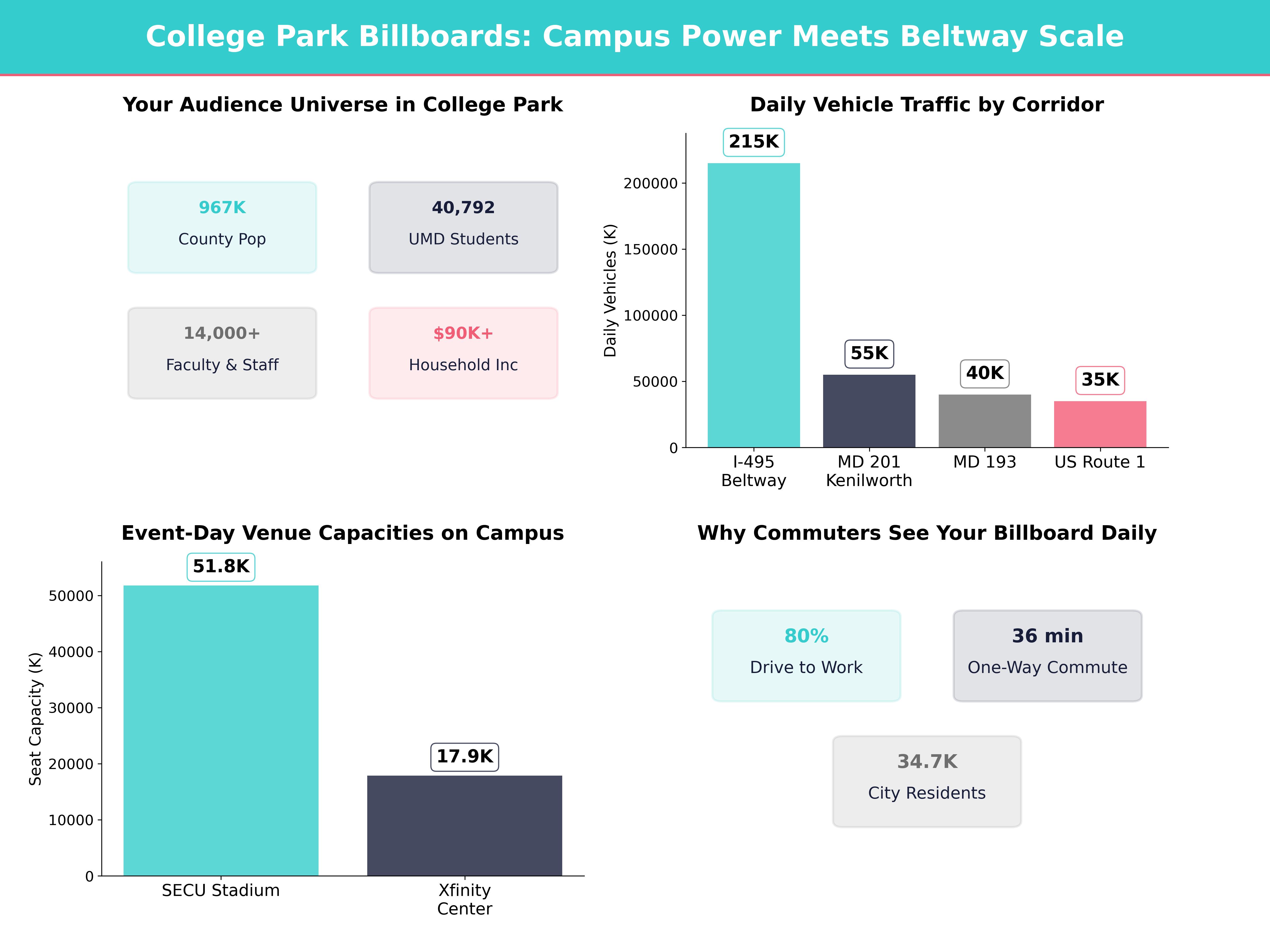
Nearby Capital Beltway segments around College Park and Greenbelt regularly carry more than 200,000 vehicles per day, and some segments run in the 230,000-plus AADT range. U.S. Route 1 is the signature local corridor, with Maryland SHA counts generally placing it in the 30,000 to 40,000 AADT range through central College Park. MD 193 segments near College Park are typically in the 35,000 to 45,000 AADT range, while nearby MD 201 can rise into the 50,000 to 60,000 AADT band on key approaches.
Do I need a contract to advertise with Blip in College Park?
No, Blip has no long-term contracts or minimum commitments. You can start, pause, or stop your campaign at any time.
How fast can I launch a billboard campaign with Blip in College Park?
You can have your campaign live in minutes. Create a free account, select your locations, set your budget, upload your design, and start running once approved.
Where can I advertise with Blip in College Park?
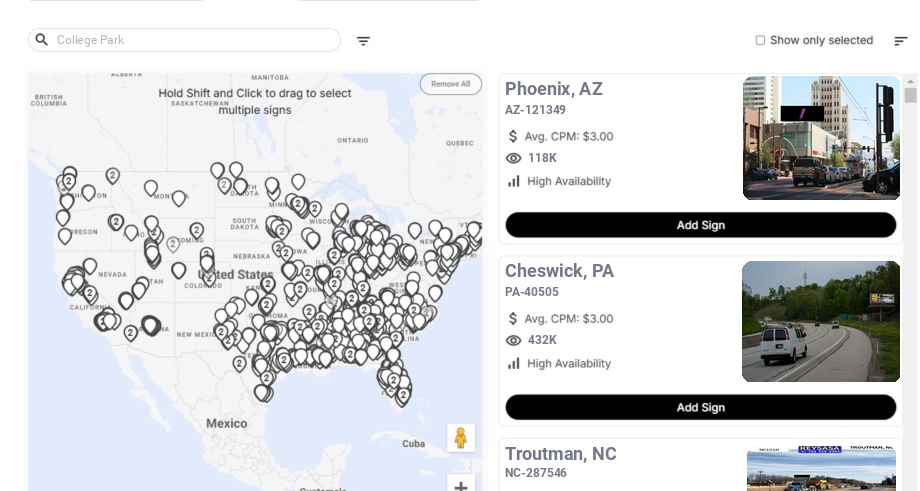
Blip has digital billboards in College Park. You can browse available locations on a map, choose the ones that fit your audience, and start advertising right away.
Still have questions? Launch a campaign in minutes — no contracts, no commitments.
Start Your CampaignCollege Park Billboard Advertising Guide
College Park, Maryland, gives us one of the strongest billboard markets in the Washington region because it combines a city population of 34,740 with the daily pull of the University of Maryland, College Park and the broader 967,201 residents of Prince George’s County 30,000 to 60,000+ AADT locally and more than 200,000 vehicles per day on the Beltway. Even with service from WMATA, MTA Maryland, and Shuttle-UM, road travel still does most of the market’s heavy lifting, with about 80% of workers commuting by car, truck, or van, which keeps billboard exposure frequent and valuable.
College Park Market Overview
College Park works especially well for billboard advertising because the city operates as both a college town and a regional commuter node. For us, that means we can build campaigns for hyperlocal action on Route 1, or broader awareness across the Capital Beltway and adjacent Prince George’s County communities.
Population, growth, and local scale
City of College Park population figures show 34,740 residents in 2020, up from 30,413 in 2010. That was an increase of 4,327 people, or about 14.2% in one decade. Prince George’s County 863,420 residents in 2010 to 967,201 in 2020, which added 103,781 residents and represented roughly 12.0% growth.
That growth matters because it tells us College Park is not a static campus enclave. It is a city with increasing housing demand, expanding retail potential, and a stronger year-round customer base than many advertisers assume.
The University of Maryland is the market’s defining audience engine. University fact pages list 40,792 students, and the main campus spans about 1,340 acres. The university also employs more than 14,000 faculty and staff, which gives us a daily audience mix that includes students, researchers, administrators, healthcare users, contractors, and visiting families.
Economic and mobility context
College Park sits inside the larger Washington-area economy, and that gives local billboards unusual purchasing-power diversity. Prince George’s County Economic Development Corporation and state planning materials from the Maryland Department of Planning consistently place county median household income above $90,000. That means student-oriented value messaging can work here, but so can higher-consideration offers for healthcare, legal services, automotive, home improvement, financial services, and business recruiting.
Mobility patterns are just as important as income. County planning profiles generally show that about 80% of workers commute by car, truck, or van, and the average one-way commute is about 36 minutes. For us, that is ideal billboard territory. Long commutes and car dependence increase repeat exposure, and repeat exposure is where out-of-home starts compounding.
College Park also has a strong innovation layer. The University of Maryland Discovery District covers 150 acres, and that strengthens the B2B, recruiting, education, and professional-services opportunity. In practical terms, College Park gives us three overlapping markets at once: a young student market, an established suburban household market, and a research-and-employment market.
Key Traffic Corridors for College Park Billboards
College Park travel patterns are concentrated on a few corridors, which makes media planning more efficient than in a spread-out market. When we understand how drivers move between campus, the Beltway, and neighboring communities, we can match the right message to the right road.
I-95 and I-495, the Capital Beltway around College Park
According to traffic maps from the Maryland Department of Transportation State Highway Administration, nearby Capital Beltway segments around College Park and Greenbelt regularly carry more than 200,000 vehicles per day, and some segments run in the 230,000-plus AADT range. This is the highest-scale visibility play in the market.
We use Beltway-facing digital boards when we want regional awareness instead of neighborhood precision. These locations are especially effective for:
- Healthcare systems and urgent care brands, because they need broad name recognition across multiple communities.
- Auto dealers, insurance groups, and financial services, because commuters have enough trip time to absorb repeat brand impressions.
- Regional entertainment, attractions, and higher education programs, because the Beltway audience includes both Prince George’s County residents and travelers moving between Montgomery County, Washington, D.C., and the I-95 corridor.
The tradeoff is speed. Because traffic moves faster here, we keep creative simpler, bolder, and more benefit-led.
U.S. Route 1, Baltimore Avenue through College Park
U.S. Route 1 is the signature local corridor. Maryland SHA counts generally place this stretch in the 30,000 to 40,000 AADT range through central College Park, depending on the segment. This road is not just a pass-through. It is the spine of the city’s restaurant, apartment, student, and retail activity.
This corridor gives us a different type of billboard value than the Beltway. Speeds are lower, signalized intersections create more dwell time, and drivers are often close to a decision point. That makes Route 1 particularly strong for:
- Restaurants, cafés, and late-night food offers, because students and campus visitors are often deciding in real time.
- Apartments, student housing, storage, and internet providers, because move-in and leasing decisions cluster around this corridor.
- Urgent care, dental, banking, and telecom services, because campus-adjacent convenience matters more than broad regional branding.
The College Park Partnership has spent years strengthening the Route 1 business environment, and that continued corridor investment helps billboards perform better because more destinations are concentrated nearby.
MD 193, MD 201, and College Park’s feeder routes
The next tier of useful roads includes MD 193 and MD 201. SHA traffic maps typically show MD 193 segments near College Park in the 35,000 to 45,000 AADT range, while nearby MD 201, Kenilworth Avenue, can rise into the 50,000 to 60,000 AADT band on key approaches. These roads feed Beltway traffic, connect to residential areas, and carry a more family-oriented audience than the core student stretch of Route 1.
We use these approaches when we want to reach:
- Families and established households in Greenbelt, Hyattsville Riverdale Park, and surrounding neighborhoods.
- Home services, grocery, healthcare, and local retail brands that depend on routine errands and repeated suburban exposure.
- Multilingual consumer campaigns, because south and southwest of College Park the market becomes more diverse and more neighborhood-driven.
We also watch the Baltimore-Washington Parkway as a parallel north-south flow. Even when a specific board is not directly on that route, nearby placements can still capture travelers moving between College Park, Greenbelt, and the larger Baltimore-Washington corridor.
College Park Audience Segments
One of College Park’s biggest advantages is that we do not need to choose between a student market and a mainstream suburban market. We can reach both, and we can do it within a few miles.
Students, faculty, and campus workers in College Park
The University of Maryland alone creates a campus audience of 40,792 students and more than 14,000 employees. That scale changes how we should think about College Park. This is not a small liberal-arts town. It is a Big Ten university city with daily movement patterns that resemble a small metro.
For us, this segment supports campaigns for:
- Food, delivery, entertainment, and events, because decision cycles are short and frequency matters.
- Apartments, storage, furniture, and move-in services, because the academic calendar creates predictable demand windows.
- Graduate programs, continuing education, recruiting, and professional services, because faculty, staff, and older students broaden the audience beyond undergraduates.
The campus also includes high-traffic destinations such as STAMP Student Union, the University of Maryland Visitor Center, and major academic buildings that generate daily circulation.
Regional commuters and suburban households around College Park
The broader county audience is where College Park billboards gain staying power. Prince George’s County 967,201 residents, and much of the nearby household base moves by road. With about 80% of workers commuting by car, truck, or van, and average commute times around 36 minutes, we get the kind of repeated weekly exposure that helps billboards influence search behavior, brand recall, and store visits.
This segment is especially important for:
- Healthcare providers, because trust builds over multiple impressions.
- Automotive, legal, and insurance advertisers, because consumers often act after several exposures rather than one.
- Family retail and home improvement brands, because suburban travel patterns are steady across weekdays and weekends.
Event visitors, sports fans, and short-stay guests in College Park
College Park also has a meaningful event-driven audience. Maryland Athletics brings large spikes around SECU Stadium, which seats 51,802, and the Xfinity Center, which seats 17,950. The Hotel at the University of Maryland adds 297 rooms of meeting, visitor, and event capacity near campus, and the Clarice Smith Performing Arts Center adds another year-round stream of arts patrons and visiting families.
This audience is perfect for short-window campaigns tied to:
- Hotels, restaurants, bars, and parking-related services.
- Game-day offers, alumni events, and local entertainment.
- Retail and attractions that benefit from parents, alumni, and weekend visitors who may not know the area well.
College Park’s aviation heritage also adds a niche visitor story. The city’s airport dates to 1909, which helps reinforce College Park as a place that draws more than just daily commuters.
Innovation, research, and business audiences in College Park
The Discovery District gives us a business audience that many college towns lack. At 150 acres, it supports office, research, startup, and technology activity next to campus. That makes College Park useful for B2B recruiting, office leasing, technical hiring, cybersecurity, engineering services, and professional events.
When we want to reach this audience, we usually benefit from a more polished, credibility-driven message than we would use for student creative. College Park rewards both styles, but it rewards them in different places.
Seasonal and Timing Opportunities in College Park
College Park is highly seasonal, but in a useful way. The market gives us repeatable timing windows instead of unpredictable bursts, which makes planning much easier.
Academic calendar cycles in College Park
The University of Maryland calendar creates two major relocation and reactivation periods each year. The first comes in late July through September, when fall move-in, orientation, and class starts drive demand. The second comes in December and January, when winter break ends and the spring term begins.
We use these windows for apartments, self-storage, furniture, telecom, grocery delivery, banking, and student services. We also treat May as a high-value moment because commencement brings visiting families, job seekers, gift purchases, restaurant demand, and short-stay travel.
Nearby Prince George’s County Public Schools also bring a family calendar into the picture. Late-summer back-to-school periods and spring activity seasons give us opportunities for pediatric care, tutoring, youth sports, and family retail.
Sports, arts, and weekend surges in College Park
Football season is one of the clearest timing opportunities. Maryland Athletics typically brings 6 to 7 home football dates each fall, and each one changes traffic, hotel occupancy, restaurant demand, and alumni presence. Basketball season adds winter and early spring peaks, while The Clarice and other campus venues create arts-driven traffic throughout the year.
We also watch university signature events such as Maryland Day, admissions visit periods, homecoming, and major campus conference weekends. Even when these events do not fill a stadium, they still create the kind of local intensity that digital billboards handle well because we can increase presence only when those audiences are active.
Weather, services, and holiday spending around College Park
Maryland weather gives us another timing layer. Spring is strong for landscaping, home improvement, and allergy-related healthcare. Summer is strong for HVAC, cold drinks, back-to-school retail, and move-in offers. Fall is ideal for football, home services, and holiday pre-promotion. Winter can work well for urgent care, tire and auto service, heating repair, and post-holiday fitness or education messaging.
Holiday travel also boosts regional road visibility. From Thanksgiving through New Year’s, Beltway and feeder-route impressions become more valuable for retailers, entertainment brands, healthcare systems, and restaurants because family visits and shopping trips increase overall road time.
Billboard Design Tips for the College Park Market
College Park does not reward generic “one-size-fits-all” billboard creative. We need to build for a place that is youthful, educated, fast-moving, and regionally connected.
Use College Park cues that feel local, not fake
We usually perform better when our creative acknowledges the local rhythm of campus life without pretending to be the university. Red, black, and gold-adjacent palettes can feel familiar in a Maryland context, but we should avoid official university marks unless we have permission. A better approach is to mirror the market’s energy rather than mimic institutional branding.
College Park creative often works best when it feels:
- Fast and specific, because Route 1 audiences are close to action.
- Smart and direct, because the market includes students, faculty, and professionals.
- Value-aware, because even in a county with median household income above $90,000, student audiences still respond to clear price or convenience signals.
Match the message to the road in College Park
On the Beltway, we keep the message simpler because traffic is faster and volumes exceed 200,000 vehicles per day on some nearby segments. Brand name, one benefit, and one memory hook are usually enough. On Route 1, where traffic commonly falls in the 30,000 to 40,000 AADT range and drivers move more slowly, we can be slightly more directional and action-oriented.
That means a good College Park creative system often includes different versions for different roads:
- A regional awareness version for I-95 and I-495.
- A conversion-oriented version for Route 1.
- A family or neighborhood version for MD 193, MD 201, and southern feeder routes.
Reflect the area’s diversity and daypart behavior
College Park sits in one of Maryland’s most diverse counties, so message tone matters. In some corridors, especially south of campus toward Hyattsville Riverdale Park, multilingual or Spanish-language variations can be worth testing. In the campus core, urgency and convenience usually beat formality. In the Discovery District and business corridors, credibility and professionalism usually beat slang.
Time of day should shape creative as well. Morning commuters respond to reliability, healthcare access, education, and professional services. Afternoon and early evening travelers respond to retail, dining, childcare, and errands. Late evening Route 1 traffic is often much more responsive to food, entertainment, and app-based services.
Regional Strategies Around College Park
The best College Park campaigns usually treat the market as a set of linked zones instead of one uniform geography. That helps us avoid wasting impressions and lets us tailor messaging by audience intent.
Downtown College Park and the campus-adjacent Route 1 core
This is our highest-intent local zone. We use it for restaurants, apartments, student housing, urgent care, telecom, nightlife, convenience retail, and campus-adjacent services. The audience here is younger, more immediate, and more likely to act quickly.
If our goal is walk-in traffic or short-term response, this is often the first zone we test.
The Beltway, Greenbelt, and north-side commuter approaches
The City of Greenbelt and the Beltway approaches around College Park give us broader suburban and regional reach. We use these placements for hospitals, colleges, regional retail, automotive, legal, and other brands that need frequency across several communities.
This is also the best zone when we want to reach both locals and pass-through travelers without narrowing ourselves to student life.
South Route 1 toward Riverdale Park and Hyattsville
As we move south from College Park, the market becomes less campus-dominant and more mixed. We still get students and university workers, but we also get more families, arts-oriented consumers, and neighborhood retail traffic. That makes this area especially useful for grocery, healthcare, family dining, home services, and culturally tailored consumer campaigns.
We also like this stretch for brands that want to bridge College Park awareness with inside-the-Beltway neighborhood relevance.
Discovery District, research nodes, and future transit-influenced areas
The Discovery District deserves its own strategy. At 150 acres, it supports a more professional audience than many advertisers expect in College Park. We use nearby placements for recruiting, office leasing, B2B services, executive education, and technical hiring.
We also keep an eye on the Purple Line 16.2 miles long with 21 stations, and future station-area activity will strengthen connections between College Park, Riverdale Park, and New Carrollton
Using Blip Tools in College Park
College Park is a market where flexible digital execution matters. Traffic, events, semesters, and audience mixes change quickly, so we benefit when we can adjust just as quickly.
When we want precise control in College Park
If we already know we want Route 1, Beltway, or Greenbelt-facing inventory, we can use a manual approach and choose the exact boards that fit our geography. That is especially useful for move-in campaigns, restaurant launches, apartment leasing, or any promotion tied to a particular corridor.
Dayparting is valuable here. We often separate:
- 6:00 a.m. to 10:00 a.m. for commuter-heavy messaging.
- 3:00 p.m. to 7:00 p.m. for retail, healthcare, and family errands.
- 8:00 p.m. to midnight for food, entertainment, and student-oriented offers.
When we want broader efficiency across the College Park area
If our goal is reach across several submarkets, Blip’s optimized approach fits College Park well. We can let the system distribute budget across campus-adjacent boards, commuter corridors, and nearby suburban zones instead of trying to micromanage every placement.
That approach works especially well when we are promoting:
- A regional healthcare brand.
- A chain retailer with multiple nearby stores.
- An event, concert, or sports-related offer that benefits from area-wide visibility.
- A recruiting push that needs both student and professional audiences.
When we want to test, learn, and adjust
College Park rewards iterative campaigns. We can run one creative set during August move-in, another during football season, and another during spring admissions or commencement. We can also compare commuter-focused messaging against student-focused messaging and move budget toward the version that gains traction.
The built-in artwork tools are useful here because College Park often needs multiple creative versions rather than one static design. A campus-season version, a family-services version, and a game-day version can all serve the same brand in different parts of the market.
Getting Started with Billboard Rental in College Park
Renting a billboard in College Park is much easier when we start with the audience and the road, not the format. The city is compact, but the reasons people travel through it are very different, and those differences should guide every placement choice we make.
We start with one clear goal
Before we choose locations, we decide what success should look like. In College Park, the main goals usually fall into a few buckets:
- We may want broad awareness across Prince George’s County and Beltway commuters.
- We may want immediate local action near campus and Route 1.
- We may want timed visibility around move-in, football weekends, Maryland Day, or commencement.
- We may want recruiting or professional reach near the Discovery District and research corridors.
A clear objective makes the location decision much simpler.
We evaluate College Park locations by travel behavior
When we compare boards, we usually ask four practical questions.
- How fast is the road? Faster roads like I-95 and I-495 are better for simple branding, while slower roads like Route 1 can support more direct offers.
- Who is most likely on that route? Campus boards lean younger, while MD 193, MD 201, and Greenbelt-area boards lean more suburban and family-oriented.
- What time of day matters most? Commuter service brands may need morning and afternoon windows, while restaurants may care more about late afternoon and evening.
- How close is the board to the decision point? Apartments, restaurants, and urgent care often benefit when the board is near the destination, not just in the general market.
We keep execution simpler with Blip
Traditional billboard buying in a market like College Park can be slow, rigid, and overbuilt for local campaigns. We may have to negotiate fixed periods, commit too early, or accept inventory bundles that do not match our geography.
Blip makes the process much more practical for this kind of market. We can launch around a specific event window, pause between semesters, rotate creative for sports weekends, or expand only after we see which corridors respond best. That flexibility matters in College Park because the audience mix shifts from week to week and sometimes from hour to hour.
We launch small, measure, and expand in College Park
For many College Park advertisers, the smartest first step is not one giant buy. It is a focused test across 2 to 3 corridor types, such as one campus-adjacent Route 1 placement set, one commuter-facing Beltway set, and one suburban feeder set. After that, we can review performance, keep the strongest boards, and scale into the next season.
That process usually gives us better results than trying to lock in a long traditional schedule from the start. College Park is dynamic, and our billboard strategy should be dynamic too.