Billboards near Rosedale, MD
No Minimum Spend. No Long-Term Contracts. Just Results.
Trusted by Leading Brands


Billboard advertising
near Rosedale has never been easier



How much is a billboard near Rosedale?
Why Choose Blip for Billboard Advertising near Rosedale
-
Blip lets you launch Rosedale billboard ads in minutes, so you can reach I-95 and I-695 commuters without a sales rep or long setup.
-
Set a daily budget for Rosedale and Blip stays within it, ideal for testing local shoppers heading to White Marsh and downtown Baltimore.
-
Use Blip's dayparting to hit Rosedale rush hours, when 150k+ vehicles move through I-95 and the Beltway with more dwell time.
-
No contracts with Blip means you can scale Rosedale campaigns around back-to-school, holiday retail, or Port-linked hiring needs.
-
Track Rosedale results in real time and shift spend fast as traffic spikes on Pulaski Highway, I-95, or I-695.
-
Blip's creative tools help you make bold, fast-read Rosedale ads with clear exits, since drivers have just seconds to react.
Frequently Asked Questions About Billboard Advertising near Rosedale
How much does a billboard cost near Rosedale, Maryland with Blip?
With Blip, you can advertise on digital Rosedale billboards on any budget, choosing a daily spend that works for you while Blip automatically keeps your campaign within that limit. Each “blip” is a 7.5–10 second ad display on rotating digital billboards serving the Rosedale area, and you only pay for the blips you receive, similar to pay-per-click ads online. The price of individual blips on billboards near Rosedale, Maryland varies based on time, location, and advertiser demand, and you can adjust your daily budget anytime.
Where can I advertise with Blip near Rosedale, Maryland?
With 3 nearby digital billboards in Baltimore serving the Rosedale area, advertisers can tap into a concentrated stream of commuters, shoppers, and local residents who move daily along I‑95 and I‑695 toward downtown Baltimore, White Marsh, and the broader Baltimore County market. Our 3 digital billboards located in Baltimore serving the Rosedale area are positioned to capture these flows as commuters and shoppers head west and southwest toward downtown Baltimore and the Inner Harbor, northeast toward White Marsh Mall and The Avenue at White Marsh, and south toward Port of Baltimore–adjacent industrial areas and Dundalk.
Who does Rosedale, Maryland billboard advertising reach?
Rosedale is an unincorporated community and census-designated place in eastern Baltimore County, and the Rosedale area contributes roughly 19,000–20,000 residents clustered just inside the Baltimore Beltway (I‑695). The area skews toward working-age adults and families, with strong representation of 25–54-year-olds and significant population of school-aged children and teens. Regional transportation profiles indicate that in Baltimore County, more than 90% of households have at least one vehicle, underscoring the importance of roadway-based advertising like billboards.
When is the best time to run Blip ads in Rosedale, Maryland?
For the Rosedale area, we generally suggest early morning, traditional rush hour, midday, and evenings and weekends depending on your goal. Morning peak is approximately 6:30–9:00 a.m., and evening peak is approximately 3:30–7:00 p.m., with Friday evenings often the heaviest. Because traffic near the Rosedale area interchanges is consistently heavy during peak hours, prioritizing those windows can generate more impressions per dollar.
Do I need a contract to advertise with Blip near Rosedale?
No, Blip has no long-term contracts or minimum commitments. You can start, pause, or stop your campaign at any time.
How fast can I launch a billboard campaign with Blip near Rosedale?
You can have your campaign live in minutes. Create a free account, select your locations, set your budget, upload your design, and start running once approved.
Where can I advertise with Blip near Rosedale?
Blip has digital billboards near Rosedale. You can browse available locations on a map, choose the ones that fit your audience, and start advertising right away.
Still have questions? Launch a campaign in minutes — no contracts, no commitments.
Start Your CampaignRosedale Billboard Advertising Guide
The Rosedale area sits at a powerful crossroads of suburban neighborhoods, industrial parks, and major interstates just east of Baltimore. With 3 nearby digital billboards in Baltimore serving the Rosedale area, we can help advertisers tap into a concentrated stream of commuters, shoppers, and local residents who move daily along I‑95 and I‑695 toward downtown Baltimore, White Marsh, and the broader Baltimore County market. For brands specifically seeking billboards near Rosedale, this cluster of placements offers consistent visibility along some of the region’s most important travel routes.
Understanding the Rosedale Area Market
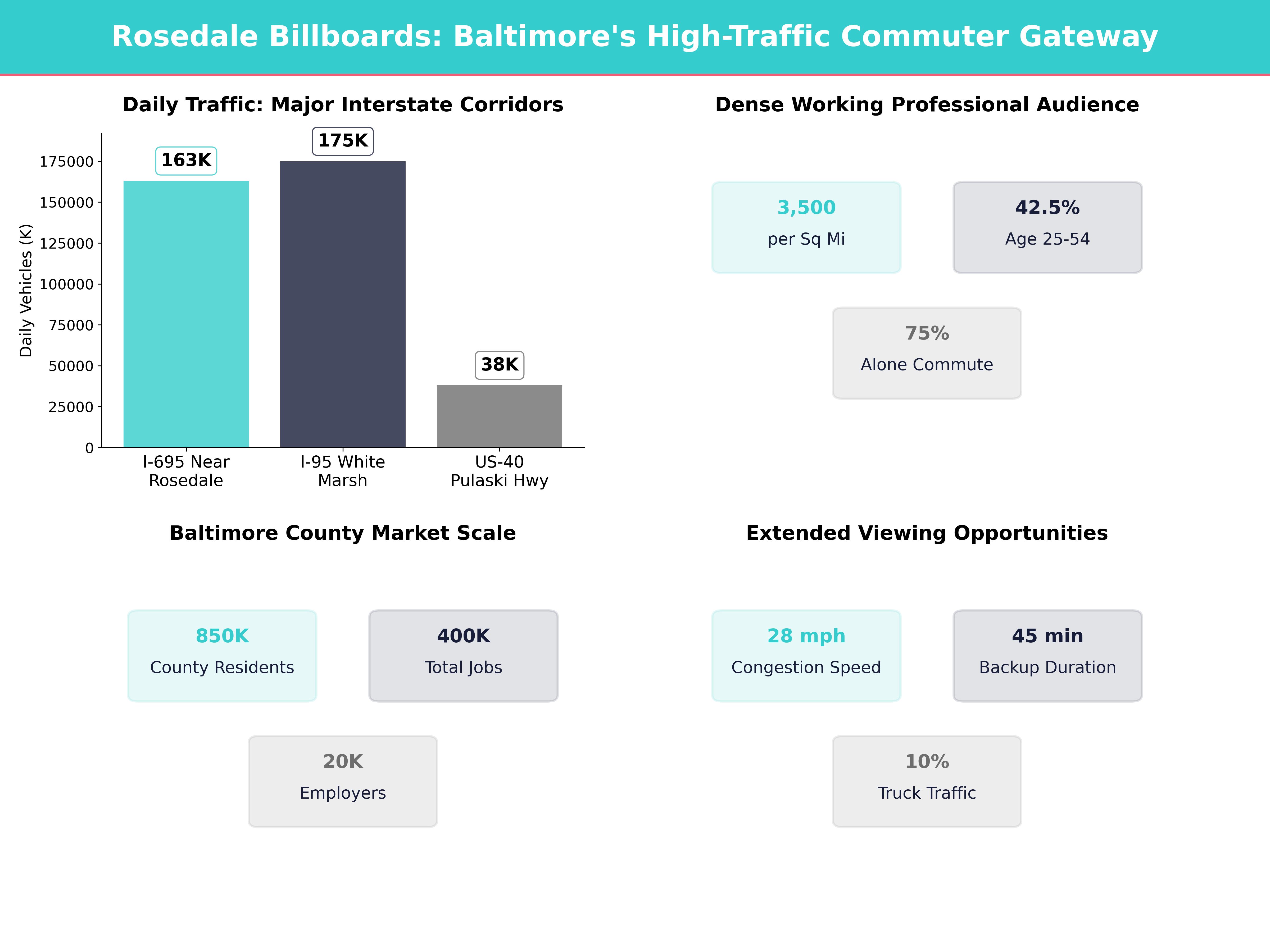
Rosedale is an unincorporated community and census-designated place in eastern Baltimore County. According to planning data summarized by Baltimore County Government 850,000 residents across 612 square miles, and the Rosedale area contributes roughly 19,000–20,000 of those residents clustered just inside the Baltimore Beltway (I‑695). This places Rosedale within one of the largest counties in Maryland by population, accounting for around 2–3% of the county’s total residents in a relatively compact area, making Rosedale billboards particularly efficient at reaching a dense, close‑in audience.
Key context about the Rosedale area:
- Proximity to Baltimore City: Rosedale is only about 6–7 miles from downtown Baltimore, putting it within a short commute of major employers, hospitals, universities, and entertainment destinations. According to Baltimore City and Visit Baltimore more than 20 million visitors annually, many of whom travel via the I‑95 and I‑695 corridors that pass near Rosedale. This steady visitor volume makes billboard advertising near Rosedale a strong option for attractions and tourism-driven businesses.
- Commuter-heavy: Many residents work in Baltimore City, White Marsh, Dundalk, and other parts of Baltimore County, driving daily along I‑95, I‑695, US‑40 (Pulaski Highway), and Philadelphia Road. Regional transportation data from MDOT show that in the Baltimore region, more than 75% of workers commute by driving alone, with typical one‑way commute times in the 28–32 minute range—ideal for repeated billboard exposure along key routes.
- Economic mix: The immediate area includes warehouse and distribution centers, auto and service businesses along Pulaski Highway, medical facilities, and retail corridors that attract both local residents and pass-through traffic. According to Baltimore County Department of Economic and Workforce Development 20,000 employers and 400,000+ jobs, with strong clusters in logistics, healthcare, and retail that are well represented around Rosedale.
- Regional reach: The Rosedale area acts as a gateway between Baltimore City and northeastern suburbs like White Marsh, Middle River, and Nottingham, which are major shopping and dining hubs ( Visit Baltimore County 150 stores and restaurants at White Marsh Mall and The Avenue at White Marsh, drawing shoppers from across Baltimore County and beyond.
By placing messages on our digital billboards near Baltimore that serve the Rosedale area, advertisers can reach a market that is suburban enough to care about local services and family life, yet urban-adjacent enough to support diverse, higher-frequency campaigns. The combination of dense housing, steady employment, and high traffic volume translates into a broad but locally grounded audience, and it’s why many businesses choose billboard advertising near Rosedale for both branding and direct-response goals.
Traffic and Commuting Patterns Near Rosedale
To build an effective digital billboard strategy, it helps to understand how and when people move near Rosedale.
Major Corridors
The Maryland Department of Transportation State Highway Administration (MDOT SHA) reports very heavy traffic volumes on the interstates that surround the Rosedale area:
- I‑695 (Baltimore Beltway, eastern segment near Rosedale):
Recent MDOT SHA Average Annual Daily Traffic (AADT) counts show segments near Rosedale carrying roughly 150,000–175,000 vehicles per day, with truck traffic often accounting for 8–12% of the total volume due to nearby industrial and warehouse activity. - I‑95 northeast of the Baltimore City line (White Marsh/Rosedale approach):
AADT counts are typically in the 160,000–190,000 vehicles per day range, making this one of the heaviest-traveled stretches of interstate in Maryland. Peak summer and holiday weekends can push volumes even higher as beach and long-distance travelers pass through. Strategically placed billboards near Rosedale along this corridor capture both local commuters and regional travelers. - US‑40 / Pulaski Highway near Rosedale:
Different segments average 30,000–45,000 vehicles per day, depending on the exact location. This puts Pulaski Highway in line with some of the region’s busier urban arterials and provides strong exposure for more localized, neighborhood-focused messaging.
Our 3 digital billboards located in Baltimore serving the Rosedale area are positioned to capture these flows as commuters and shoppers head:
- West and southwest toward downtown Baltimore and the Inner Harbor ( Visit Baltimore
- Northeast toward White Marsh Mall and The Avenue at White Marsh
- South toward Port of Baltimore–adjacent industrial areas and Dundalk (the Port of Baltimore handles more than 40 million tons of cargo annually and supports tens of thousands of regional jobs)
- Around the Beltway toward Towson, Hunt Valley, and other Baltimore County employment centers, including large office and medical hubs near Towson University GBMC HealthCare
These placement patterns make Rosedale billboards a flexible tool for campaigns that need to reach both city-bound traffic and shoppers heading toward northeastern suburbs.
Rush-Hour Peaks
Local traffic reports from outlets like WBAL-TV and The Baltimore Sun consistently highlight congestion on:
- I‑95 near the I‑695 interchange
- I‑695 between the I‑95 and I‑83 interchanges
Regional congestion analyses often rank these segments among the more delay-prone in the Baltimore metro area, with average speeds in peak periods frequently dropping to 20–35 mph and incident-related backups lasting 30–60 minutes or more.
From these patterns, we can assume:
- Morning peak: Approximately 6:30–9:00 a.m., heavy inbound traffic toward downtown and major employment centers.
- Midday mini-peak: Around 11:00 a.m.–1:00 p.m., a noticeable rise in volumes tied to service, delivery, and lunch travel.
- Evening peak: Approximately 3:30��7:00 p.m., outbound traffic returning to the Rosedale area and northeastern suburbs, with Friday evenings often the heaviest.
With Blip’s scheduling tools, we can concentrate impressions during these known congestion times when cars are moving slowly and have more dwell time to notice your creative. Because average digital billboard ad plays last 7.5–10 seconds, slower traffic significantly increases the likelihood of full ad views, which is especially valuable for advertisers investing in billboard advertising near Rosedale’s busiest interchanges.
Who You Reach in the Rosedale Area
While Rosedale itself is a defined area, our Baltimore-based billboards serving the Rosedale area also reach a broader Baltimore County audience moving between the city, the Beltway, and northeastern suburbs.
Demographic Snapshot
Drawing on data summarized by Baltimore County Government Baltimore County Public Schools
-
Population density:
- Baltimore County averages roughly 1,350 residents per square mile; Rosedale-area zip codes such as 21237, 21224, and 21206 are more densely populated, commonly exceeding 3,000–4,000 residents per square mile in many neighborhoods.
- This density—combined with clustered retail and employment centers—supports high repeat exposure for local campaigns and makes billboard rental near Rosedale an efficient way to generate frequency.
-
Age distribution: The area skews toward working-age adults and families:
- Strong representation of 25–54-year-olds, often making up 40–45% of the local population—ideal for campaigns related to careers, financial services, home improvement, and healthcare.
- Significant population of school-aged children and teens (5–17); BCPS 111,000 students countywide, and schools around Rosedale feed heavy morning and afternoon traffic, benefiting family-oriented campaigns.
- Household structure: Many nearby communities have two- and three-person households as the most common sizes, with a substantial share of married-couple families and single-parent households, supporting messaging about convenience, savings, and family time.
- Income range: Household incomes in nearby Baltimore County communities generally span mid- to upper-middle levels, with many neighborhoods in the $60,000–$100,000+ range and some pockets above $120,000. This supports a mix of value-driven and premium product advertising—everything from discount retail to higher-end home services and healthcare.
- Commuting and car ownership: Regional transportation profiles indicate that in Baltimore County, more than 90% of households have at least one vehicle, and a majority have two or more, underscoring the importance of roadway-based advertising like billboards.
Lifestyle & Key Sectors
Based on coverage from Baltimore County tourism
- Family-oriented: Parks, youth sports, and school activities are important. Baltimore County operates more than 200 parks and recreation sites, with multiple ballfields, playgrounds, and community centers within a 10–15 minute drive of Rosedale. Messages tied to family life, safety, and convenience perform well.
- Healthcare-focused: The area is close to major healthcare employers and facilities, including Johns Hopkins–affiliated centers, MedStar Health locations, and local clinics. Healthcare is one of the largest employment sectors in the county, supporting tens of thousands of jobs; this makes the Rosedale corridor strong ground for campaigns promoting primary care, urgent care, dental services, and specialty medical practices.
- Retail and dining: Residents frequent White Marsh Mall, The Avenue at White Marsh, and big-box corridors along Route 40 and White Marsh Boulevard. These hubs feature dozens of national and local brands, with extended evening and weekend hours that align well with billboard visibility. Quick-service restaurants, local eateries, and specialty retailers can use billboards to steer traffic from the interstates to their doors, especially within a 3–5 mile radius.
- Industrial and logistics: Eastern Baltimore County, including the Rosedale/Dundalk/Port areas, has a heavy concentration of warehouses, trucking firms, and industrial employers. Baltimore County Economic and Workforce Development
Timing Your Campaigns Throughout the Year
Digital billboards let us adapt quickly to local rhythms around the Rosedale area. We recommend aligning your campaign calendar to these patterns, informed by school schedules, retail seasons, and tourism trends.
Winter (January–March)
- Post-holiday sales and tax prep: Retail and service businesses can capture consumers refocusing on essentials after holiday spending. Local and regional tax preparers often see activity rise 20–40% between late January and mid‑April.
- Healthcare and fitness: Flu season and New Year’s resolutions drive demand. Health-related visits often spike in January and February; urgent care centers and gyms can benefit from heavier exposure during this period.
- Commuter focus: Shorter daylight hours mean more commuters driving in the dark; bright, high-contrast creative works well against winter skies. According to MDOT SHA, winter weather-related incidents can further slow traffic, temporarily boosting dwell time on billboards near interchanges.
Spring (April–June)
- Home improvement and real estate: As weather warms, campaigns for contractors, roofers, landscapers, and real estate agents can reach homeowners in the Rosedale area planning projects and moves. Spring is traditionally one of the strongest listing seasons; regional housing data often show 30–50% more listings compared with winter months.
- Education and summer programs: K‑12 and college messaging, summer camps, and kids’ activities perform strongly before school lets out (BCPS typically ends the academic year in June). Enrollment drives for camps, enrichment programs, and sports leagues tend to peak April–early June, making this a prime window for billboard visibility.
- Event marketing: Promote festivals, concerts, and Orioles games drawing people into Baltimore City; leverage directional creatives (“Next exit,” “10 minutes ahead”) to capture interstate travelers. Oriole Park at Camden Yards welcomes more than 1.3–1.5 million fans in a typical season, many of whom use the I‑95 and I‑695 corridors that Rosedale traffic feeds.
Summer (July–August)
- Travel and local attractions: Residents make day trips to the Inner Harbor, waterfront areas, and regional destinations. Visit Baltimore Visit Maryland tens of millions of annual visitors and billions in tourism spending. Ads for attractions, museums, and entertainment can catch families traveling near Rosedale on I‑95 and I‑695.
- Seasonal hiring: Retailers, hospitality businesses, and warehouses can run recruitment campaigns when seasonal hiring spikes. Many businesses ramp up staff by 10–25% leading into summer weekends and peak travel periods.
- Heat and vehicle services: High temperatures increase demand for HVAC repair, auto AC service, and tire checks. Local news outlets frequently highlight heat advisories from Baltimore County Government
Fall (September–December)
- Back-to-school and college: Use early August through September for schools, tutoring centers, and college recruitment. With more than 170 BCPS schools and centers, back-to-school traffic contributes to heavier weekday flows around major corridors leading into and out of the Rosedale area.
- Healthcare and benefits: Open enrollment periods for health insurance and employee benefits typically occur in the fall—ideal for insurers and HR-driven campaigns. Employers often communicate benefits options from October through early December, aligning with a strong window for health-focused billboard messaging.
- Holiday retail and dining: From October through December, the Rosedale area experiences heavy shopping traffic around White Marsh and Towson; Visit Baltimore County 20–30% of annual sales.
Dayparting: Reaching the Right People at the Right Time
Blip’s flexible scheduling lets us bid for specific hours and days. For the Rosedale area, we generally suggest:
-
Early morning (5:30–7:30 a.m.):
- Ideal for coffeeshops, breakfast QSR, transit services, and employers recruiting early-shift workers. Regional employment data indicate that a notable share of logistics and manufacturing shifts begin before 7:00 a.m., especially around industrial corridors near I‑95 and I‑695.
-
Traditional rush hour (7:30–9:00 a.m. and 4:00–6:30 p.m.):
- Best for professional services, healthcare, higher education, and any brand seeking maximum commuter reach. With corridor volumes exceeding 150,000–180,000 vehicles per day, allocating more budget to these windows can deliver a higher concentration of impressions.
-
Midday (11:00 a.m.–2:00 p.m.):
- Target office workers and service employees on lunch breaks; good for restaurants, retail promotions, and appointment-based services. Many restaurants report lunchtime accounting for 25–35% of daily sales, making lunchtime-focused creatives especially valuable.
-
Evenings and weekends:
- Focus on entertainment, family activities, shopping, and dining decisions that are often made just before heading out. Weekend traffic to malls and big-box centers often spikes 20–40% above weekday baselines, especially in November and December.
Because traffic near the Rosedale area interchanges is consistently heavy during peak hours, prioritizing those windows can generate more impressions per dollar. However, off-peak inventory may come at lower bid prices, which can be attractive for budget-conscious advertisers who want steady frequency and are less constrained by time of day. This mix of peak and off-peak options makes billboard rental near Rosedale adaptable to a wide range of budgets.
Crafting Effective Creative for the Rosedale Area
To connect with drivers near Rosedale, you’ll want artwork that reflects both the local character and the fast-read nature of digital billboards.
Visuals That Work
- Bold, high-contrast color: Use strong contrasts (dark backgrounds with bright text or vice versa) so your creative pops against the often gray or overcast Mid-Atlantic sky. This is especially important in winter months, when daylight is limited to roughly 9–10 hours per day.
- Simple imagery: One central image or icon works best—think a product shot, a happy customer, or a recognizable landmark like the Baltimore skyline, Inner Harbor, Oriole Park, or the Key Bridge area to anchor your message.
- Local cues: References like “Just off I‑95,” “Near White Marsh,” or “Serving the Rosedale area” immediately signal relevance. Including estimated drive times like “5 Minutes from This Exit” can help capture attention from drivers deciding where to stop and distinguishes Rosedale billboards from more generic regional placements.
Messaging Guidelines
Considering average highway speeds and MDOT’s focus on safety and distraction reduction:
- 7 words or fewer: Keep the main message extremely concise: “Urgent Care Near Rosedale – Open 24/7” or “New Homes Near I‑95 From $400s.” Shorter copy improves legibility at speeds of 45–65 mph, where drivers typically have only 3–6 seconds to process a message.
- Single call to action: Choose one clear action: visit website, call, or take a nearby exit. Overloading drivers with multiple asks lowers recall.
- Readable typography: Use large, sans-serif fonts; avoid scripts and thin weights. Based on common readability guidelines, aim for main text heights of at least 18–24 inches on standard-size digital faces.
- Directional language: If your business is near a specific exit or landmark, highlight it: “Exit 64 – Next Right,” “2 Miles Ahead at Pulaski Hwy.” This is particularly effective given the frequent decision points at I‑95/I‑695 and key exits serving Rosedale and White Marsh.
Rotating Creative with Blip
Because Blip supports multiple creatives within one campaign, we can:
- Test different headlines (“Same-Day Dentistry” vs. “Emergency Dental Near Rosedale Area”) and monitor which generates more engagement (e.g., corresponding website traffic or search volume). Many advertisers see 10–30% performance swings between their best- and worst-performing creatives.
- Run time-specific messages—like “Lunch Specials 11–2” vs. “Dinner & Happy Hour Tonight”—during different dayparts, aligning with known traffic surges and sales peaks.
- Localize by direction: creative facing inbound traffic might emphasize downtown events, while outbound-facing creative might highlight local services and residential offerings near Rosedale.
Matching Campaign Strategy to Business Goals
Different industries can use the same boards serving the Rosedale area in distinct ways. Here are a few strategic approaches:
Local Services and Healthcare
Primary care, urgent care, dental, and specialty clinics near Rosedale can:
- Focus on radius-based awareness: “Family Doctor Serving the Rosedale Area – New Patients Welcome.” Many healthcare providers draw 70–80% of their patients from within a 5–10 mile radius, making targeted local billboards highly effective.
- Schedule heavier weekday morning and late afternoon impressions when residents think about appointments and school or work schedules.
- Use reassurance messaging: highlight same-day appointments, walk-ins, or extended hours. Healthcare campaigns that promote 24/7 access or urgent care often see higher response during flu season and winter months, when Baltimore County Department of Health
Home Services and Real Estate
Roofers, HVAC companies, landscapers, property managers, and real estate agents can:
- Target spring and fall with seasonal maintenance and move-in messaging. Many regional housing markets experience 20–40% more closings in late spring and early summer compared with winter, making pre-listing and pre-move campaigns particularly timely.
- Use distance-based copy: “Roof Leaks? We’re 10 Minutes from the Rosedale Area.” Clear proximity messages are especially effective along I‑95 and I‑695, where multiple service options compete for attention.
- Connect to weather events: after heavy storms or heat waves (often covered by outlets like WBAL NewsRadio and The Baltimore Sun), quickly swap creatives to highlight emergency services. The Mid-Atlantic region averages 30–40 thunderstorm days per year, providing recurring opportunities for storm-related messaging.
Retail, Dining, and Entertainment
Restaurants, retailers, and venues drawing customers from the Rosedale area can:
- Run weekend-heavy schedules to match shopping and dining patterns. Studies of retail traffic commonly show Saturdays and Sundays accounting for 35–45% of weekly in‑store visits.
- Promote limited-time offers, especially around holidays and paydays (1st and 15th of the month). Time-bound promotions often generate noticeable short-term lift in store visits and website traffic.
- Use directional CTAs: “Turn Right at Next Exit for White Marsh Dining.” With regional shopping centers attracting thousands of visitors per day during peak seasons, even a small share of diverted traffic can yield meaningful incremental sales. For brands that depend on in-person visits, billboard advertising near Rosedale’s retail corridors can be a powerful traffic driver.
Recruitment and Workforce Campaigns
Given the industrial and logistics footprint near the Rosedale area and the Port of Baltimore:
- Warehouses, trucking companies, and manufacturers can target early morning and late evening shifts, when potential applicants are commuting. Many industrial and logistics operations run two or three shifts, keeping hiring needs steady year-round.
- Highlight starting pay (“Now Hiring – $22/hr + Benefits”), sign-on bonuses, or paid training. Regional wage data show that clear pay transparency can meaningfully improve application rates for blue-collar and logistics roles.
- Consider bilingual messaging if your workforce includes significant Spanish- or other language-speaking communities; in many Baltimore-area neighborhoods, multilingual signage is increasingly common and can improve response rates.
Budgeting and Optimization with Blip
Blip allows you to set a budget as low as a few dollars per day and bid on each “blip” (a single 7.5–10 second ad play). To make the most of this flexibility near the Rosedale area:
- Start with a test budget: For example, allocate $20–$50 per day for 2–4 weeks to understand how many impressions your bid level yields on the Baltimore boards serving the Rosedale area. Depending on competition and time of day, this can translate into hundreds to thousands of plays per day.
- Prioritize high-value times: Begin by focusing on rush-hour blocks, then expand into off-peak times if you want added frequency. On heavily traveled corridors like I‑95 and I‑695, even a modest number of peak-time blips can deliver exposure to tens of thousands of vehicles over the course of a week.
- Adjust bids by competition: If multiple advertisers are targeting the same prime hours, gently raising your bid can help secure more plays. When demand is lower—such as mid-mornings or later evenings—lower bids can still win consistent inventory.
- Monitor results: Track correlated metrics—website sessions from the local area, direct traffic spikes, coupon redemptions, call volume, or new customer mentions (“I saw you on the billboard”). Many small and mid-sized businesses see noticeable lifts in brand recall and search activity within 1–2 weeks of launching a concentrated billboard campaign. Use this feedback to refine creative and scheduling.
For cost-conscious marketers, this approach makes billboard rental near Rosedale accessible without committing to long-term, fixed-price contracts.
Compliance, Safety, and Local Considerations
Maryland and Baltimore-area regulations are aimed at maintaining roadway safety and aesthetic standards. While we handle compliance on the billboard side, it helps to keep a few principles in mind:
- Avoid excessive small text: MDOT SHA encourages minimizing distractions; small, dense copy isn’t just ineffective—it may be disallowed. Legibility guidelines typically recommend no more than 1–2 short lines of main copy plus a logo or simple URL.
- No misleading claims: Ensure that offers, prices, and time-sensitive claims are accurate and up to date. Local consumer protection laws enforced by the Maryland Attorney General and county agencies can apply to advertising across all media.
- Family-friendly content: With a large share of families and school traffic in the Rosedale area, keep content appropriate for all ages. Roads around schools and youth recreation facilities see daily activity spikes in the 7:00–9:00 a.m. and 2:00–4:00 p.m. windows.
You can review broader transportation and safety context through MDOT SHA and local updates via Baltimore County Government WBAL-TV and WMAR-2 News are valuable resources.
Putting It All Together
Advertising on digital billboards near Baltimore that serve the Rosedale area gives you access to:
- Daily exposure to hundreds of thousands of vehicles moving along I‑95, I‑695, and major arterials like US‑40 and White Marsh Boulevard.
- A diverse audience of working families, commuters, industrial workers, and shoppers, with local population counts in adjacent zip codes reaching tens of thousands of residents each.
- The ability to start small, test quickly, and scale based on performance using Blip’s flexible bidding and scheduling, adjusting your budget by as little as a few dollars per day.
By aligning your creative, timing, and targeting with the specific movement and lifestyle patterns of people near the Rosedale area—and using credible local data from sources like Baltimore County Government Visit Baltimore County MDOT SHA—we can design campaigns that do more than generate impressions: they drive real, measurable results for your business and make your investment in billboards near Rosedale work harder across your entire marketing mix.