Billboards in Norridge, IL
No Minimum Spend. No Long-Term Contracts. Just Results.
Turn everyday drivers into your next customers with Norridge billboards powered by Blip. Launch eye-catching billboards near Norridge, Illinois in minutes, set any budget, and play your ads on flexible schedules that fit the rhythm of the Norridge area.
Trusted by Leading Brands


Billboard advertising
in Norridge has
never been easier
HERE'S HOW IT WORKS
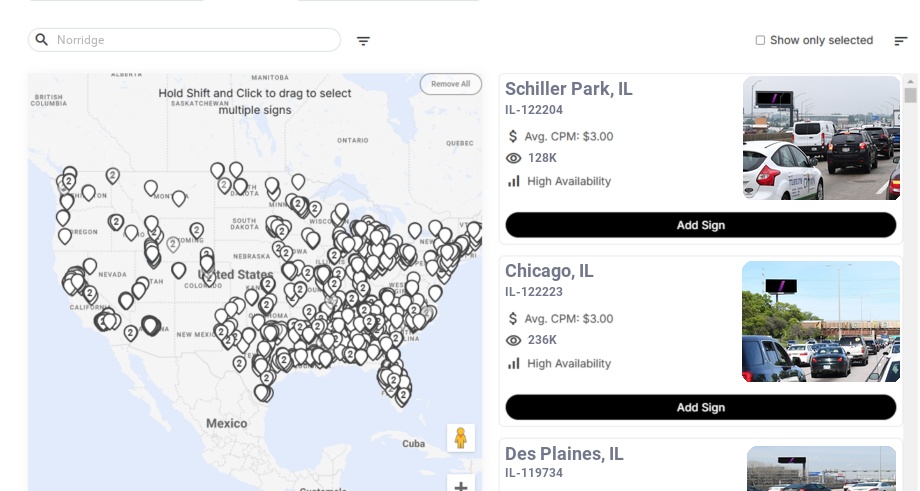
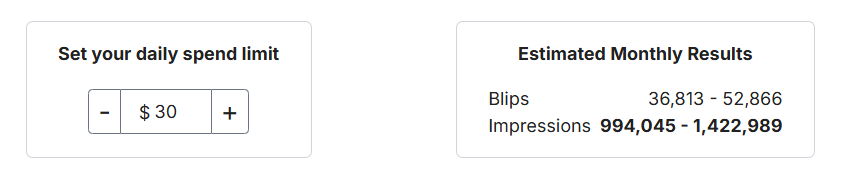
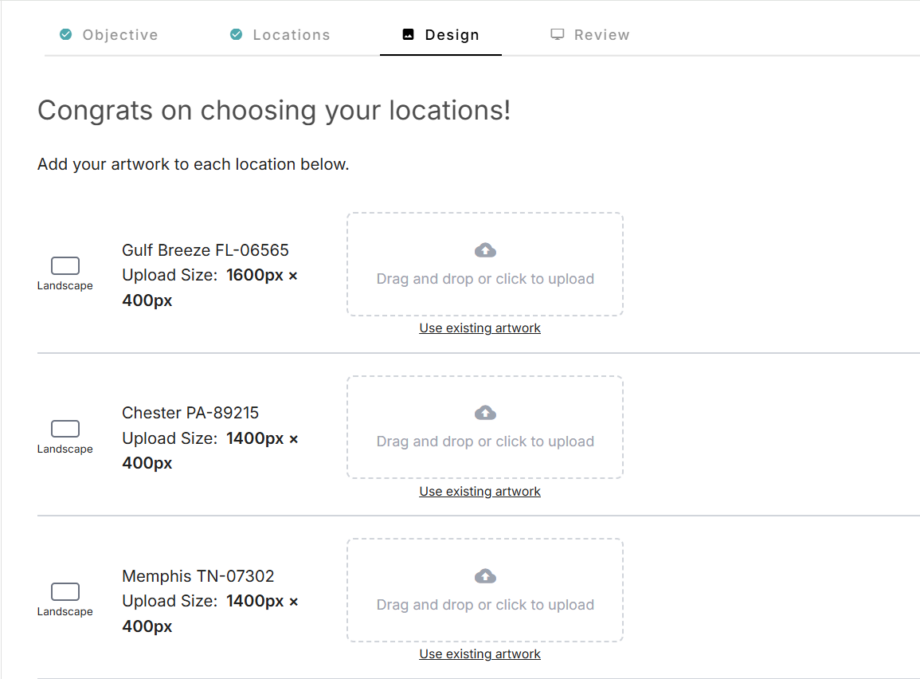
How much is a billboard in Norridge?
Billboards in other Illinois cities
Norridge Billboard Advertising Guide
The Norridge area sits at a powerful crossroads of dense neighborhoods, destination retail, and one of the busiest airports in the world. With 53 digital billboards serving the Norridge area in nearby cities like Harwood Heights Rosemont, Schiller Park, Des Plaines Melrose Park, Stone Park, North Riverside, and Chicago, we can help you turn this everyday movement into measurable attention for your brand. This guide walks through how to use those Norridge billboards strategically to reach people who live, work, shop, and travel near Norridge, Illinois and to plan billboard advertising near Norridge that fits your goals and budget.
Understanding the Norridge Area Market
Norridge is a compact but highly concentrated community on Chicago’s Northwest Side. According to the Village of Norridge
Key demographic and market characteristics to keep in mind:
-
Older, established households:
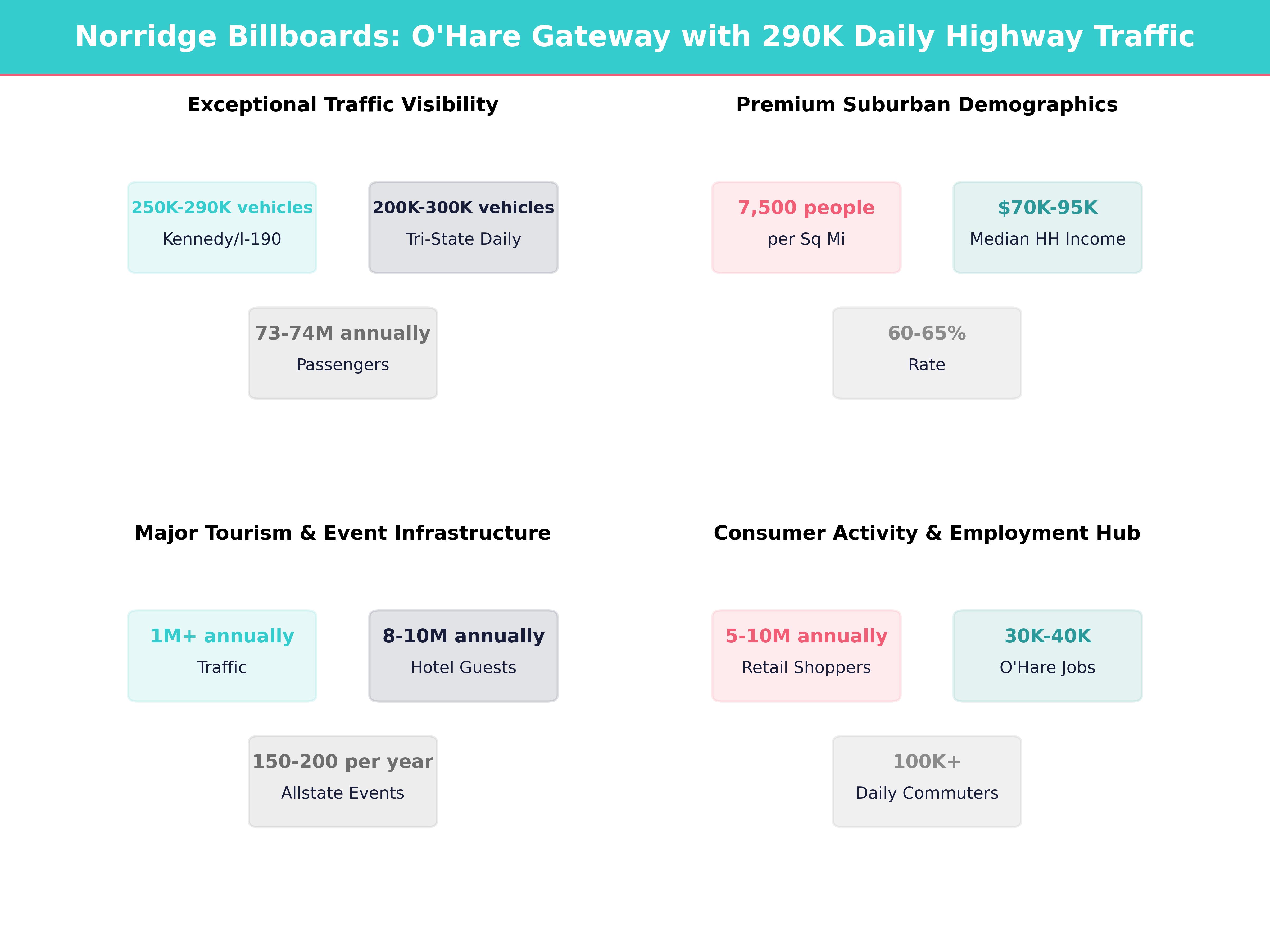
Recent estimates put Norridge’s median age around the mid‑40s, several years higher than the broader Chicago metro’s median in the mid‑30s. In many nearby blocks, more than 60–65% of occupied housing units are owner-occupied, and over 25–30% of households include someone aged 65 or older. This favors messaging for:- Financial services (retirement, investments, estate planning)
- Home improvement and real estate (roofing, windows, remodeling)
- Healthcare, especially specialists and clinics (cardiology, orthopedics, dental)
- Higher-consideration purchases (autos, insurance, retirement planning)
-
Ethnically diverse, with strong European roots:
Norridge and neighboring Harwood Heights have long-standing Polish, Italian, and other Central/Eastern European communities—some estimates put people of Polish ancestry at 30%+ of local residents—alongside growing Latino and other populations. Nearby Chicago neighborhoods such as Dunning and Portage Park are also heavily Polish- and Latino-identifying. Ads that acknowledge cultural traditions, food, and family can resonate particularly well, especially around holidays when 70–80% of households report gathering with extended family. -
Regional pull beyond the village limits:
Major destinations like Harlem Irving Plaza Allstate Arena, the Donald E. Stephens Convention Center, and O’Hare International Airport- Harlem Irving Plaza spans more than 700,000 square feet of retail and features over 140 stores and restaurants, drawing shoppers from multiple ZIP codes.
- Allstate Arena seats up to 18,500 people for concerts and sporting events, with many events drawing 8,000–15,000 attendees.
- The Donald E. Stephens Convention Center offers roughly 840,000 square feet of exhibition space and hosts more than 1 million visitors annually, according to Meet Chicago Northwest
By using billboards near Norridge, we’re not just speaking to 15,000 locals—we’re tapping into daily flows of tens of thousands of shoppers, commuters, and travelers moving around the Northwest Side and near O’Hare. That makes billboard advertising near Norridge a strong complement to your digital and in‑store marketing.
Where the 53 Digital Billboards Reach the Norridge Area
Our 53 digital billboards serving the Norridge area are concentrated in nearby corridors that locals rely on every day. Average daily traffic (ADT) counts from the Illinois Department of Transportation and local agencies routinely range from 20,000 to over 250,000 vehicles depending on the roadway. This cluster of Norridge billboards and nearby inventory gives you multiple options for billboard rental near Norridge that match your ideal customer routes.
-
Harwood Heights & Norridge edge (≈1–2 miles)
Boards along Harlem Ave and near major retail clusters catch:- Shoppers heading to Harlem Irving Plaza and neighboring big-box centers. IDOT counts on Harlem Avenue near the HIP often exceed 30,000 vehicles per day, and peak Saturday shopping hours can see 1,500–2,000 vehicles per hour.
- Local traffic between the city-side neighborhoods (like Dunning and Portage Park) and nearby suburbs. These neighborhood arterials typically see 15,000–25,000 vehicles daily, creating consistent reach for everyday-service advertising and high-frequency billboard advertising near Norridge.
-
Rosemont, Schiller Park & Des Plaines (≈2–4 miles)
These locations are ideal for capturing:- Drivers approaching or leaving O’Hare via I‑190, I‑90, and I‑294. Near the airport, the Kennedy Expressway and I‑190 corridor can exceed 250,000–290,000 vehicles per day, according to data referenced by the Chicago Department of Transportation.
- Event-goers heading to Allstate Arena, Rosemont Theatre, and the Convention Center—on major concert or sports nights, the Rosemont entertainment district can attract 20,000–30,000 visitors in a single evening.
- Workers at the airport and in the surrounding office/industrial parks; O’Hare itself supports well over 30,000–40,000 on-site jobs, and the broader airport economic area supports tens of thousands more.
-
Melrose Park, Stone Park & North Riverside (≈5–8 miles)
Billboards along major east–west routes like North Ave and Cermak serve:- Everyday shopping trips to malls, auto dealers, and big-box clusters. IDOT volumes on these segments often range from 25,000–45,000 vehicles per day, with weekend retail peaks.
- Commuters cutting between the West Side of Chicago and the western suburbs, where rush hours can see 1,200–1,800 vehicles per hour** in each direction.
-
Chicago (≈9–10 miles)
Boards just inside the Chicago city limits help:- Extend your Norridge-area presence into nearby Chicago neighborhoods with populations of 40,000–60,000 residents per community area.
- Reach urban commuters who shop or work near Norridge, Rosemont, and the Northwest Side; many of these corridors are on CTA and Pace bus routes, adding visibility to transit users.
Together, these boards build a “ring” of visibility around Norridge, allowing you to design campaigns that follow your audience as they shop, commute, and travel, and to scale billboard rental near Norridge from hyper-local to regional coverage.
Traffic Patterns and Commuter Flows to Leverage
The Norridge area is defined by road and transit movement. Understanding those patterns will help you choose which boards, and what times of day, matter most.
Highways and major arterials
-
I‑90 (Kennedy Expressway) & I‑190:
According to data cited by the Chicago Department of Transportation, the Kennedy corridor near O’Hare can see well over 250,000 vehicles per day on busy segments, with some stretches approaching 290,000. Boards in nearby Rosemont and Des Plaines intercept:- Airport travelers (business and leisure) from O’Hare’s 73–74 million annual passengers
- Suburban commuters heading to and from the city—regional estimates suggest more than 100,000 workers commute into the central city from northwest suburbs daily
- Logistics and freight traffic tied to O’Hare and adjacent industrial zones; the airport area handles millions of tons of air cargo annually, feeding continuous truck traffic
-
I‑294 (Tri‑State Tollway):
The Tri‑State near O’Hare is one of the heaviest-traveled toll segments in Illinois, with many stretches carrying 200,000–300,000 vehicles per day, according to the Illinois Tollway. Rush hours routinely stretch beyond the typical 7–9 a.m. and 4–6 p.m. windows, often peaking as early as 6:30 a.m. and as late as 7 p.m. This extended peak makes drive-time scheduling particularly valuable. -
Harlem Ave, Cumberland Ave, Irving Park Rd, Lawrence Ave & Foster Ave:
These surface streets carry steady all-day volumes between city neighborhoods, Norridge/Harwood Heights, and the airport/office parks, often in the 20,000–35,000 vehicles per day range. They’re prime for:- Retail and restaurant promotions, especially given that households in the broader Northwest Side often spend $3,000–$4,000 per year on food away from home
- Local service providers (medical, legal, education, trades) that rely on a 3–8 mile draw radius
- Quick-response messages: “Next Right,” “2 Miles Ahead,” or “5 Min from This Sign,” which align with average arterial speeds of 25–35 mph and work especially well on Norridge billboards positioned near key turns and intersections.
Transit and airport flows
-
O’Hare International Airport:
According to Chicago’s official O’Hare statistics 73–74 million passengers in 2023, averaging about 200,000 passengers per day, and more than 2.5 million international passengers in peak months. Many stay in hotels and attend events in Rosemont—and travel directly through the Norridge area by car, shuttle, or rideshare. Boards near Rosemont and Schiller Park are ideal for:- Hotels, entertainment, and dining that target the more than 8–10 million annual visitors staying in the O’Hare/Rosemont hotel cluster
- Tourist attractions throughout Chicagoland, as a sizable share of these passengers have layovers or overnight stays
- Transportation services and parking; off-airport parking operators typically serve tens of thousands of vehicles yearly
-
CTA & Pace transit:
The nearby CTA Pace bus routes on Harlem and Irving Park, generate park-and-ride traffic and last-mile driving.- Pre‑pandemic, the Blue Line recorded average weekday ridership above 150,000; recent ridership has rebounded to tens of thousands of daily riders, with the O’Hare branch carrying a large share of that volume.
- Pace routes serving the O’Hare and Northwest Side corridors carry thousands of riders per weekday, often with 70–80% of riders using the system at least three times per week.
Billboards near these nodes can reinforce: - Subscription services and apps (seen repeatedly by regular riders who pass the same signs on 10–20+ trips per month)
- Local businesses near park-and-ride lots and stations
When you plan a schedule in Blip, aligning your spend with these daily flows—commute, shopping hours, game nights, and flight bank times—will dramatically increase your odds of being seen by the right people at the right moment and maximize the value of any billboard rental near Norridge.
Audience Profiles Near Norridge: Who You’re Reaching
To craft effective creative and scheduling, think in terms of distinct Norridge-area audience segments:
-
Local homeowners and families
- Typically middle-income or above; median household incomes in nearby Northwest Side suburbs and neighborhoods often run in the $70,000–95,000 range.
- Many households have roots in the area for 10+ years, and owner-occupancy rates commonly exceed 60%.
-
High propensity for:
- Home services (HVAC, roofing, landscaping, security)
- Family healthcare and dental practices; households in similar suburbs average 3–4 medical visits per person per year
- Financial planning and insurance—particularly life and retirement products for the area’s older skew
- Best reached via boards in Harwood Heights, Norridge-adjacent Chicago, Melrose Park, and Stone Park along neighborhood arterials, making Norridge billboards a natural fit for consistent, hyper-local visibility.
-
Airport and logistics workers
- Tens of thousands work at O’Hare and nearby warehousing/distribution centers on all shifts. Regional analyses of the O’Hare jobs hub indicate that total employment in the broader airport area exceeds 100,000 positions.
- A large share of these workers commute from within a 10–20 mile radius, frequently using I‑90, I‑294, and arterial roads like Irving Park and Lawrence.
-
Ideal for:
- Recruitment ads (drivers, warehouse staff, mechanics, hospitality) in an environment where logistics and hospitality turnover often exceeds 30% annually
- Quick-service restaurants and convenience retail positioned for grab-and-go visits before or after shifts
- Training schools (CDL, aviation tech, trade programs) tapping into a workforce where many are looking to upskill
- Focus boards in Rosemont, Schiller Park, and Des Plaines with heavy pre-dawn and late-night scheduling to match shift changes.
-
Business travelers and convention attendees
- O’Hare’s ~73–74 million annual passengers and Rosemont’s constant convention calendar (outlined on the Rosemont tourism site) feed a steady stream of professionals.
- Large trade shows at the Stephens Convention Center can draw 10,000–50,000 attendees over several days, and multi-show months can bring 100,000+ event visitors to Rosemont alone.
-
Great audience for:
- Higher-end restaurants and nightlife in Rosemont’s entertainment district and Chicago’s downtown
- Corporate services, fintech, and B2B brands seeking broad regional recognition among decision-makers who attend conferences
- Attractions across Chicago—museums, sports, tours—especially as tourism organizations report millions of annual leisure visits to the city
- Aim for boards between O’Hare, Rosemont’s entertainment district, and the city, especially on event and check-in/check-out days (typically Mon–Thu and Sun).
-
Regional shoppers and entertainment seekers
- Harlem Irving Plaza alone draws visitors from multiple ZIP codes; centers of its size routinely attract 5–10 million shopper visits annually.
- Events at Allstate Arena or Rosemont Theatre bring thousands per event; Allstate Arena can host 150–200 events per year, and a single sold-out show can exceed 10,000 attendees.
-
Ideal for:
- Retail promotions and outlet centers, especially for audiences driving 5–15 miles for deals and specialty stores
- Gyms, studios, and personal care businesses that capture the 20–40% of adults who report visiting fitness or wellness services weekly
- Casinos, arcades, family entertainment centers—especially with households in this region often spending $2,000–3,000 per year on entertainment and recreation
- Concentrate impressions on Friday–Sunday and event nights, particularly in Rosemont, North Riverside, and Melrose Park corridors.
By mapping your specific target (e.g., “Norridge homeowners with older vehicles” or “convention visitors staying in Rosemont hotels”) to these segments, you can choose the right mix of boards and dayparts in Blip and decide where billboard advertising near Norridge will have the most impact.
Seasonal and Event-Driven Opportunities
The Norridge area’s calendar is packed with repeatable seasonal patterns you can build into your campaigns. Local sales and traffic data from regional retail districts show that peak seasonal windows can boost foot traffic by 20–50% versus off-peak weeks.
Winter (Dec–Feb)
- Holiday shopping at Harlem Irving Plaza and nearby big-box centers spikes foot and car traffic; November–December retail sales often account for 25–30% of annual revenue for many retailers.
- Weather-related needs (heating, snow removal, auto repair) surge as Chicago typically sees 30+ inches of annual snowfall and dozens of days below freezing.
-
Strategy:
- Heavy presence around retail corridors starting Black Friday through late December, when weekend traffic counts can climb 10–20% above fall averages.
- Simple, high-contrast designs to cut through snow, gray skies, and early darkness; sunset can occur as early as 4:20 p.m. in December.
- Consider 6–9 a.m. and 3–7 p.m. to catch holiday commuters and shoppers, as national data show 60–70% of holiday shopping trips happen after work or on weekends.
Spring (Mar–May)
- Home projects, tax season, graduations, and spring sports dominate, with home-improvement spending often climbing 15–25% from winter levels.
-
Strategy:
- Rotate creatives: tax services March–mid-April, home/garden April–May, with grad- or prom-related messaging in late April/May.
- Use boards along North Ave, Irving Park, and Harlem for neighborhood homeowners who are within a 10-minute drive of major home centers.
Summer (Jun–Aug)
- Travel season through O’Hare, summer festivals, and outdoor events in Rosemont drive strong leisure traffic. July and August are among the busiest months for airport passenger volumes.
-
Strategy:
- Increase spend near O’Hare/Rosemont for tourism-driven businesses, as hotel occupancies often rise 10–15 percentage points compared with winter.
- Promote family attractions, summer sales, and quick-service dining when families are on school break; local park districts such as the Norridge Park District
- Use time-of-day targeting to focus on weekend getaways and mid-day leisure trips (11 a.m.–4 p.m.), when non-commuter traffic dominates.
Fall (Sep–Nov)
- Back-to-school, football season, Thanksgiving travel. Back-to-school periods can contribute 15–20% of annual sales for apparel and school-supply retailers.
-
Strategy:
- Back-to-school messaging in August/early September near retail and transit, aimed at families visiting big-box centers and the HIP.
- Weeknight and weekend schedules keyed to Bears games or major college matchups, especially on routes from suburbs to city; game days can cause traffic increases of 10–25% on key corridors.
- Pre‑Thanksgiving and early November promotions near O’Hare and arterial roads to capture early holiday travelers.
You can use Blip’s scheduling to “pulse” your budget around these periods—raising your bid and impression share during the 4–6 weeks that matter most for your category, then maintaining a lighter, always-on presence the rest of the year. This approach keeps your Norridge billboards relevant to what locals and visitors are actually doing that month.
Crafting Creative that Works Near Norridge
In a fast-moving, visually cluttered environment, creative discipline is essential. For Norridge-area boards, we recommend:
1. Design for 2–3 seconds of viewing time
- Limit to 7–9 total words plus a logo and URL or short call-to-action; research on out-of-home recall shows that messages with 10 words or fewer can achieve up to 75% higher comprehension than denser copy.
- Use one primary focal point—a product, face, or icon—to reduce cognitive load in those 2–3 seconds.
- Avoid dense details like bullet lists or multiple offers; those belong on your landing page or in-store signage.
2. High contrast against Midwest skies
-
Winters are gray, and night comes early. Use:
- Light text on a dark background or vice versa
- Bold, saturated colors (reds, blues, yellows) that stand out against concrete and sky
- Large fonts—think roughly 6 ft+ tall in real-life scale, which typically equates to at least 12–18 inch characters in artwork for standard bulletins
3. Hyper-local hooks
Reference local landmarks and experiences recognized in the Norridge area:
- “5 minutes from Harlem & Irving”
- “Next exit for Rosemont hotels”
- “Off North Ave, just past 25th”
- “Serving the Norridge area since 1998”
These localized cues help convert a fleeting impression into a stored mental map: “That’s close to me.” Studies of out-of-home advertising show that geo-specific references can improve intent-to-visit by 10–20% vs. generic messaging. When you include these in billboard advertising near Norridge, you make it clear that your message is meant for people right where they are driving.
4. Multilingual or culturally aware messaging
Given the area’s ethnic mix, especially Polish and Italian roots and growing Latino communities:
- Consider bilingual headlines for certain campaigns (English + Polish or Spanish) if you’re targeting those communities specifically; in nearby Chicago neighborhoods, more than 40% of residents speak a language other than English at home.
- Tailor imagery around family gatherings, church events, and food traditions, especially for holidays like Easter, Christmas, and local festivals.
- Always keep legibility first—if using multiple languages, keep each line short and separate, and maintain that 7–9 word guideline overall.
5. Consistency across routes
If you’re using multiple boards around Norridge:
- Maintain a consistent color palette and core visual so that drivers on different routes recognize your brand; repeated exposure across 3–5 different boards can boost brand recall substantially compared with a single isolated location.
- Use variations only for the final call-to-action depending on direction (“Next Right” vs. “5 Minutes Ahead”).
Smart Scheduling and Budgeting with Blip in the Norridge Area
With 53 boards serving the Norridge area, it’s easy to overspread your budget without focus. Using Blip’s flexible bidding and scheduling tools, we recommend:
1. Define your primary objective
-
Brand awareness near Norridge:
- Use a broad mix of boards in Harwood Heights, Chicago-side neighborhoods, and Melrose Park.
- Run all day, but slightly heavier in morning and evening rush. On a busy corridor with 25,000–35,000 vehicles per day, even a modest share of impressions can net tens of thousands of weekly views.
-
Drive visits to a single location:
- Prioritize the 5–10 boards closest to your address and along natural approach routes, which keeps your frequency high; seeing an ad 5–10 times over a few weeks is often enough for strong recall.
- Use directional messaging and narrow your dayparts to your store’s peak hours (for many retailers, 11 a.m.–7 p.m.).
-
Event or short-term promotion:
- Concentrate your budget in the 7–14 days before the event, when ticket searches and RSVPs typically spike by 30–50%.
- Focus on boards along the specific routes your audience will travel (e.g., from Norridge to Rosemont venues).
2. Use dayparting to avoid waste
Align your spending with when your audience is on the road:
- B2B and services: 6–10 a.m. and 3–7 p.m. weekdays—these windows often capture 60–70% of daily commuter traffic.
- Family retail and dining: 3–8 p.m. weekdays; 10 a.m.–8 p.m. weekends, aligning with school dismissal times and family outing patterns.
- Nightlife and entertainment near Rosemont/Chicago: 5 p.m.–midnight Thu–Sat; hospitality businesses often see 50%+ of weekly revenue on these nights.
You can gradually test additional hours and only increase spend where performance improves.
3. Start with a focused footprint, then expand
Instead of buying low volume across 53 boards, you might:
- Start with 8–12 high-relevance boards (e.g., Rosemont + Harwood Heights + Melrose Park). At typical traffic volumes, that can provide exposure to hundreds of thousands of weekly vehicle trips.
- After 2–4 weeks, review which locations correlate best with store visits, web traffic, or search interest.
- Expand to a second “ring” of boards only where you see traction. This phased approach to billboard rental near Norridge helps you concentrate budget where it’s working.
Example Campaign Plays for the Norridge Area
To make these ideas concrete, here are a few patterns we see working well in markets like the Norridge area.
1. Local medical practice expansion
- Goal: Attract new patients within a 5–8 mile radius.
-
Tactics:
- Boards: Harwood Heights, Chicago near Harlem, Melrose Park. These corridors collectively see 50,000+ vehicles per day, giving you strong reach among nearby households.
- Schedule: 6–9 a.m. and 3–7 p.m. weekdays, lighter weekends, matching commute patterns of working families.
-
Creative:
- Headline: “New Clinic Serving the Norridge Area”
- Sub-line: “Same-Day Appointments – Exit at Harlem & Irving”
- Clear logo + easy URL.
- Measurement: Track new patients by ZIP code; practices often see noticeable lifts (e.g., 10–25% more new-patient calls) within a few weeks of sustained local out-of-home exposure.
2. O’Hare-area hotel or parking service
- Goal: Capture airport travelers and traveling workers.
-
Tactics:
- Boards: Heaviest in Rosemont, Schiller Park, Des Plaines, plus a few city-side boards for inbound traffic; these segments together can reach hundreds of thousands of daily vehicle trips tied to O’Hare.
- Schedule: Heavier during mornings (5–10 a.m.) and late afternoons/evenings (3–10 p.m.) when flights cluster; O’Hare’s departures and arrivals tend to peak in these windows.
-
Creative:
- Headline: “Airport Parking from $X/Day – 5 Min from O’Hare”
- Visual: Simple car + plane icon, bright color.
- Call-to-action: Short URL or QR code (for traffic near stoplights).
- Measurement: Use a unique promo code or parking rate (e.g., “NORRIDGE10”) and track how many bookings use it; many O’Hare-area services report that 5–15% of customers mention seeing an out-of-home ad when asked.
3. Retailer at or near Harlem Irving Plaza
- Goal: Drive in-store traffic and awareness in the Norridge shopping hub.
-
Tactics:
- Boards: Focus on Harwood Heights and nearby Chicago arterials feeding into Harlem and Irving, hitting shoppers within a 5–10 minute drive of the HIP.
- Schedule: 11 a.m.–8 p.m., with heavier Thu–Sun, when malls and lifestyle centers typically see 60–70% of weekly traffic.
-
Creative:
- Headline: “Today Only: 30% Off – At the HIP”
- Sub-line: “Inside Harlem Irving Plaza – 2 Min from This Sign”
- Seasonal variations (back-to-school, Black Friday, holiday) tied to known sales spikes of 20–40% over average weeks.
- Measurement: Compare daily sales vs. same day of prior weeks/years; track redemption of in‑store offers or QR codes specific to the billboard campaign.
These example plays all rely on billboards near Norridge and surrounding corridors to intercept people already on their way to shop, work, or travel.
Tracking, Learning, and Optimizing in a Local Context
Even though billboard impressions are inherently top-of-funnel, you can still gather data and refine your campaign:
- Use unique URLs or promo codes on your creative for Norridge-area boards, vs. other channels, to attribute responses. Many advertisers see 5–20% of redemptions or site visits come through these vanity paths when promoted consistently.
- Watch for search lift in Google Trends or your own analytics for branded keywords during your flight dates; a sustained out-of-home campaign can boost branded search volume by 10–30%.
- If you have multiple locations or service areas, compare sales or inquiries by ZIP code before, during, and after a heavy run around the Norridge area to see where lift concentrates.
- Monitor local news and event calendars from outlets like ABC 7 Chicago, the Chicago Sun-Times, the Chicago Tribune, WGN-TV Village of Norridge
Over a few months, you’ll build a clear picture of which boards, hours, and messages drive the best response from people who live near, work near, or pass through the Norridge area, and which types of billboard rental near Norridge are worth scaling.
Bringing It All Together
The Norridge area may be small on a map, but it sits at the center of some of the most valuable traffic and consumer flows in the Chicago region. With 53 digital billboards serving the Norridge area in nearby communities—from Harwood Heights and Rosemont to Melrose Park and Chicago—we can help you surround your ideal audience as they commute, shop, and travel with efficient billboard advertising near Norridge.
By combining local insight (who lives and moves near Norridge), disciplined creative (short, bold, and geo-specific), and precise scheduling (aligned with commute, shopping, and event patterns), you can build a billboard campaign that not only looks good on a screen, but also delivers real results on the ground. Whether you need always-on Norridge billboards for brand awareness or short-term billboard rental near Norridge for a key promotion, the surrounding network of signs gives you the flexibility to match your message to the market.