Billboards in Orland Park, IL
No Minimum Spend. No Long-Term Contracts. Just Results.
Turn daily drives into showtime with Orland Park billboards powered by Blip. Choose from 22 digital billboards near Orland Park, Illinois, set your own budget, and run playful, eye-catching messages that light up the Orland Park area exactly when your audience is on the move.
Trusted by Leading Brands


Billboard advertising
in Orland Park has
never been easier
HERE'S HOW IT WORKS
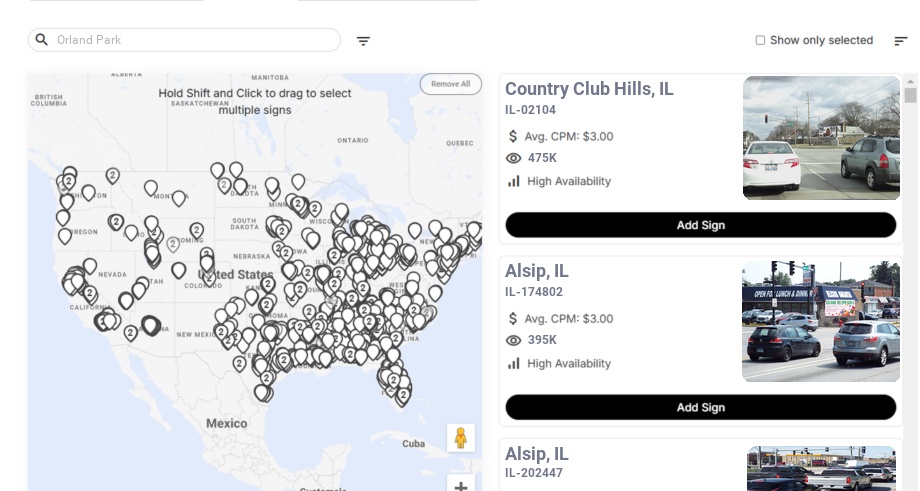
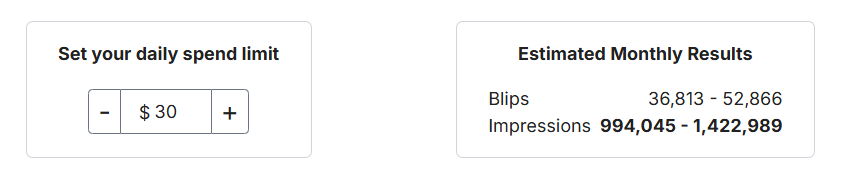
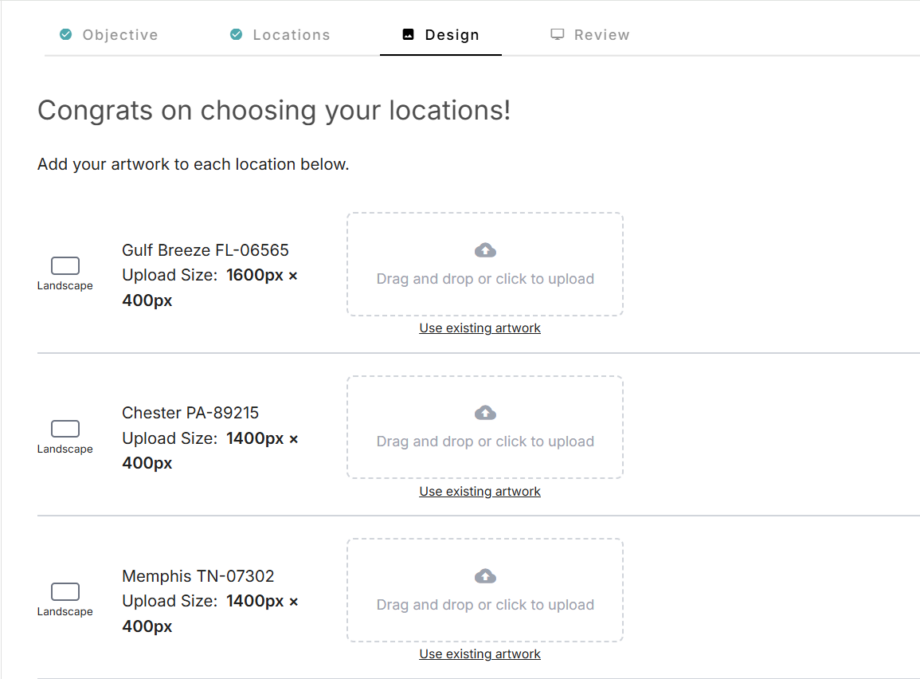
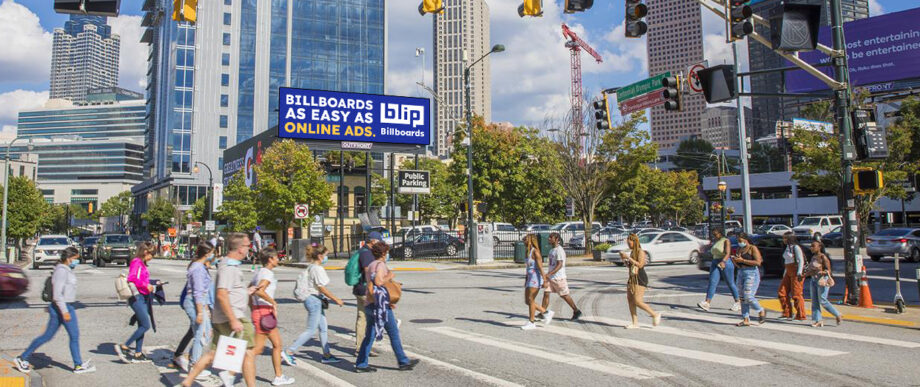
How much is a billboard in Orland Park?
Billboards in other Illinois cities
Orland Park Billboard Advertising Guide
The Orland Park area sits at the heart of Chicago’s southwest suburbs—a dense cluster of affluent households, regional shopping destinations, and heavy commuter traffic. With 22 nearby digital billboards near Orland Park in communities like Worth, Country Club Hills, Alsip, Lockport, Chicago Ridge, and Justice, we can help you put your message in front of residents, shoppers, and commuters moving through this busy hub every day. The broader southwest Cook/Will County corridor that feeds Orland Park includes well over 250,000 residents within a 10–12‑mile radius and more than 95,000 households, giving advertisers a deep pool of potential customers traveling these roads daily for billboard advertising near Orland Park.
Why the Orland Park Area Is a Billboard Powerhouse
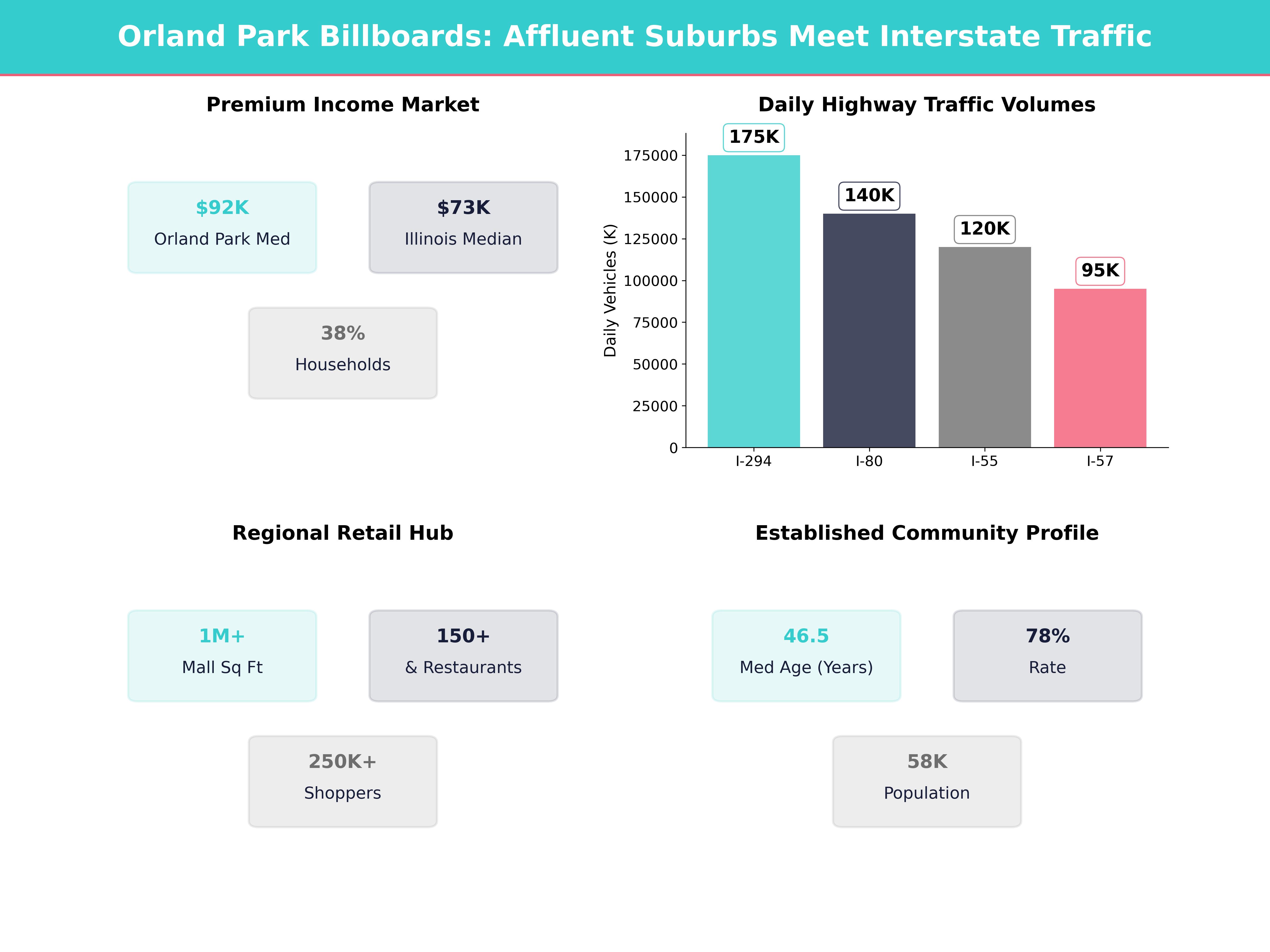
The village of Orland Park is one of the best‑known commercial centers in Chicago’s southwest suburbs. According to the Village of Orland Park 58,000 residents in about 23,000 households, with a broader trade area that pulls from neighboring suburbs in both Cook and Will Counties such as Tinley Park, Palos Heights, Oak Forest, Homer Glen, and Lockport. Local business organizations like the Orland Park Area Chamber of Commerce 250,000+ consumers who routinely shop and dine in the Orland Park commercial core. A few key data points make the Orland Park area especially attractive for billboard advertisers and brands considering Orland Park billboards:
- Affluent households: Median household income is around $90,000–$95,000, well above the Illinois median (roughly $72,000–$75,000 depending on the year). More than 35–40% of households earn $100,000 or more annually, and a significant share are dual‑income families with strong discretionary spending power. In nearby bedroom communities like Homer Glen, Frankfort, and Mokena, median household incomes often exceed $100,000, further boosting the buying power moving through Orland Park’s roads and making billboards near Orland Park highly valuable for premium brands.
- Mature, decision‑making audience: The median age in the Orland Park area is about 46–47 years, with roughly 20–22% aged 65+ and around 20–22% under 18. Less than 10–12% of residents fall into the 18–24 age bracket, meaning a heavier concentration of mid‑career professionals and established homeowners compared to Chicago overall. That skews older than Chicago’s median age (around 35 years), which means more established homeowners, investors, and long‑term residents—ideal for big‑ticket and recurring‑purchase marketing such as home improvement, financial services, and healthcare that can be promoted effectively through billboard advertising near Orland Park.
- Highly educated residents: Around 40–45% of adults hold a bachelor’s degree or higher, and more than 90% have at least a high school diploma. Local higher‑education institutions such as Moraine Valley Community College Trinity Christian College in Palos Heights reinforce a culture of education and professional development, supporting demand for quality healthcare, financial services, higher‑end retail, and professional services.
- Regional retail draw: Orland Square Mall 1 million square feet of retail space and more than 150 stores and restaurants, and the broader La Grange Road/159th Street corridor adds another 2–3 million square feet of big‑box, lifestyle, and power‑center retail including centers like Orland Park Place Chicago Southland Convention & Visitors Bureau 10–20+ miles from both Cook and Will Counties to visit major anchors and restaurants in the Orland Park area. This constant regional draw is exactly what Orland Park billboards are designed to capture.
- Strong local business base: The Village reports more than 1,000 licensed businesses in Orland Park alone, including 300+ retail and restaurant operations, multiple auto dealers, medical practices, and financial institutions clustered along La Grange Road and 159th Street. This creates dense competition for attention—exactly where high‑impact billboard visibility pays off.
Together, these characteristics mean campaigns near Orland Park benefit from a large, stable, and spending‑ready audience that is repeatedly exposed to the same local road network—perfect for building frequency with digital billboards and other forms of billboard advertising near Orland Park.
Understanding the Orland Park Audience
To design effective billboard campaigns near Orland Park, it helps to break down the local audience into key segments:
1. Commuters to Chicago and Other Suburbs
Many residents of the Orland Park area commute to downtown Chicago or to major employment corridors along I‑55, I‑80, and I‑294. In many southwest suburban communities, 75–80% of workers typically drive to work alone, fewer than 10% use transit, and average commute times often exceed 30–32 minutes, with a significant portion of workers facing 45‑minute or longer trips. According to regional planning data tracked by agencies like the Chicago Metropolitan Agency for Planning, the southwest corridor that includes Orland Park, Tinley Park, and Homer Glen sends tens of thousands of commuters toward Chicago and other job centers each weekday.
This creates repeat daily exposure along:
- I‑80 east–west near Orland Park and Tinley Park
- I‑55 north–south corridor near Lockport
- I‑294 (Tri‑State Tollway) near Alsip, Chicago Ridge, and Justice
- Harlem Avenue (IL‑43) and La Grange Road (US‑45) running north–south
- 159th Street (US‑6) and 95th Street running east–west
These corridors are exactly where several of our 22 boards serving the Orland Park area are concentrated, letting you reach both outbound morning commuters and evening return traffic. In addition, Metra’s SouthWest Service 179th Street, 143rd Street, and 153rd Street—supporting park‑and‑ride traffic that also passes nearby arterial roads and billboard locations, further increasing the value of billboard advertising near Orland Park.
2. Suburban Families and Youth Activities
The Orland Park area’s strong base of families and youth activity is reflected in:
- Multiple school districts and private schools serving thousands of K‑12 students across Orland School District 135, Consolidated High School District 230, and neighboring districts
- Park and recreation offerings managed by the Village of Orland Park Recreation Department 60 parks, 600+ acres of parkland, and facilities like the Sportsplex, Aquatic Center, and ice rinks
- Club sports, dance, music schools, and tutoring centers that draw families from a 10–15‑mile radius for regular practices, leagues, and lessons
Local park district and youth sports participation rates in comparable suburbs often range from 40–60% of school‑age children, generating thousands of car trips per week tied to games, practices, and events. Afternoons, early evenings, and weekends see heavy traffic around schools, sports complexes, shopping centers, and quick‑service restaurants. Campaigns for family entertainment, food, healthcare, and education can tap into this pattern by targeting drive times to games, practices, and errands with well‑placed Orland Park billboards.
3. Older, Affluent Homeowners
With roughly one‑fifth of residents 65 and older, and homeownership rates often in the 75–80% range in Orland Park and neighboring suburbs, the area is a prime market for:
- Financial and retirement planning
- Home improvement and remodeling
- Healthcare specialists and clinics
- Travel, leisure, and lifestyle services
In many southwest suburbs, 40–50% of owner‑occupied homes were built between the 1970s and 1990s, meaning a large stock of properties now reaching prime remodeling age for roofs, windows, siding, kitchens, and baths. These residents are frequent users of local medical centers, shopping destinations, and restaurants; nearby providers include facilities such as Silver Cross Hospital
Where Our 22 Digital Billboards Reach Orland Park Area Drivers
While our screens are in nearby communities, they are strategically located along the main arteries people use to reach and leave the Orland Park area. Key nearby cities with our digital coverage include:
- Worth (≈6.4 miles from Orland Park):
Near Harlem Avenue (IL‑43) and 111th/115th Streets, Worth services steady north–south flows between the Orland Park area and Chicago’s southwest side. Harlem Avenue is one of the region’s busiest arterials, with certain segments carrying 30,000–40,000 vehicles per day. This is ideal for reaching residents headed toward Chicago Ridge, Oak Lawn, and the city and for advertisers looking for billboards near Orland Park that still capture Chicago‑bound traffic. - Country Club Hills (≈7.8 miles):
Located near the junction of I‑57 and 167th/183rd Streets, this area catches traffic from the south and east heading toward the Orland Park retail zone, especially from suburbs like Markham, Hazel Crest, and Homewood. IDOT counts along nearby I‑57 often exceed 90,000–100,000 vehicles per day, giving advertisers strong regional reach. - Alsip (≈8.0 miles) & Chicago Ridge (≈8.3 miles):
Near I‑294, Cicero Avenue (IL‑50), and Ridgeland/Harlem, these locations are powerful for capturing regional through‑traffic and shoppers moving between the Orland Park area, Oak Lawn, Burbank, and other nearby suburbs. Segments of Cicero Avenue in this corridor typically carry 25,000–35,000 vehicles per day, and the adjacent Chicago Ridge Mall contributes a strong retail draw. - Lockport (≈8.0 miles):
Positioned near I‑355, I‑55, and 159th/167th Streets, Lockport boards reach Will County commuters and shoppers heading toward the Orland Park retail cluster from the southwest, including Homer Glen and Joliet. I‑355 and I‑55 together move well over 200,000 vehicles per day through the southwest suburbs, with a large share of those trips tied to work, logistics, and shopping, making this a smart area for billboard rental near Orland Park. - Justice (≈9.4 miles):
Near I‑294 and Archer Avenue (IL‑171), this area hits a mix of local residents and regional travelers heading to and from the Orland Park area, Midway Airport, and the broader Chicago metro. Archer Avenue itself often carries 20,000–25,000 vehicles per day, connecting multiple southwest suburbs.
According to Illinois Department of Transportation traffic count maps, these major corridors regularly see daily traffic volumes such as:
- I‑80 near the Orland Park area: often 140,000+ vehicles per day
- I‑55 near Lockport: frequently 120,000+ vehicles per day
- I‑294 near Alsip/Chicago Ridge/Justice: segments exceeding 170,000–180,000 vehicles per day
Across a full year, that equates to 40–60 million vehicle trips on each of these major expressways alone. Our 22 digital billboards serving the Orland Park area are positioned to intercept these flows as drivers converge on retail, dining, and residential zones, giving you practical options for billboard rental near Orland Park.
Timing Your Blips Around Local Traffic Patterns
With Blip, you can buy exposure a few seconds at a time and control when your ads show. For the Orland Park area, aligning your schedule with real‑world traffic makes your budget work harder. Regional travel surveys show that weekday traffic in the Chicago metro can be 30–40% higher during peak commute periods than in mid‑day or late evening hours, and weekend mid‑day volumes around major retail corridors can rival or even exceed weekday peaks.
Weekday Patterns
-
Morning commute (6:30–9:00 a.m.):
Best for reaching Chicago‑bound workers and local office employees. Traffic data from the Illinois Tollway and IDOT show morning peak volumes on I‑294, I‑55, and I‑80 often at 120–150% of off‑peak levels. Focus on roads heading east and north out of the Orland Park area (toward Worth, Alsip, Chicago Ridge, and Justice).- Great for: coffee and breakfast QSRs, mass transit parking promotions (e.g., near Metra’s Orland Park stations
-
Midday (10:00 a.m.–2:30 p.m.):
Ideal for retirees, at‑home workers, and errand‑running parents. In many suburban retail districts, 25–35% of daily shopping trips occur during this window. Traffic to Orland Square Mall and surrounding retail, medical offices, and restaurants is strong.- Great for: healthcare, senior living, home services, lunch specials, and professional services.
-
Afternoon school and activity rush (2:30–5:00 p.m.):
Family‑oriented traffic spikes as parents pick up children and head to practices, lessons, and part‑time jobs. In school‑year months, activity‑related trips can add 10–20% more vehicles to local arterials compared with summer weekdays.- Great for: youth programs, tutoring, after‑school food deals, quick‑service restaurants, and local entertainment.
-
Evening commute and dine‑out window (4:00–7:30 p.m.):
Heavy volumes back toward the Orland Park area for shopping and dining; restaurant data for similar suburbs suggest that 40–50% of daily dine‑in revenue is generated after 4:00 p.m.- Great for: restaurants, entertainment, gyms, retailers, home improvement, and appointment‑based services.
Weekend Patterns
- Friday evening (4:00–8:00 p.m.):
Start of the weekend retail and dining rush, especially toward the Orland Square area and nearby plazas. Traffic counts on key shopping arterials can be 20–30% higher than a typical Monday or Tuesday evening. - Saturday (10:00 a.m.–7:00 p.m.):
Orland Park acts as a regional shopping and dining magnet. Boards near Worth, Alsip, Chicago Ridge, and Lockport capture shoppers as they drive in from multiple directions. In many regional malls, Saturday alone can account for 20–25% of weekly foot traffic, making it a prime day for billboard‑driven offers. - Sunday (9:00 a.m.–3:00 p.m.):
Steadier flows around religious services, brunch, and errands, plus sports viewing and family activities. Auto dealers, home improvement centers, and grocery stores often see 15–20% of weekly visits on Sundays.
Using Blip’s scheduling tools, you can concentrate spending in these specific blocks—e.g., only Saturday daytime plus weekday 4:00–7:00 p.m.—to maximize impact without paying for low‑value hours and to get more from your billboard rental near Orland Park.
Seasonal and Event‑Driven Opportunities
The Orland Park area has notable seasonality and local events that you can align with your campaigns:
- Back‑to‑school (August–September):
Heavy shopping for clothing, electronics, and school supplies at Orland Square Mall and nearby big‑box centers. National retail data show back‑to‑school spending commonly reaches $800–$900 per household for families with K‑12 students, much of it condensed into a 4–6‑week period. A family‑centric message with clear offers performs well during this window. - Holiday retail season (November–December):
Orland Park is one of the primary holiday shopping destinations for the southwest suburbs. Door‑counter data from regional malls often show November–December foot traffic 40–60% higher than average months, and many retailers generate 25–30% of annual sales in this period. Traffic volumes around the area’s retail corridors surge, providing excellent reach for gift, jewelry, auto, and electronics campaigns. - Spring home improvement (March–May):
Warmer weather brings increased spending on landscaping, remodeling, roofing, and exterior services, especially among the area’s homeowner base. In the Chicago region, home improvement retailers frequently report double‑digit percentage increases in sales between February and May, and contractor inquiries can jump 30–50% as soon as frost ends. - Summer recreation and outdoor dining (May–August):
The Village’s Parks and Recreation hundreds to several thousand attendees on peak days. This is prime time for restaurants, attractions, and family services to run time‑sensitive creatives like “Tonight Only” or “After the Game” specials on Orland Park billboards. - Local news and sports:
By following outlets like the Daily Southtown and Orland Park Patch, you can time creative around high‑interest news, local sports playoff runs, or major development announcements. Big civic updates posted by the Village of Orland Park
Digital billboards give you flexibility to rotate creatives or adjust budgets quickly for these seasonal surges.
Creative Strategies That Resonate Near Orland Park
Strong geography‑specific creative will significantly improve your results in the Orland Park area. Consider the following best practices:
1. Speak to Suburban Lifestyles and Convenience
Suburban households in this region typically own 2 or more vehicles and make multiple car trips per day for shopping, school, and activities. Prominent themes that work well:
- “Minutes from Orland Square” or “Just off La Grange Rd / 159th St” to tap into familiar routes
- Emphasis on easy parking, stress‑free shopping, or quick appointments
- Clear references to proximity: “Serving Orland Park families since…”, “Your Orland Park area [service] experts”
These kinds of location‑based messages help your billboard advertising near Orland Park feel immediately relevant to daily routines.
2. Highlight Quality and Trust
Given the area’s higher incomes and older median age, trust and quality often matter more than rock‑bottom pricing. Surveys of older homeowners commonly show that 70–80% prioritize reputation and referrals over price alone for major purchases. On your billboards:
- Include credentials (e.g., “Board‑Certified,” “Family‑Owned Since 1988”)
- Show professional imagery for healthcare, legal, or financial services
- Use clean layouts with strong, legible typefaces—particularly important for older drivers, who may need larger copy to read at 55–65 mph
3. Make Offers Simple and Time‑Relevant
Drivers have 3–7 seconds to absorb your message, and eye‑tracking studies on roadside advertising show that creatives with 6–8 words or fewer significantly outperform dense layouts:
- Limit text to 7 words or fewer where possible
- Use one primary offer or call to action: “$0 Down Invisalign,” “Tonight: Kids Eat Free,” “Book a Free Roof Inspection”
- Feature large, high‑contrast pricing or date triggers: “This Weekend Only,” “Ends Sunday”
4. Use Recognizable Local Landmarks
Subtle references to the Orland Park area boost relevance and recall:
- Mention cross‑streets or nearby anchors: “Across from Orland Square,” “Next to [major store] on 159th St”
- Call out proximity to known facilities like the Sportsplex, Centennial Park, or Orland Park Place
- Incorporate stylized but simple skyline or roadway elements that evoke the southwest suburbs rather than downtown Chicago
These tactics help your Orland Park billboards feel like part of the local landscape instead of generic ads.
5. Design for Day and Night
Because many impressions occur in early morning or after dark—especially in winter, when sunset can be before 4:30 p.m.:
- Use bold, saturated colors rather than thin, light text on dark backgrounds
- Increase font sizes and avoid overly intricate scripts
- Ensure your logo is large and illuminated clearly at all distances; research on OOH legibility suggests keeping key text at 18–24 inches high or more on full‑size bulletins for optimal readability at highway speeds
Using Blip Tools to Target the Orland Park Area Efficiently
Blip’s flexibility is especially valuable in a multi‑suburb market like the Orland Park area. A few tactical approaches:
1. Clustered Coverage Around Orland Park Corridors
Use combinations of boards in Worth, Alsip, Chicago Ridge, and Justice to surround major inbound/outbound routes connecting to:
- La Grange Road (US‑45)
- Harlem Avenue (IL‑43)
- 159th Street (US‑6)
- Access ramps to I‑80, I‑55, and I‑294
Regional traffic modeling shows that many southwest suburban residents use 2–3 different arterial routes in a typical week; clustering boards along these paths increases the probability that your target customers will see your message multiple times per week, not just once. This creates a “halo” effect—drivers repeatedly see your brand as they travel between home, work, and Orland Park’s retail zones, maximizing the effectiveness of billboard advertising near Orland Park.
2. Dayparting by Objective
- Brand Awareness:
Run lighter but consistent coverage all day, with slightly higher intensity during commuting windows. For example, allocate 50–60% of your impressions to morning/evening peaks and 40–50% spread across mid‑day and early evening. - Retail and Dining Promotions:
Concentrate on late‑afternoon and weekend dayparts when shoppers head toward the Orland Park area. Many retailers see 60–70% of daily in‑store traffic after 3:00 p.m. on weekends—your Blip schedule should reflect that pattern. - Professional Services and Healthcare:
Focus on weekday mornings and mid‑days, when decision‑makers and retirees are most attentive and more likely to call or book online. Local medical practices often report that 70–80% of appointment calls come in between 8:00 a.m. and 3:00 p.m.
3. Budget Control for Testing
You can:
- Start with a modest daily budget to test different creatives across multiple boards—e.g., $10–$20 per day over 2–4 weeks to establish baseline performance
- Shift spend from lower‑performing boards to those closer to your strongest customer clusters, such as boards serving specific ZIP codes that appear frequently in your sales records
- Run short, high‑frequency bursts (e.g., 2–3 weeks) around big promotions, then scale back to always‑on branding; many advertisers find that 1–2 bursts per quarter layered over a lighter evergreen presence provides strong recall without overspending
This kind of agile approach makes billboard rental near Orland Park more efficient and measurable.
Campaign Ideas by Industry in the Orland Park Area
Here are examples of how different business types can leverage billboards near Orland Park and the surrounding suburbs:
Retail & Shopping Centers
- Promote “Only 5 Minutes from Orland Square” with bold arrows and exit instructions from I‑80 or La Grange Rd. Malls and power centers in the Chicago suburbs often draw 8–12 million visits per year, providing ample opportunity to convert billboard impressions into foot traffic.
- Show limited‑time sales with clear dates (“3‑Day Sale Fri–Sun”) and simple visuals.
- Coordinate messaging with digital, social, and in‑center signage to create a multi‑touch experience, using consistent colors and taglines.
Restaurants and Hospitality
- Target evening and weekend drive times with specific meal offers: “Steak for 2 – Tonight on 159th St.” In similar suburbs, 50–60% of restaurant revenue can come from Friday–Sunday, making these critical days for visibility.
- Use boards along routes from Worth, Alsip, Chicago Ridge, and Lockport to catch inbound traffic.
- Feature reservations URLs or QR codes in moderation—but prioritize simple brand recall and location, since only a fraction of drivers (often <10%) will be able to safely interact with a QR code in real time.
Healthcare, Dental, and Senior Living
- Emphasize benefits like “Same‑Day Appointments,” “Walk‑Ins Welcome,” or “New Patient Specials.” In many practices, “new patient” offers can increase call volume by 20–30% during campaign periods.
- Use reassuring imagery and highlight proximity: “Serving the Orland Park area on [street].”
- Schedule higher frequencies around open enrollment periods (October–December) or flu season (typically peaking November–February), when demand for preventive care and insurance decisions spikes.
Home Services and Contractors
- Target the Orland Park homeowner base with clear, benefit‑driven creative: “Need a New Roof Before Winter?” Demand for roofing, HVAC, and exterior work in the Chicago area can swing 40–60% between peak and off‑peak seasons depending on weather.
- Rotate seasonal messages: roofing and HVAC in spring/summer, insulation and windows in fall, emergency repairs after major storms.
- Consider pairing with yard signs and local mailers to reinforce recognition; combining OOH with direct mail has been shown in industry studies to lift response rates by 10–20% compared with mail alone.
Auto Dealers and Repair Shops
- Use regional reach along I‑80 and I‑55 to highlight large inventories and certified service. Auto dealers in the Chicago metro regularly serve customers from 20–30 miles away, making regional billboard coverage very effective.
- Feature simple offers: “0% APR for 36 Months,” “Oil Change $39.95 – Orland Park area.”
- Shift creative quickly around holiday sales, model year‑end clearance, or EV showcases, aligning with known high‑volume buying windows like Memorial Day, Labor Day, and year‑end events.
Education, Tutoring, and Youth Programs
- Time campaigns to registration windows: late spring for summer camps, late summer for fall programs, and January for mid‑year enrollments. After‑school and enrichment programs frequently see 30–40% jumps in inquiries in the 4–6 weeks before a new term.
- Speak to parents’ concerns: safety, results, and convenience near Orland Park’s schools and neighborhoods.
- Use simple calls to action: “Enroll Today,” “Schedule a Free Assessment,” “Call for a Free Tour.”
Measuring and Optimizing Your Orland Park Area Campaign
To ensure your investment is working hard:
-
Define Clear Goals First
- Brand awareness within the Orland Park area
- Website visits or calls
- Foot traffic to a specific location
- Event attendance or time‑bound promotions
For example, set numeric targets like “Increase direct‑type web visits by 15% in 4 weeks” or “Generate 50 incremental calls during our spring promotion.”
-
Align Tracking with Your Creative
- Use unique URLs or phone numbers for billboard campaigns (e.g.,
/orlandpark) - Watch for traffic spikes in Google Analytics that correlate with your ad flight dates, particularly in direct and branded search; many advertisers see 10–30% lifts during active OOH campaigns
- Ask “How did you hear about us?” and track responses; even if only 10–20% of customers answer, the data will show trends over time
- Use unique URLs or phone numbers for billboard campaigns (e.g.,
-
Rotate and A/B Test Creative
- Run two variations simultaneously (e.g., different offers or headlines) on the same set of boards.
- After 2–4 weeks, shift spend to the better‑performing version based on calls, web traffic, or sales. Industry benchmarks suggest that stronger creative can outperform weaker versions by 20–50% on response metrics.
-
Refine Location Mix
- If your strongest customers come from the south or east of the Orland Park area, weight more impressions toward Country Club Hills, Alsip, and Chicago Ridge.
- If they skew west and southwest, increase coverage around Lockport and Homer Glen‑facing routes.
- Re‑evaluate every quarter, using sales and lead data by ZIP code to confirm whether your billboard footprint matches your best‑performing markets.
-
Stay Informed Locally
- Monitor the Village of Orland Park news Daily Southtown and Patch for upcoming developments, road projects, or events that could influence traffic patterns or consumer demand.
- Check updates from nearby municipalities such as Worth, Alsip, Chicago Ridge, Lockport, and Justice for festivals, parades, or construction that might temporarily alter traffic flows.
- Use these insights to adjust your dayparts, board selection, or creative—such as promoting alternate routes, event tie‑ins, or time‑sensitive offers.
By combining Orland Park’s strong demographics with strategic placement on our 22 digital billboards in nearby communities, targeted scheduling, and thoughtful creative, we can help you build a high‑impact campaign that reaches the right audiences at the right moments—whether they’re commuting, shopping, dining, or enjoying everything the Orland Park area has to offer. This approach ensures your billboard advertising near Orland Park delivers meaningful, measurable results.