Billboards in Effingham, IL
No Minimum Spend. No Long-Term Contracts. Just Results.
Ready to make your brand pop in Effingham? Blip lets you place digital billboard ads with total control—pick the screen, set any budget, upload your creative, and only pay when your ad blips on.
Trusted by Leading Brands


Billboard advertising
in Effingham has
never been easier
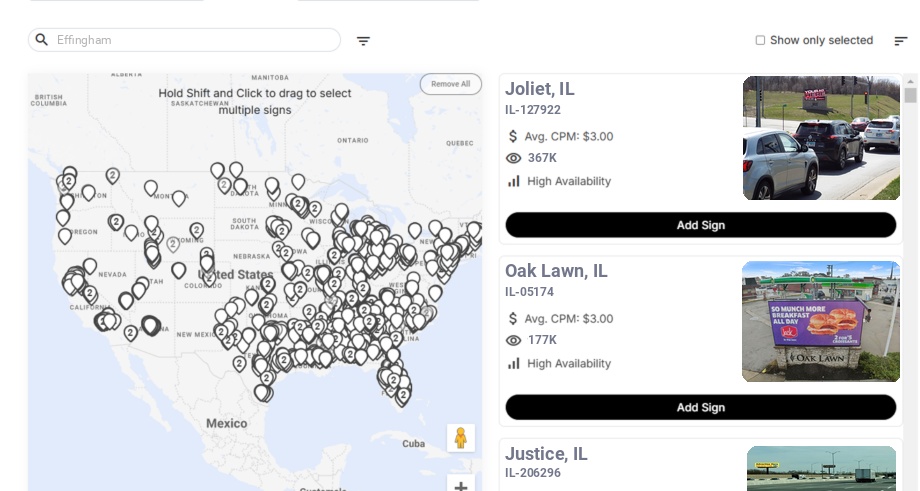
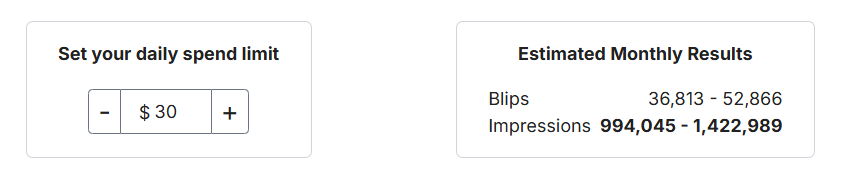
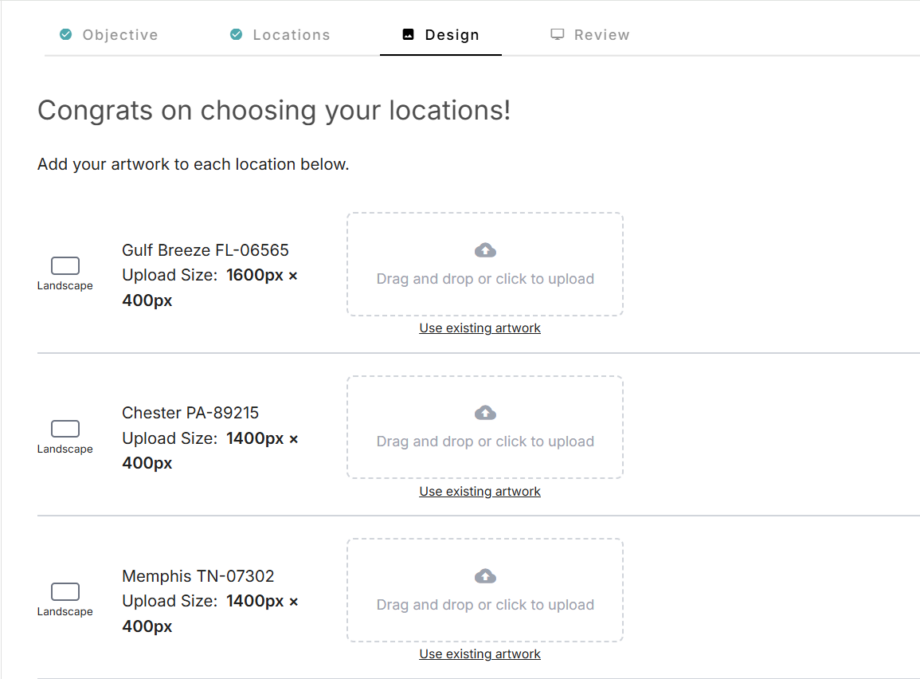
How much is a billboard in Effingham?
Why Choose Blip for Billboard Advertising in Effingham
Blip lets you launch fast in Effingham on I-57 and I-70, reaching travelers at the Crossroads of Opportunity without traditional billboard hurdles.
Use flexible budgets in Effingham to match commuter rush, school traffic, or summer fair weekends—pay only when your ad blips on.
No contracts in Effingham means you can test U.S. 45, Keller Drive, and Fayette Avenue, then pause or pivot based on what works.
Track Effingham campaigns in real time and shift spend between interstate travelers and local shoppers near the hospital, colleges, and retail corridors.
Blip's creative tools make it easy to tailor Effingham ads for quick-hit messages like 'Next exit' or 'Book tonight' for I-57 and I-70 drivers.
Frequently Asked Questions About Billboard Advertising in Effingham
How much does a billboard cost in Effingham with Blip?
Where can I advertise with Blip in Effingham near the busiest traffic routes?
Why is Effingham a good market for Blip billboard ads?
When is the best time to run billboard ads in Effingham?
What kind of audience can I reach with Blip in Effingham?
Do I need a contract to advertise with Blip in Effingham?
How fast can I launch a billboard campaign with Blip in Effingham?
Where can I advertise with Blip in Effingham?
Still have questions? Launch a campaign in minutes — no contracts, no commitments.
Start Your CampaignEffingham Billboard Advertising Guide
Effingham is a strong billboard market because it combines a stable local customer base with unusually concentrated regional traffic. The City of Effingham had a 2020 population of 12,649, and Effingham County had 34,668 residents across roughly 478 square miles, for a density of about 73 residents per square mile. This is large enough to support repeat local impressions while still being compact enough for smart placement strategy.
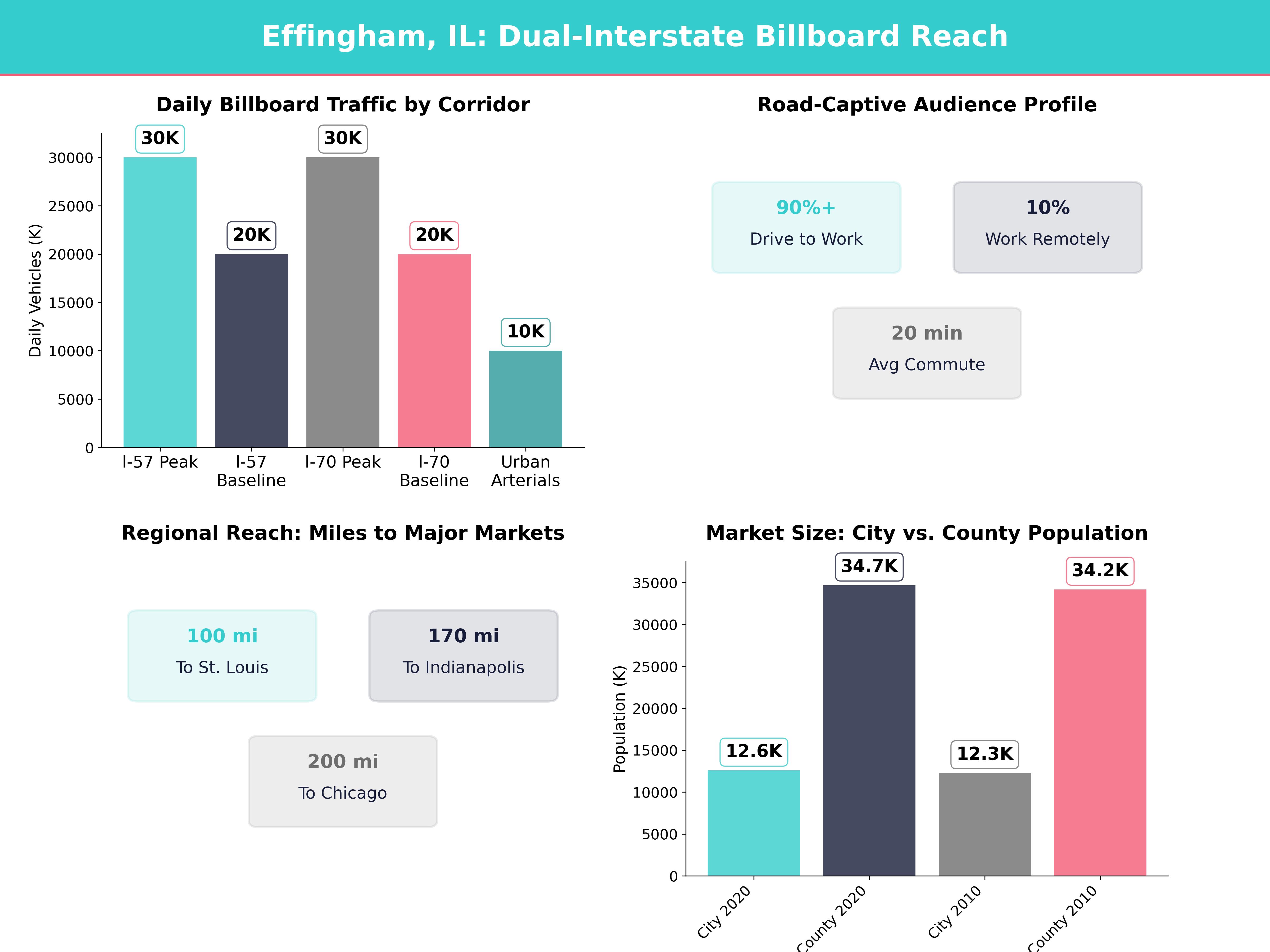
Effingham also benefits from Effingham’s position at the junction of Interstate 57 and Interstate 70, which gives advertisers access to both local drivers and a steady stream of pass-through travelers. In a county where more than 90% of workers commute by personal vehicle, digital billboards can deliver reach, frequency, and timing that align naturally with how people move.
Market Overview for Effingham Advertising
Effingham functions as a small-city trade center with an outsized transportation footprint. The Effingham Regional Growth Alliance
From a population standpoint, Effingham is steady rather than volatile, which is useful for advertisers who want predictable repetition. The city grew from 12,328 residents in 2010 to 12,649 in 2020, an increase of 321 people, or about 2.6%.
Effingham County grew from 34,242 residents in 2010 to 34,668 in 2020, an increase of 426 people, or about 1.2%. That kind of measured growth tells us we are advertising into a market with durable routines, stable households, and familiar travel behavior.
Effingham’s geography also expands its practical ad market beyond city limits. The city sits roughly 100 miles east of St. Louis, about 170 miles west of Indianapolis, and about 200 miles south of Chicago.
That positioning matters because many billboard impressions in Effingham come from people who are not just local residents, but regional shoppers, truck drivers, business travelers, sports families, and overnight guests moving between larger metros. Car dependence is one of Effingham’s biggest billboard advantages.
American Community Survey commuting data show that more than 90% of workers in Effingham County travel by car, truck, or van, while the average one-way commute is under 20 minutes. Remote work remains a minority pattern, at under 10% of workers, which means the road network still captures daily attention.
For us, that translates into two important advertising benefits: Frequency builds quickly. Because local drive times are short, many residents repeat the same routes several times per week.
And Trip intent is easy to read. In Effingham, people are often driving with a clear purpose, such as work, school, healthcare, shopping, dining, or interstate travel.
The local economy supports a broad mix of billboard categories. Healthcare is anchored by HSHS St. Anthony’s Memorial Hospital, a 133-bed facility.
Business and professional employment is reinforced by companies such as Heartland Dental Mid America Motorworks. Education and workforce development are supported by Lake Land College, whose district spans 9 counties.
Combined with hospitality, logistics, retail, agriculture, and local services, that gives us a market where billboard demand can come from both B2C and B2B advertisers.
Key Traffic Corridors for Effingham Digital Billboards
Effingham’s travel patterns are unusually concentrated. Rather than spreading impressions across dozens of medium-volume corridors, we can focus on a handful of roads that do the bulk of the work.
Interstate 57 in Effingham
Interstate 57 is one of Effingham’s defining advertising corridors because it links the city northward toward central Illinois and Chicago, and southward toward southern Illinois and the Mississippi corridor. According to traffic count resources from the Illinois Department of Transportation, the mainline I-57 sections around Effingham generally carry more than 20,000 vehicles per day, and the heaviest segments near the interchange push into the 30,000-plus AADT range.
That traffic profile makes I-57 especially effective for advertisers that benefit from urgency or immediate action. Hotels, restaurants, fuel, and convenience brands can capture travelers who still need to make a stop decision before the interchange or next exit.
Healthcare providers and urgent care brands can build awareness among local drivers who use the interstate as a fast connector. Employers with shift-based or CDL-heavy recruiting needs can reach regional workers and professional drivers moving through the corridor.
For northbound traffic, we are often speaking to drivers heading toward Mattoon Champaign, and Chicago. For southbound traffic, we are often speaking to longer-haul travelers, truckers, and visitors moving toward southern Illinois.
That directional difference is useful when we tailor creative by travel intent.
Interstate 70 Through Effingham
Interstate 70 gives Effingham its east-west reach. Like I-57, IDOT traffic counts place the Effingham-area I-70 mainline above 20,000 vehicles per day, with the strongest sections near the I-57 junction reaching the 30,000-plus class.
This corridor connects the Effingham trade area to St. Louis on one side and Indianapolis on the other, which is why so many stopover and service businesses perform well here. I-70 is especially valuable for advertisers that depend on regional pass-through traffic.
Travel centers, auto services, and quick-service restaurants benefit from impulse-friendly messaging on east-west trips. Attractions, events, and entertainment venues can use I-70 to catch weekend leisure travel.
Industrial, logistics, and warehouse employers can use I-70 placements for broad regional recruiting because the corridor carries both freight and workforce traffic. Because I-70 brings in both same-day travelers and overnight guests, it tends to support messages such as “Book tonight,” “Next exit,” “Open late,” “Hiring now,” and “Easy truck access.”
U.S. 45, Keller Drive, and Fayette Avenue in Effingham
If the interstates deliver reach, U.S. 45, Keller Drive, and Fayette Avenue deliver local intent. These are the routes we use when we want to reach residents running errands, school pickups, healthcare visits, grocery trips, and meal stops.
On the busiest commercial stretches, IDOT traffic counts on Effingham’s major urban arterials move into the 10,000-plus vehicles per day range, which is significant for a city of Effingham’s size. This corridor cluster is ideal for advertisers who need proximity to the point of decision.
Banks, insurance agencies, and healthcare clinics can stay top of mind before local appointments or errands. Retail, furniture, and home service brands can reach household decision-makers in a practical buying mindset.
Local restaurants and entertainment venues can drive same-day traffic, especially during lunch, dinner, and Friday evening windows. The commercial corridor also serves visitors who leave the interstate for food, lodging, or shopping.
That means local boards can work as a second touch after an interstate impression.
Illinois Routes 32, 33, 37, and the Rural Approaches to Effingham
Illinois Route 32, Illinois Route 33, Illinois Route 37, and county approach roads matter because they funnel surrounding communities into Effingham’s retail and service core. Residents from Teutopolis, Altamont Dieterich Jasper County routinely rely on Effingham for shopping, healthcare, dining, and business services.
These routes often work best for brands with a regional trade-area strategy. Agricultural suppliers, equipment dealers, and farm service companies can align messaging with planting and harvest travel.
Regional healthcare and legal services can remind outlying households that the most convenient appointment destination is Effingham. Countywide events and fairs can use these approaches to build attendance from smaller communities.
Audience Segments We Can Reach in Effingham
Effingham’s audience is not one single group. The strength of the market is that we can speak to several high-value audiences with different creative and different timing.
Effingham Commuters and Local Errand Traffic
The local commuter segment is the foundation of any sustained campaign. With more than 90% of workers traveling by personal vehicle and an average one-way commute under 20 minutes, we can build repetition quickly on the roads residents already use for work, school, groceries, appointments, and dining.
This audience responds well to practical categories such as healthcare, finance, home services, automotive repair, insurance, restaurants, local retail, and civic messaging. Because their routes repeat, even modest schedules can create familiarity within a few days.
Interstate Travelers, Truckers, and Overnight Guests in Effingham
The two-interstate junction creates a second audience that many small Illinois cities do not have at the same scale. Drivers on I-57 and I-70 include vacationers, business travelers, truck drivers, sports families, college visitors, and people using Effingham as a rest stop between larger metros.
This group is especially valuable because many of their decisions are immediate. They need gas, food, coffee, hotels, restrooms, medical help, or a reason to stop.
For that reason, Effingham is an excellent market for: Hospitality and travel services. Dining and convenience brands.
Auto repair, tire, towing, and emergency services. Attractions, events, and event ticketing.
Families, Students, and School Communities in Effingham
School calendars create reliable traffic rhythms. Effingham Unit 40 Schools and Teutopolis CUSD 50 August-to-May schedule, which means back-to-school, sports, concerts, graduations, and spring events all have predictable ad windows.
Family audiences also move repeatedly through shopping, dining, church, and youth activity patterns. Lake Land College adds another layer through its 9-county district and workforce presence at the Kluthe Center in Effingham.
That helps advertisers reach adult learners, job-seekers, parents, and local employers with recruiting or training-oriented campaigns.
Healthcare, Faith, and Event Audiences in Effingham
Effingham has several destination-style institutions that increase the variety of impressions we can capture. HSHS St. Anthony’s Memorial Hospital contributes healthcare traffic daily, while Cross at the Crossroads adds a faith-tourism landmark that stands 198 feet tall and is widely recognized by travelers.
The Effingham Performance Center 1,500-seat venue, and the Thelma Keller Convention Center
Ready to reach your audience in Effingham?
Start Your Campaign →Seasonal and Timing Opportunities in Effingham
Effingham works best when we match billboard timing to how the area actually moves through the year. The market is not just about geography, it is also about seasonality.
Spring in Effingham
Spring campaigns usually gain momentum from March through May. Tax season, home improvement, landscaping, graduation planning, and youth sports all add urgency.
We also see stronger weekend mobility as weather improves and road-trip activity starts to rise on I-57 and I-70. This is a strong window for: HVAC, lawn care, roofing, and home services.
Healthcare checkups and elective appointment reminders. Graduation, dining, formalwear, and gift-related promotions.
Summer in Effingham
Summer is Effingham’s broadest travel season because interstate road trips pick up, schools are out, and event calendars become more active. Visit Effingham, Enjoy Illinois, Lake Sara, and the Effingham County Fair all contribute to a more leisure-oriented pattern from Memorial Day through Labor Day.
The county fair, held in nearby Altamont July and early August, is a particularly useful regional timing cue. Summer is ideal for hospitality, dining, attractions, cold beverages, outdoor recreation, and stop-now messaging.
It is also a strong recruiting season for employers that want to reach students, seasonal workers, and job changers.
Fall in Effingham
Fall gives us one of the best combinations of local routine and regional travel. School is back in session in August, Friday night sports return, harvest traffic increases on rural approaches, and families begin shifting toward holiday purchasing by October and November.
This season works especially well for: Retail, furniture, and home décor. Healthcare enrollment and year-end appointment pushes.
Agricultural services, machinery, and supply businesses. Higher education, trades, and workforce recruiting.
Winter in Effingham
Winter changes travel behavior, but it does not eliminate billboard value. Instead, it shifts intent toward reliability, comfort, and safety.
Holiday travel around Thanksgiving and Christmas creates strong interstate visibility, while colder weather increases demand for healthcare, auto service, indoor entertainment, and convenience-focused dining. During winter, we often do best with concise messages about warmth, trust, quick service, and immediate availability.
Effingham’s hospitality cluster, hospital traffic, and entertainment venues all continue to generate movement even when weather is less predictable.
Billboard Design Tips for the Effingham Market
Effingham rewards creative that respects speed, practicality, and local identity. We should not design for abstract brand theater here, and we should design for drivers who are making real decisions on real trips.
Design for Interstate Speed at the Effingham Crossroads
At the I-57 and I-70 junction, drivers are moving fast and scanning for useful information. That means our best creative is usually direct, high-contrast, and place-oriented.
We should prioritize bold type, one main offer, and a simple visual hierarchy. In Effingham, directional language often beats cleverness.
Phrases such as “Next exit,” “Book tonight,” “Open late,” “Truck parking,” “Family care,” and “2 miles ahead” fit the travel mindset of the market. If a business is close to the interchange, we should say so plainly.
Reflect Effingham’s Midwestern, Family-Oriented Tone
Effingham audiences tend to respond well to messages that feel trustworthy, practical, and community-aware. This is a market where healthcare, education, churches, schools, athletics, farming, logistics, and family businesses all shape local culture.
We usually perform better with confident, helpful messaging than with irony or overly edgy creative. Color choices should also reflect the environment.
Bright reds, deep blues, clean whites, and strong blacks tend to stand out against summer greens, harvest browns, and winter gray skies. For local service businesses, familiar imagery such as families, vehicles, tools, homes, and storefronts often feels more relevant than generic stock concepts.
Use Effingham-Specific Landmarks and Context
Effingham gives us several local cues we can borrow in creative. The 198-foot Cross at the Crossroads, the hospitality cluster near the interchange, Lake Sara, and the city’s role as a stopover market all provide context that can make a billboard feel local instead of generic.
For example, advertisers can reference: Travel convenience, if they are close to I-57 or I-70. Community reliability, if they serve local families and schools.
Event proximity, if they benefit from traffic to the Effingham Performance Center
Rotate Creative by Season and Audience in Effingham
Effingham is not a market where one creative concept should run unchanged all year. We should rotate by season and corridor.
Interstate travelers need immediate utility, while local families often need familiarity and relevance. Agricultural and rural audiences respond to different cues than healthcare or event audiences.
A restaurant, for example, might run travel-focused summer creative on interstate boards, family-night creative on Keller Drive in fall, and holiday gathering creative in winter. That kind of rotation often makes the same locations perform much harder.
Regional Strategies Across Effingham and Nearby Communities
A good Effingham campaign rarely relies on one board type alone. We usually get the best results when we divide the market into sub-areas and assign each one a job.
The Effingham Interchange and Commercial Core
This is our broad-reach zone. Boards near the I-57/I-70 junction and the main commercial areas give us access to both locals and travelers.
We should use this zone for awareness, immediate stop decisions, hospitality, dining, entertainment, healthcare, and recruiting. If a brand wants the widest possible audience in Effingham, this is usually the first place we start.
The North and South I-57 Approaches to Effingham
The north and south approaches are strong for healthcare, employers, colleges, and regional services. These boards let us catch repeat regional movement without relying entirely on the interchange decision point.
They are useful when we want to reach commuters and workforce traffic coming in from outside the city.
The East and West I-70 Approaches to Effingham
These boards work particularly well for stop-now categories and for brands that benefit from east-west freight and leisure travel. Hospitality, travel centers, restaurants, tire shops, and event marketers often perform well here because the audience is already in a travel frame of mind.
Surrounding Communities Around Effingham
Effingham’s trade area is broader than the city itself. Teutopolis, Altamont Dieterich Newton all feed people toward Effingham for some mix of shopping, work, education, and healthcare.
When we want regional depth, we should localize copy for those surrounding communities rather than treating the whole county as one audience. A message that says “Effingham’s closest urgent care,” “Worth the drive to Effingham,” or “Serving Teutopolis and Altamont” can outperform a generic countywide line because it acknowledges actual travel behavior.
Ready to reach your audience in Effingham?
Start Your Campaign →Using Blip Tools in Effingham
Blip’s flexibility is especially useful in Effingham because the market has both repeat local traffic and variable traveler traffic. We do not need to force one static schedule onto every audience.
Budget and Dayparting Strategies for Effingham
We can daypart around Effingham’s strongest traffic behaviors instead of buying the full day evenly. Morning and late-afternoon windows help with commuter, school, and local-service campaigns, while late afternoon, evening, and weekend periods often work well for dining, entertainment, and travel stops.
Seasonal bursts also make sense here. We can increase budgets around summer travel, county fair timing, holiday travel weeks, school start dates, or major Effingham Performance Center
Creative Rotation for Effingham Audiences
Because Effingham contains multiple audiences, we should rotate creative by board group. An interstate creative set can focus on convenience and immediacy, while an in-town creative set can emphasize trust, appointments, specials, or local reputation.
Blip’s artwork tools make that kind of regional customization much easier than treating every placement the same way.
Real-Time Optimization in Effingham
Real-time reporting helps us learn which roads, times, and creative versions are earning the strongest delivery. In a market like Effingham, that means we can quickly see whether our campaign is acting more like a commuter campaign, a travel-stop campaign, or a regional awareness campaign.
Then we can adjust placements or timing without waiting for a long contract cycle to end.
Getting Started with Billboard Rental in Effingham
Renting a billboard in Effingham is simplest when we begin with the customer journey, not the board itself. The right location depends on what we want the driver to do next.
Start with a Clear Effingham Objective
We should decide whether our goal is one of these four common outcomes: an immediate stop, such as a hotel, restaurant, fuel stop, or urgent care visit. Local awareness, such as a bank, clinic, retailer, or home service brand.
Regional recruiting, such as healthcare, manufacturing, logistics, or skilled trades hiring. Event or seasonal attendance, such as fairs, concerts, conventions, and holiday promotions.
That decision shapes whether we start on the interstate, in town, or with a mix of both.
Evaluate Effingham Billboard Locations by Decision Point
As we compare boards, we should look at more than traffic counts alone. In Effingham, the best-fit location usually depends on direction of travel, proximity to exits, distance from the business, nearby competitors, and whether the driver has time to act on the message.
For example, a hotel or travel plaza usually benefits from boards placed before a stop decision. A medical clinic, furniture store, or local restaurant may get better value from in-town boards where the message can reinforce familiarity over several trips.
Useful evaluation questions include these: Is the audience local, regional, or pass-through? Does the board appear before the decision point or after it?
Is the message urgent, or does it need repetition over time? Does the corridor match the product category?
Launch, Learn, and Scale in Effingham
One of the biggest advantages of renting digital billboards through Blip is that we can start small and learn quickly. We can test a few Effingham locations, set a manageable daily budget, run different creative by corridor, and watch performance in real time.
Because ads display in 7.5-to-10-second blips and pricing starts at $0.01 per display, we can build an evidence-based Effingham strategy without the long commitments that traditional billboard buying often requires. In practical terms, we usually recommend that we start with a small cluster of Effingham boards, review delivery and timing after the first stretch of data, and then expand around the strongest corridor.
In a market as route-driven as Effingham, that disciplined approach often produces better results than buying broad coverage all at once.